On a Friday in March 2023, the California banking regulator closed Silicon Valley Bank and handed it to the FDIC. By then most of the money was already moving out the door, pulled by the kind of customers the bank had: startups, venture funds, companies that kept all of payroll in one account. The accounts were big. Almost all of them sat above the insured limit of $250,000, which meant that under the ordinary rules most of that money was not coming back.
That was the only real question over the weekend. Not whether the bank would survive. It was already gone. Whether the people with more than $250,000 in it would be made whole, when the law said they would not be.
By Sunday evening the answer came out under three names. The Treasury Secretary, the Chair of the Federal Reserve, and the head of the FDIC released a joint statement. They reached for a power written into the law in 1991 for exactly this moment, the systemic risk exception, and used it to guarantee every deposit at Silicon Valley Bank and at Signature Bank, closed that same Sunday — the insured money and the uninsured money, the whole amount, above the cap and below it. Depositors would have all of it Monday morning. That same night the Fed opened a new lending line that let other banks borrow against their Treasury and agency bonds valued not at what those bonds were worth but at full face value.
The sentence everyone repeated afterward was the one that said no losses would be borne by the taxpayer. It was true the way it was built to be true. The bill for covering the uninsured deposits, which the FDIC set out to recover from other banks at near sixteen billion dollars for the two of them, would come back through a special assessment on the banking system — which is to say it would be borne, eventually, by the people who bank. The line was accurate. It was also the part you were handed to carry.
Twenty parts in, the picture doesn’t change. This is the part where the company doesn’t pay the taxes it owes, you cover the gap — and then, because that wasn’t enough, the government hands the company your money on top of it.
The Bailout Is The Part You’re Allowed To Be Angry About
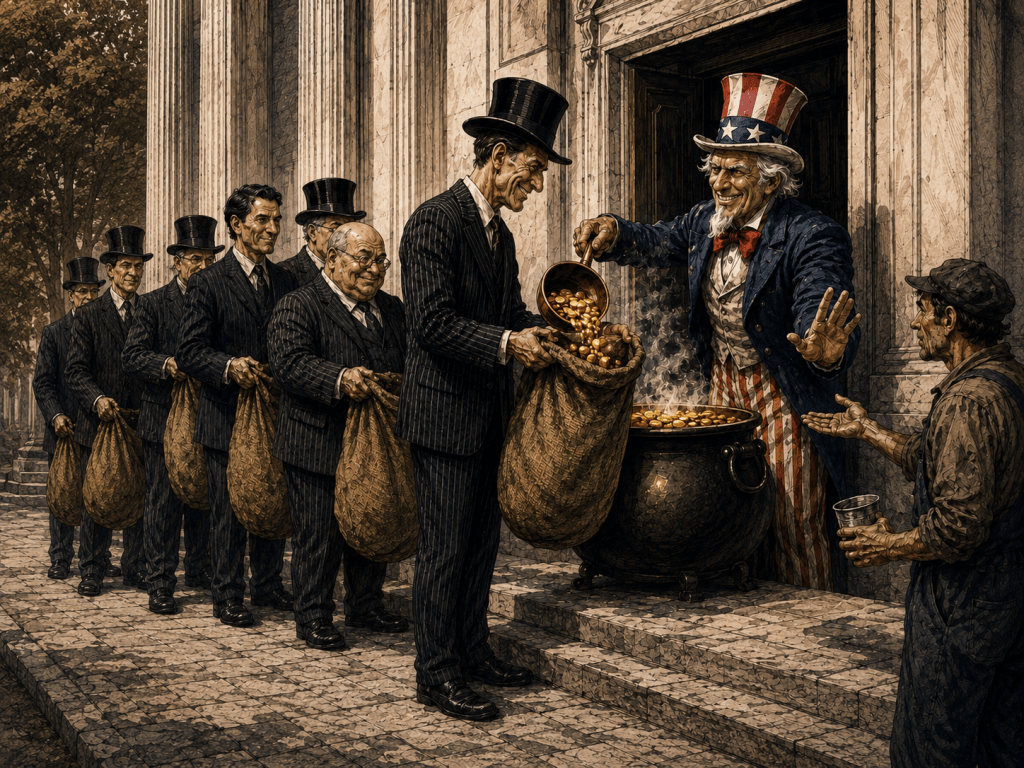
The loud fight is the bailout. One big rescue, on television, with a number attached, and an argument afterward about whether it was outrageous or whether we got paid back. That fight is real and it is mostly not where the money is. The single visible rescue is the smallest, briefest, and most photographed part of a much larger and much quieter arrangement, and the noise around it is doing a job. While you argue about the rescue you watched, the structure you didn’t keeps running.
So the spine of this post is a contrast, and it runs through all of it. There is the rescue you are shown — the weekend, the headline, the “paid back with interest” — and there is the architecture that actually moves the money: a standing guarantee the largest firms never pay for, a government that is the buyer and the insurer of last resort by statute, and a steady flow of public cash and credit to companies that are not in any trouble at all. The first is mostly a symptom. Arguing the symptom, loudly, for years, while the architecture sits untouched, is not a failure of the system. It is one of the ways the system keeps the architecture.
The last post was the same shape from the other direction: the dodge was the money the firm kept that never got taxed, and this is the same asymmetry running the other way, the public money flowing in. Different valve, same plumbing.
A few honest things before the mechanisms, because the argument doesn’t survive without them. This is not the claim that no firm should ever be rescued. In a true panic, letting the system fall over hurts the bottom 90% first and worst — the wiped-out savings, the payroll that doesn’t run Monday, the small business whose bank is simply gone — and a rescue can genuinely be the least-bad thing on the table. Deposit insurance is not a trick. It is the reason ordinary people stopped lining up outside the doors, and it is worth keeping exactly as it is. Some subsidies have a real public-good case, and the last post’s concession on basic research stands here and is not retracted: research throws off benefits past the company doing it, and paying for some of it is defensible. Not every government contract is a handout; the government buys real things. None of that is the disagreement.
And mostly this is a consensus, and the post won’t pretend otherwise in either direction. The whole architecture was built and left standing by both parties, across many administrations: the savings-and-loan cleanup, the 2008 program and the far larger Federal Reserve facilities begun under one party and run by the next, the auto rescue, the 2020 emergency lending and the forgiven small-business loans, the permanent farm and energy and defense subsidy state nobody ever votes down. There is no clean villain there, and inventing one would be its own dishonesty.
One piece is not symmetric, and flattening it into “both sides” would be the opposite dishonesty. The bank-capital rule written after 2008 made the largest banks hold more equity against their own failure. The 2023 version of it would have raised required capital at the biggest firms by something like a sixth to a fifth. It was reproposed in March 2026, scaled down to roughly no net increase, after the official who wrote it left the Federal Reserve at the start of 2025 and the biggest bank-lobbying campaign since Dodd-Frank ran against it. The honest part: the agency votes on that reproposal crossed the usual lines, and the lone Fed dissent was the governor who wanted the capital kept. So the villain is not a party. The direction is still one-way — a loosening of a safeguard the last crisis paid for — and that one-way pull, the standing weight of the thing being regulated, is the subject of the rest of this post.
Four Ways The Money Comes In, From The One You Watched To The One You Can’t See
The cleanest way to see the architecture is to walk it by how visible it is, starting with the rescue you watched and were told was repaid, and ending with the one that is never announced, never voted on, and never costs a thing on paper. Four steps. Each has a beneficiary you can name. Each one is quieter than the one before it, and the quietest is the largest.
The first step is the rescue itself, and it is the loudest because it is meant to be. It is also the one wrapped in the phrase that does the most work: paid back, with interest. Look at what that phrase actually covers. When the 2008 program finally closed in 2023, the Government Accountability Office could tally it: the money put into the banks did come back and then some, a net gain to the Treasury. That is the slice the phrase describes, and it is true. The same tally shows the auto piece lost money, and the part aimed at homeowners was never a loan at all but a grant that was never going to be repaid and mostly wasn’t. And none of that touches the Federal Reserve’s emergency lending, which dwarfed the headline program and never appears on the scoreboard people quote. “Paid back with interest” is a true sentence about the most photogenic part, deployed to describe the whole. That is the mechanism, not a footnote to it: the repaid slice is held up so the rest stays unwatched, and the rescue gets filed as a one-time event that worked out fine.
It is not a one-time event. It is a recurring institution. The savings-and-loan cleanup, then 2008, then the 2020 facilities, then the bank weekend in 2023 — the specifics change, the move does not. There is always a power already on the shelf: an emergency lending authority, a systemic risk exception. It is always invoked when the failure is large enough. And it is always renamed afterward as something other than a bailout, and scored on the part that came back. A thing that happens every time a crisis is big enough, through standing legal machinery built for the purpose, is not an emergency. It is a feature with an emergency’s press coverage.
The second step is quieter, because you only see it the moment it fires. The government stands behind a long list of private risk by statute, permanently, and most of the time the guarantee is invisible because it is not being used. Deposit insurance and the systemic risk exception are the cleanest version: the backstop that turned an entire failed bank’s uninsured accounts whole over one weekend in 2023. But it runs much wider. The government buys on cost-plus terms that move the risk of overruns onto the buyer. It reinsures crops and floods that private insurers will not touch. It stands behind a wall of loan guarantees so that private lenders make the loan and the public holds the default. The lending line opened in that 2023 weekend let banks borrow against Treasury and agency bonds at full face value rather than the lower price those bonds would actually fetch — the government absorbing, by design, the gap between what the paper was worth and what the bank needed it to be worth. The upside on all of it is private. The downside is built into the law ahead of time, where no one ever has to vote on it again.
The third step is barely visible at all, because it is not a rescue and not an emergency. It is the standing flow of public money to firms in no trouble whatsoever. This is the line to keep sharp: this is money handed in, not tax left uncollected — the previous post’s territory ended where this begins. The permanent farm, energy, and defense subsidy architecture runs every year regardless of the business cycle, to firms that are profitable, for activities they would largely do anyway. The more recent industrial subsidies are the same shape with a national-security label. The clearest single example arrived in 2025, when the government converted what remained of a chipmaker’s manufacturing grants into a roughly ten percent ownership stake — and, as part of the same deal, eliminated the clawback and profit-sharing terms that had been attached to the money already paid out, along with the milestone and workforce conditions. The public took equity and at the same time let the firm out of the terms that protected the public’s side of it. That is the whole setup in one deal: the money is permanent, and the strings on it are negotiable down to nothing.
The fourth step is invisible, and it is the biggest. The largest financial institutions borrow money more cheaply than smaller ones, every ordinary day, for one reason: the people lending to them expect that if it ever came to it, they would be rescued. That expectation is rational — the 2023 weekend was the proof — and it shows up as a discount on the cost of funding, which is a subsidy with no line item, no vote, and no announcement. It is worth being honest about the size, the way the last post was honest about the gap it could not pin down exactly. Estimates of this funding advantage vary widely depending on method, run from modest to very large, and the most careful ones predate the 2023 episode that re-confirmed the expectation. What is not in dispute is the direction and the source: the bigger and more connected the institution, the larger the discount, and it is paid by no one and collected continuously. The loudest transfer is the rescue you watched. The largest is the one that never needed to happen to be worth money, because the belief that it would is enough.
What’s Real
A few honest qualifications, because the strongest version of the argument is the one that doesn’t pretend the counter-arguments aren’t there.
A systemic rescue can genuinely be the least-bad option, and not as a talking point. When the alternative is a chain of failures that takes the payroll system and the savings of people who did nothing wrong down with it, doing nothing is not the principled choice; it is the most expensive one, paid by the people least able to pay it. The objection here is not that the 2008 or 2023 interventions should not have happened. It is the same objection the last post made about losses carried forward: concede the principle, then look at the scale and the design. A rescue that is unavoidable in the moment is still a rescue whose terms were set long before the moment, by who was made to hold the downside and who was not.
Deposit insurance earns its defense outright. The reason a bank failure in 2023 did not become a nationwide run is that ordinary depositors had no reason to run; their money was insured and they knew it. That backstop prevents exactly the kind of panic that historically devastated people at the bottom first. Keeping it, and keeping it strong, is not the thing under criticism. What is under criticism is the part of the same weekend that went well past it, to uninsured balances far above the cap, and what that established about who else can now expect the same.
And some subsidies have a real public-good rationale, the research point included and unretracted from the last post. Basic research produces benefits the funding company cannot capture, which is a textbook reason for public support, and a serious person can favor that while opposing what the broader subsidy state has become. Not every contract is a subsidy either; the government has to buy real goods and services from private firms, and most procurement is just procurement. None of these points is fake. The post’s argument is not that they are. It is that they are the reasons given for a structure whose actual output is the distribution above, and that “a rescue was necessary” has been doing the work of “these terms were necessary” for a very long time, said by people who know the difference.
What They’re Paying For
What the one-way market actually produces, set against what the bailout argument claims to be about, is four things stacked together. Each is worth real money to someone specific, and the someone is nameable, which is the difference between this and a complaint about “corporations.”
It is a rescue that recurs on schedule and is scored only on the part that comes back. The beneficiary is not abstract. It is the creditors and counterparties of the largest failing institutions, made whole through standing emergency machinery, while the public is handed the repaid slice as proof the whole thing netted out fine.
And it is a set of guarantees the public wrote into law and the firm never pays for — the deposit backstop stretched past its limit, the cost-plus contract, the loan the public insures so a private lender doesn’t have to. The beneficiary is the firm that gets to run private-sector returns on a risk the public is holding by statute, and only finds out the size of the gift on the weekend it is finally used.
And it is a steady transfer of cash and credit to firms in no distress at all, with the conditions on it negotiable down to nothing. The beneficiary is the already-profitable company collecting the permanent subsidy, and the shareholders who keep the upside while the clawback that was supposed to protect the public is quietly written out of the agreement.
And it is a discount on the cost of money that goes only to the biggest, paid by no one, collected every day, because everyone believes the rescue would come. The beneficiary is the largest institutions specifically, whose size is itself the subsidy, and the political actors who took the donations, kept the architecture standing, and loosened the one rule built to make that size cost something. That is the bill the argument about the last bailout has been keeping you from reading.
The Fixes Are Boring
The fixes below are structural, not slogans. The post is not going to put “claw back the bonuses” on the list, because the one-time gesture against the people who ran a rescued firm changes none of the architecture and is mostly there to be seen doing something. It is also not going to put “no bailouts, ever” on the list, because that is not a fix; in a real panic it just guarantees a worse, improvised rescue on worse terms, which is the populist version of the same trap. These sound impossible because the people who profit have spent a long time making them sound impossible and making the last bailout the fight you have instead. Several are things the country recently did, then loosened. Roughly cheapest and most immediate to genuinely hard:
- Price the standing guarantee and bill the firms that hold it. The largest institutions get a funding discount from the expectation of rescue and pay nothing for it; charge for it directly, as a fee scaled to size and systemic footprint. The diluted version is the status quo: deposit-insurance assessments exist but do not price the implicit guarantee on the non-deposit funding where the discount actually lives.
- Make every direct subsidy or public equity stake carry permanent, non-negotiable strings. Clawback on failure, profit-share on success, no buybacks or dividends while public money is in the firm, and none of it renegotiable later. The built-to-fail version is on the record: in 2025 the clawback and profit-share terms on chip subsidies already paid out were eliminated outright, “to create permanency of capital.”
- Pre-fund the rescue from the firms most likely to need one, before they need it. A standing resolution fund paid into by the largest institutions, so the systemic exception, when invoked, draws on money they posted rather than a guarantee the public extends for free. The watered-down version is what 2023 showed: the exception was available and used, and the cost was assessed on the industry only after the fact.
- Finish the post-2008 capital rule instead of unwinding it. Require the largest institutions to hold equity sized to the damage their failure would do, which is the cheapest insurance against ever needing the rescue at all. The undone version is current events: the 2023 capital proposal was reproposed in March 2026 down to roughly capital-neutral after its author left and the industry’s biggest lobbying campaign since Dodd-Frank ran against it.
- Bar buybacks and dividends for any firm holding a public backstop, for as long as it holds it. Public support exists to keep a firm functioning, not to fund payouts to shareholders while the public carries the risk. The toothless version is familiar: relief programs nominally restrict uses, then forgive almost all of it with minimal checking, the way roughly ninety-five percent of the pandemic small-business loans were converted to grants.
- Make resolution actually impose losses on the largest firms’ creditors. The whole point of orderly resolution was that big-firm creditors take the hit instead of the public; enforce it, so lending to a giant carries real risk and the funding discount shrinks on its own. The diluted version is the one we saw: in 2023 the uninsured creditors were made whole anyway, which tells every future creditor exactly what to expect.
- Break up the institutions whose size is the subsidy — and say plainly this is the hard one. If the funding discount comes from being too big and connected to fail, the only fix that reaches it at the root is being smaller. It is last because it is genuinely hard: it carries real administrability problems, real questions about where the lines fall, and the firms it reaches will fight it hardest. The honest position is that the difficulty is a reason to design it carefully, not a reason to keep treating the other six as radical so this one is never discussed.
Six of the seven are a statute, an appropriation, or an enforcement choice — things a Congress or an administration could do without inventing a new institution, several by reversing a loosening enacted in the last few years. The seventh is the genuinely hard one, and it is honest to say so rather than pretend the list is all easy. None of them is the radical position. The radical position, measured against the idea that a market is supposed to run both ways, is the one we are living in: the upside private, the downside public, and an argument about the last rescue standing in for the architecture none of the money ever leaves.
Who Is This For
Twenty parts in, you’ve now seen this machine run both ways: the money the public never collects, and the money the public hands over. The same firms are on the receiving end of both. What you were shown is the rescue. Where the money is is the guarantee. The next post turns the same question one more time. Here the public money flows in, toward the private firm, to rescue it and to subsidize it and to stand behind it for free. The next layer is the mirror image: the public money deliberately held back, starved out of the institutions the public actually owns, so that when they fail on schedule the failure can be pointed to as proof that government cannot do anything right. Part 21 is coordinated sabotage: break the public thing on purpose, then read the wreckage aloud as the verdict. Different layer. Same question.
 Even that's Odd
Leave a comment