
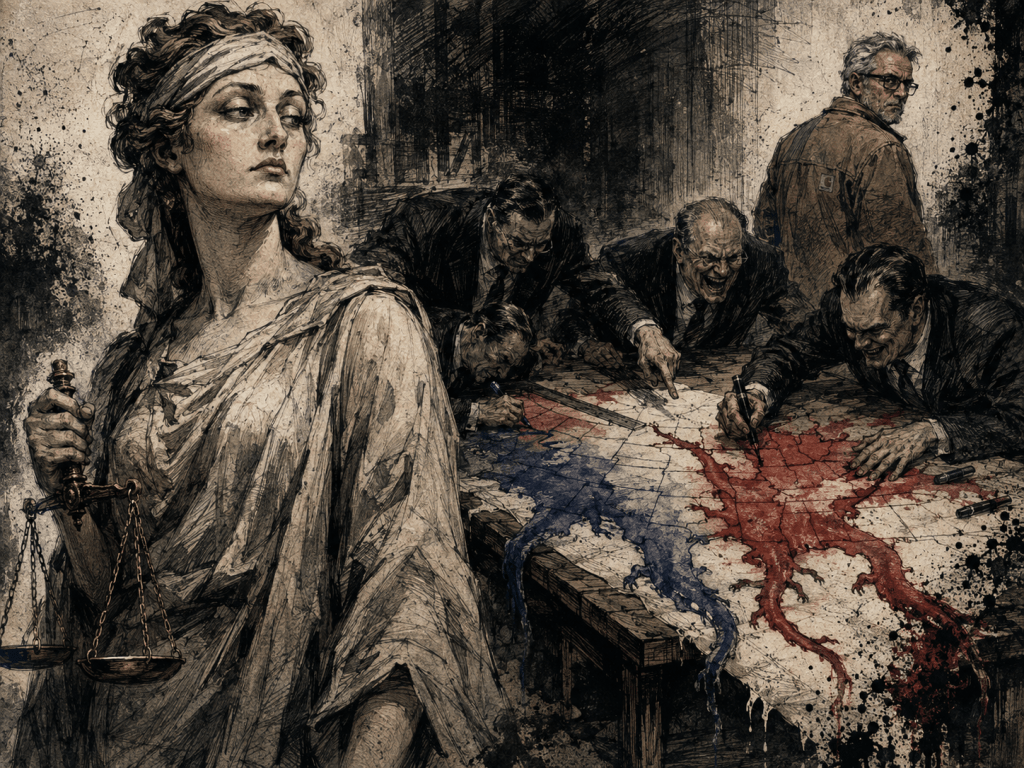
This is a new thing I’m trying. I say my piece first — all my bias, all my gut, no notes, no Googling, no homework. Then I run the whole thing past Claude to check me. What I got right, what I got wrong, where I was loud and confidently incorrect. The point isn’t to be right on the first pass. The point is to show the seams.
So the Supreme Court just gutted the Voting Rights Act.
The way I understand it, they said you can’t draw districts based on race. And on its face — fine. If you’re using race to limit a minority’s voting power, that’s exactly the thing the Voting Rights Act was built to stop. But that’s not what this was. This was the opposite. They took a tool built to undo Jim Crow and used it to dismantle the remedy. And then — this is the part that broke my brain — they basically said it’s still fine to carve up districts by party.
Partisan is OK?
Let me just go off my own read here, because this ruling makes no sense to me and I’d rather be honest about the bias than pretend I came to it clean.
My understanding of the Voting Rights Act was that it existed to make sure Jim Crow couldn’t quietly disenfranchise minority voters. So states had to draw districts that actually represented those voters instead of cracking them into nothing. That makes sense to me. It was built to right a wrong. I believe in fairness and equality, so I’m on board with the intent.
Now this Court — and I’m sorry, I can’t see these as anything other than activist justices bought and installed to get exactly this outcome — says that considering minority race to fix the problem is itself discrimination against everyone else. Okay. But then they turn around and say you can slice districts by partisan favorability?
That sounds just as corrupt. Forget which party. How is it even legal to divide people up by how they’re likely to vote? That’s the line everyone’s heard a hundred times and it’s still true: the politicians are choosing their voters instead of the voters choosing their representatives. Who looked at “let political parties draw their own districts” and thought yes, that’s the system? Only the people who benefit from it, and the courts willing to bless it.
If you can’t win without cheating, maybe you shouldn’t be doing the thing you’re trying to win at. And instead of adjusting, you bend the system to your will. That bending eventually breaks it. It’s the fox guarding the henhouse. Justice is supposed to be blind — but blind isn’t the same as turning a blind eye. They are not the same thing and I’m tired of the swap.
This is something I don’t think the founders ever intended, or even saw coming. I think they’d look at this and not recognize it.
What are the consequences? My honest guess: short term, it consolidates power and shoves us toward authoritarianism. Looking at history, it probably also lights a fire under people — getting your voice taken away tends to make you show up. So: more political activity, probably more unrest, an administration that seems to want an excuse for a police-state response. Short term I think it makes things worse for everyone, not just the targeted group. I believe a rising tide lifts all boats, which means the opposite is also true. You attack one part of society and the whole thing sinks a little. More poverty, more crime, more incarceration. Everyone pays.
Two more things I can’t let go of.
One: the justification I keep hearing is that the South is just going back to Jim Crow because “blue states don’t have any Republicans” and “blue states did it first.” Both of those sound wrong to me on the facts. And there’s a deeper thing here. Drawing districts on partisan lines in the South is different from doing it in the North — because in the South the parties split along racial lines, so any gerrymander is functionally racial vote suppression whether you call it that or not. In the North the parties don’t line up by race the same way, so it’s not the same machine. Same word, different weapon.
Two: I read that Massachusetts is something like 30% Republican and has zero Republican districts — and that with proportional representation Republicans should hold about a third of the seats. I also read there were reasons they supposedly couldn’t reasonably draw one, which I’d like to understand. And separately — the Supreme Court turned down Virginia’s redraw even though the voters themselves voted to allow it. Something is off there. You can feel it.
So that’s my gut.
I wrote all of that off the top of my head — no notes, no search, that’s the whole point. Then I ran it past Claude to check it for accuracy. Here’s what came back.
The Check
The Supreme Court just gutted the Voting Rights Act.
Verdict: pretty much right, with one technicality I should cop to. The case is Louisiana v. Callais, decided April 29, 2026, 6–3, Justice Alito writing. They struck down Louisiana’s 2024 map — the one with two majority-Black districts — as an unconstitutional racial gerrymander, and said the Voting Rights Act didn’t require that second district, so there was no good reason to use race at all. The technicality: they didn’t formally repeal Section 2 of the Act. What they did instead was take the 40-year-old test that voters of color use to prove a map illegally dilutes their vote — the test from Thornburg v. Gingles — and rebuild it so it almost can’t be passed. Now you have to draw a sample map that hits all of the state’s political goals, prove the voting patterns aren’t just partisanship, and show present-day intentional discrimination, with historic discrimination barely counting. So I said “gutted.” The Court would say “narrowed.” Kagan, in dissent, said it leaves Section 2 “all but a dead letter.” Between the Court’s press release and Kagan’s read, I’ll take Kagan’s.
The Voting Rights Act was built to undo Jim Crow disenfranchisement.
Verdict: right in spirit, with a wrinkle I didn’t know. The 1965 Act’s original core was ballot access — killing literacy tests, poll taxes, and the preclearance system that made the worst states get federal sign-off before changing voting rules. The specific thing in Callais — drawing majority-minority districts so a group isn’t cracked into powerlessness — mostly comes from the 1982 amendments and the 1986 Gingles decision. So my instinct was right; the “draw fair districts” piece is a second layer built on top of the original “let people actually vote” piece. (And the preclearance piece I’d have assumed still exists? Gone since 2013, Shelby County v. Holder.)
They said partisan gerrymandering is OK.
Verdict: right instinct, wrong case — and how the two cases lock together is the actual story. I had this knotted up, so I made Claude pull it apart slowly. Two separate cases. Hold them one at a time.
Case one is the one that actually does the thing I was describing, and it isn’t Callais. It’s older — Rucho v. Common Cause, 2019, 5–4. Rucho did exactly one thing: it said that if your complaint is “this map is too partisan,” federal courts will not hear it. Period. Not “the state is always right” — more like, that’s a political question, we are not the referee for it, take it elsewhere. (State courts can still strike partisan maps under their own state constitutions — which is the entire reason these fights now live in state supreme courts.)
Case two is Callais, and it’s a completely different track. Callais isn’t about party at all — it’s about race. What it did was take the one tool you could still use in federal court — a Voting Rights Act claim that a map dilutes minority votes — and raise the bar so high it almost never works anymore.
So the two rulings aren’t one master plan. They’re seven years apart, about different things. The damage is what happens when you stand them next to each other. Picture a Southern state that wants to break up Black voting power. It draws the map and says: we weren’t targeting Black voters, we were targeting Democrats. Step one, Rucho — nobody is allowed to challenge the “targeting Democrats” part in federal court. Step two, Callais — proving it was really about race is now nearly impossible. Both exits welded shut. The state never had to win the argument; there’s just no longer anyone with the authority to make it. That’s the laundromat — a racial motive goes in, “just partisanship” comes out, and nobody’s allowed to check the receipts. Not one case engineering the next. A pincer.
The founders never intended this, or even saw it coming.
Verdict: half right, and the half I got wrong is worth knowing. They didn’t intend for parties to pick voters because they didn’t intend for parties — they were afraid of them. Madison’s whole argument in Federalist 10 is about caging the “mischiefs of faction.” Washington’s Farewell Address is a warning about the “spirit of party.” The Constitution doesn’t mention parties because they hoped not to have them, and then had them inside a decade anyway. So “they never foresaw the party system” — true. But “they’d never have allowed map-rigging” — not true. The Elections Clause hands the “Times, Places and Manner” of congressional elections straight to state legislatures, the exact self-interested people who’d weaponize it, with no commission and no guardrail. And they didn’t wait: Patrick Henry is widely credited with trying to draw James Madison out of the very first Congress in 1788, before the word “gerrymander” existed. Gerry’s salamander was 1812 — and Gerry was a Declaration signer who refused to sign the Constitution and then became Madison’s VP. So the cleaner way for me to say it isn’t “they’d be horrified.” It’s that this violates the principle they stated — power answers to the governed, entrenched faction is the disease — even though their own blueprint failed to stop it, and some of them proved that by doing it to each other.
The Supreme Court turned down Virginia’s redraw even though the voters approved it.
Verdict: I had the result right, I just didn’t have the plumbing. Here’s the plumbing. In 2020, Virginia voters amended their constitution to take redistricting away from the legislature and hand it to a bipartisan commission. To redraw mid-decade anyway, Democrats had to pass a new amendment undoing that — and Virginia makes you pass an amendment twice, in two separate sessions, with an election in between, before it goes to a referendum. Their first vote came in October 2025 — but early voting for the November 2025 election had already started. Voters approved the new amendment on April 21, 2026, about 52–48, roughly 3 million ballots. On May 8 the Virginia Supreme Court — the state court, 4–3, not the U.S. Supreme Court, nothing to do with Callais — ruled the early-voting timing meant there was no proper “intervening election,” so the referendum was null and void. Democrats ran an emergency appeal up to the U.S. Supreme Court (leaning on a narrowed version of the “independent state legislature” theory — which is normally the Republican argument; you can’t make it up), and on May 15 the U.S. Supreme Court declined to step in, because federal courts don’t second-guess a state court reading its own constitution. So I had it right that the redraw got killed and the U.S. Supreme Court didn’t save it. What I didn’t have: it was the state court that did the actual killing, on a procedural technicality, and the federal pass came after. Keep the courts and dates straight in this thing or it’s the paragraph that gets the rest thrown out.
“Blue states did it first” is not correct.
Verdict: right. In this round, Texas went first — summer 2025, at the President’s request, to grab five seats. California (Prop 50, November 2025) and Virginia were the response. The “no Republicans in New England, Trump got 45% there” line was used by Republican members of Congress to justify Texas — it’s the excuse, not an honest account of who started it. “Blue states have lopsided Democratic delegations” — true. “Blue states started the mid-decade map war” — not true.
Massachusetts is ~30% Republican with zero Republican seats, and supposedly couldn’t reasonably draw one.
Verdict: half wrong on the number, dead right on the punchline. The 30% isn’t registration — Massachusetts is roughly 64% unenrolled, 26% registered Democrat, and about 8% registered Republican. The ~30% is vote share: Republicans regularly pull 30–40% statewide (Trump got 36% there in 2024). And the “they couldn’t reasonably draw one” part isn’t a Democratic excuse — it’s the documented finding. The simulations (Princeton/MGGG, an Election Law Journal study, the senators who actually drew the map) all land in the same place: Republican voters in Massachusetts are spread so evenly you can’t build even one Republican-majority district without drawing something grotesque. They’re not too concentrated — they’re too diffuse. Locked out by their own uniform distribution. The current map was even signed by a Republican governor. So I swap “registered” for “voted” and the rest of the point gets stronger, not weaker.
The North/South distinction.
Verdict: this was my best guess in the whole take, and it held. I said partisan gerrymandering in the South functions as racial vote suppression because the parties split on race down there, while in the North they don’t, so it’s not the same machine. Turns out that’s basically the actual legal and political-science argument — it’s why “we did it for partisan reasons” is a coherent (if cynical) defense in Massachusetts and a fig leaf in Louisiana. Same word, different weapon — that was my phrase, and it’s close to exactly how the people who study this describe it. I should have led with this instead of burying it near the bottom.
My consequences forecast.
Verdict: not gradable, and I’m not going to pretend it is. It’s a prediction, not a fact. The closest historical rhyme: after Shelby County gutted preclearance in 2013, the states it freed moved fast on new voting rules, and it did light an organizing fire. Whether this consolidates power, triggers unrest, and drags everyone down the way I think it will — that’s my read of where the trend points, and it should sit here labeled as exactly that. Forecast, not finding.
Scorecard: of the nine things I threw down, my gut did better than I expected. The core instinct — race out, party in as cover, politicians picking their voters — holds. The North/South point was the sharpest thing in the take and I buried it. The real misses were attribution and arithmetic: it’s Rucho, not Callais, that shields partisan maps; it was Virginia’s own court, not the U.S. Supreme Court, that did the actual killing; the founders didn’t foresee the party system but they sure didn’t stop map-rigging, and did it to each other; and Massachusetts is 30% by vote, not registration. None of that sinks the argument. But the other side only needs one of them to throw the whole thing out — which is the entire reason I run this past a check before it goes up.
Bias up top. The check at the bottom. That’s the deal.
The Problem Under the Problem
Here’s where this actually took me, and it’s not where I started.
I opened this furious at a court. I’m closing it somewhere worse. Because if the captured branches won’t fix the rigging, and the Court has now said in writing that the rigging isn’t its job — then where does a person actually go to get justice out of a corrupt system? I went looking for the institution whose entire purpose is “fix it when everything else is captured.” There isn’t one. And the part that rattled me: that’s not an accident. The founders argued this exact question among themselves, and the side that wanted an emergency lever lost. The system was built — on purpose — with no auto-correct.
So here’s the question I can’t answer in this post, and I’m not going to fake one: what is the solution when there’s no lever to pull — when the only thing that’s ever actually moved this country is slow, unguaranteed, and has to run straight through the arena that was rigged to stop it?
That’s the next one.
 Even that's Odd
Leave a comment