
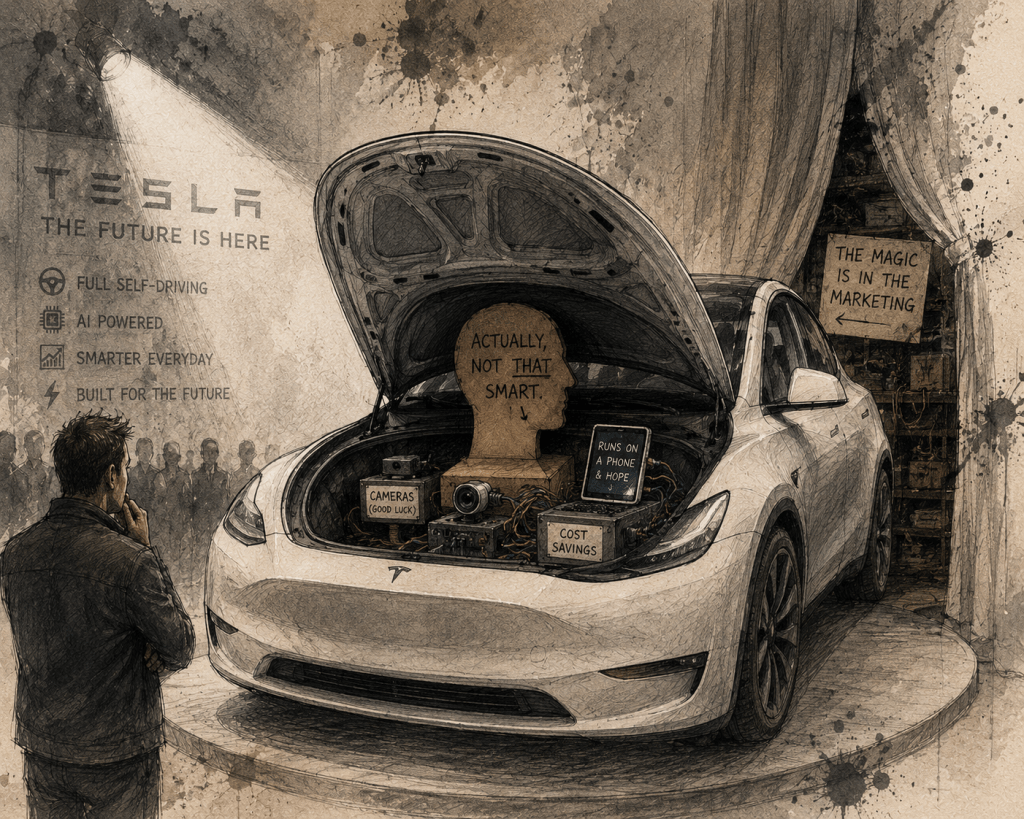
I’m a little confused by the over-exuberant Tesla love. Seven months and a few thousand miles into my 2023 Model Y Long Range, and the consensus among the fanbase still doesn’t track for me.
I’m an Apple person, so I understand the dynamic. But even with Apple, I can name the things they get wrong without it threatening my identity. With Tesla, that move seems off the table for a lot of owners. The car has obvious problems, and people refuse to even consider an alternative.
We bought ours for four specific reasons: the advertised 300+ mile range, the torque, the price, and the third row. If anything else had checked those four boxes — and had the NACS charging port — we’d probably be in a different car. None of those four reasons turned out to be quite what we were sold, which is what this post is about.
I’m not trashing the car. It’s fine. It’ll be a great first car for our kids when they’re old enough to drive it. But it is not AMAZING. And the gap between what the marketing says it is and what it actually is — that’s the part I keep tripping over.
What’s Actually Good
The torque. This is a family car that does not drive like one. When you’re not in Chill mode, it’s genuinely fun. (Which is also the problem — see below.)
The Supercharger network. Faster would be nice, but as a network it’s actually good — well-placed, mostly working, far ahead of the alternatives.
The driver assists, as kid insurance. Speed limit warnings and lane-departure alerts are exactly what a new driver should have to push against. This will be a great car to hand to a 16-year-old.
Regenerative braking. I love trying to drive without touching the brakes. You can turn it into a small private game. I am, admittedly, easily entertained.
The packaging. For its outside footprint, there’s a surprising amount of room inside, even with the third row up. Folded down, I once fit 20 bags of mulch without doing anything clever. The biggest miss: it should have been a hatchback. The sloping rear glass wastes so much usable cargo space.
The Torque Paradox
This is the cleanest example of the whole Tesla problem, so it gets its own section.
Sport mode is genuinely fun. I almost never use it. I can’t, because using it tanks the range, and the range is already worse than advertised, so I’m permanently in Chill mode trying to keep enough battery to get home.
Chill mode does what its name says. Even if you stomp the pedal — say, you need a burst to merge or pass safely — the car refuses to give it up. You’d think a “smart” car would notice that you’re flat-footing the accelerator and conclude you need the power right now. It does not. Chill mode is chill mode.
So I paid for performance I can’t use, in a car that’s smart enough to suppress it but not smart enough to know when I need it.
The “Smart Technology” Problem
This is my biggest philosophical issue with Tesla, and with most “smart” technology in general: if you have to be smart to use something, it’s not smart technology. It’s technology for smart people. Which makes it stupid technology by definition.
Real smart technology should help people who don’t already know what they’re doing. It should fill in the gap, not require you to fill it yourself. The Tesla constantly asks me to be smarter than the car — to remember which menu the wiper sensitivity is in, to know that auto high beams now means “selectively dimmed high beams not low beams,” to plan road trips around an EPA number that doesn’t reflect real driving. Before anyone says “you just have to know how to use it” — yes, that’s exactly the problem. I shouldn’t have to.
The Touchscreen Decision
The more I drive this car, the more convinced I am that “everything is on the touchscreen” was a cost decision sold as a design decision. Fewer physical controls means fewer wires, fewer switches, fewer parts to source and assemble. The minimalist interior isn’t innovation, it’s a bill of materials. They charged a premium for it, called it the future, and people bought it.
I’ve moved as many controls as I can to my lower control bar, which helps. But the original problem is still there: critical functions live three menus deep, and the backup camera takes over the center screen when you change lanes left, and you could get used to all of it — the question is why you should have to.
The Sensors That Aren’t There
No LiDAR. No radar. No thermal imaging. The car drives by camera only, which means it sees what I can see — meaning it doesn’t see well in rain, doesn’t see well in the dark, and absolutely doesn’t see my 35-pound dog when he’s near the bumper. (For scale: 35 pounds is a toddler.)
I do not understand how a vehicle this dependent on cameras is supposed to drive itself when the cameras can’t outperform a tired human’s eyes. Radar and thermal aren’t exotic — every premium SUV from a decade ago has more sensor variety than this car does. It’s a sensor downgrade dressed up as a software upgrade.
Lane Keep Wants to Kill Me
I live on rural roads. I drive to the outside of my lane because that’s the safe spot — away from oncoming traffic, with room for the deer that come out of the woods.
The car disagrees. It constantly steers me back toward the centerline — closer to oncoming traffic, closer to debris in the road that I was just trying to drive around. You’d think the technology would learn driver preferences. It does not. Every drive is a small fight with the car about which part of the lane I want to be in.
Joe Mode Quiets the Wrong Things
Tesla has a setting called Joe Mode that reduces the volume of non-critical alerts by about 50%. Sounds great. The problem: it doesn’t touch the safety warnings, which are the loud ones. Lane departure chimes will still rattle your teeth. The alerts I actually want quieter aren’t in the list of alerts the feature affects.
Highway Following Has a Catch
Highway autopilot is great as long as you don’t want to change lanes. The moment you do change lanes, regen braking kicks in and the car slows abruptly — which on a highway can actually be dangerous. Apparently you need to pay extra for Full Self-Driving to get a basic lane-change behavior that doesn’t punish you for using it.
Service
If you don’t live near a service center, plan accordingly. The mobile-service model works for some things, but for anything that requires the car to come in, you’re driving an hour or being told the next slot is three weeks out. It’s not a complete dealbreaker — Tesla’s lower routine-maintenance load reduces how often you actually need to go in — but when you do need service, it’s a project.
The Voice Commands
The glove box on this car only opens via voice command or touchscreen menu. There’s no physical latch. How many times can I say “open the glove box” before I just stop using the glove box? It can’t be that expensive to put a real latch on a panel. They removed it because they could, and called it design.
Comfort
Road noise is worse than it should be for an EV. The seats get hot and sweaty (Tesla added vented seats in the Juniper refresh, which would help, but mine doesn’t have them). The third row is fine for short trips with kids, and unusable for anything else. The glass roof I loved at first turns out to need an aftermarket sunshade, because the AC can’t keep up. So I paid for the premium roof and then paid again to shade it. Everything about this car has a “yes, but” attached to it.
The Bottom Line
I like the car. It’s fine. It serves our needs. Let’s stop pretending it’s perfect because it has a T on the trunk.
It’s a good electric vehicle with some real innovations and some real shortcomings — the same description that fits every car ever made. The difference with Tesla is that the marketing has convinced a large fraction of owners that “real shortcomings” is somehow not a category that applies. It does. The car cuts corners. It overpromises. It cosplays as smart and is mostly cheap. None of which means it isn’t, on balance, the right call for some of us right now. It is. We’re driving one. I just refuse to pretend the trade-offs aren’t trade-offs.
I’ll keep driving mine, complaining about it, and looking forward to the day the kids inherit it and have to figure out how to open the glove box.


Leave a Reply