
I own an EV. I am not opposed to EVs. And the more I drive mine, the more I think going fully electric — meaning battery-only, plug-only — is short-sighted.
ICE alone is a worse answer. The complexity, the maintenance, the dependence on a fuel that has to be extracted, refined, and trucked everywhere — that’s a 20th-century solution we’re still hauling around.
But pure EV doesn’t quite solve the problem either. You’re trading one fuel logistics nightmare for another. The range isn’t really what the sticker says (more on that in another post), the charging takes a meaningful amount of time even on Superchargers, and the load on the grid only gets worse as more EVs come online. My one car nearly doubled our electric bill. Scale that to a national fleet and you’ve replaced gasoline trucks with substation problems.
The Missing Middle
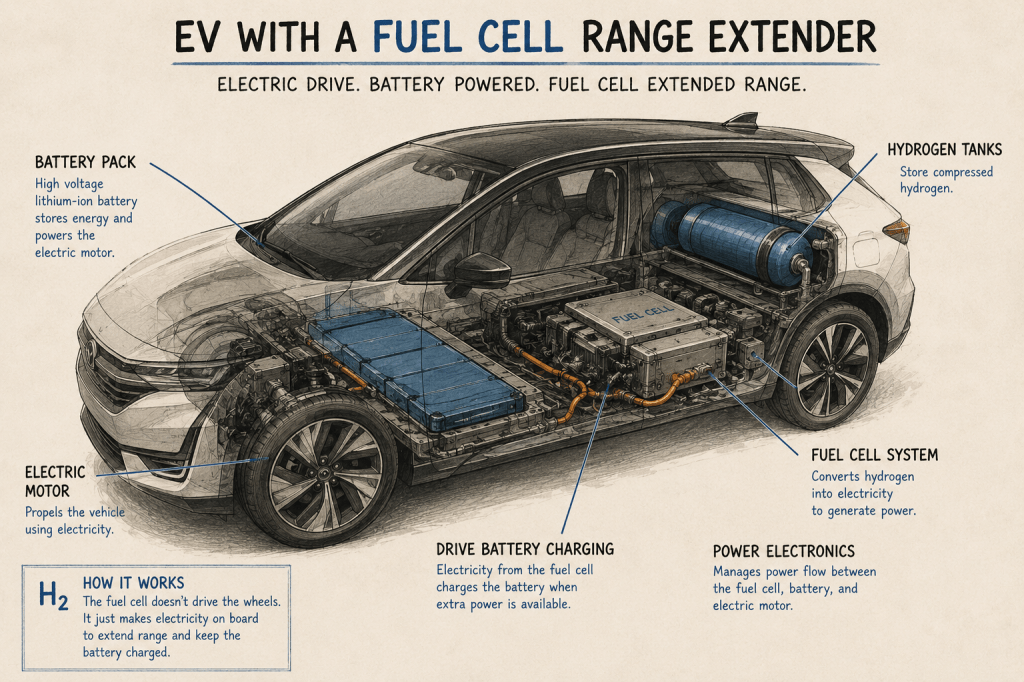
The architecture I want is a range-extender EV. Small battery, big enough to handle daily driving — commutes, school runs, errands. Onboard generator to recharge the battery for longer trips or when you forgot to plug in. The wheels are still electric-driven; the generator just exists to refill the battery. This is what the Chevy Volt did fifteen years ago, and it’s basically the right idea.
But here’s the part I really want: the range extender should be a fuel cell, not a small gas engine.
A fuel cell takes hydrogen and oxygen, makes electricity, and emits water vapor. No combustion. No oil. No exhaust. No fuel injectors, no spark plugs, no oil changes. The Toyota Mirai and the Honda Clarity have been on the road for years proving the technology works. The car-design problem is solved.
The reason fuel cell vehicles haven’t taken off is the same reason EV charging stations were a wasteland ten years ago: there’s no fuel infrastructure. You can fill a hydrogen tank in five minutes — when you can find a hydrogen station, which in most of the country, you cannot.
So the dream car: a small battery, an electric drivetrain, and a fuel cell that quietly recharges the battery on long trips, fed by a five-minute hydrogen fill-up at a station that doesn’t yet exist on most highways. We have the cars. We do not have the pumps.
Why Not Battery + Generator?
For now, fine. The hydrogen station problem isn’t getting solved in the next five years. So a small ICE generator powering an electric drivetrain is the workable compromise — same architecture, different fuel, using infrastructure that already exists. You give up the “no combustion” purity, but you don’t give up the right driving experience, and you don’t give up the ability to refuel anywhere.
Which brings me to the update.
Update: Somebody Built the Compromise
VW’s revived Scout brand unveiled the Traveler SUV and Terra pickup, both available with what they’re calling the Harvester — a small four-cylinder gas generator that recharges the battery on long trips. Pure EV version: roughly 350 miles. Harvester version: more than 500 miles, refuelable at any gas station. The engine doesn’t drive the wheels; propulsion stays fully electric. 0-60 in a projected 3.5 seconds. Body-on-frame. Real physical switches.
This is the architecture I’ve been describing. Not the dream version — that’s still the fuel cell — but the workable version, using the fuel logistics we actually have right now.
And apparently I’m not alone in wanting it. Scout’s CEO told Bloomberg that 80% of reservations are for the Harvester, not the pure EV. The market is voting for the range extender. The pure-EV-only crowd is louder, but it isn’t the majority of buyers when buyers are given the option.
Production isn’t until 2027, and the first deliveries are projected as 2028 model years, so this isn’t an immediate fix. But it’s the right direction. Now we need the rest of the industry to either match it, or — better — to put the fuel cell version next to it on the showroom floor and let buyers pick which infrastructure they want to bet on.
 Even that's Odd
Leave a comment