
My dad died in 2007, which means he never saw the Tesla in my driveway, the heat pump in the basement, or the solar panels on half the houses on my road. Which is a shame, because everything he did in the 1970s that we found weird at the time has, in the intervening fifty years, become either standard advice or actual technology. He was right about all of it. He was just forty years early, which in our family is mostly indistinguishable from being wrong.
The Electric Tractor
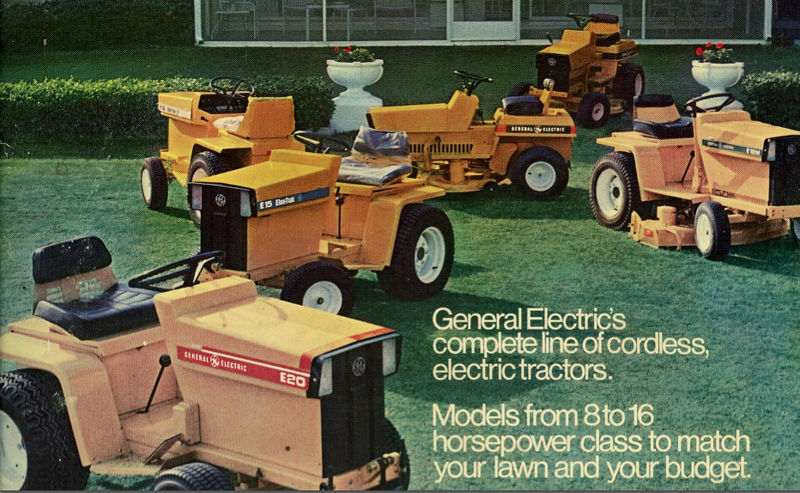
The clearest example. Sometime in the late ’70s, after the oil crisis turned my father into a one-man energy reform commission, he went to Sears and came home with a General Electric Elec-Trak — a battery-powered lawn tractor. Six car batteries strapped into the frame, running everything. It mowed the lawn. It hauled leaves. It did pretty much anything you asked of a tractor right up until you attached the snow blower attachment, at which point the batteries would drain so fast you’d be lucky to clear the bottom of the driveway before it died on you, generally somewhere it would be hard to push back to the garage.
That’s the same lesson Tesla owners are learning in 2026: cold weather is the enemy of batteries, and heavy loads in cold weather are even worse. He just figured it out forty-five years earlier, on a riding mower, with no help from a phone app telling him his range was about to evaporate.
The Elec-Traks are now collectors’ items. You can find them on eBay for more than he paid for it new.
Drafting Behind Semis
My dad would tuck the station wagon in behind an 18-wheeler at what he called a safe but aerodynamically optimal distance. We called it terrifying. He called it free fuel. The kids in the back called it a guaranteed way to come home smelling like diesel.
There’s now a word for what he was doing — hypermiling — and there are YouTube channels and Reddit threads dedicated to it. I do a version of the same thing in my Model Y, except the car gives it a respectable name. “Range efficiency.” Same maneuver, fancier label. Probably the same diesel fumes when the trucker accelerates.
No AC, Coast Down the Hills
“We don’t need air conditioning. Roll down the windows. It’s more efficient.” He said this in every car we ever owned. We melted into the vinyl. He was right about the efficiency. He was less right about the human cost.
The Tesla now tells me exactly how much range I lose when I turn on the AC, and how much more I lose when I run the heat in winter. Dad would have loved that readout. He’d have ignored everything else on the dashboard and just stared at the kilowatt graph.
He also coasted in neutral down every hill long enough to coast down. Foot off the gas, transmission disengaged, drifting along like a sailboat. People behind us thought we were broken. The Tesla does the same thing automatically now, except it captures the energy back into the battery instead of just throwing it away. The technology caught up with the instinct.
The Column Shifter
Small one, but I noticed it the first week I had the Model Y. The gear selector is a stalk on the steering column. That’s where my dad’s was. Every car he owned in the ’60s and ’70s had a column shifter. The car industry spent decades abandoning that layout for floor-mounted shifters, center consoles, gear levers shaped like joysticks, and is now quietly putting the gear selector back on the column. Full circle in about fifty years.
The All-Electric House
This is the one that nearly broke him. Sometime in the early ’70s, he built an all-electric house. Electric heat, electric everything. The argument was that electricity was clean, abundant, and the future. It was a plausible read at the time. It was also approximately the worst possible moment to make that bet, because the oil shock pushed electricity prices up alongside everything else, and the heating bills for an all-electric house in a Northeast winter turned ruinous fast.
The fireplace became the primary heat source. Rooms not adjacent to the fireplace became refrigerators with furniture. We renovated in 2005 and put in a proper heating system, but he insisted we keep the electric baseboards in place — just in case. I never asked what “just in case” meant. I now have a heat pump and I think about him every time I see the electric bill, which has not been ruinous, because the technology finally caught up to the math he was doing in 1972.
Solar
He talked about solar panels in the ’70s the way people now talk about home batteries. The roof faces this way. You could put them here. The technology will come. We nodded. We did not, in fact, believe him.
Half my neighborhood has solar panels now. I’m running the numbers on a Powerwall.
The pattern across all of this is the same. He wasn’t a futurist. He wasn’t doing it to be ahead of anyone. He was a kid of the Depression who watched the 1973 oil embargo and concluded — correctly — that energy was about to be the defining variable of the next half-century, and that the household answer was electricity, efficiency, and not heating rooms you weren’t sitting in. He acted on that conclusion immediately, with the technology of his moment, which is to say: badly. The tractor didn’t have enough battery. The house didn’t have enough insulation. The station wagon didn’t have regenerative braking. The solar panels he wanted didn’t really exist yet for a single-family roof in upstate New York.
But the conclusions were right. Every single one of them. I drive past my old house sometimes, and I think about the Elec-Trak dying in the snow halfway down the driveway, and the fireplace working overtime through January, and the column shifter on the wagon, and my dad doing the math in his head about kilowatt-hours when nobody around him cared. He’d be eighty-six this year. He would have loved the Tesla. He would have hated what it costs. He’d have driven it anyway, and he’d have drafted behind a truck for the last fifty miles home.


Leave a Reply