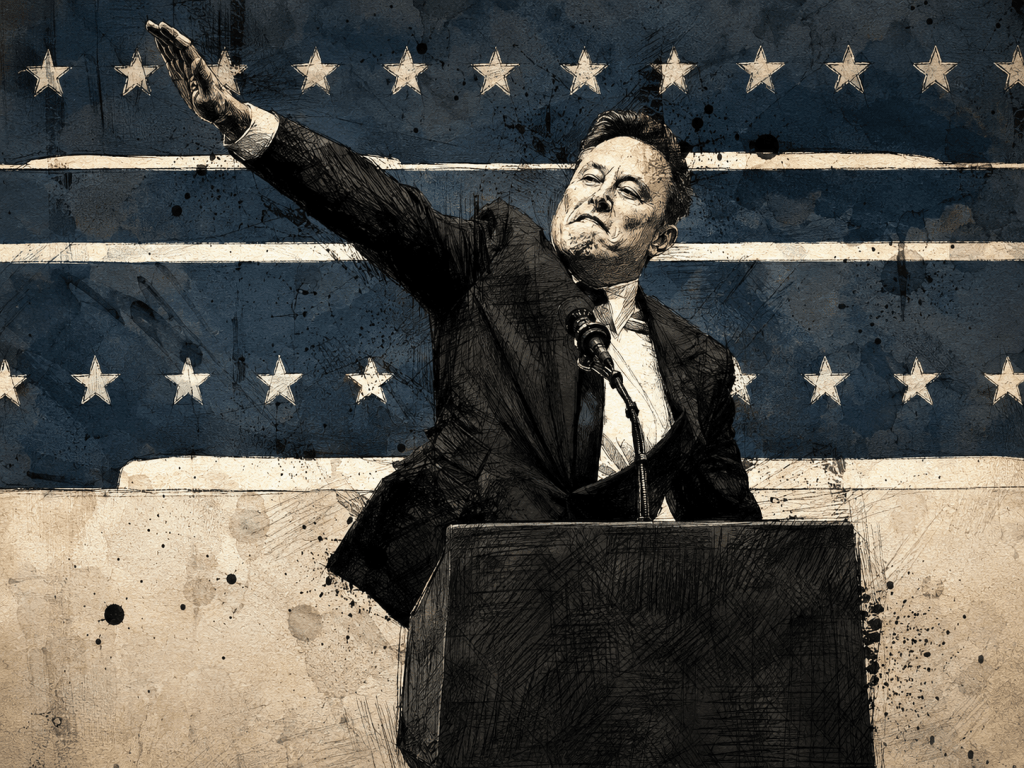
This is the first political post I ever wrote, and I want to be honest about where it came from. I’d been hearing the word “fascism” thrown around about the current administration and I had two reactions at the same time. One was yeah, something feels off in a way it didn’t before. The other was but people throw that word around a lot, and if you compare anything to Nazi Germany you usually lose the argument by default.
So instead of going with the gut, I decided to actually go look. I sat down with an AI, fed it a structured prompt, and asked it to compare what’s documented as happening in the United States right now to what’s documented as happening in early 1933 Germany — specifically the first year Hitler was in power, before the full machinery of the camps and the killing was built. Not 1942 Germany. The narrow window when democratic norms were just starting to come apart but most observers still didn’t think it was that bad.
I’m publishing the comparison below pretty much as the research came back, because the parallels are uncomfortable enough that I’d rather you have the receipts than my paraphrase. What I’ll do is tell you what hit me, walk through what I think actually holds up, and try to be honest about where the comparison breaks down — because it does, in important ways.
What hit me first
The early-1933 frame is the thing that changed how I was thinking about this. Comparing anything to “Nazi Germany” usually means comparing it to gas chambers and conquered Europe, and on that comparison nothing in 2025 America looks like Nazi Germany. But that’s not the right comparison. The right comparison is the few months after Hitler became Chancellor on January 30, 1933 — before Dachau opened, before the Enabling Act, before most Germans believed they were living through anything that historic. That version of Germany looked like a struggling democracy doing tough enforcement actions and using harsh rhetoric. Most people thought the system would correct.
It didn’t correct. And the reason it didn’t is a sequence of specific structural moves that, when you lay them out, do not look unfamiliar.
What the structural comparison looks like
I’m going to walk through these as the research surfaced them, because the cumulative weight is the point.
Paramilitary and military deployment in cities. In February 1933, the SA and SS were deployed as “auxiliary police” in Prussian cities, in uniform, conducting street patrols. In 2025, more than 7,000 active-duty military personnel are deployed to border regions with civilian detention authority, and federalized National Guard troops have been sent into Chicago, Portland, Los Angeles, and Washington D.C.
Mass detention without due process. Germany 1933 used “Schutzhaft” — protective custody — to detain roughly 45,000 people in the first months without charge or judicial review. ProPublica has documented more than 170 U.S. citizens detained by immigration agents in 2025, some held incommunicado for days without access to lawyers. Around 75,000 people with no criminal records have been arrested in immigration operations.
Profiling by appearance. In 1933 Germany, the people targeted were identified by appearance. In 2025, Border Patrol Chief Gregory Bovino acknowledged to a reporter that agents consider “how they look” when deciding who to detain.
Defying the courts. The Enabling Act of March 1933 let Hitler bypass courts entirely. In 2025, multiple federal judges have noted that the administration has specifically directed immigration courts to ignore court orders, and there’s a documented pattern of disregard for judicial authority short of formal abolition.
Detention sites. Dachau opened March 1933 as the first permanent camp, initially for political prisoners. In 2025, immigrants are being detained at Guantanamo Bay, Camp Atterbury in Indiana, and Joint Base McGuire-Dix-Lakehurst in New Jersey.
Killing the watchdogs. Germany 1933 dissolved civil rights protections and shut down monitoring organizations. In 2025, DHS shut down the Office of Immigration Detention Ombudsman, the Office of Citizenship and Immigration Services Ombudsman, and the Office for Civil Rights and Civil Liberties — the three offices that would have investigated the abuses now happening.
Masked enforcement. SA and SS conducted nighttime raids with covered faces. In 2025, federal agents are conducting daytime residential operations in masks and full tactical gear, with masked officers positioned on rooftops.
“Enemies within” rhetoric. Nazi propaganda referred constantly to “innere Feinde” — internal enemies — and framed the nation as under existential threat from inside. In September 2025, Trump told a gathering of 800+ military officers that America faces “a war from within” and is “under invasion from within,” explicitly calling it “no different than a foreign enemy.”
Media, books, civil service, universities
This is where the comparison stops being about enforcement and starts being about institutions, and where it gets harder to wave away.
On media: in 1933 Germany, Goebbels introduced the Schriftleitergesetz — the Editor’s Law — formally bringing journalism under government control by January 1934. Over 1,600 newspapers were closed by 1935. In 2025, the U.S. has no equivalent law, but Trump has posted more than 3,500 attacks on the press over a decade, used “fake news” close to 1,500 times, and called critical outlets “enemy of the people” in 70 different posts. The Pentagon revoked press credentials for CNN, the Washington Post, NBC News, the New York Times, NPR, Politico, and The Hill — and replaced them with Newsmax, the Washington Examiner, the Daily Caller, OAN, the New York Post, and Breitbart. Associated Press reporters were indefinitely banned from pooled events in February for refusing to call the Gulf of Mexico the “Gulf of America.” Republican trust in national news organizations dropped from 70% to 40% from 2016 to 2024.
The difference is that Germany formalized control through law and the U.S. is doing it through access denial, sustained rhetorical attack, and the slow collapse of public trust in the institution. The end state — independent journalism delegitimized — is the same.
On books: in May 1933, Nazi student groups and SA members raided Magnus Hirschfeld’s Institute for Sexual Research and publicly burned over 20,000 books in Berlin’s Bebelplatz. The Institute had been the world’s leading research center for what we’d now call LGBTQ+ medicine and identity. A hundred book burnings were recorded in seventy German cities between March and October 1933. In 2025, PEN America has documented nearly 23,000 book bans in U.S. public schools since 2021. In the 2024-25 school year alone, 6,870 ban instances affected almost 4,000 unique titles, 72% of which were driven by organized pressure groups and government entities rather than individual parent complaints. Utah’s law puts books on a statewide ban list after they’ve been banned in any three districts. Alabama’s Administrative Code requires public libraries to remove anything about “transgender procedures, gender ideology, or the concept of more than two biological genders.” The books being banned in 2025 are about the same subjects as the books being burned in 1933. That’s not a coincidence I find easy to dismiss.
On the civil service: Germany’s April 1933 Law for the Restoration of the Professional Civil Service let the government dismiss any civil servant who wouldn’t “support the national state at all times and without reservation.” In August 1934 the loyalty oath was rewritten so officials swore allegiance to Hitler personally rather than to the constitution. In 2025, Trump’s first-day executive order reinstating Schedule F (now “Schedule Policy/Career”) strips civil service protections from federal workers deemed to be “resisting and undermining the policies and directives of their executive leadership.” Estimates of who’s affected range from 50,000 to 500,000 federal workers. The National Treasury Employees Union has explicitly called this a political loyalty test.
On universities: Germany’s 1933 civil service law mandated the firing of Jewish and politically suspect professors. By fall 1933, 15% of all university teachers had lost their jobs. Nearly 900 professors signed a Vow of Allegiance to Adolf Hitler and the National Socialist State that November. In 2025, Trump signed Executive Order 14173 targeting DEI programs, then issued an accreditation order calling the accreditation system his “secret weapon” to “reclaim our once great educational institutions from the radical Left.” Columbia capitulated — removed DEI language, paid the federal government $220 million, placed an academic department under receivership, and accepted oversight by an independent monitor. Harvard refused; the administration froze $2.3 billion in research funding, including for pediatric cancer and Alzheimer’s research. Vice President Vance has called universities “the enemy.” When Mussolini required Italian professors to swear loyalty oaths in 1931, only 12 of 1,200 refused. Most who complied told themselves the oath didn’t affect their teaching. It did.
Where the comparison breaks down
I want to be honest about this part because it matters.
The scale of violence is not comparable. The 2025 actions involve pepper balls, tear gas, masked agents, and as of this writing roughly half a dozen civilian shootings by federal agents. Nazi Germany in 1933 had street murders, paramilitary executions, and the rapid construction of a system that would eventually kill millions. We are not there. Comparing the two as if they were the same is dishonest, and the comparison loses its weight if you pretend they are.
The U.S. judiciary, so far, is resisting. Federal courts are blocking some operations and refusing to validate others. The Weimar judiciary collapsed almost instantly — only one prosecutor in all of Germany refused the Hitler oath. The fact that American judges are still issuing injunctions, even injunctions that get ignored, is a structural difference that matters.
Congress has not passed an Enabling Act. There has been no formal suspension of constitutional protections. Trump’s emergency declarations and executive orders push at the boundaries of executive power, but they have not yet been formally legitimized by the legislature as Hitler’s were within two months of taking office.
A free press still exists, and that’s not nothing. The Pentagon may have kicked out CNN and the New York Times, but those outlets still publish daily, with bylines and editors and independent ownership.
These differences are not decorative. They are the institutional friction that makes the trajectory potentially reversible.
Where I land
The parallels are real, structural, and accumulating. They’re not perfect — they’re never perfect — and the differences in scale and institutional resistance matter enormously. But the rhyme is loud enough that I think it’s worth saying out loud rather than pretending it isn’t there.
The thing the 1933 comparison actually teaches is not “this is the same.” It’s that the parts of the system that were supposed to correct in Germany — the courts, the press, the civil service, the universities — mostly didn’t. They complied in stages, each compliance telling itself it was reasonable, each justifying the next. The institutions that exist in a country at the start of an authoritarian drift are not what saves it. What saves it is whether those institutions actively refuse, in the moments where refusal is uncomfortable and costly.
I started this looking for whether the F-word was overheated rhetoric or accurate description. The honest answer I came to is: it’s not accurate yet, and the structural moves required for it to become accurate are visibly underway. Whether that trajectory continues or reverses is not really about Trump. It’s about whether the institutions that haven’t yet bent decide to keep refusing.
That’s where I land. Take the receipts above and decide for yourself.


Leave a Reply