
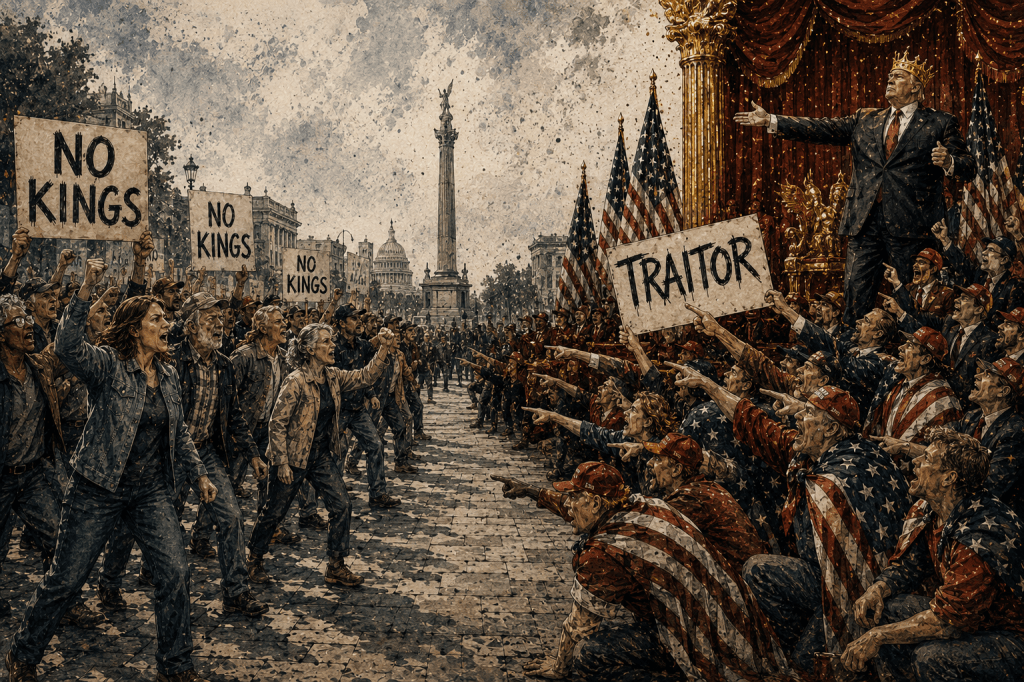
There’s a flag the size of a tablecloth on the back of a pickup that parks at the field where my kid plays baseball. The truck has a “Patriots Don’t Comply” sticker on it. The guy who owns it is probably very nice. But I find myself thinking, every time I see it: comply with what? And what does the flag have to do with the noncompliance?
I’d been turning the word “patriot” over for a while before I sat down to write this. The first political post I did was about whether we’re sliding into fascism, and the word “patriot” kept showing up adjacent to that conversation in ways that didn’t quite track for me. People I’d call patriots in the dictionary sense get called traitors. People who seem mostly interested in their team winning call themselves patriots. The word has stopped pointing at the thing it’s supposed to point at.
So I did the dumb obvious thing and looked it up.
Merriam-Webster says a patriot is “one who loves and supports his or her country.” Patriotism is “love for or devotion to one’s country.” Encyclopedia Britannica frames it as commitment to a political community — to the common good and the welfare of fellow citizens. That last one is the part that landed for me. Patriotism is about the people who make up the country, not the abstraction of the country itself.
Compare that to nationalism, which Merriam-Webster notes implies “placing your nation above others,” and Britannica frames as an ideology of national superiority and primacy. The two words get used interchangeably in American politics, and they shouldn’t be. They mean different things and they produce different behavior.
The cleanest test I came up with is what each one does with criticism. If you can love your country and also say “we’re getting this wrong, we should fix it” — that’s patriotism. The criticism is because you care about the country and want it to be better. If criticism feels like betrayal, if “if you don’t like it here, leave” sounds like a reasonable response to someone pointing out a problem — that’s not patriotism. That’s nationalism wearing patriotism’s clothes.
Three places I see the word getting misused, all of which would be unrecognizable to anyone who actually looked it up.
Patriot meaning “supports the current leader.” Patriotism is devotion to the country, not to whoever happens to be running it at the moment. George Washington spent his Farewell Address specifically warning against the kind of partisanship that conflates love of country with love of party. Holding leaders accountable, including the ones you voted for, is patriotic. Supporting them no matter what they do is something else.
Patriot meaning “performs the symbols.” Flag pins, bumper stickers, hand on the heart, “Patriots Don’t Comply” decals. The symbols are fine. They’re a way of expressing devotion. But they’re only patriotic if the behavior under them lines up. You can’t fly the flag on your truck and also cheer for ignoring court orders or pardoning people convicted of beating Capitol Police. At that point the flag is decoration, not a value.
Patriot meaning “real American, as opposed to those people.” This is the one that’s farthest from the actual definition. If patriotism is commitment to the political community, then defining the political community to exclude half of it is the opposite of patriotic. It’s nationalism — the version where loyalty to the nation requires deciding which people count as the nation.
What I keep coming back to is that real patriotism is compatible with almost any politics. You can be on the left, the right, the middle, or somewhere off the map and still be a patriot, as long as your starting point is I care about this country and the people in it, and I want it to live up to what it says it is. The word doesn’t belong to a party. It doesn’t belong to a candidate. It belongs to anyone willing to do the work of caring about the actual place and the actual people.
The Black civil rights organizers in the 1960s who got beaten on bridges trying to make America keep its written promises — they were patriots. The conservative federal judges right now refusing to rubber-stamp orders they consider unlawful — they’re patriots. The poll workers who showed up in 2020 in both red and blue states to count votes accurately while being threatened — they were patriots. The whistleblowers in every administration, Republican and Democratic, who got fired for telling the truth about something the country needed to know — patriots. None of these people had matching politics. All of them put the country above their own immediate interests.
The next time someone calls someone unpatriotic, the question worth asking is whether they mean that person doesn’t love the country or whether they mean that person doesn’t agree with me. Most of the time it’s the second thing wearing the first thing’s clothes.
The dictionary version of patriot is someone who cares enough to want their country to be better than it is right now. I’m going to keep using the word that way and see who else does too.
That’s the whole post.


Leave a Reply