
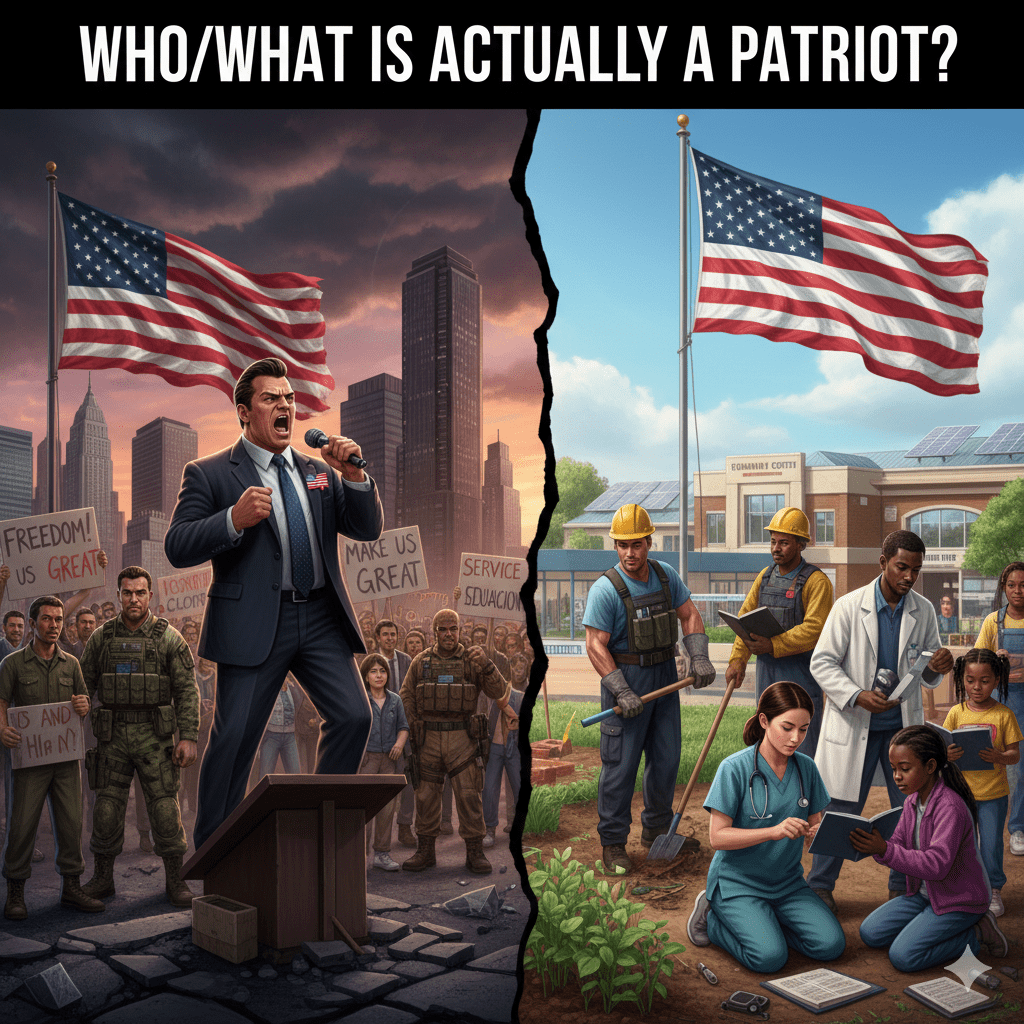
Spoiler: It’s probably not who you think—or at least not for the reasons you think
In contemporary American politics, “patriot” has become perhaps the most weaponized word in our vocabulary. Politicians invoke it to rally supporters. Activists claim it to legitimize their causes. Critics wield it to question opponents’ loyalty. Everyone wants to be one, and everyone wants to decide who isn’t.
But here’s the problem: most of these uses have almost nothing to do with what “patriot” actually means.
When someone calls themselves a patriot—or accuses someone else of not being one—they’re usually not talking about love of country. They’re talking about political allegiance, policy agreement, or cultural identity. The word has been stretched so far from its original meaning that it’s worth asking: what does “patriot” actually mean, and who qualifies?
Let’s start with what dictionaries and scholars say, then look at where modern usage goes off the rails.
The Core Definitions
Patriot and Patriotism
According to Merriam-Webster, a patriot is “one who loves and supports his or her country.” The dictionary elaborates that this includes being prepared to support and defend it. Patriotism, meanwhile, is defined simply as “love for or devotion to one’s country.”
Key characteristics of patriotism:
- Attachment to one’s country and its well-being
- A sense of responsibility toward the nation
- Can include pride, but doesn’t require believing the country is always right
- Compatible with criticism aimed at improvement
The Encyclopedia Britannica describes patriotism as an attachment and commitment to a political community—a devotion focused on the common good and the welfare of fellow citizens. Importantly, this definition frames patriotism as something that can coexist with honest critique, since genuine devotion means wanting your country to live up to its ideals.
Nationalism
Nationalism is a related but distinct concept. Merriam-Webster notes in their usage guidance that nationalism often implies “placing your nation above others,” which is not necessarily inherent in patriotism.
Britannica draws a clearer line: while patriotism is characterized by attachment and commitment, nationalism functions more as an ideology about the nation. It tends to carry stronger claims about national identity, superiority, and primacy over other nations.
Key characteristics of nationalism:
- Emphasis on national superiority
- “Us versus them” mentality
- More likely to view outsiders or internal minorities as threats
- Often demands conformity to a specific vision of national identity
- Less tolerant of criticism, which may be viewed as disloyalty
A Practical Test: Patriotism or Nationalism?
Here’s a simple way to distinguish between patriotic and nationalistic statements:
Patriotic framing:
- “I love this country, which is why I want us to address this injustice.”
- “We should honor our founding principles by extending rights more fully.”
- “Real patriotism means holding our leaders accountable.”
These statements reflect devotion to the country and its ideals, with criticism seen as a form of caring. This aligns with Britannica’s description of patriotism as commitment to the political community and the common good.
Nationalistic framing:
- “My country, right or wrong—never criticize America.”
- “Real Americans are only [specific ethnicity/religion/political party].”
- “If you don’t like it here, leave.”
- “We’re better than every other country, and that’s all that matters.”
These statements emphasize superiority, exclusion, and uncritical loyalty. They match Merriam-Webster’s description of nationalism as placing one’s nation above others and often defining who does and doesn’t truly belong.
Where “Patriot” Gets Misused
In contemporary American discourse, “patriot” frequently gets deployed in ways that contradict its dictionary definition. Here are the most common distortions:
1. Patriot = Uncritical Support for Government or Leader
The misuse: Treating “patriot” as synonymous with unwavering support for whoever is currently in power, or for a particular political party.
Why it’s wrong: Patriotism is devotion to the country and its principles, not to any individual leader or party. In fact, holding leaders accountable is a patriotic act when it serves the nation’s best interests. George Washington himself warned against excessive partisanship in his Farewell Address.
2. Patriot = Symbol Performance Without Substance
The misuse: Defining patriotism purely through displays like flag pins, bumper stickers, or specific slogans—while simultaneously rejecting civic duties like respecting election results, supporting the rule of law, or defending rights for all citizens.
Why it’s wrong: Patriotism is about devotion to the country’s well-being and its foundational principles. Symbols can express that devotion, but they’re meaningless if accompanied by actions that undermine democratic institutions or the rights they’re supposed to represent.
3. Patriot = Exclusionary Identity
The misuse: Using “patriot” or “real American” to exclude certain groups based on ethnicity, religion, political views, or other characteristics. For example: “Real patriots support [specific policy]” or “You can’t be a patriot if you’re [identity group].”
Why it’s wrong: This usage shifts from patriotism into nationalism’s “us versus them” logic. It defines national belonging narrowly and treats diversity of opinion or identity as threatening—the opposite of commitment to a pluralistic political community.
Why This Distinction Matters
The difference between patriotism and nationalism isn’t just semantic. These concepts lead to very different political behaviors:
Patriotism encourages:
- Constructive criticism and reform
- Accountability for leaders and institutions
- Inclusive citizenship
- Long-term thinking about the nation’s well-being
Nationalism encourages:
- Defensiveness against criticism
- Cult of personality around leaders
- Exclusionary definitions of belonging
- Competitive, zero-sum thinking about other nations
When people use “patriot” to mean “agrees with my politics” or “supports my preferred leader,” they’re often (knowingly or not) promoting nationalism while claiming the moral high ground of patriotism.
Final Thoughts
True patriotism is compatible with a wide range of political views. It can exist on the left, right, and center. What it requires is genuine devotion to the country’s welfare and a commitment to its political community—not blind loyalty to symbols, leaders, or parties.
The next time you hear someone called “unpatriotic” for criticizing a policy or “not a real patriot” for holding different views, ask yourself: Is this actually about love of country, or is it about demanding conformity to a particular political identity?
According to the dictionary definitions, patriotism is about caring enough to want your country to be its best self. And sometimes that means being willing to say so when it falls short.
Have you encountered uses of “patriot” that seemed at odds with what the word actually means? This is part of an ongoing series exploring how political language shapes (and sometimes distorts) public discourse.
 Even that's Odd
Leave a comment