
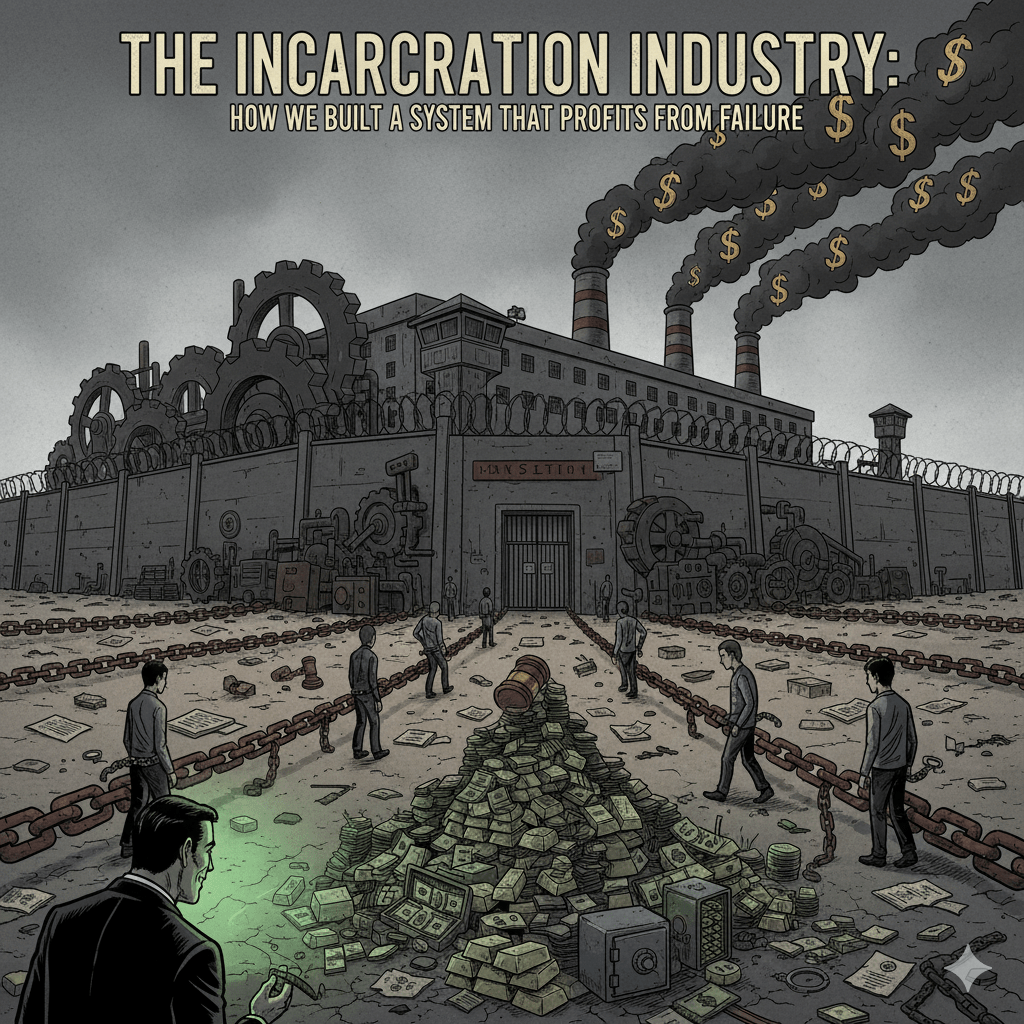
Part 10 of the series: How Systems Are Rigged Against the Bottom 90%
Before we start, let’s address the elephant in the room: when we talk about criminal justice reform, we are NOT talking about “defunding the police” or “cashless bail.” These are real proposals that some activists made, and they’re bad ideas. But opponents of reform use these bad policies as strawmen to shut down any honest discussion of actual problems—mass incarceration, private prisons profiting from slavery, and a system that’s failing everyone, including the police officers doing difficult, often dangerous work.
What we’re talking about is this: The United States has 4% of the world’s population and 25% of the world’s prisoners. We spend $80 billion annually on incarceration. Private companies profit from every phone call, every commissary purchase, every day someone spends locked up. We have literal slavery written into our Constitution. And despite spending more than almost any other country on criminal justice, our recidivism rate is catastrophically high—68% of released prisoners are rearrested within three years.
This isn’t a system designed to reduce crime or rehabilitate people. It’s a system designed to extract maximum profit from incarceration while ensuring a steady supply of prisoners to keep the money flowing.
And like every other extractive system we’ve covered, it affects the bottom 90% regardless of political affiliation. You might think you’re safe because you’re law-abiding. But this system extracts from you too—through taxes funding a broken system, through communities destabilized by mass incarceration, through family members trapped in cycles they can’t escape.
Let’s look at exactly how this works and who profits.
The Scale of Mass Incarceration
The numbers are staggering:
• 2.3 million people incarcerated in the U.S. (2024) • 639 per 100,000 incarceration rate—highest in the world • $80 billion annual spending on state and federal prisons • $14 billion annual spending on jails • 10.5 million jail admissions per year (many for pre-trial detention) • 68% of released state prisoners rearrested within 3 years • 83% rearrested within 9 years
For context on how extreme this is:
• El Salvador: 605 per 100,000 (second highest, authoritarian regime) • Rwanda: 580 per 100,000 (third highest) • Turkmenistan: 576 per 100,000 (fourth highest, authoritarian regime) • Cuba: 510 per 100,000 • Thailand: 445 per 100,000
We incarcerate people at higher rates than authoritarian regimes. Let that sink in.
Now compare to developed democracies:
• UK: 130 per 100,000 • Canada: 104 per 100,000 • France: 93 per 100,000 • Germany: 69 per 100,000 • Sweden: 59 per 100,000 • Norway: 49 per 100,000 • Japan: 37 per 100,000
We incarcerate people at 5-17 times the rate of other developed countries. Countries with lower crime rates than ours. Countries where people feel safer than Americans do.
This isn’t about having more crime. It’s about having a system that profits from incarceration.
Private Prisons: The Profit Motive
Private prisons house about 8% of all U.S. prisoners—roughly 96,000 people in state and federal facilities, plus thousands more in immigration detention. That might sound like a small percentage, but the influence of private prison companies extends far beyond the facilities they directly operate.
The Major Players
CoreCivic (formerly Corrections Corporation of America):
• $1.9 billion in revenue (2023) • Operates 54 facilities across the U.S. • CEO Damon Hininger compensation: $3.7 million (2022) • Stock price increased 70% from 2016-2019 under Trump administration’s immigration enforcement • Contracts often include occupancy guarantees—states must pay for 90-100% occupancy whether or not they have prisoners to fill beds
GEO Group:
• $2.4 billion in revenue (2023) • Operates 86 facilities • CEO Brian Evans compensation: $3.3 million (2022) • Heavily involved in immigration detention (53% of ICE detention beds) • Also profits from electronic monitoring, halfway houses, and “community corrections”
Management & Training Corporation:
• Operates 22 facilities • Privately held (exact revenue not disclosed, estimated $500M+) • Focuses on federal contracts
The Occupancy Guarantee Scam
Here’s how private prisons ensure profitability: they negotiate contracts with states that include occupancy guarantees. The state agrees to keep the prison 90-100% full, or pay for empty beds.
Examples:
• Arizona: 100% occupancy guarantee in three private prison contracts • Oklahoma: 95% occupancy guarantee • Virginia: 95% occupancy guarantee
What does this mean in practice? If crime drops, if reforms reduce incarceration, if judges become less punitive—the state still has to pay for those empty beds. This creates a direct financial incentive to keep prisons full.
Judges have been caught filling quotas. Prosecutors have been found referring to occupancy guarantees when arguing for harsher sentences. The incentive structure is corrupted at every level.
Cost-Cutting That Harms Everyone
Private prisons profit by cutting costs. Specifically:
Staffing: Private prisons employ fewer guards at lower wages with less training. CoreCivic guards receive 160 hours of training compared to 600+ hours in federal prisons. Lower staff-to-prisoner ratios mean more violence, more contraband, less security.
Healthcare: Private prisons spend 50% less per prisoner on medical care than public facilities. This results in untreated chronic conditions, mental health crises, preventable deaths.
Programming: Education, job training, substance abuse treatment—anything that might reduce recidivism gets cut to maximize profit. Why invest in rehabilitation when you profit from people coming back?
The result? Private prisons have 28% higher rates of assaults on staff and 36% higher rates of assaults on prisoners compared to public facilities. They’re more dangerous for everyone—guards and prisoners alike.
And despite being more dangerous and providing worse outcomes, private prisons cost about the same as public facilities after accounting for the additional oversight required. The cost savings are a myth. The profit is real.
Prison Services: Extracting From Families
Even in public prisons, private companies profit enormously from services provided to prisoners and their families. This is extraction at its most predatory—targeting people who have no choice and families who are desperate to stay connected.
Prison Phone Calls
Prison phone services are near-monopolies that charge unconscionable rates:
• Average cost: $0.14-0.25 per minute for in-state calls • Interstate calls: $0.21-0.31 per minute • 15-minute call: $2.10-4.65 • Monthly cost for regular family contact: $300-500
Compare this to regular phone service where unlimited calling costs $30-50/month.
The major players:
• Securus Technologies: Controls 50% of prison phone market • GTL (Global Tel Link): Controls 30% of prison phone market • Combined revenue: $1.4 billion annually just from prison phone calls
These companies bid for exclusive contracts with prisons and jails. The contracts often include kickbacks to the facilities—commissions ranging from 40-60% of gross revenue. So prisons profit from keeping phone rates high, and they have exclusive contracts that prevent competition.
In 2021, the FCC finally capped interstate call rates at $0.21/minute. In-state calls remain unregulated in most states, keeping prices high.
Why does this matter? Because family contact reduces recidivism. Prisoners who maintain family connections are 13% less likely to be re-incarcerated. But many families can’t afford $300-500/month for phone calls, especially when their primary earner is incarcerated. So the system profits by making it expensive to do the thing that would reduce recidivism.
Commissary Markups
Prisons don’t provide adequate basic necessities. Prisoners need to buy from commissaries, which charge extreme markups:
• Ramen noodles: $0.50-1.00 (3-6x retail price) • Bar of soap: $2.00-3.50 (5-7x retail price) • Deodorant: $3.50-5.00 (3-5x retail price) • Tylenol (2 tablets): $5.00 (25x retail price) • Stamped envelope: $1.50-2.00 (3-4x retail price)
Prisoners earn $0.14-0.63 per hour for prison labor (more on this below). At $0.25/hour, it takes 20 hours of work to afford a bar of soap. At minimum wage, soap costs 30 minutes of work.
The commissary contracts go to companies like:
• Keefe Group (part of TKC Holdings): $1 billion+ annual revenue from prison commissaries • Trinity Services Group: Major commissary provider • Union Supply Direct: Commissary services in multiple states
Like phone contracts, commissary contracts often include kickbacks to prisons—typically 10-30% of revenue. Prisons profit from keeping commissary prices high.
Money Transfers
Families sending money to incarcerated loved ones pay fees at every step:
• Typical fee: $3-7 per transaction, regardless of amount • Express transfer fees: $10-15 • Some facilities require using specific services (JPay, Access Corrections) that charge higher fees • Sending $50 costs $5-7 in fees = 10-14% transaction cost
JPay (owned by Securus) is the dominant player:
• Operates in 35+ states • $200+ million annual revenue • Fees range from $2.35-6.95 per transfer • Also charges for email (prisoners pay $0.25-0.50 per message or $3-10/month for “stamps”)
Every single interaction with an incarcerated person—phone calls, commissary purchases, money transfers, emails—is an opportunity for extraction. And families have no choice. If you want to stay connected to your incarcerated loved one, you pay whatever they charge.
Prison Labor: Modern Slavery
The 13th Amendment to the U.S. Constitution abolished slavery with one critical exception:
“Neither slavery nor involuntary servitude, except as a punishment for crime whereof the party shall have been duly convicted, shall exist within the United States.”
That exception created a loophole that’s been exploited ever since. Today, approximately 800,000 prisoners work, with wages ranging from $0.14 to $0.63 per hour in most states. Some states pay nothing at all.
The Numbers
Prison labor wages by state:
• Alabama: $0 (prisoners are not paid) • Arkansas: $0 (prisoners are not paid) • Georgia: $0 (prisoners are not paid) • Mississippi: $0 (prisoners are not paid) • South Carolina: $0 (prisoners are not paid) • Texas: $0 (prisoners are not paid) • Louisiana: $0.04-0.20/hour • Florida: $0.20-0.55/hour • Arizona: $0.15-0.50/hour • Average nationally: $0.14-0.63/hour
Even in states that pay, deductions reduce take-home pay:
• Court costs and fees: 10-80% of wages • Victim restitution: 10-50% • Room and board fees: Some states charge prisoners for their incarceration • After deductions, prisoners often take home $0.05-0.25 per hour
Total value of prison labor: Estimated at $11 billion annually in goods and services produced. Amount paid to prisoners: Less than $500 million. The difference—$10.5 billion—is extracted as profit by prisons, states, and the private companies that use prison labor.
What Prisoners Produce
Prison labor produces everything from military equipment to consumer goods:
Federal Prison Industries (UNICOR):
• $500 million annual revenue • Produces military uniforms, body armor, helmets • Makes office furniture, electronics, textiles • Federal prisoners earn $0.23-1.15/hour (highest prison wages in the country) • Mandatory work requirement—federal prisoners must work if physically able
State Prison Industries:
• Alabama: $450 million in goods produced annually, prisoners paid $0 • California: $180+ million in sales, prisoners earn $0.08-0.37/hour • Products include furniture, clothing, food products, DMV license plates, road signs
Private companies using prison labor:
• Whole Foods: Sourced produce and baked goods from prison labor • McDonald’s: Used prison labor for uniforms (until public outcry) • Walmart: Distributed products made by prison labor • Victoria’s Secret: Used prison labor for lingerie (until exposed) • AT&T: Used prisoners in call centers • Starbucks: Used prison labor for packaging
Most of these companies claimed they didn’t know they were using prison labor—their suppliers subcontracted to prison industries without disclosure. But the incentive is clear: labor that costs $0.14-0.63/hour is extremely profitable.
Why This Is Slavery
Prison labor is involuntary. Prisoners who refuse to work face:
• Solitary confinement • Loss of good time credits (extended sentences) • Loss of family visitation • Disciplinary charges that affect parole eligibility • Denial of access to programs that could reduce their sentences
This is forced labor under threat of punishment. By definition, that’s slavery.
And because prisoners have no choice and no bargaining power, they can be paid whatever the prison decides. $0.14/hour. $0. There’s no minimum wage for prisoners. No overtime. No worker protections. If you’re injured on the job, too bad—worker’s compensation doesn’t apply.
This creates a direct incentive to incarcerate people—free or near-free labor that produces billions in goods and services. And this incentive affects sentencing, parole decisions, and the entire criminal justice system.
Recidivism: Designed for Failure
Here’s the clearest evidence that the system is designed to fail: 68% of released state prisoners are rearrested within three years. 83% within nine years. If this were any other system with an 83% failure rate, we’d scrap it and start over.
But recidivism isn’t a bug—it’s a feature. Every prisoner who comes back is:
• More revenue for private prisons • More profit for commissaries, phone companies, money transfer services • More free labor for prisons and private companies • More justification for tough-on-crime policies • More funding for law enforcement and prisons
The system profits from failure. So why would it invest in success?
What Actually Reduces Recidivism
We know what works because other countries do it:
Norway:
• Recidivism rate: 20% within two years • Approach: Focus on rehabilitation, not punishment • Prisoners live in dormitory-style housing with private rooms • Access to education, job training, therapy, substance abuse treatment • Gradual reintegration—prisoners can work outside prison, come back at night • Maximum sentence: 21 years (can be extended if still dangerous) • Philosophy: Prison is the punishment (loss of freedom), not additional suffering
Germany:
• Recidivism rate: 35-40% within three years • Focus on education and job training • Prisoners earn normal wages for work (€9-15/hour) • Emphasis on maintaining family connections • Robust post-release support
Netherlands:
• Recidivism rate: 28% within two years • Extensive rehabilitation programs • Prisoners can leave for work, school, or treatment during the day • Mental health and addiction services • So few prisoners that they’re closing prisons and converting them to refugee housing
These countries treat prisoners as people who will eventually return to society and should be prepared for that. The U.S. treats prisoners as revenue sources who should be kept in the system as long as possible.
Why the U.S. Doesn’t Do This
What reduces recidivism:
• Education and job training • Substance abuse treatment • Mental health services • Family contact during incarceration • Housing and employment support after release • Expunging or sealing records for non-violent offenses
What the U.S. does instead:
• Minimal education (20% of prisoners have access to college programs, down from 350 programs pre-1994) • Limited substance abuse treatment (only 11% of prisoners who need it receive it) • Inadequate mental health care (44% of prisoners have mental health problems, most untreated) • Make family contact expensive ($300-500/month for phone calls) • No housing support—60% of released prisoners experience homelessness • No job support—75% of released prisoners are unemployed one year after release • Permanent criminal records that bar employment, housing, education, voting
And then we’re shocked—shocked!—when people reoffend.
The system is working exactly as designed. It’s just not designed to reduce crime. It’s designed to maximize incarceration.
The War on Drugs: Filling the Prisons
You can’t talk about mass incarceration without talking about the War on Drugs, which has been the single most effective tool for filling prisons.
In 1980, there were 40,900 people incarcerated for drug offenses. By 2019, that number hit 430,900—a 950% increase. Drug offenses now account for 46% of federal prisoners and 15% of state prisoners.
The majority are non-violent offenses. Simple possession. Low-level dealing. People with addiction problems who need treatment, not incarceration.
The Racial Disparity
Drug use rates are similar across racial groups. But incarceration rates are not:
• Black Americans: 5.9 times more likely to be incarcerated than white Americans • Latino Americans: 3.1 times more likely than white Americans • For drug offenses specifically: Black Americans are incarcerated at 5 times the rate of white Americans despite similar usage rates
This isn’t accidental. The War on Drugs was explicitly designed to target Black communities. John Ehrlichman, Nixon’s domestic policy advisor, admitted this in a 1994 interview:
“We knew we couldn’t make it illegal to be either against the war or Black, but by getting the public to associate the hippies with marijuana and Blacks with heroin, and then criminalizing both heavily, we could disrupt those communities. We could arrest their leaders, raid their homes, break up their meetings, and vilify them night after night on the evening news. Did we know we were lying about the drugs? Of course we did.”
The War on Drugs was never about drugs. It was about social control. And it provided the perfect justification for mass incarceration that continues to this day.
What Works: Decriminalization and Treatment
Portugal:
In 2001, Portugal decriminalized all drugs. Not legalized—decriminalized. Possession is still illegal, but it’s treated as an administrative offense, not a criminal one.
Results after 20 years:
• Drug-induced deaths decreased 80% • HIV infection rates among drug users dropped 95% • Drug use among 15-24 year olds decreased • Lifetime drug use rates remain below EU average • Drug-related crime decreased • Incarceration for drug offenses dropped 90%
Instead of prison, Portugal invested in treatment, harm reduction, and social services. And it worked—by every measure, Portugal’s approach succeeded where punitive approaches failed.
Switzerland:
• Heroin-assisted treatment programs for severe addicts • Supervised injection sites • Results: 82% reduction in heroin-related deaths, 60% decrease in new heroin users, significant reductions in drug-related crime
Netherlands:
• Decriminalized cannabis in 1976 • Focus on harm reduction for hard drugs • Drug use rates lower than U.S., far fewer overdose deaths, minimal drug-related incarceration
Treatment works. Harm reduction works. Decriminalization works. But these approaches don’t fill prisons. And that’s exactly why we don’t do them.
Both Parties Are Complicit
Mass incarceration isn’t a partisan issue—both parties built this system and both continue to profit from it.
The Tough-on-Crime Consensus
Republicans: Led the War on Drugs, mandatory minimums, three-strikes laws. Positioned themselves as the party of law and order. Pushed for private prisons and prison labor.
Democrats: The 1994 Crime Bill (championed by Joe Biden) provided $9.7 billion for prison construction, expanded the death penalty to 60 offenses, eliminated Pell Grants for prisoners, and introduced three-strikes provisions. Bill Clinton later admitted it went too far, but only after millions were incarcerated.
Both parties competed to be “tougher on crime.” Both supported mandatory minimums. Both funded prison expansion. Both accepted money from private prison companies and prison guard unions.
The Money Trail
Private prison companies donate to both parties:
• CoreCivic and GEO Group combined: $10+ million in lobbying (2008-2020) • Campaign contributions to both parties • Major recipients include members of judiciary and appropriations committees • State-level donations to governors, legislators, judges
Prison guard unions also donate heavily:
• California Correctional Peace Officers Association: $22 million in political spending (2000-2020) • Strong supporters of tough-on-crime policies, three-strikes laws, opposition to sentencing reform • Major influence on California politics despite California being a Democratic stronghold
Both private prisons and public prison guard unions have the same incentive: keep prisons full and keep sentences long. And both donate to politicians who will ensure that happens.
Recent Reforms: Performative at Best
In recent years, both parties have talked about criminal justice reform:
• First Step Act (2018): Reduced some federal sentences, expanded good time credits. Affected about 7,000 federal prisoners. There are 1.2 million state prisoners who weren’t affected at all. • Biden administration ended federal contracts with private prisons (2021). Only affects about 14,000 prisoners. States still contract with private prisons for 82,000 more. • Some states reduced marijuana penalties. But arrests for marijuana possession: 350,000+ per year, disproportionately Black and Latino.
These are incremental changes that look good in press releases but barely touch the actual problem. Mass incarceration continues. Private prison companies pivot to immigration detention and electronic monitoring. The money keeps flowing.
Both parties maintain the profitable status quo while performing concern. And the incarceration machine grinds on.
What Reform Actually Means (Not What You’ve Been Told It Means)
Let’s be absolutely clear about what we’re talking about when we say “criminal justice reform”:
What Reform Is NOT
“Defund the police” is a bad idea. Some activists proposed literally defunding or abolishing police departments. This doesn’t address the actual problems and creates obvious new ones. But this bad proposal has been used as a strawman to shut down all reform discussion – as if wanting to end private prisons or prison slavery means you want to eliminate police.
We’re not talking about eliminating police. We’re talking about examining why we have the highest incarceration rate in the world, why it costs $80 billion annually, and whether that money is being spent effectively.
“Cashless bail” as implemented in some jurisdictions is also problematic. Blanket release policies put genuinely dangerous people back on the streets before trial. The current bail system is unjust – wealth-based detention means rich people go free while poor people stay locked up for months before conviction. But the solution isn’t no assessment at all.
What we need is risk-based assessment using objective criteria, with monitoring and support services for those released pre-trial. Not wealth-based detention. Not blanket release. Actual assessment of risk combined with appropriate supervision.
What Reform Actually IS
1. End private prisons and occupancy guarantees
No one should profit from incarceration. Period. If prisons must exist, they should be public, accountable, and focused on rehabilitation—not profit. And no government should ever sign a contract promising to keep prisons full.
2. End prison slavery
Remove the exception in the 13th Amendment. If prisoners work, pay them minimum wage. This isn’t radical—it’s what Germany does. Prisoners there earn €9-15/hour, save money for release, support their families, and develop work skills. It’s better for everyone except the people profiting from free labor.
3. Regulate prison services
Phone calls, commissary, money transfers—these should cost what they actually cost, not 5-20x markup. Cap phone rates at normal rates. Limit commissary markups. Ban kickbacks to prisons. Family contact reduces recidivism—we should make it affordable, not prohibitively expensive.
4. Decriminalize drugs and invest in treatment
Follow Portugal’s model: decriminalize possession, treat addiction as a health problem, invest in treatment and harm reduction. This approach reduces overdose deaths, reduces crime, reduces incarceration, and costs less than our current approach.
5. Focus on rehabilitation, not punishment
Invest in education, job training, mental health services, substance abuse treatment. Norway spends more per prisoner than we do, but their recidivism rate is 20% vs our 68%. Rehabilitation is cheaper in the long run than revolving-door incarceration.
6. Support reentry
Housing, job placement, continuing education, mental health services. Most released prisoners are homeless and unemployed within a year. Then we’re surprised they reoffend. Invest in successful reintegration—it’s cheaper than reincarceration.
7. Reform sentencing and parole
End mandatory minimums that remove judicial discretion. Restore parole in states that eliminated it. Expunge or seal records for non-violent offenses after successful completion of sentence. Stop punishing people for life for mistakes made decades ago.
8. Reform policing where needed
Police do difficult, dangerous work. But the job has expanded to include things that shouldn’t be criminal justice issues—homelessness, mental health crises, substance abuse, truancy. Other countries handle these through social services. Redirect some resources to appropriate responders while maintaining adequate police funding for actual crime.
Better training for de-escalation and mental health crisis intervention. Accountability systems that actually function. End civil asset forfeiture that incentivizes policing-for-profit. End quotas and arrest-based metrics that push officers to make questionable arrests just to hit numbers.
9. Fix the bail system
Replace wealth-based detention with risk-based assessment. If someone is dangerous, keep them detained regardless of ability to pay. If someone isn’t dangerous, release them with appropriate monitoring regardless of inability to pay. The current system detains poor people who aren’t threats while releasing rich people who are—that benefits no one except bail bondsmen.
The Common Thread
Notice what all these reforms have in common: they’re about effectiveness, not ideology. They’re about reducing crime, reducing costs, reducing recidivism. They’re about stopping the extraction and focusing on what actually works.
Every single one of these policies has been proven effective in other countries. Countries with lower crime rates than ours. Countries where people feel safer. Countries that spend less on criminal justice and get better results.
The reason we don’t implement them isn’t because they don’t work. It’s because they don’t generate profit.
Who Opposes Reform and Why
If these reforms work everywhere else and would save money while reducing crime and recidivism, why haven’t we implemented them?
Because the current system is extremely profitable for a small group of people who spend heavily to maintain it.
Private Prison Companies
CoreCivic and GEO Group have spent $10+ million lobbying against sentencing reform, against ending mandatory minimums, against anything that would reduce incarceration. They donate to tough-on-crime politicians. They fund think tanks that produce research supporting harsh sentencing.
They oppose reform because reform means fewer prisoners, which means lower revenue.
Prison Services Companies
Securus, GTL, JPay, Keefe Group—all oppose regulations that would limit phone rates, commissary markups, and money transfer fees. They lobby state legislators. They negotiate exclusive contracts with kickbacks that give prisons incentives to keep prices high.
They oppose reform because cheaper phone calls and lower commissary prices mean lower profits.
Prison Guard Unions
The California Correctional Peace Officers Association and similar unions in other states oppose sentencing reform, support three-strikes laws, and fight against prison closures even when prisons are half-empty.
Their members do difficult work. But the unions have institutional interests in maintaining high incarceration—more prisoners means more jobs, higher budgets, more political power.
Companies Using Prison Labor
The companies benefiting from $0.14/hour labor oppose paying prisoners minimum wage. They claim it would make their products uncompetitive—which is an admission that their business model depends on slavery.
Tough-on-Crime Politicians
Politicians in both parties have built careers on being “tough on crime.” Admitting that mass incarceration doesn’t work would require admitting they were wrong for decades. It’s easier to take money from prison companies and maintain the status quo.
All of these groups use the same strategy: they fund politicians who block reform, they lobby against changes, and they weaponize phrases like “soft on crime,” “defund the police,” and “cashless bail” to make any reform discussion politically toxic.
The International Comparison: Proving We’re the Outlier
Let’s look at the full picture of how extreme the U.S. system is:
Incarceration Rates (per 100,000 people)
• U.S.: 639 • Norway: 49 • Germany: 69 • Japan: 37 • Canada: 104 • UK: 130 • France: 93
We incarcerate 5-17x more people than comparable democracies.
Recidivism Rates
• U.S.: 68% within 3 years • Norway: 20% within 2 years • Germany: 35-40% within 3 years • Netherlands: 28% within 2 years • Japan: 45% within 5 years
Our system fails 2-3x more often than rehabilitation-focused systems.
Cost Per Prisoner Per Year
• U.S.: $35,000-40,000 average (up to $75,000 in some states) • Norway: $120,000 (includes extensive rehabilitation, education, mental health services) • Germany: $50,000-60,000 • Netherlands: $70,000
Countries that spend more per prisoner get better results—lower recidivism, lower crime. But they’re investing in rehabilitation, not profit extraction. Norway spends 3x what we do per prisoner, but their prisoners don’t come back. Ours do, at a 68% rate. Over decades, our revolving-door system costs far more.
Life After Prison
U.S.:
• Permanent criminal record • Banned from most professional licenses • Difficulty finding housing (“no felons”) • Barred from many jobs • Can’t vote in some states • Ineligible for federal student aid • Barred from public housing • Result: 75% unemployed one year after release, 60% experience homelessness
Norway:
• Records sealed after sentence completion for most offenses • Housing assistance provided • Job placement services • Continued education support • Full voting rights maintained throughout incarceration • Result: Most find employment and housing within months of release
We make it nearly impossible to succeed after prison. Then we act shocked when people reoffend.
The Crime Paradox
Here’s the thing that should make everyone question the system: countries with lower incarceration rates have lower crime rates.
Violent crime rate (per 100,000):
• U.S.: 380 • Norway: 70 • Germany: 80 • UK: 140 • Canada: 110 • Japan: 25
We incarcerate 5-17x more people and have 2-15x higher violent crime rates. Mass incarceration doesn’t reduce crime. Countries that focus on rehabilitation, reintegration, and addressing root causes have both lower incarceration and lower crime.
The U.S. system doesn’t work. By any measure—cost, recidivism, crime rates, social outcomes—it’s a failure. But it’s a profitable failure for the companies and unions that control it.
Conclusion: A System Built to Extract, Not to Rehabilitate
The U.S. criminal justice system is not failing. It’s succeeding—at exactly what it was designed to do. Extract profit from incarceration. Provide free labor. Maintain a permanent underclass of people who can be exploited and discarded.
Every part of the system is designed for extraction:
• Private prisons profit from keeping beds filled • Prison services companies profit from $1/minute phone calls and $5 Tylenol • States and private companies profit from prison labor at $0.14/hour or $0 • The system is designed to ensure high recidivism so the profits continue • Both parties take money from these industries and maintain the status quo
We have 4% of the world’s population and 25% of its prisoners. We incarcerate at 5-17x the rate of comparable democracies. We spend $80 billion annually. And we get worse results—higher crime, higher recidivism, more violence.
Every other developed country does this better. They focus on rehabilitation, provide treatment for addiction and mental health, maintain family connections, prepare people for reintegration, and seal records after sentences are completed. Their recidivism rates are 20-40%. Ours is 68%.
The solutions exist. They work everywhere else. They would save money, reduce crime, and reduce the human cost of mass incarceration.
But implementing them requires acknowledging that the current system isn’t broken—it’s working exactly as intended. And the people who profit from it will fight any change with lobbying, campaign contributions, and weaponized language designed to shut down discussion.
When someone uses “defund the police” or “cashless bail” to dismiss reform, recognize it for what it is: using bad policy proposals from some activists as strawmen to prevent honest analysis of a system that extracts billions from the bottom 90% while failing by every objective measure.
Real reform means:
End private prisons. End prison slavery. Regulate prison services. Decriminalize drugs and invest in treatment. Focus on rehabilitation. Support reentry. Reform sentencing. Improve policing where needed. Fix the bail system.
Not because we’re soft on crime. Because mass incarceration doesn’t reduce crime, costs a fortune, and serves no one except the people profiting from it.
The question isn’t whether we can afford reform. The question is why we’re still tolerating a system that:
Costs $80 billion annually. Incarcerated 2.3 million people. Has a 68% failure rate. Incentivizes keeping prisons full. Allows literal slavery. Charges $1/minute for phone calls. And produces higher crime than countries that do the opposite.
This system is designed to fail everyone except the people extracting profit. And that’s exactly why it continues.
Next time: We’ll examine military spending—how the U.S. spends more than the next 10 countries combined, where that $968 billion actually goes, who profits from endless wars and failed weapons programs, and why both parties keep voting to increase the budget while troops are on food stamps.
 Even that's Odd
Leave a comment