
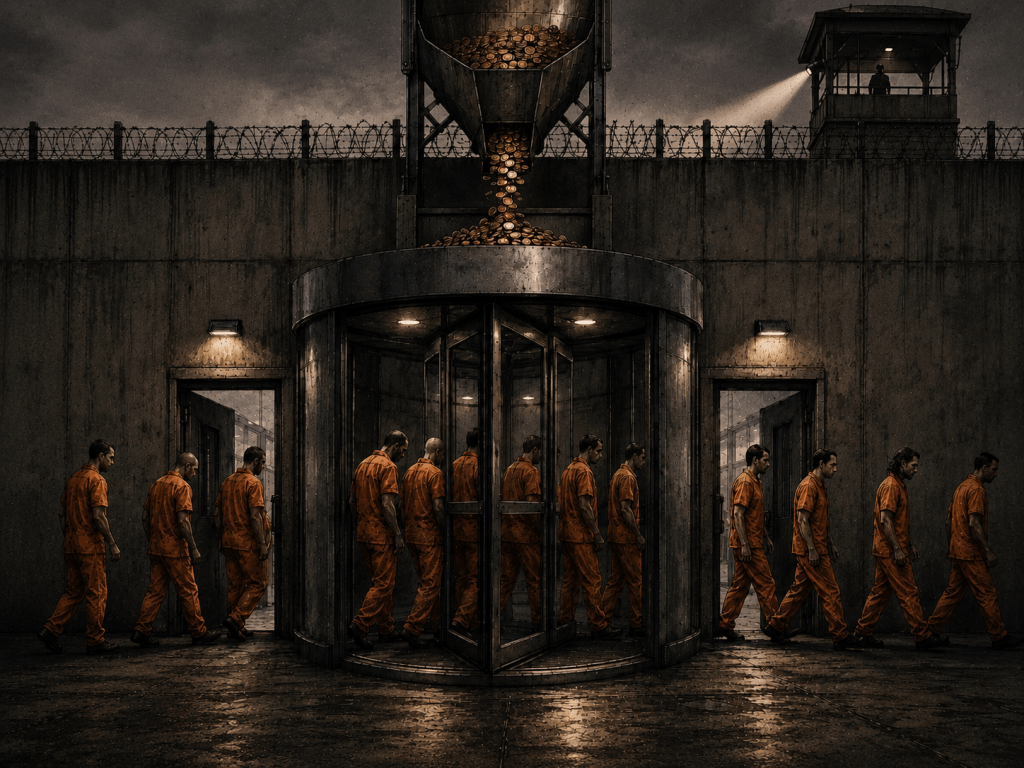
You Don’t Get Out
Say you did eighteen months. Drug offense, low-level, the kind that gets you four years in some states and twenty in others depending on which side of which line you were on when the cops showed up. You served your time. Today is the day you get out.
Now find an apartment. The application asks if you’ve been convicted of a felony. Some states say landlords can’t ask. Most states say they can. The fair-chance laws that exist mostly cover government-subsidized housing and federal contractors; the guy with the duplex on the corner is not covered. So you check the box, or you lie and risk eviction later, or you don’t apply.
Find a job. Same form, same box. Roughly a quarter of American jobs require some kind of occupational license, and a lot of those licenses bar people with felony records, sometimes for life. The jobs that don’t bar you outright have hiring managers who can. So you take what’s available, which tends to be shift work in industries that don’t ask, which tends to put you next to the same people and the same nights that put you inside the first time.
Get federal student aid to retrain. Drug offense — restricted, depending on the year and the offense. Public housing — barred from many programs for years. Vote — depends entirely on which state you happen to be standing in.
Within three years, 68% of people standing where you’re standing will be rearrested. Within nine years, it’s 83% (Bureau of Justice Statistics). We talk about those numbers like they’re a tragedy or a mystery. They are neither. They are what happens when you build a system that systematically removes the things that prevent reoffense — housing, employment, family contact, sobriety support, voting, basic civic participation — and then prosecutes the person again the second they slip.
This is the same argument as the last post. The locks just got bigger.
The Most Expensive Lock
Part 9 ended on the line that most of what’s left in this series is the same game with the locks changed out for whichever lock is cheapest in the particular industry. Incarceration is the version where the lock is a building.
Some numbers worth keeping in view. The U.S. incarcerates at roughly 639 per 100,000 residents. The UK runs 130. Canada 104. Germany 69. Norway 49. Japan 37. The two countries closest to our rate are El Salvador (605) and Turkmenistan (576). We are not in the same league as comparable democracies. We are not in the same league as most of the countries we openly describe as authoritarian regimes.
It’s not cheap. Walls cost money. Guards cost money. Food, healthcare, transport, the whole apparatus. The U.S. spends roughly $80 billion a year on prisons and jails. Per prisoner, that’s around $35,000 to $40,000 in the average state. Norway, the country everybody points at when this conversation happens, spends about $120,000. Norway spends three times what we do per prisoner and has a recidivism rate around a third of ours. That number sounds backwards until you understand what the two systems are actually being run for.
The locks in Part 9 worked indirectly. The healthcare premium suppressed wage negotiation across the whole economy; you had to aggregate it before the dollars showed up. Incarceration is the direct version. The bed is occupied or it isn’t. The phone call is billed or it isn’t. The labor is extracted or it isn’t. Every day, every prisoner, the meter runs.
Three Layers of Extraction
The extraction works in three layers stacked on top of each other.
The first layer is the labor. The Thirteenth Amendment, ratified in 1865, abolished slavery — “except as a punishment for crime whereof the party shall have been duly convicted.” That exception built the convict-leasing system in the post-Reconstruction South almost immediately, and it’s still in the Constitution, and it is still operative. Roughly 800,000 incarcerated people work today. In several states — Alabama, Arkansas, Georgia, Mississippi, South Carolina, Texas — prisoners doing non-industry work are paid nothing at all. In most of the rest, the wage runs $0.14 to $0.63 an hour before deductions for court costs, restitution, and in some places room and board. Federal Prison Industries (UNICOR) generates around half a billion dollars in annual revenue producing military uniforms, body armor, and office furniture. State prison industries produce hundreds of millions more. The estimated total annual value of prison labor is around $11 billion. The estimated total paid to prisoners is under $500 million. The difference is the margin.
The second layer is the services. A phone call from inside costs $0.14 to $0.31 a minute on interstate calls the FCC capped in 2021, and more on the in-state calls most states still don’t regulate. Securus and GTL together control roughly 80% of that market. The contracts with prisons typically include “commissions” — kickbacks of 40% to 60% of revenue, paid back to the facility for granting the exclusive contract. The prison and the phone company are not adversaries. They are partners. The commissary markups run 3x to 25x retail (a generic two-pack of Tylenol can run five dollars, payable by a prisoner earning a quarter an hour). The money-transfer services families use to fund those commissary accounts charge 10% to 15% of the amount sent. Every interaction an incarcerated person can have with the outside world — call, package, deposit, email — is a billable event with a private vendor on the other end. The vendor’s revenue comes mostly out of the pockets of the families.
The third layer is the building itself. About 8% of American prisoners are in private facilities. That’s CoreCivic ($1.9 billion in 2023 revenue), GEO Group ($2.4 billion), and a handful of smaller operators. The financial structure most of those contracts use is the occupancy guarantee: the state agrees to keep the facility 90% to 100% full, or to pay for the empty beds anyway. That single contractual term is one of the more remarkable artifacts in American policy. It doesn’t just create a soft incentive for harsh sentencing. It writes the incentive into the operating budget of the state government.
How You Fill the Beds
A system this size needs throughput. In 1980, about 40,000 Americans were incarcerated for drug offenses. By 2019, the number had climbed to roughly 430,000 — a 950% increase, against an underlying population that grew about 45% over the same window. Drug cases account for nearly half of federal prisoners and a meaningful share of state prisoners, and they have provided the steady volume that keeps the system fed.
Survey data has shown for decades that drug use rates are roughly comparable across racial groups. Incarceration rates for drug offenses are not. Black Americans are imprisoned for drug offenses at roughly five times the rate of white Americans. That gap doesn’t come from differential use. It comes from differential enforcement — which neighborhoods get patrolled, which arrests get charged, which charges get pled down, which judges have discretion and which don’t.
The most-quoted explanation for this is a remark John Ehrlichman supposedly made to a journalist in 1994, two decades after he left the Nixon White House, in which he is said to have admitted that the War on Drugs was designed in part to disrupt Black and anti-war communities. The quote is plausible and matches the policy outcomes. It’s also disputed by Ehrlichman’s family, first appeared in print more than twenty years after the alleged conversation, and ran after Ehrlichman was dead and couldn’t confirm or deny it. The argument doesn’t actually need the quote. The disparate enforcement is sitting in the conviction data. The convictions are the receipts.
And the pipeline didn’t slow down when the party changed. The 1994 Crime Bill — drafted in significant part by Senator Joe Biden, signed by Bill Clinton — put $9.7 billion into prison construction, eliminated Pell Grants for incarcerated students (which had been the single most effective recidivism intervention the federal government funded), and used grant money to push states toward truth-in-sentencing and three-strikes laws. CoreCivic and GEO Group donate to both parties. The California Correctional Peace Officers Association — the prison guard union in the most reliably Democratic large state in the country — has spent more than $20 million on state politics since 2000, opposing sentencing reform under governors of both parties. The First Step Act of 2018, the most-cited bipartisan reform of the last decade, affected roughly 7,000 federal prisoners. There are 1.2 million state prisoners it didn’t touch. Performative reform from both sides. The machine keeps running.
Recidivism Is the Business Model
I want to be careful about the framing of recidivism here, because the easy version of the argument — “the system wants you to come back” — sounds like a conspiracy claim and falls apart on contact with anybody who works in corrections in good faith. Most of the wardens, COs, and parole officers I’ve ever met or read want the people who leave their facility to stay out. That isn’t the argument. The argument isn’t about intentions. It’s about incentives.
A released prisoner who succeeds — gets a job, gets housing, stays clean, reconnects with family — generates no further revenue for any entity in the system. A released prisoner who fails returns as another bed-day, another billable phone call, another commissary account, another block of UNICOR throughput. The system as a whole is funded in a way that pays out when it fails and stops paying when it succeeds. Nobody has to want recidivism for the institutional money to keep flowing toward whichever policies produce it.
Norway’s recidivism rate is about 20% over two years. Germany runs 35% to 40% over three. The Netherlands is closing prisons because it can’t fill them. None of those countries are softer on crime than we are by any measure of crime that anyone actually experiences — their violent crime rates run a fraction of ours. They’re just running the system for a different deliverable. The deliverable is people who don’t come back. So they invest in the things that make people not come back: real education, real treatment, real housing on the way out, sentences short enough that the person who returns still recognizes the society they’re returning to.
Necessary Versus Profitable
A few honest qualifications before the closer, because the strongest version of an argument is the one that doesn’t pretend the counter-arguments aren’t there.
Some incarceration is necessary. There are people who have done serious harm and need to be separated from the rest of us, sometimes for a long time. The argument isn’t that prisons shouldn’t exist. The argument is about scale and design — that 2.3 million is not a number any honest analysis of “people who have done serious harm” produces, and that the design of the facility should be aimed at the person who will eventually walk out of it, because almost all of them eventually do.
Police work is hard and often dangerous, and most officers are doing their best inside a structure that has been asked to do far more than policing — homelessness response, mental health crisis intervention, school discipline, addiction triage, marriage counseling at 2am. Most of that isn’t what officers were trained for and isn’t what departments are funded for. “Defund the police,” as a slogan, was a bad slogan. It described an actual position held by a small number of people, it didn’t describe what most reformers wanted, and it gave opponents of any reform at all a strawman to ride for a decade. Cashless bail, as implemented in a few jurisdictions without serious risk assessment, produced real problems. Those proposals being bad does not make the underlying issues — wealth-based pretrial detention, militarized response to minor offenses, criminal justice as social services of last resort — go away. You can hold both things in your head at the same time, and you should.
And: real reform doesn’t have to be radical to be effective. The countries with the lowest recidivism don’t have radically different criminal codes from ours. They have different sentence lengths, different facilities, different reentry support, different rules about what follows you out the door. Most of what works is dull and bureaucratic.
What They’re Paying For
Part 9 ended on the observation that what’s being purchased in the housing-healthcare-debt complex isn’t the rent, or the premium, or the loan payment — those are the revenue line. What’s being purchased is the immobility itself. The worker who can’t leave.
Same frame, more literal version. The $40,000-a-year bed is the revenue. The $0.21-a-minute phone call is the revenue. The five-dollar Tylenol is the revenue. The occupancy guarantee is the revenue. What’s being purchased is 2.3 million people who cannot vote in many states, cannot organize, cannot strike, cannot leave, cannot negotiate, and produce $11 billion in goods at near-zero labor cost. Plus the much larger population on the outside — released, paroled, charged-but-not-convicted, surveilled, fee-paying, license-restricted — for whom the door technically opened but who learned on the way out that the lock had just been moved.
The Fixes Are Boring
None of what follows is radical. Most of it is already working somewhere else. Roughly in priority order, since the first one is also the easiest:
- End the occupancy guarantee. No state should sign a contract that obligates it to keep cells full. That single contractual term is the worst artifact in the system and the easiest one to delete.
- Remove the Thirteenth Amendment exception. Pay incarcerated workers at least minimum wage. Germany pays its prisoners €9–15 an hour and the German economy has not collapsed. The labor is real; the workers are real; the wage should be too.
- Cap prison phone rates and commissary markups. The FCC capped interstate calls in 2021 and nothing bad happened. Extend that to in-state calls. Cap commissary markups. Ban kickbacks from vendors to facilities outright.
- Decriminalize drug possession and fund treatment instead. Portugal decriminalized all drugs in 2001. Overdose deaths fell roughly 80%. Drug-related HIV infections fell roughly 95%. Lifetime use rates didn’t rise. Treatment costs less than incarceration and produces better outcomes on every measure that matters.
- Expand education in prisons. Pell Grants for incarcerated students, eliminated by the 1994 Crime Bill, were restored in 2023. Fund the programs that use them. Education is the single most effective recidivism intervention there is, and we already know it works.
- End mandatory minimums. Give judges the discretion to sentence the case in front of them. Most other democracies trust their judges to do this.
- Seal records for non-violent offenses after sentence completion. If we expect people to reenter society, stop forcing them to wear the conviction for the rest of their lives. The box on the rental application is the lock the opening paragraphs of this post described.
- Replace cash bail with actual risk assessment. Not blanket release. Not wealth-based detention. An assessment, then a decision. The current system detains poor people who aren’t dangerous and releases rich people who sometimes are. That’s the worst of both worlds.
- Move non-criminal calls to non-police responders. Mental health crises, homelessness, school discipline, addiction triage — most of what got added to police portfolios over the last fifty years isn’t policing. Hand it to people trained to do it. The officers I’ve talked to about this are mostly in favor; it’s the part of the job they didn’t sign up for.
None of those are radical. None of them require abolishing prisons or eliminating police departments. Most of them are what the lowest-recidivism, lowest-crime countries already do. The reason we don’t do them is that the people profiting from the current arrangement spend a lot of money making sure we don’t.
The next post is about military spending: $968 billion this year, more than the next ten countries combined, and a deliverable that doesn’t match the price tag in almost any direction you measure it. Different industry. Same question. Who is this actually for.


Leave a Reply