
Part 12 of the series: How Systems Are Rigged Against the Bottom 90%
We’ve covered healthcare, housing, education, prisons, and military spending. Billions—trillions—extracted from the bottom 90% and funneled to the top 10%. Different industries. Different mechanisms. Same result: wealth flows up.
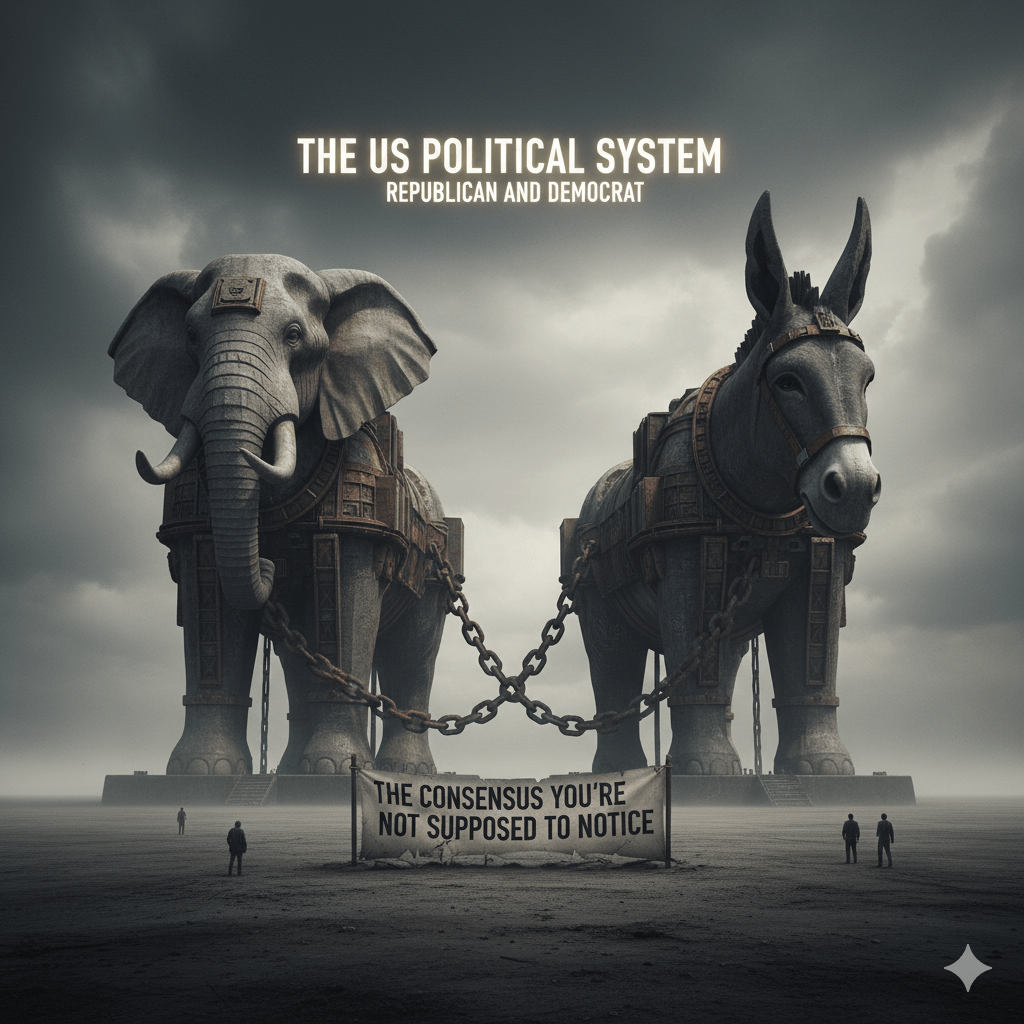
And here’s what should be obvious by now: both parties perpetuate every single one of these systems.
Both parties take money from health insurance companies and vote against universal healthcare. Both parties take money from defense contractors and vote for $968 billion military budgets. Both parties take money from private prison companies and vote for tough-on-crime policies. Both parties take money from real estate investors and maintain single-family zoning. Both parties allowed employer-based healthcare to become permanent, student debt to become inescapable, and housing to become unaffordable.
This isn’t conspiracy theory. It’s documented fact. The money trail is public. The voting records are public. The extraction is measurable, provable, and bipartisan.
But people don’t see it. Because the political system is designed to hide the wealth extraction behind manufactured division. The parties argue passionately about things that don’t affect extraction—culture war issues, identity politics, symbolic gestures—while quietly agreeing on the systems that actually transfer wealth.
Let’s examine exactly how this works.
What They Agree On vs. What They Fight About
The easiest way to see the con is to compare what both parties agree on with what they argue about.
What Both Parties Agree On (Quietly)
1. Military Spending
Every year, both parties vote to increase the military budget. 2024: House 310-118, Senate 87-13. Overwhelming bipartisan support for $968 billion. Both parties take money from defense contractors. Both parties spread contractor jobs across districts. Both parties vote yes.
2. Employer-Based Healthcare
Neither party seriously pushes for universal healthcare despite it working in every other developed country and costing less than our current system. Why? Both parties take money from health insurance companies. Insurance/pharma/hospital industries spent $1.2 billion lobbying from 2009-2020. That money went to both parties.
3. Mass Incarceration
Both parties built the mass incarceration system. Republicans pushed War on Drugs. Democrats passed the 1994 Crime Bill. Both take money from private prison companies ($10M+ lobbying 2008-2020) and prison guard unions ($22M from California CCPOA alone 2000-2020). Recent “reforms” are performative—they barely touch the 2.3 million incarcerated.
4. Student Debt System
Both parties maintain the system where student debt can’t be discharged in bankruptcy (law changed in 1976, maintained ever since). Both parties allowed tuition to skyrocket while cutting state funding for universities. Neither party seriously pushes for free public universities despite $70B/year being a rounding error compared to military spending.
5. Single-Family Zoning
This is mostly local government, but both parties at state and federal level decline to address artificial housing scarcity. Real estate industry donates $500M+ annually in lobbying to maintain favorable policies. Both parties take the money. Both parties protect existing homeowner wealth by maintaining scarcity.
6. Corporate Tax Rates
Corporate tax rate: 52% in 1952, 35% in 2016, 21% since 2017 (Trump tax cuts). Democrats complained but didn’t reverse it when they had House, Senate, and Presidency in 2021-2022. Why? Both parties take corporate money. The effective tax rate (what corporations actually pay after loopholes) is even lower—many profitable corporations pay $0.
7. Financial Deregulation
Glass-Steagall (law separating commercial and investment banking) was repealed in 1999 under Clinton. Bush-era deregulation continued. Obama’s Dodd-Frank partially addressed 2008 financial crisis but left Wall Street basically intact. Trump rolled back Dodd-Frank provisions. Both parties take money from financial industry. Neither seriously regulates Wall Street.
8. Campaign Finance
Both parties oppose changing the system that allows unlimited money in politics. Citizens United (2010) allowed unlimited corporate spending on elections. Democrats complain about it but don’t push for constitutional amendment to overturn it when they have power. Why? Both parties benefit from corporate money.
What They Fight About (Loudly)
Meanwhile, the parties engage in loud, passionate fights about:
• Abortion • Guns • Immigration • Trans rights • Critical race theory in schools • Which bathrooms people use • Whether to say “Merry Christmas” or “Happy Holidays” • Dr. Seuss books • Mr. Potato Head • Which statues to keep or remove • Whether kneeling during the anthem is disrespectful
These aren’t unimportant issues—they matter to real people. But notice: none of them affect the extraction systems. You can have any opinion on abortion, guns, or immigration and still be trapped by employer-based healthcare, crushed by student debt, priced out of housing, and watching $968 billion flow to defense contractors.
The loud fights are designed to distract from the quiet consensus. While you’re arguing with your uncle about whether Trump or Biden is worse, both parties are voting to increase the military budget, taking money from insurance companies, and maintaining every extractive system we’ve covered.
The Pattern
Issues that affect extraction = quiet bipartisan consensus
Issues that don’t affect extraction = loud partisan warfare
This isn’t an accident. It’s the design.
The Money: Where It Comes From and Where It Goes
Both parties take money from the same industries. This is public information. OpenSecrets.org tracks all of it.
Top Industries Donating to Both Parties (2020-2024 cycle)
Finance/Insurance/Real Estate: $2.4 billion
• Split roughly evenly between parties • Banks, hedge funds, private equity, insurance companies, real estate firms • Top recipients: members of Financial Services Committee, Banking Committee
Health Sector: $1.0 billion
• Slight Republican lean, but both parties receive hundreds of millions • Insurance companies, pharmaceutical companies, hospitals • Top recipients: members of committees overseeing healthcare policy
Defense/Aerospace: $155+ million in lobbying alone
• Campaign contributions roughly 50-50 split • Lockheed Martin, Raytheon, Northrop Grumman, Boeing, General Dynamics • Top recipients: Armed Services Committee members, Defense Appropriations Subcommittee
Energy/Natural Resources: $481 million
• Heavy Republican lean, but Democrats take plenty • Oil, gas, coal, utilities • Both parties block aggressive climate action that would hurt these industries
Agribusiness: $207 million
• Split between parties • Large agricultural corporations, food processors • Both parties vote for massive agricultural subsidies
What This Money Buys
Campaign contributions and lobbying buy access and influence:
• Direct meetings with members of Congress and their staff • Input on legislation before it’s written • Amendments to bills that benefit the donor industry • Votes against regulations that would hurt profits • Votes for subsidies, tax breaks, and favorable policies
Example: The Affordable Care Act (Obamacare)
• Single-payer was never seriously considered despite being cheaper and more effective • Public option was killed by moderate Democrats who took insurance money • What passed: a system that requires buying insurance from private companies • Insurance stocks soared after ACA passed • Insurance companies wrote large portions of the actual legislation
The insurance industry got exactly what it wanted: 40 million new customers required to buy their product, with subsidies to help them pay. This wasn’t reform—it was a corporate giveaway disguised as helping people.
The Revolving Door
Money isn’t just campaign contributions. It’s also future employment:
• Former members of Congress become lobbyists: 50% of retiring Senators, 42% of retiring Representatives • Average salary for former Senator as lobbyist: $1M+/year • Former congressional staffers work for industries they used to regulate • Former regulators work for companies they used to oversee
Examples:
• Former Senate Majority Leader Tom Daschle: healthcare lobbyist after leaving office • Former House Speaker John Boehner: tobacco and cannabis industry • Hundreds of former defense officials work for defense contractors • Former pharmaceutical industry executives staff FDA and HHS, then return to industry
The message is clear: be friendly to these industries while in office, get a lucrative job after you leave. Be hostile to them, get primaried by a candidate they fund.
How the System Maintains Itself
The political system has multiple mechanisms to prevent change:
1. Primary Challenges
Want to vote against the military budget? Defense contractors will fund your primary opponent. Want to push for single-payer? Insurance companies will fund your primary opponent. Want to regulate Wall Street? Financial industry will fund your primary opponent.
Progressive Democrats who challenge corporate interests face well-funded primary challengers backed by corporate money. Republicans who question military spending or corporate subsidies get primaried by “more conservative” candidates funded by those industries.
The threat doesn’t have to be carried out. The threat existing is enough to keep most members in line.
2. Committee Assignments
Leadership controls committee assignments. Want to be on Armed Services Committee (where defense policy is made)? Better be pro-military spending. Want to be on Financial Services? Better be friendly to banks. Want to be on Energy and Commerce? Better not push for aggressive environmental regulation.
Members who buck leadership and corporate interests don’t get powerful committee positions. They don’t get campaign funding from party leadership. They don’t get support.
3. Leadership Positions
Party leadership positions go to members who fundraise best. Who raises the most money? Members most friendly to corporate donors. Nancy Pelosi was famous for raising hundreds of millions from corporate interests. Mitch McConnell the same.
This ensures leadership is beholden to corporate interests. And leadership controls what bills get votes, what amendments are allowed, what policies are prioritized.
4. The Filibuster and Procedural Roadblocks
The Senate filibuster requires 60 votes to pass most legislation. This means even if one party controls Senate, House, and Presidency, they need 60 Senate votes—which they almost never have.
This provides perfect cover: “We’d love to pass universal healthcare / cut military spending / regulate Wall Street, but we don’t have 60 votes.” True. But also convenient—because it means neither party has to actually deliver on promises that would hurt corporate interests.
Notice what passes without filibuster challenges: military budgets. Corporate tax cuts. Industry-friendly policies. The filibuster gets used to block policies that would hurt extraction, rarely to block policies that benefit it.
5. Rotating Villains
When one party controls government, there are always a few members who conveniently vote against their party’s stated priorities—giving cover to the rest.
2021-2022: Democrats controlled House, Senate (barely), and Presidency. Did they pass universal healthcare? No. Did they cut military spending? No. Did they pass major financial regulation? No.
Why? Joe Manchin and Kyrsten Sinema—two moderate Democrats—blocked progressive policies. This allowed the other 48 Democrats to say “we tried” without actually having to vote against corporate interests.
The rotating villain serves a function: it protects the majority of the party from having to vote against donors while maintaining the illusion that they support reform.
Republicans do the same thing. When they had total control 2017-2018, they failed to repeal Obamacare. Why? John McCain and a couple others voted no. This protected the rest of the party from voting for something that would hurt millions of constituents while allowing them to claim they tried.
“Both Sides” Arguments and Why They Miss the Point
When you point out that both parties maintain extractive systems, people often respond with:
“But the parties ARE different!”
Yes. They are. Democrats are better on social issues, environmental policy, voting rights, LGBTQ rights, abortion access. Republicans are worse on all of these. This matters.
But on the extraction systems—healthcare, military spending, financial regulation, corporate taxes, campaign finance—both parties are aligned with corporate interests. Different rhetoric, same voting record on extraction.
You can care about abortion rights AND recognize that both parties take healthcare industry money and oppose universal healthcare. You can care about gun control AND recognize that both parties vote for $968 billion military budgets while troops are on food stamps.
The differences are real. They’re also used to obscure the similarities on issues that affect extraction.
“You’re saying don’t vote!”
No. Vote. Absolutely vote. One party is worse on social issues. Elections have consequences for real people.
But recognize that voting isn’t enough when both parties maintain extraction. You also need to:
• Support primary challengers who refuse corporate money • Demand campaign finance reform • Support candidates who explicitly commit to policies that would reduce extraction • Organize outside the electoral system • Build power independent of both parties
Voting for the lesser evil is rational. Just don’t confuse it with actually fixing the systems that extract from the bottom 90%.
“This is cynical / nihilistic”
No. It’s accurate. The data on campaign contributions is public. The voting records are public. The extraction is measurable.
What’s actually cynical is pretending the system works when it demonstrably doesn’t. What’s nihilistic is telling people to just vote harder when both parties take money from the industries extracting wealth.
Recognizing the problem is the first step to fixing it. And the problem is: both parties are captured by corporate money, and until that changes, the extraction continues regardless of who wins elections.
Why Reform Is So Difficult
The system is designed to be nearly impossible to reform from within:
1. The People Who Benefit From the System Control the System
Congress controls campaign finance laws. Congress takes corporate money. Why would Congress vote to end the system that funds their campaigns?
Congress controls healthcare policy. Congress takes insurance company money. Why would Congress vote for universal healthcare that would eliminate that money?
Congress controls military spending. Congress takes defense contractor money. Why would Congress vote to cut the budget and lose those contributions?
The people who would need to reform the system are the same people benefiting from it staying broken.
2. The Media Is Corporate-Owned
Six corporations control 90% of U.S. media:
• Comcast (NBCUniversal, MSNBC, CNBC) • Disney (ABC, ESPN) • Warner Bros. Discovery (CNN, HBO, Discovery) • Paramount Global (CBS, MTV, Nickelodeon) • Fox Corporation (Fox News, Fox Broadcasting) • News Corp (Wall Street Journal, New York Post)
These corporations benefit from the current system. They’re not going to seriously report on corporate capture of government or campaign finance corruption. They’ll report on culture war issues all day long—those are safe and drive engagement. But structural critique of the system that enriches them? Rare.
Plus, corporate advertisers fund media. Pharmaceutical companies spend $6+ billion annually on advertising. Defense contractors advertise. Insurance companies advertise. Media that seriously challenged these industries would lose advertising revenue.
The result: media focuses on partisan conflict and ignores bipartisan corruption.
3. Alternatives Get Marginalized
Candidates who refuse corporate money and challenge extraction systems get labeled “radical,” “socialist,” “unrealistic,” or “unelectable.”
Bernie Sanders proposed policies—universal healthcare, free public universities, breaking up big banks—that are standard in other developed countries. Yet he was treated as a dangerous radical by media and party establishments. Why? Because his policies threatened corporate interests.
The same thing happens at all levels. Progressive challengers get less media coverage, less party support, less funding. The system protects itself by marginalizing alternatives.
4. Supreme Court Protects Corporate Power
Citizens United (2010) ruled that corporate spending on elections is protected free speech. This opened the floodgates to unlimited corporate money in politics.
To overturn Citizens United would require either: (1) A constitutional amendment (requires 2/3 of Congress and 3/4 of states—impossible when both parties benefit from corporate money), or (2) A new Supreme Court willing to overturn it (current Court is 6-3 conservative and pro-corporate).
The Court has become another mechanism protecting extraction. When policies that would help the bottom 90% get challenged, the Court often sides with corporate interests.
What Actually Changes Things
If reform from within is nearly impossible, what does create change?
1. Mass Movements
Every major progressive change in U.S. history came from mass movements that forced political change:
• Labor rights: Union organizing, strikes, mass protests (1880s-1930s) • Women’s suffrage: Decades of organizing and protest (1848-1920) • Civil Rights: Mass movement, civil disobedience, economic pressure (1950s-1960s) • End of Vietnam War: Mass anti-war movement • LGBTQ rights: Decades of organizing, Stonewall, AIDS activism, coalition building
None of these were achieved by voting or asking nicely. They required sustained organizing, disruption, economic pressure, and forcing politicians to respond to mass movements.
2. Primary Challenges From Outside the System
The Squad (AOC, Rashida Tlaib, Ilhan Omar, others) won by primarying corporate-backed Democrats. They refuse corporate money. They push policies that would reduce extraction.
They’re a minority in Congress, but they’ve shifted the conversation. Universal healthcare is now discussed. Corporate power is questioned. Student debt forgiveness became policy (though limited and challenged).
More candidates like this—funded by small donors, refusing corporate money, explicitly challenging extraction—could shift the system. But it requires building infrastructure to support them against corporate-backed opposition.
3. State and Local Action
Federal government is deeply captured. But state and local governments can implement policies that work around federal gridlock:
• Several states have ended single-family zoning (Oregon, California in some cities) • Some states have implemented paid family leave, higher minimum wages • Local governments can refuse to cooperate with federal agencies on issues like immigration enforcement • State-level campaign finance reform (though limited by federal law)
It’s not a complete solution, but it’s something.
4. Economic Pressure
The civil rights movement combined protests with economic boycotts. The labor movement combined organizing with strikes. When corporate profits are threatened, corporations pressure politicians to respond.
This requires coordination and sacrifice. But it works.
5. Building Alternatives
Sometimes change comes from building alternatives that make the existing system obsolete:
• Mutual aid networks • Community land trusts for housing • Worker cooperatives • Credit unions instead of banks • Community healthcare clinics
These don’t replace systemic change, but they build power and demonstrate alternatives are possible.
The International Comparison: How Other Countries Limit Corruption
Other democracies have campaign finance systems that limit corporate influence:
Germany
• Strict limits on campaign contributions • Public financing for parties based on votes received • Caps on campaign spending • Short campaign periods (officially 6 weeks, though unofficial campaigning happens longer) • Result: Campaigns cost millions, not billions
UK
• Spending limits on campaigns • Short campaign period (6 weeks) • Free broadcast time for parties • Strict disclosure requirements • Ban on TV advertising (parties get free broadcast slots instead) • Result: 2019 general election, all parties combined spent ~£50M ($63M USD)
Compare: U.S. 2020 election cost $14 billion. 220x more than UK.
Canada
• Individual contribution limits: CAD $1,725/year • Corporate and union contributions banned since 2004 • Public financing for parties • Spending limits on campaigns • Result: 2021 election cost ~CAD $500M total ($370M USD)
U.S. 2020: $14 billion. 38x more than Canada despite having 9x the population (should be only 9x if spending per capita were equal).
The Pattern
Countries that limit campaign spending, ban corporate contributions, and provide public financing have less corporate capture. Their healthcare systems are better and cheaper. Their education is more affordable. Their infrastructure is maintained. Their governments actually pass policies that benefit the majority.
The U.S. has unlimited corporate money in politics. And we have the worst healthcare outcomes, the most expensive education, crumbling infrastructure, and a government that consistently votes against the interests of the bottom 90%.
This isn’t a coincidence.
Conclusion: The System Working as Designed
The U.S. political system isn’t broken. It’s working exactly as designed—just not for the bottom 90%.
Both parties take money from healthcare, defense, prison, pharmaceutical, insurance, financial, and real estate industries. Both parties vote to protect those industries’ profits. Both parties oppose reforms that would reduce extraction.
Meanwhile, they fight loudly about culture war issues that don’t affect extraction—keeping us divided and distracted while the wealth transfer continues.
Every system we’ve covered—healthcare, housing, education, prisons, military—is maintained by bipartisan consensus. Democrats complain about the problems. Republicans offer different complaints. But when it comes time to vote on whether to maintain the extractive systems, both parties vote yes.
The differences between the parties are real and matter to real people. But on the fundamental question of extraction—whether the bottom 90% should continue subsidizing the top 10%—both parties are aligned.
This is what corporate capture looks like. Not a conspiracy. Just a system where the people making the rules are funded by the people who benefit from those rules.
Recognizing this doesn’t mean don’t vote. It means: vote, but also organize outside the electoral system. Build movements. Support candidates who refuse corporate money. Create economic pressure. Build alternatives. Because voting for the lesser evil might slow the extraction, but it won’t stop it.
Every other developed democracy has figured out how to limit corporate influence on politics. We haven’t—because the people who would need to implement those limits are the same people benefiting from not having them.
The system is designed to extract wealth from the bottom 90% and transfer it to the top 10%. And the political system is designed to make changing that nearly impossible while maintaining the illusion of choice.
Healthcare, housing, education, prisons, military spending—all of it is extraction. All of it is bipartisan. All of it is by design.
The question isn’t whether the system is rigged. The data proves it is. The question is: what do we do about it?
And the answer starts with recognizing that as long as both parties are funded by the industries extracting wealth, voting alone won’t fix it. We need fundamental campaign finance reform, mass movements, and building power outside the two-party system.
Because the wealth extraction will continue until we force it to stop.
 Even that's Odd
Leave a comment