
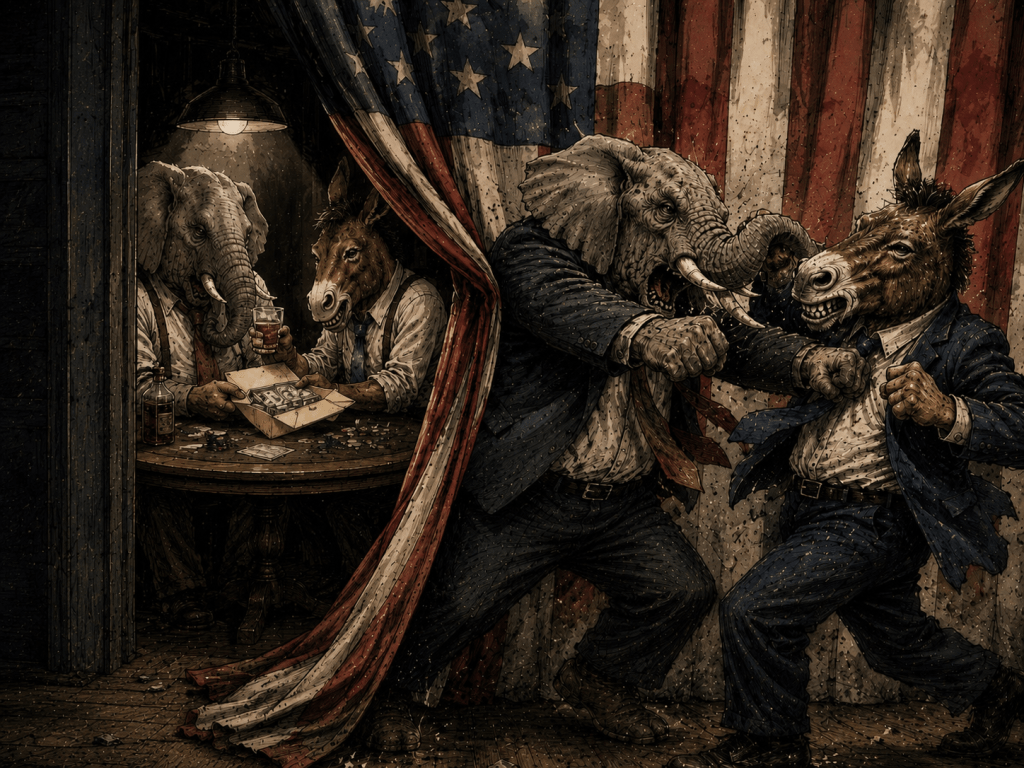
Watch the floor of either chamber on a December afternoon when the National Defense Authorization Act comes up for a vote. The bill is 1,800 pages long and nobody has read all of it. The members who will speak against it are mostly junior, mostly from safe districts, and mostly not on Armed Services. The members who will speak for it are senior, on the relevant committees, and represent districts where one of the prime contractors has a plant or a supplier or a sub-supplier with a logo on a hard hat. The floor speeches use different vocabularies. The vote is 85 to 14 in the Senate. Whatever else they fought about that year, this comes through.
Walk down the hall to where Medicare for All is sitting in committee, again, where it has been sitting for years. The bill has co-sponsors. It has polling. It has cost projections from people who do this work for a living and a comparative literature of about thirty other countries that have already done some version of it. It does not have a vote. It will not get a vote. The committee chair, of whichever party, takes money from the same insurance companies and the same hospital systems and the same pharmaceutical manufacturers as the ranking member. The floor speeches, if there ever were any, would use different vocabularies. The bill would not move.
Those two scenes are the same scene. They describe one Congress.
This is the same argument as the last seven posts. The lock just got political.
Where The Fight Is And Isn’t
The cable news version of American politics is two parties locked in existential combat over the future of the country. The C-SPAN version is something else. There are categories of bill where the parties fight bitterly — abortion access, immigration enforcement, voting rules, judicial confirmations, gun regulation. The fights are real. The vote margins are narrow. The rhetoric is genuine. Real people are affected, sometimes catastrophically, by which side wins.
There are also categories of bill where they don’t. The annual defense authorization passes the House by margins like 281 to 140 and the Senate by 85 to 14. The most recent farm bill cleared with roughly two-thirds in both chambers and the largest agribusiness lobbies got most of what they asked for. The 2018 Economic Growth, Regulatory Relief, and Consumer Protection Act — which rolled back portions of Dodd-Frank for mid-sized banks — cleared the Senate 67 to 31, with sixteen Democrats joining every Republican present. The 2017 Tax Cuts and Jobs Act passed on a partisan vote, but the corporate rate cut from 35 to 21 percent has not been reversed in the eight years since, including the two years one party held the House, the Senate, and the presidency.
Before any of the rest of this lands, the obvious thing has to be said clearly, because the argument doesn’t work without it. The two parties are not the same and the difference matters. Which party holds the White House determines whether the Justice Department prosecutes voting-rights cases or abandons them, whether the EPA enforces clean-air rules or guts them, whether federal judges who treat Roe as settled law get confirmed or blocked, whether trans kids get protected or targeted, whether the National Labor Relations Board sides with workers trying to organize or with the companies trying to stop them. Which party holds the Senate determines what kind of judge sits on every federal bench for the next thirty years. Elections have consequences and the consequences land on real people. Anyone telling you it doesn’t matter who wins is either selling something or trying to get you to stay home, and historically the people who benefit when you stay home are not the people on your side.
And: on the specific category of question this series has been tracking — the structural extraction from the bottom 90 percent — the votes line up more often than they don’t. The parties differ on what they would do with the power they win. They agree, quietly and consistently, on the structural rules that determine who gets to fund the path to winning it. The first difference is why you vote. The second is why voting alone has not been enough.
The pattern, once you start looking for it, holds across most of the industries this series has covered. Where the bill threatens donor revenue, there is bipartisan consensus to leave it alone or to pass something that looks like reform without functioning as it. Where the bill doesn’t, there’s a fight. The fight is mostly real. The consensus is mostly invisible.
Who Pays For The Campaign
The 2024 federal election cycle cost about $15.9 billion across all races, according to OpenSecrets, which has tracked this number for thirty years and is the source most reporters actually use. The previous cycle cost about $14.4 billion. The cycle before that, $7.1 billion. The line goes up. It has gone up every cycle since the Supreme Court decided Citizens United v. FEC in 2010, which struck down the ban on independent political expenditures by corporations and unions and made the super PAC, in its current form, a usable instrument.
The money does not come from voters. Roughly half of all federal campaign money in the 2024 cycle came from donors who gave $10,000 or more, a group that represents a vanishingly small percentage of the adult population. The single largest individual donor of the cycle, Elon Musk, contributed somewhere north of $290 million through America PAC and related vehicles. The next several largest individual donors each cleared $50 million. By comparison, the median household income in the United States is about $80,000.
The industries giving the money are the industries this series has been covering. Finance, insurance, and real estate — the sector OpenSecrets tracks as FIRE — gave more than $2.3 billion across the 2024 cycle, split roughly evenly between the parties at the top of the ticket and weighted toward whichever party held the relevant committee gavel further down. Health insurers, hospital systems, and pharmaceutical manufacturers gave more than $900 million combined. Defense contractors gave less in raw dollars — about $40 million in direct contributions — because they don’t have to. Their leverage is the supply chain, not the check. Energy gave about $220 million, weighted Republican but with a solid Democratic floor. Agribusiness gave about $180 million.
None of this is hidden. The disclosures are public. The aggregations are done by nonprofits and by journalists, and the numbers have been reported in every cycle for as long as the disclosures have existed. The reason it doesn’t feel like common knowledge is that the press treats individual scandals as news and treats the underlying system as weather. A specific senator taking a specific check from a specific lobbyist on the eve of a specific vote is a story. The system in which every senator takes checks from the industries they regulate is not.
The Mechanisms That Hold It Together
Money is the input. The output requires machinery, and the machinery is older than any of the current donors. Three pieces of it are worth understanding, because together they explain why elections that look competitive in the aggregate keep producing a Congress that looks captured in the specific.
The first piece is the primary. A House member from a safe district — and most House districts are safe, by design, after a generation of partisan and incumbent-protecting redistricting — faces a meaningful threat exactly once every two years, and it isn’t the general election. It’s the primary. Primaries draw small electorates, often in the low single digits as a percentage of registered voters, and small electorates are cheap to influence with concentrated money. A challenger funded by industry can credibly threaten an incumbent who votes the wrong way on the wrong bill, and the incumbent knows it before the threat is ever made. The threat doesn’t have to be carried out to do its work. Most of the time the vote moves and the challenge never materializes. That is the system functioning, not failing.
The second piece is the committee. Legislative power in Congress is not distributed evenly across the membership. It is concentrated in the chairs and ranking members of the committees that touch the most money, and committee assignments are controlled by party leadership. Leadership distributes assignments based on a mix of seniority, regional balance, and fundraising. Members who raise large sums for the party’s campaign committee tend to get the better assignments. Members who don’t, don’t. This is not a secret — it is how the leadership of both parties has openly described the process for decades. The members who end up on Financial Services, Energy and Commerce, Ways and Means, and Armed Services are the members who are good at raising money from the industries those committees oversee. The relationship is not coincidental.
The third piece is the door. Members of Congress who leave office, voluntarily or otherwise, do not go back to whatever they were doing before. They take seats on corporate boards, they join law and lobbying firms, they run trade associations, they teach a class one day a week at a policy school and consult the other four. The Center for Responsive Politics has tracked this for years; in the most recent fully analyzed window, more than half of departing senators and a comparable share of departing House members registered as lobbyists or took industry roles within two years of leaving. The compensation is not comparable to congressional pay. The expectation, on the way out, is the floor of the next career. The expectation, while still in office, is that the floor will be there if the votes were right.
Senior congressional staff make the same trip on shorter timelines and at lower salaries that are still many multiples of what they made on the Hill. Senior regulators do it from the executive branch side, joining the firms they used to regulate. Former enforcement attorneys from the SEC, the CFTC, the FTC, the FDA — the agencies built explicitly to constrain industry behavior — move to defense-side firms representing the companies they used to prosecute. The cooling-off periods between roles are measured in months. The careers they enable are measured in decades.
The Procedural Cover
Voters can be forgiven for thinking that when one party holds the House, the Senate, and the White House, that party can pass the things it has campaigned on. The civic textbook version says so. The actual procedural reality of the modern Senate, with the filibuster effectively in place on most legislation, says something else. Sixty votes are required to bring most bills to the floor. Sixty votes have been held by one party in the Senate for approximately five months out of the last fifty years.
The filibuster is not in the Constitution. It is a Senate rule, and Senate rules can be changed by majority vote, as they have been changed several times in the modern era — for judicial nominees in 2013, for Supreme Court nominees in 2017. Changing them to allow a simple majority to pass legislation requires only that the majority decide to do so. Neither party has, when they had the majority. The reasons given are always procedural. The effect is structural.
The structural effect is that any policy that would damage donor revenue can be defeated by a determined minority, and that the majority party can credibly tell its voters that it tried. Both halves of that sentence are useful to incumbents. The first half kills the bill. The second half keeps the seat. Within the same caucus, the two or three members willing to vote against their party’s stated priority — the rotating cast that hands the leadership a fig leaf at the cost of a few hostile news cycles for themselves — tend to be members from purple states whose own donor networks are conveniently aligned with the position they’re taking. The leadership is not always unhappy when the bill fails. It depends on who the donors are and what they wanted.
What’s Real
A few honest qualifications, because the strongest version of this argument is the one that doesn’t pretend the counter-arguments aren’t there.
Most members of Congress are not, in any meaningful sense, corrupt. The volume of legal-but-distorting money in the system is so large that explicit bribery would be redundant, and the people who reach Congress in the first place have mostly internalized the incentive structure long before they get there. They don’t need to be told to vote with the donors. The donors funded the campaign that won them the seat, the campaign that wins them the next one is already being funded, and the structural fact of where the money comes from shapes which positions feel reasonable, which compromises feel necessary, and which questions feel out of scope. Calling that corruption obscures more than it clarifies. It is something worse than corruption. It is the system functioning as designed.
None of this is a “both sides are the same” argument, and the people who try to use it that way are doing the donor class’s work for free. The Republican Party has, over the last decade, become substantially more hostile to democratic norms, voting rights, and the basic mechanics of free and fair elections than the Democratic Party. That asymmetry is documented, it is widening, and it has consequences that fall on real people. The parties differ, often sharply, on what they would do with the power they win. They agree, quietly and consistently, on the structural rules that determine who gets to fund the path to winning it. Those are two different statements about two different questions. Both are true. Treating either one as the whole picture is how the system stays in place.
And: the fixes below will sound like the kind of thing that gets dismissed by people who know how Washington actually works. That dismissal is part of the system. The fixes are not unworkable. They are precisely the fixes that the people who profit from the current arrangement have spent decades making sound unworkable.
What They’re Paying For
Part 11 ended on the observation that the product being purchased by nearly a trillion dollars in annual military spending isn’t, primarily, defense — it is a permanent industrial subsidy, a system of political patronage, and a global posture, stacked together under a single label that describes none of them accurately. The political system itself is the version of that argument that explains why the contents and the label never get reconciled.
What roughly $16 billion in election spending and several billion more in annual lobbying is purchasing is not, primarily, representation. The country was already nominally a representative democracy at a much smaller price. The purchase is four things stacked together.
It is a primary-election filter that screens out candidates whose policy positions would threaten concentrated donor revenue, before those candidates ever appear on a general-election ballot. The general election is the part the cameras cover. The primary is the part that matters.
It is a committee structure that places the members most attentive to industry interests in the chairs of the committees that regulate those industries, and a leadership selection process that rewards the same skill set at the top of each caucus. The hearings happen. The bills get marked up. The amendments that would matter get tabled.
It is a revolving door that converts a decade of public service into a multi-decade private-sector annuity, and that does so on terms transparent enough to every sitting member of Congress that the floor never has to be discussed. It is the floor. Everyone knows.
And it is a set of procedural rules — the filibuster chief among them — that give the leadership of both parties plausible deniability when the bills the donors don’t want never come to the floor. The deniability is the deliverable. The legislation that would actually change the underlying systems doesn’t fail. It never gets voted on.
The two parties fight, often genuinely, in the space that remains after those four mechanisms have done their work. That space is large enough to fill a 24-hour news cycle, every day, for years. It is not large enough to contain a Medicare for All bill, a defense budget cut in half, an antitrust action against the four meatpackers, a serious carbon tax, a public option in housing, a wealth tax, or any other policy that would touch the parts of the economy where the donor money actually lives.
The Fixes Are Boring
None of what follows is radical. Most of it is what comparable democracies already do. The reason these fixes sound impossible in the American context is that the people who profit from the current arrangement have spent decades making them sound impossible, not because they are untested or unworkable. They are the most-tested and most-workable answers to the political-finance question that the comparative literature contains.
- Public financing of federal campaigns. Full public financing, not matching funds, not voluntary opt-in programs that the well-funded candidates ignore. Allocate a fixed amount per qualified candidate, prohibit supplementary fundraising during the campaign period, and cap independent expenditures. Several US states run versions of this for state-level races and the sky has failed to fall. Canada, the UK, Germany, France, and most of the rest of the OECD run versions of it at the national level. The “free speech” objection is the objection the people receiving the current money would obviously make and the Supreme Court has obviously sided with. It is wrong on the merits and the comparative evidence is overwhelming.
- Constitutional amendment to overturn Citizens United. Not a workaround. Not disclosure-only reform that leaves the underlying spending intact. An amendment establishing that money is not speech and that corporations are not persons for purposes of campaign finance regulation. Twenty-two states have already passed resolutions calling for one. The bar is high — two-thirds of Congress and three-quarters of the states — and that is the bar precisely because the framers wanted constitutional changes to be hard. It has been cleared twenty-seven times. This would make twenty-eight.
- Ban corporate political contributions entirely. Not “limit.” Not “disclose.” Ban. Canada did it in 2004 and Canadian politics has not collapsed; if anything, the corruption problems Canadians now complain about are smaller in dollar terms than the corruption problems Americans accept as normal. Corporations are legal fictions created by states to enable commerce. They are not constituents. They do not vote. They have no business funding the elections of the officials who write the laws governing their behavior.
- Abolish the filibuster. Restore majority rule in the Senate for legislation, as it already operates for executive and judicial appointments. The filibuster is not a Constitutional protection of minority rights; it is a procedural artifact that has been used, in its modern form, primarily to kill bills that would have damaged donor revenue. Both parties have, in turn, called for ending it when in the majority and defended it when in the minority. The next majority that takes office should end it on day one and not relitigate the question.
- End partisan gerrymandering through independent redistricting commissions in every state. Several states have already adopted them, by ballot initiative where the legislature wouldn’t. Tie federal infrastructure and election-administration funding to compliance. The current system, in which the party that wins a state legislature in a census year draws the maps that elect the next decade’s congressional delegation, is a closed loop that protects incumbents in both parties. The closed loop is the part to break.
- Lifetime lobbying ban for former members of Congress and senior executive-branch officials. Not the current one-to-two-year cooling-off period, which has been a joke since the day it was enacted. Lifetime. You serve in Congress, you serve on a federal regulatory commission, you hold a confirmed executive-branch position above a specified pay grade — you don’t work for the industries you regulated, ever, in any capacity, for compensation. The objection that this would discourage good people from public service is the objection of people who define “good people” as “people who expected to monetize the role afterward.”
- Strict, low contribution limits indexed to inflation, with aggressive enforcement. The current Federal Election Commission is an underfunded, structurally deadlocked agency that has not meaningfully enforced campaign finance law in years. Fund it. Restructure its commission to break the partisan tie. Give it real penalties, real audit authority, and the political backing to use both. Cap individual contributions at a level that a median-income household could conceivably reach — not the current $3,300-per-candidate-per-election figure that effectively excludes 90 percent of voters from meaningful donor status — and enforce the cap against the bundling and pass-through structures that have made it functionally optional.
- A national popular vote for the presidency. The Electoral College is not load-bearing infrastructure. It is a compromise from a different country, structured around concerns that no longer apply, that distorts every modern presidential campaign by concentrating it in six or seven swing states whose voters get disproportionate attention and whose specific industries get disproportionate policy consideration. The National Popular Vote Interstate Compact has been adopted by states representing more than 200 electoral votes and takes effect when it crosses 270. Finish it.
Who Is This For
The next post is about the structural pieces of the constitutional system itself — the rules and offices the framers wrote, the gaps they didn’t anticipate, and the parts of the machinery that have stopped doing what they were designed to do. Different layer. Same question. The two parties on the floor of the chamber that December afternoon are not the answer. The bill they’re voting on is. The names on the disclosure form are the names of the people the system is actually for. The fight on television is real, and it is worth winning, and winning it is not the same thing as breaking the lock.


Leave a Reply