
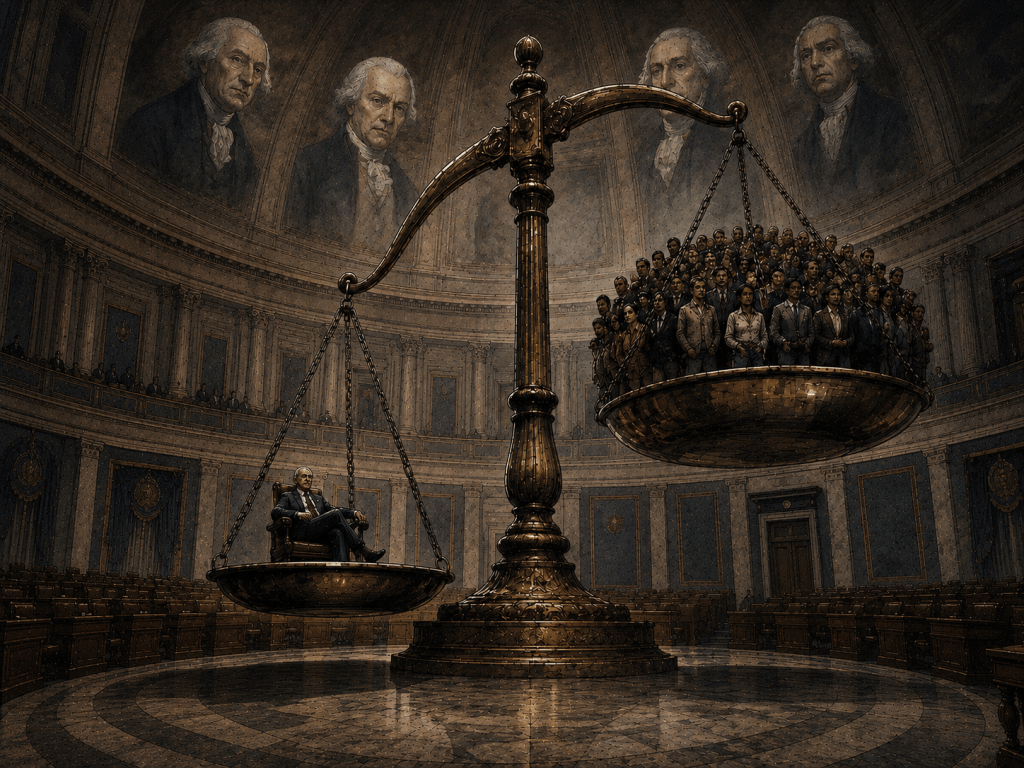
Two Yeas
A senator from Wyoming and a senator from California vote yes on the same bill. Roll call vote. Two yeas. The clerk records them as equivalent. Nobody on the floor notes the difference. Nobody is supposed to.
The Wyoming senator represents about 588,000 people — somewhere between the populations of Milwaukee and El Paso. The California senator represents about 39 million people — somewhere between the populations of Canada and Poland. By Senate representation per person, the Wyoming voter has roughly sixty-seven times the weight of the California voter. The ratio gets a little larger every census, because California keeps growing and Wyoming roughly doesn’t.
That ratio used to be smaller. At the constitutional convention in 1787, the largest state (Virginia) had about twelve times the population of the smallest (Delaware), and the framers fought for weeks about whether even that gap was tolerable. The Connecticut Compromise that produced the Senate was a deal between people who couldn’t agree on a single body, and the deal was supposed to balance equal-suffrage representation of states with proportional representation of people. More than two centuries later, the House still does most of what it was supposed to do. The Senate has drifted into something the convention did not propose, would have argued about for another six weeks if it had, and would in some plausible counterfactuals have rejected.
Three constitutional structures are the subject of this post. The Senate is one. The federal judiciary and the Electoral College are the other two. They have different histories and different mechanics. They share one thing: each was designed to do something specific that it has stopped doing, and the design never anticipated the country doing what it currently does.
This is the same argument as the last eight posts. The lock just got constitutional.
What The Design Was Supposed To Do
Two qualifications before the diagnosis, because the argument doesn’t work without either of them.
The framers were not infallible. They wrote the Three-Fifths Compromise into the Constitution, counting enslaved people as fractional persons for apportionment without granting them any of the rights of persons. They disenfranchised nearly everyone — women, the propertyless, the enslaved, the Indigenous. They built a Senate that gave equal voting weight to states with vastly different populations because they couldn’t get a deal otherwise, and then they tried to make it harder for later generations to change that arrangement than to change almost any other clause in the document. They were a specific group of 18th-century men solving 18th-century problems with the tools they had. The interesting question isn’t whether they were heroes or villains. The interesting question is which of their solutions still function and which don’t.
Second qualification. Pointing out that the Senate is malapportioned, that the Supreme Court has been captured by appointment-timing luck, and that the Electoral College has produced two presidents this century who lost the popular vote cannot be allowed to slide into “so it doesn’t matter who wins.” Within the broken rules, the rules still produce winners and losers, and the differences are not symmetric. The Republican Party currently benefits structurally from every failure this post is about — the Senate’s bias toward small rural states, the Court’s capture by Mitch McConnell’s procedural maneuvers in 2016 and 2020, the Electoral College’s overweighting of swing states the party has learned to target. The Republican Party also opposes nearly every structural reform listed at the end of this post. Those alignments are not coincidences. Within the existing rules, which party holds the White House determines whether the Justice Department defends voting rights, whether the EPA enforces clean-air rules, whether federal judges who treat Roe as settled law get confirmed, whether the NLRB sides with workers. Elections held under the broken rules still have consequences, and the consequences fall on real people. The critique that follows is about the rules. It is not an instruction to stay home.
With both of those on the table: this post is about three specific structural failures, plus the meta-failure that protects them. Each of the three was designed to do something. Each has stopped doing it. The fourth — Article V itself — has stopped working as a normal democratic tool, and that meta-failure is what keeps the other three locked in.
Three Structures That Stopped Working
The Senate first, because it is the headline. The Connecticut Compromise gave each state two senators on the assumption that no state would dwarf the others. That assumption no longer holds. By recent census figures, the 26 smallest states contain roughly 18 percent of the U.S. population and control 52 percent of the Senate. A simple majority of senators can be assembled from states representing less than a fifth of the country, on any vote that doesn’t trigger the filibuster, which is most votes that get a vote. The bias is no longer random. Small rural states cluster particular ways — demographically (whiter, less urban, older), economically (more reliant on agriculture, extraction, and federal transfers), politically (more reliably Republican over the last two cycles). The structural overweighting of those states isn’t a glitch the system happens to be producing. It is the original design operating exactly as written, on a country it was never written for.
The federal judiciary second. The Constitution says judges “shall hold their Offices during good Behaviour,” which has been interpreted since the founding as life tenure. The early Court took the framers at their apparent word about duration — the first generation of justices typically served around a decade, and several resigned to pursue other appointments. Today, with appointments made younger by both parties precisely because lifetime tenure rewards it, recent Supreme Court justices have served two to three decades, and several current justices are on pace to serve thirty-five years or more. A child born today will reach adulthood before some of the current Court reaches the average modern retirement age. Every other comparable democracy that has a constitutional or supreme court has term-limited it. Germany sets twelve-year terms. France sets nine. Italy sets nine. Japan imposes mandatory retirement at seventy. The United States is the outlier, and the reason isn’t constitutional inevitability. The Constitution says “good behaviour,” not “for life.” The reason is that the political class on both sides has discovered the lifetime appointment is the highest-leverage prize in American politics, and neither party has been willing to give up its potential winning lottery ticket.
The capture has a date stamp. In March 2016, Antonin Scalia died and Barack Obama nominated Merrick Garland to replace him. Senate Majority Leader Mitch McConnell refused to hold hearings. The nomination sat for 293 days, the longest any Supreme Court nomination has ever been left pending, and expired with the 114th Congress. The argument was that a Supreme Court vacancy in an election year ought to be filled by the next president. In September 2020, Ruth Bader Ginsburg died, six weeks before that year’s presidential election. The same Senate majority leader rushed Amy Coney Barrett’s confirmation through eight days before the election. The argument was that the Senate has the prerogative to act, or not, on the timing it chooses. Both arguments are defensible under the existing rules. The same person made both arguments four years apart, with opposite outcomes, and the cumulative effect was to deliver three of the current nine seats to the political coalition he led. The Court’s current composition is not a reflection of any deeper judgment about how Americans want to be governed. It is the product of two procedural decisions by one Senate majority leader, applied asymmetrically across two consecutive election cycles.
The Electoral College third. It was originally designed as a deliberative body, with electors meeting in their states to weigh candidates and exercise independent judgment. By the early 19th century, almost every state had adopted winner-take-all allocation of its electors, which is what the system has been for two hundred years and is not in the Constitution at all. The result is that presidential campaigns are no longer national. They are campaigns in six or seven swing states whose voters get most of the candidate attention, most of the policy attention, and most of the resources. The other forty-four states are written off by both parties as foregone conclusions; in those states, the campaign is mostly a fundraising operation for the swing-state campaigns. Two presidents this century — George W. Bush in 2000, Donald Trump in 2016 — took office having received fewer total votes than their opponent. In a system that calls itself a democracy, this should be a standing structural alarm. It isn’t, because the people with the authority to fix it are the people whose election the current system made possible.
The Lock On The Toolbox
None of those three failures gets fixed by ordinary politics, because the Constitution was deliberately written to be hard to amend, and the bar has been raised by the country’s geography to a level the framers did not anticipate.
Article V offers two paths to amendment. Either two-thirds of both houses of Congress propose an amendment, or two-thirds of state legislatures call for a constitutional convention. Either path then requires ratification by three-quarters of the states — today, thirty-eight. In a fifty-state country with the current partisan geography, thirteen states can block any amendment, and the thirteen smallest states by population together contain roughly 4 percent of the country. Almost any meaningful structural reform — abolishing the Electoral College, term-limiting the Court, restoring proportional representation in the House — collides with that ratification math the moment it is taken seriously by anyone with the standing to advance it.
And one provision is locked harder than the rest. Article V contains a single explicit exception to its own amendment process: “no State, without its Consent, shall be deprived of its equal Suffrage in the Senate.” Every other clause in the Constitution can be amended by the normal supermajority process. The Senate’s malapportionment cannot. The only way to change it is to get the consent of the small states whose advantage would be diluted, which on any clear-eyed assessment is not going to happen voluntarily.
This is the meta-trap. The structural failures of the Senate, the Court, and the Electoral College are protected by an amendment process that the same structural failures help control. The country cannot reform the rules through the rules. The civics-textbook version says it can. The actual procedural math says it can’t.
What’s Real
A few honest qualifications, because the strongest version of the argument is the one that doesn’t pretend the counter-arguments aren’t there.
Federalism is not a bug. Giving subnational governments meaningful authority over local matters is, in general, a good idea, and the original case for the Senate — that small states needed some protection from being constantly overrun by large states in a federal legislature — was a real concern with real merit. The argument here isn’t that states should be abolished, or that subnational variation is bad. It is that giving equal Senate representation to a state of 588,000 and a state of 39 million does not protect small states from being overrun. It gives small states, in fact, more political power per voter than large states have, which is a different problem from the one the Senate was designed to solve.
Originalism, as a school of constitutional interpretation, makes a real point about the danger of judges substituting their own policy preferences for the text. The point gets weaker when the same school is applied flexibly to expand executive power, restrict reproductive rights, and protect commercial speech — results the original public meaning of the document does not obviously compel. Selective originalism is not originalism. The interesting question about the modern Court isn’t whether originalism is right or wrong as a theory. It’s whether the current Court is actually doing originalism, or doing politics in originalist vocabulary.
And: the danger of constitutional amendment in a polarized environment is real. The Constitution is harder to amend than most national constitutions for a reason, and a country that amended it on every passing electoral majority would be worse off, not better, than the country currently is. None of what follows is “amend the Constitution constantly.” It is “amend it to fix the specific structural failures that are now preventing it from functioning as a democratic instrument at all.” Those are two different positions, and the second one isn’t made unserious by the first.
What They’re Paying For
The structural arrangement that Article V, the Senate, the Court, and the Electoral College together produce is not a system of checks and balances functioning as designed. It is three things stacked together.
It is a permanent veto, vested in a numerical minority of the country, over any policy that would touch the structures themselves. The country cannot use the political system to fix the political system, because the part of the political system that would have to authorize the fix is structurally controlled by the minority that benefits from the current arrangement.
It is an extended-duration policy lock, vested in a nine-member court whose members serve into their 80s and whose appointments are determined by the lottery of which party happens to hold the Senate when which justice happens to die. The lock is durable across the elected branches in a way that no elected branch is.
And it is a presidency that is no longer reliably accountable to the population that elects it, because winning the presidency does not require winning a majority of the country, and recent presidents have demonstrated that the office can be held by candidates the majority specifically voted against.
The result is not what the framers intended. They intended a republic responsive to its citizens, constrained by separation of powers, capable of self-correction. The mechanism currently produces something narrower. A numerical minority can hold the Senate indefinitely. That minority can shape the Court for three decades by appointment timing. The Court can then shape the law for three decades after that. The presidency can be won without the popular vote. The amendment process that would fix any of this requires the consent of the same minority that benefits from it. The country has the institutional vocabulary of a representative democracy and the institutional mechanics of something more limited. The distance between the two is the structural failure.
The Fixes Are Boring
The fixes below sound impossible because the people who profit from the current arrangement have spent decades making them sound impossible. They are not impossible. They are, in most cases, what comparable democracies already do, and in several cases what a single act of Congress could accomplish next week. Roughly in order from cheapest to hardest:
- Repeal the Permanent Apportionment Act of 1929 and uncap the House. The 435-seat cap is statutory, not constitutional. A single act of Congress can replace it. Adopting the Wyoming Rule — smallest state gets one seat, every other state apportioned proportionally — would put the House at around 574 members, dilute the small-state advantage in the Electoral College at the same time (since electoral allocations follow House size), and improve constituent representation everywhere. The 1929 cap was the political compromise that ended a decade of rural-versus-urban deadlock after the 1920 census; the rural-leaning House couldn’t agree to a reapportionment that would have shifted seats toward growing cities, so it froze the chamber at the then-existing 435 instead. The decision was political, not architectural. It is the cheapest, fastest structural fix on this list and it touches all three of the diagnosed failures simultaneously.
- Statehood for the District of Columbia by simple act of Congress. DC has more people than Wyoming and more people than Vermont. Its residents pay federal taxes, serve in the military, and have no voting representation in the body that taxes them and sends them to war. The District of Columbia Admission Act has been introduced in every Congress since 2013 and passed the House in 2020 and 2021. The Senate has not voted on it. The constitutional path is contested but not blocked. Pass the act. The reason it hasn’t passed is partisan calculation about how the new senators would likely vote, not constitutional principle.
- Offer statehood to Puerto Rico, on Puerto Rico’s terms. The status question has to be decided by Puerto Ricans, not by Congress. Recent referenda have produced varying margins for statehood; the federal government should commit to honoring whatever clear majority Puerto Rico produces and admit accordingly. This is also a simple act of Congress. The same partisan calculation has blocked it. Same response: pass the act.
- Eighteen-year terms for Supreme Court justices, staggered so each presidential term produces two appointments. Real legal debate exists about whether this requires a constitutional amendment or whether it can be done by statute. The structure most reform proposals use is “active service” on the Supreme Court for eighteen years followed by senior status on a lower federal court, which arguably preserves “good behaviour” tenure while ending the perpetual seat. The honest answer is that the statute-only route would be litigated immediately and the Court would decide it. If the Court strikes it down, amendment. Either way, the destination is eighteen-year staggered terms. The current arrangement — thirty-five-year tenures decided by mortality timing and one senator’s procedural choices — is what a serious country does not have.
- Constitutional amendment to abolish the Electoral College and elect the president by national popular vote. Not the National Popular Vote Interstate Compact, which is a workaround that depends on the durability of state legislative commitments and would face a federal-supremacy challenge the moment it crosses 270 electoral votes. The actual answer is the actual fix: amend the Constitution to elect the president by majority of national votes cast, with a runoff if no candidate clears fifty percent. Hard to pass. Worth doing the hard thing rather than the workaround that won’t survive its own first test.
- The Senate question is the genuinely hard one, and there are three honest answers. Article V locks equal Senate suffrage in a way no other provision is locked: no state can be deprived of equal suffrage in the Senate without its consent. The first answer is to get the consent of the small states, which is not going to happen voluntarily. The second is to admit enough new states — DC, Puerto Rico, potentially others — to dilute the imbalance over time without ever amending the equal-suffrage clause. The third is to accept that this particular structural feature is locked and design around it: uncap the House, abolish the Electoral College, term-limit the Court, and make the Senate a less consequential body in the structure as a whole. Pick a path, or pick a combination. Don’t pretend the lock isn’t there.
None of those are radical. The Wyoming Rule was a serious proposal in the 19th century. Term-limited high courts are the global standard. Statehood by simple congressional act has happened thirty-seven times in American history. The amendment process is the framers’ own tool, and they expected it to be used; it has been cleared twenty-seven times already. The reason these fixes feel impossible is not that they are unworkable. It is that the political coalitions that benefit from the current arrangement have built a political culture in which proposing them sounds like a category error. It isn’t. It is the conversation the country is supposed to be able to have about itself.
Who Is This For
The next post is about the fight that fills the space the structural rules leave open. The structures determine which kinds of policies can pass and which kinds can’t. The fight determines what we argue about while the impossible policies don’t pass. Different layer. Same question. The fight on television is real, and it is loud, and it is engineered to be both. The question of which fights are available to have on television, and which never reach the floor at all, is older than any of the people currently fighting them.


Leave a Reply