
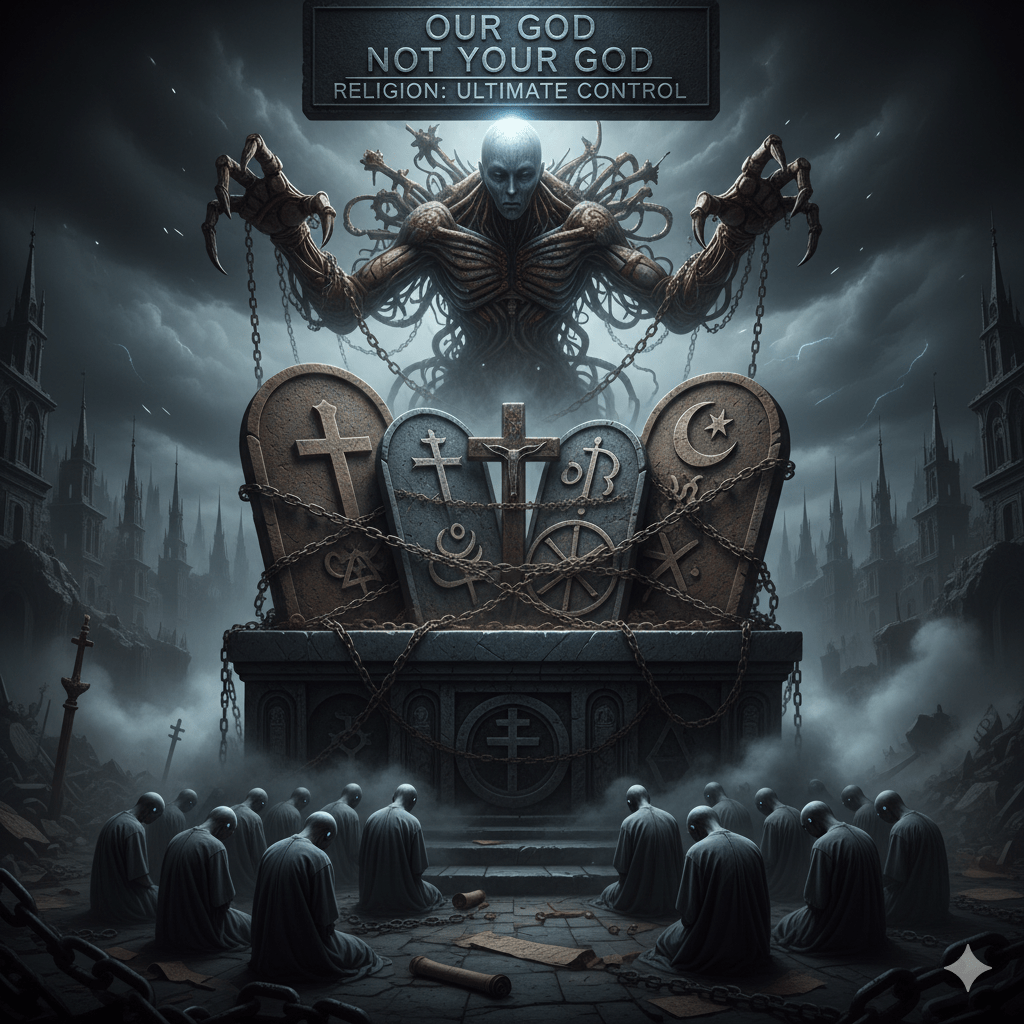
Religion as the Ultimate Control Mechanism
Let’s start with a question that makes people uncomfortable: Which god is the real one?
Christians say Jesus Christ is the son of God and the only path to salvation. Muslims say Muhammad is the final prophet and the Quran is God’s literal word. Jews say the Messiah hasn’t come yet. Hindus worship multiple manifestations of the divine. Buddhists don’t focus on gods at all. Mormons say an angel gave Joseph Smith golden plates in upstate New York in 1823. Scientologists say we’re inhabited by the souls of aliens killed by an intergalactic warlord 75 million years ago.
They can’t all be right. But here’s what’s interesting: believers in each of these religions are absolutely certain THEY have the truth. Not pretty sure. Not probably right. Absolutely certain. Willing to die for it. Willing to kill for it.
And here’s the really interesting part: which god you believe in is almost entirely determined by where you were born. Born in Saudi Arabia? You’re probably Muslim. Born in Utah? Probably Mormon. Born in India? Probably Hindu. Born in Mississippi? Probably Baptist. Born in Italy? Probably Catholic.
So either God deliberately arranged for people to be born in places where they’d learn the “correct” religion (in which case geography is destiny and free will is meaningless), or—and bear with me here—maybe religion is a human invention that serves very specific social and political purposes.
This isn’t an attack on anyone’s personal faith. If religion brings you comfort, community, and moral guidance, that’s genuinely valuable. But we need to talk about how religion functions as a political and social force. Because throughout history and continuing today, religion has been one of humanity’s most effective tools for controlling populations, starting wars, dividing people into tribes, and justifying the unjustifiable.
And in modern America, religion has become the ultimate weapon for maintaining systems that extract wealth from the bottom 90% while keeping us too divided to fight back.
The Geography of God: Why Your Religion Depends on Your Birthplace
Let’s look at the numbers, because they tell a story that makes the “one true religion” claim pretty hard to sustain.
World religious demographics (2024):
- Christianity: 2.4 billion (31% of world population)
- Islam: 1.9 billion (24%)
- Hinduism: 1.2 billion (15%)
- Buddhism: 520 million (7%)
- Folk religions: 430 million (6%)
- Other religions: 60 million (1%)
- Judaism: 15 million (0.2%)
- Unaffiliated (atheist, agnostic, nothing in particular): 1.2 billion (16%)
Now here’s the geographic distribution:
- Middle East & North Africa: 93% Muslim
- Europe: 75% Christian
- Latin America/Caribbean: 90% Christian
- Sub-Saharan Africa: 57% Christian, 30% Muslim
- Asia-Pacific: 25% Muslim, 24% Hindu, 12% Buddhist, 7% Christian
- North America: 77% Christian
Notice the pattern? Religion tracks almost perfectly with geography and culture. If Christianity is the only true path to salvation, then God arranged for billions of people to be born in places where they’d never hear about it, or would be raised in completely different religious traditions.
A child born in Riyadh, Saudi Arabia will almost certainly grow up Muslim. That same child, if born in Dallas, Texas, will almost certainly grow up Christian. Same child, different geography, completely different conception of ultimate truth and the nature of God.
Either geography determines salvation (which makes God seem pretty arbitrary and unfair), or religious belief is a product of cultural conditioning, not divine revelation.
But here’s what makes this really interesting for our purposes: this geographic/cultural determination of religious belief makes religion the perfect tool for creating tribal identity. “We” believe in the true God. “They” are infidels/heathens/heretics. And tribal identity, as we’ve discussed, is incredibly useful for people who want to maintain power and control populations.
Religion as Social Control: The Opiate of the Masses
Karl Marx called religion “the opiate of the masses,” and while Marx was wrong about a lot of things, he nailed this one. Religion has historically served as one of the most effective mechanisms for keeping people accepting of unjust social arrangements.
Here’s how it works:
The Promise of Afterlife Rewards
Almost every major religion promises that suffering in this life will be rewarded in the next. Christianity: Heaven awaits the righteous. Islam: Paradise for the faithful. Hinduism: Good karma leads to better reincarnation. Buddhism: Enlightenment comes through accepting suffering.
This is incredibly convenient for people in power. If you can convince the peasants that their poverty and suffering are temporary tests of faith, and that rewards await in heaven, they’re much less likely to revolt against the system that keeps them poor.
Medieval Europe ran on this explicitly. The feudal system had peasants working land owned by nobles, with the Catholic Church providing the ideological justification: your station in life is God’s will, accept your suffering, and you’ll be rewarded in heaven. Meanwhile, the nobles and church leaders lived in luxury.
The Bible itself was kept in Latin—a language ordinary people couldn’t read—and priests told them what it said. When people tried to translate the Bible into common languages so people could read it themselves, they were executed as heretics. Why? Because letting people interpret scripture themselves was dangerous to the power structure.
William Tyndale translated the Bible into English in the 1520s. He was strangled and burned at the stake in 1536. His crime? Making scripture accessible without priestly mediation.
The Divine Right of Kings
For centuries, European monarchs ruled under the doctrine of “divine right”—the claim that kings were chosen by God and therefore their authority couldn’t be questioned. To challenge the king was to challenge God.
This wasn’t just theoretical. Kings had themselves crowned by religious authorities to legitimize their rule. The Archbishop of Canterbury crowns British monarchs to this day—a remnant of the idea that political power comes from God.
What’s genius about this system is that it makes political hierarchy seem natural and inevitable. You’re not oppressed by an unjust system—you’re part of God’s ordained order. Fighting back isn’t just politically dangerous, it’s spiritually damning.
Keeping Women Subordinate
Every major world religion has, at various times and places, been used to justify the subordination of women. This isn’t about whether specific religious texts are inherently sexist—it’s about how religious authority has been wielded.
Christianity: “Wives, submit to your husbands” (Ephesians 5:22). Women couldn’t be priests in most denominations until very recently—and still can’t in Catholicism and many Protestant denominations. The subordination isn’t incidental; it’s doctrinal.
Islam: Women required to cover themselves, often denied education, forbidden from many professions, subjected to male guardianship laws in many Muslim-majority countries. These practices are justified by religious interpretation, regardless of what the Quran actually says.
Hinduism: The caste system and restrictions on women are interwoven with religious tradition. Women couldn’t read the Vedas, couldn’t perform certain rituals, were (and in some places still are) considered the property of fathers, then husbands, then sons.
Why would religion systematically subordinate half the population? Because controlling women’s reproduction, labor, and autonomy has always been central to maintaining social hierarchy and family wealth. Religion provides the unquestionable justification.
American Slavery and Religious Justification
American slavery wasn’t just economically profitable—it was religiously sanctioned. Southern ministers preached that slavery was ordained by God, using scripture to justify it.
The commonly cited passages:
- Ephesians 6:5: “Slaves, obey your earthly masters with respect and fear”
- Leviticus 25:44-46: Instructions for buying slaves from neighboring nations
- The “Curse of Ham” (Genesis 9): Twisted to claim Black people were cursed by God to be slaves
Southern Baptist churches split from Northern Baptists in 1845 specifically over the slavery issue. The Southern Baptist Convention was founded to defend slavery as biblically ordained. They didn’t apologize for this until 1995—150 years later.
Enslaved people were forced to attend church services where they were taught to be obedient, to accept their bondage as God’s will, and that rebellion was sin. Religion was weaponized to maintain one of history’s greatest atrocities.
And here’s the pattern: whenever you see severe injustice being maintained, you’ll often find religion being used to justify it. Because once something is “God’s will,” it becomes very difficult to challenge.
Holy Wars: When God Commands Killing
You asked if wars usually originate in the name of some god. The answer is: not all wars, but enough that the pattern is impossible to ignore. And when religion gets involved in warfare, the violence becomes particularly brutal—because you’re not just fighting for territory or resources, you’re fighting for ultimate truth.
The Crusades: Peak Holy War
The Crusades (1095-1291) are probably history’s most famous religious wars. Pope Urban II launched the First Crusade with a speech promising that anyone who died fighting Muslims in the Holy Land would have all their sins forgiven and go straight to heaven.
Think about that incentive structure: die killing Muslims, instant paradise. Kill enough Muslims, automatic salvation. This wasn’t just warfare—it was weaponized religion.
The results over two centuries:
- Estimated 1-3 million deaths
- Jerusalem conquered and reclaimed multiple times
- Massacres of Muslim and Jewish populations when Crusaders took cities
- The sack of Constantinople in 1204—Christians killing Christians because they were the ‘wrong’ kind of Christians
- Centuries of mutual hatred between Christian and Muslim worlds that reverberates today
When Crusaders took Jerusalem in 1099, they killed virtually every Muslim and Jew in the city. Contemporary accounts describe blood running ankle-deep in the streets. The Crusaders then went to the Church of the Holy Sepulchre and sang hymns of thanksgiving for their victory.
That’s what happens when you convince people that God wants them to kill: the normal moral restraints disappear. Murder becomes holy duty.
The Thirty Years’ War: Christians vs. Christians
If you think religious wars only happen between different religions, meet the Thirty Years’ War (1618-1648). This was Catholics versus Protestants tearing Europe apart.
The death toll: approximately 8 million, with some regions of Germany losing up to 60% of their population. Villages were completely depopulated. Famine and disease killed as many as combat. The war went on so long that soldiers who started fighting as young men died of old age before it ended.
What were they fighting about? Transubstantiation (does the communion bread BECOME Christ’s body or just SYMBOLIZE it?). Papal authority. Whether priests should marry. The proper way to interpret scripture.
Eight million people died arguing about the correct interpretation of a 1,600-year-old text.
The Treaty of Westphalia that finally ended the war in 1648 established a radical new principle: maybe countries shouldn’t go to war over religious differences. This revolutionary idea—that religious belief should be separate from political authority—would eventually influence the American founders.
Modern Religious Conflicts
Think religious wars are ancient history? Let’s look at conflicts from just the past 80 years:
Partition of India (1947):
When British India was split into Hindu-majority India and Muslim-majority Pakistan, the religious violence killed between 1-2 million people. Ten to twenty million people were displaced in one of history’s largest mass migrations. Trains arrived at stations with every passenger dead, killed by mobs along the way.
The Troubles in Northern Ireland (1968-1998):
Catholics versus Protestants in what’s technically a first-world Western democracy. Over 3,500 dead, more than 47,000 injured. Car bombs, assassinations, massacres. The violence only ended with the Good Friday Agreement in 1998.
Yugoslav Wars (1991-2001):
Orthodox Serbs, Catholic Croats, and Bosnian Muslims fought a series of wars that killed about 140,000 people. The Srebrenica massacre in 1995 saw Bosnian Serb forces execute over 8,000 Muslim men and boys. The worst atrocity in Europe since World War II—motivated substantially by religious and ethnic hatred.
Israeli-Palestinian Conflict (1948-present):
This conflict has political and territorial dimensions, but religion is absolutely central. Jews claiming historical and religious rights to the land. Muslims claiming religious authority over Jerusalem. Settlements built in religiously significant areas. Religious rhetoric on both sides justifying violence.
Tens of thousands dead over decades. No end in sight because both sides claim God gave them the land.
Rohingya Genocide (2016-2017):
Buddhist-majority Myanmar persecuted and expelled Muslim Rohingya. Over 24,000 killed, 18,000 Rohingya women and girls raped, 116,000 beaten, 740,000 fled to Bangladesh. Buddhist monks—supposedly dedicated to non-violence—participated in inciting the violence.
ISIS/Islamic State (2014-2019):
An explicitly religious movement claiming to establish a caliphate. Beheaded journalists and aid workers on video. Threw gay men off buildings. Enslaved Yazidi women. Killed thousands of ‘apostates.’ Estimated 33,000-50,000 fighters from around the world joined, willing to die for their interpretation of Islam.
The pattern is consistent across all these conflicts: once you convince people that God wants them to fight, normal moral prohibitions evaporate. The ‘other’ becomes subhuman. Violence becomes holy. Compromise becomes betrayal of the divine.
Not all wars are religious, but religious wars have a particular brutality because the stakes are infinite. You’re not just fighting for territory or resources—you’re fighting for eternal salvation. And that makes people willing to do truly horrific things.
Why the Founders Wanted Separation: They’d Seen the Alternative
Here’s something that modern Christian nationalists seem to have forgotten: the American founders explicitly designed a secular government. Not anti-religious—secular. And they did this for very specific historical reasons.
The Historical Context
The founders lived in the shadow of European religious wars. The Thirty Years’ War had ended just 140 years before the American Revolution. Religious persecution was recent memory. Many colonists’ families had fled religious oppression.
They’d also seen how England’s official state religion—the Church of England—created tyranny. If you didn’t conform to the official religion, you faced discrimination, persecution, or worse. Catholics couldn’t hold office. Dissenters faced fines and imprisonment.
Some American colonies had official religions too. Massachusetts Bay Colony executed Quakers for their religious beliefs. Baptists were whipped and imprisoned. Even fellow Christians weren’t safe if they were the wrong denomination.
The founders looked at this history and concluded: entangling religion and government creates tyranny. The solution? Separate them.
What the Founders Actually Said
The First Amendment: “Congress shall make no law respecting an establishment of religion, or prohibiting the free exercise thereof.”
This is the Establishment Clause and the Free Exercise Clause working together. The government can’t establish an official religion AND can’t prohibit people from practicing their religion. Both protections.
But let’s look at what the founders said outside the Constitution:
Thomas Jefferson (1802 letter to Danbury Baptists):
“I contemplate with sovereign reverence that act of the whole American people which declared that their legislature should ‘make no law respecting an establishment of religion, or prohibiting the free exercise thereof,’ thus building a wall of separation between Church and State.”
Jefferson literally used the phrase “wall of separation.” This wasn’t accidental language—it was intentional design.
James Madison (Father of the Constitution):
“The purpose of separation of church and state is to keep forever from these shores the ceaseless strife that has soaked the soil of Europe with blood for centuries.”
Madison understood that mixing religion and government inevitably leads to oppression and conflict.
Treaty of Tripoli (1797):
Negotiated under George Washington, signed by John Adams, unanimously ratified by the Senate. Article 11 states:
“The Government of the United States of America is not, in any sense, founded on the Christian religion.”
Not “partially founded.” Not “culturally influenced by.” Not “in any sense founded on the Christian religion.”
This was an official treaty, approved by founders who were alive when the Constitution was written. They knew exactly what they meant.
Why They Fled Religious Persecution, Then Created Secular Government
Yes, many colonists came to America fleeing religious persecution. The Pilgrims, Puritans, Quakers, Catholics, and others all sought freedom to practice their religion.
But here’s the crucial lesson they learned: freedom of religion requires freedom FROM religion in government. Because when government enforces one religion, everyone else suffers.
The Puritans learned this the hard way. They fled persecution in England, then promptly set up their own theocracy in Massachusetts that persecuted everyone who disagreed with them. They executed Mary Dyer, a Quaker, for returning to Boston after being banished for her religious beliefs.
The pattern was clear: put religion in charge of government, and it becomes a tool of oppression. Even people fleeing religious persecution became persecutors once they had power.
So the founders created something new: a government that protected religious freedom BY keeping religion out of government. You could believe whatever you wanted. Practice any religion. Or no religion. But the government wouldn’t favor any of them.
This was revolutionary. Most of the world still had official state religions. America said: we’re not doing that. We’ve seen where it leads.
The Rise of Christian Nationalism: Theocracy Creep
So with all this history—religious wars, persecution, the founders’ explicit rejection of religious government—how did we get to a place where American politicians are openly advocating for Christian nationalism?
The short answer: deliberate political strategy funded by people who benefit from using religion to maintain power and control.
What Is Christian Nationalism?
Christian nationalism is the belief that America is a Christian nation, was founded as a Christian nation, and should be governed according to Christian principles. It conflates American identity with Christian identity—if you’re a “real American,” you’re Christian.
This is different from simply being Christian. Most American Christians don’t support Christian nationalism. But Christian nationalists want to use government power to enforce their religious views on everyone.
The agenda includes:
- Teaching that America is a Christian nation in public schools
- Mandating prayer in schools
- Posting Ten Commandments in public buildings
- Banning abortion based on Christian theology
- Restricting LGBTQ rights based on Christian theology
- Allowing businesses to discriminate based on “religious freedom”
- Restricting what can be taught in schools about evolution, sex education, American history
- Making Christianity a de facto requirement for political office (despite Article VI explicitly prohibiting religious tests)
This isn’t hypothetical. These policies are being implemented in red states right now.
Project 2025: The Blueprint for Christian Nationalism
Project 2025 is a 900-page document created by the Heritage Foundation laying out a plan for a conservative presidency. It’s explicit about wanting to infuse Christian nationalism into federal policy.
Some highlights:
- Eliminate the Department of Education and promote “biblical worldview” education
- Ban abortion nationally with no exceptions
- Restrict access to contraception
- Roll back LGBTQ rights and recognition
- Embed religious ideology in federal agencies
- Eliminate protections against discrimination based on sexual orientation or gender identity
- Restrict what can be taught in public schools about sexuality, gender, and American history
This is the Heritage Foundation—the same organization we discussed in the tribalism post, funded by billionaires and corporations. They’re using Christian nationalism as a tool to maintain political power.
The Hypocrisy: What Would Jesus Do?
Here’s where Christian nationalism becomes particularly galling: it claims to represent Christianity while promoting policies that directly contradict Jesus’s actual teachings.
Let’s look at what Jesus actually said versus what American Christian nationalists advocate:
On Wealth:
Jesus: “It is easier for a camel to go through the eye of a needle than for a rich man to enter the kingdom of God.” (Matthew 19:24)
Christian Nationalists: Support tax cuts for billionaires, oppose raising minimum wage, defend wealth inequality as reward for hard work.
On Helping the Poor:
Jesus: “Whatever you did for one of the least of these brothers and sisters of mine, you did for me.” (Matthew 25:40)
Christian Nationalists: Oppose expanding Medicaid, want to cut food stamps, oppose affordable housing programs, demonize people receiving government assistance as “takers.”
On Immigration:
Jesus: “I was a stranger and you invited me in.” (Matthew 25:35)
Christian Nationalists: Build walls, separate families, demonize immigrants as “invaders,” oppose any path to citizenship.
On Healthcare:
Jesus: Healed the sick. For free. Didn’t check insurance. Didn’t ask if they deserved it. Just healed them.
Christian Nationalists: Oppose universal healthcare, defend a system that bankrupts sick people, argue that healthcare isn’t a right.
On Judging Others:
Jesus: “Judge not, that ye be not judged.” (Matthew 7:1)
Christian Nationalists: Obsess over other people’s sexuality, gender identity, and personal choices. Want to legislate morality based on their interpretation of scripture.
On Violence:
Jesus: “Blessed are the peacemakers.” (Matthew 5:9) “If anyone slaps you on the right cheek, turn to them the other cheek also.” (Matthew 5:39)
Christian Nationalists: Support endless military spending ($968 billion annually), oppose gun control despite mass shootings, many supported January 6th violence.
The pattern is consistent: American Christian nationalism invokes Christianity to justify policies that directly contradict Jesus’s teachings. It’s using religion as a political weapon while ignoring the actual content of that religion.
If Jesus returned today and saw mega-pastors with private jets, politicians cutting food stamps while claiming to be Christian, churches supporting billionaire tax cuts while people die from lack of healthcare—he’d probably start flipping tables again.
Religion as Political Weapon: The Wedge Issue Strategy
Here’s where it all comes together: religion isn’t just being used to control people or start wars. In modern America, it’s being deliberately weaponized to keep the bottom 90% divided while wealth extraction continues.
This is the connection to everything else in this series. While we’re fighting about abortion, LGBTQ rights, and whether America is a Christian nation, the wealthy are extracting trillions from healthcare, housing, education, and every other system we’ve discussed.
The Abortion Wedge
Abortion is the perfect wedge issue because it involves deeply held moral beliefs, can’t be easily compromised, and keeps people voting against their economic interests.
Here’s the thing: the Bible doesn’t actually mention abortion. Not once. There’s a passage in Numbers about a ritual to induce miscarriage if a wife is suspected of adultery, but there’s no “thou shalt not abort.”
The Southern Baptist Convention—now staunchly anti-abortion—passed a resolution in 1971 (two years before Roe v. Wade) supporting “legislation that will allow the possibility of abortion under such conditions as rape, incest, clear evidence of severe fetal deformity, and carefully ascertained evidence of the likelihood of damage to the emotional, mental, and physical health of the mother.”
What changed? Politics. Conservative strategists recognized they could use abortion to mobilize evangelical voters. Paul Weyrich, co-founder of the Heritage Foundation, explicitly said the New Right needed a galvanizing issue to mobilize evangelicals, and abortion was it.
The result: millions of working-class evangelical Christians vote for politicians who give tax cuts to billionaires, oppose healthcare expansion, cut education funding, and weaken labor protections—all while campaigning on abortion.
These voters are getting screwed economically, but they vote against their economic interests because abortion is framed as the ultimate moral issue that trumps everything else.
The LGBTQ Wedge
Same pattern, different issue. The Bible mentions homosexuality a handful of times (exact count depends on translation), but American Christians obsess over it while ignoring hundreds of other biblical commands.
The Bible mentions caring for the poor over 2,000 times. It mentions loving your neighbor 10 times. It mentions homosexuality maybe 6 times, depending on translation and interpretation. Yet which issue do Christian nationalists prioritize?
The reason is obvious: LGBTQ rights don’t threaten the wealth extraction system. In fact, keeping people divided over “culture war” issues helps maintain that system. Opposition to gay marriage costs billionaires nothing. Universal healthcare would cost them billions.
So conservative politicians campaign on “traditional family values” while voting to cut programs that would actually help families—childcare assistance, paid family leave, healthcare expansion, public education funding.
The “Religious Freedom” Loophole
“Religious freedom” has been twisted into a weapon for discrimination. The original concept—government can’t tell you what to believe or punish you for your faith—was good. The modern weaponized version? You can discriminate against anyone if you claim it violates your religious beliefs.
Examples:
- Hobby Lobby (2014 Supreme Court case): Corporations can refuse to cover contraception in employee health insurance based on owners’ religious beliefs
- Masterpiece Cakeshop (2018): Business owners can refuse service to LGBTQ customers if it violates religious beliefs
- Religious exemptions to vaccination requirements, even when it endangers public health
- Religious schools receiving public funding while discriminating against students and teachers
The pattern: “religious freedom” is invoked to allow discrimination that would otherwise be illegal. And the Supreme Court, stacked with Federalist Society judges, keeps expanding these exemptions.
Imagine if this logic applied consistently. What if Jehovah’s Witnesses could refuse to cover blood transfusions in employee health plans? What if Christian Scientists could refuse to cover any medical care? What if Muslims demanded halal food requirements for all employees? What if Scientologists demanded e-meter testing for job applicants?
The “religious freedom” argument only gets traction when it supports conservative Christian positions. Which tells you it’s not really about religious freedom—it’s about using religion as a weapon to maintain privilege.
Who Benefits from Religious Division
So who actually benefits from weaponizing religion? The same people who benefit from every division we’ve discussed:
- Wealthy donors who fund Christian nationalist organizations while getting tax cuts and deregulation in return
- Politicians who use religious rhetoric to win elections while voting for policies that harm their religious constituents economically
- Corporations that benefit from religious voters supporting anti-union, anti-regulation, anti-tax policies
- Media companies that profit from religious culture war content driving engagement
- Think tanks and advocacy organizations (Heritage Foundation, Family Research Council, etc.) that receive millions in funding to maintain Christian nationalist infrastructure
While working-class Christians fight about abortion, gay marriage, and whether Happy Holidays is a war on Christmas, here’s what’s actually happening:
- Healthcare costs bankrupting families (including Christian families)
- Housing becoming unaffordable (including for Christian families)
- Student debt crushing young Christians and non-Christians alike
- Wages stagnating while corporate profits soar
- Wealth concentrating at the top at rates not seen since the Gilded Age
The culture war distracts from the class war. Religion is the most effective weapon in this distraction arsenal because it involves deeply held beliefs that people are willing to die for.
And that’s why the wealthy keep funding Christian nationalist organizations even though many of them aren’t particularly religious themselves. The Koch brothers weren’t known for their piety. But they understood that funding Christian nationalism kept evangelical voters supporting economic policies that enriched the Koch family.
The Real Question
So let’s return to the opening question: which god is the real one?
The answer doesn’t matter for our purposes. Maybe one of them is real. Maybe none of them are. Maybe all religions contain some truth. Maybe personal faith is valuable regardless of objective truth. These are legitimate philosophical questions, and people of good faith can disagree.
But here’s what we know for certain: throughout history, religion has been used as a tool for social control, as justification for war, as a mechanism for creating tribal division, and as a weapon to maintain unjust power structures.
In modern America, religion is being deliberately weaponized to:
- Keep working-class Americans voting against their economic interests
- Maintain divisions that prevent bottom-90% solidarity
- Justify discrimination and inequality as divine will
- Provide cover for policies that benefit the wealthy while harming the poor
- Erode separation of church and state, moving toward theocracy
The American founders understood this danger. They’d seen religious wars devastate Europe. They’d seen religious persecution drive people from their homes. They’d seen how mixing religion and government created tyranny.
So they built a wall of separation between church and state. Not to attack religion, but to protect both religion and government from the corruption that happens when they merge.
Christian nationalism is tearing down that wall. And the people funding this demolition aren’t doing it because they’re pious. They’re doing it because religion is the most effective tool for controlling populations and maintaining systems of wealth extraction.
When politicians invoke God to justify policies, ask yourself: who actually benefits from this policy? When religious leaders tell you how to vote, ask: do these policies align with the religious teachings they claim to follow? When culture war issues dominate political discourse, ask: what economic policies are passing while we’re distracted?
Because here’s the truth: God—whichever one you believe in—probably doesn’t care about your tax policy, your immigration laws, or your healthcare system. Those are human questions requiring human answers based on evidence, compassion, and rational policy analysis.
But if your God does care about those things, then maybe ask: would Jesus support a healthcare system that bankrupts sick people? Would He vote to cut food assistance for hungry children? Would He build walls to keep out refugees? Would He give tax cuts to billionaires while working families struggle?
The answers seem pretty clear. And they have nothing to do with the culture war issues that conservative Christianity has made its defining battles.
Religion can be a source of comfort, community, and moral guidance. But when it becomes a political weapon wielded by people seeking power and profit, it stops being about faith and becomes about control.
That’s not God working through politics. That’s politics using God.
And if we want to address the systems extracting wealth from the bottom 90%, we need to recognize when religion is being used to keep us divided and submissive instead of united and demanding justice.
—
This is Part 15 of “How Systems Are Rigged Against the Bottom 90%.” We’ve covered healthcare, housing, education, the prison industry, military spending, political dysfunction, and tribalism. All follow the same pattern: systems designed to extract wealth from most of us while keeping us too divided to organize against it. Religion is both a wealth extraction mechanism (which we’ll cover in Part 16: “In Our Greed We Trust”) and the ultimate tool for maintaining that division.
 Even that's Odd
Leave a comment