
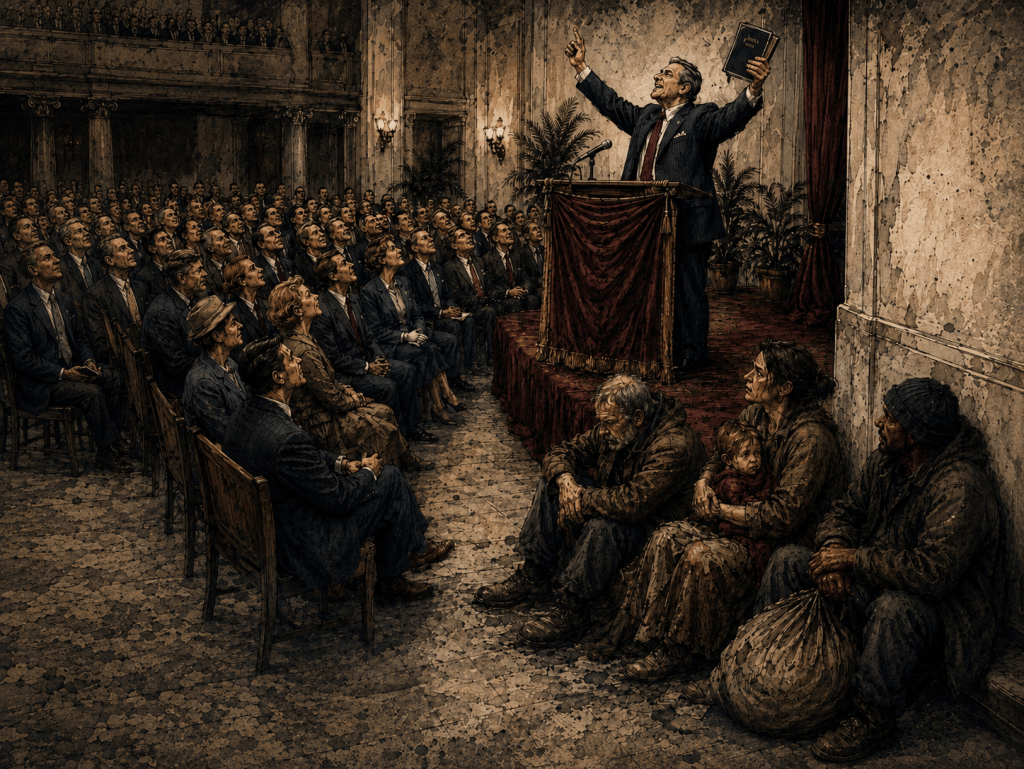
Caring Well
In October 2019, the man who ran the Southern Baptist Convention’s public-policy arm sat on stage at a conference his agency had organized about how Christian institutions handle credible allegations of sexual abuse. The conference was called Caring Well. The man was Russell Moore, president since 2013 of the SBC’s Ethics and Religious Liberty Commission. The person he had invited on stage was Rachael Denhollander, the former gymnast who first publicly accused Larry Nassar in 2016.
Denhollander criticized, on stage, the way Baptist Press — the convention’s own news service, operated by the SBC Executive Committee — had reported the abuse allegations of Jennifer Lyell, who had accused a Southern Baptist seminary professor. Executive Committee trustees were in the room. After the conference, by Moore’s later account in a letter to the ERLC trustees, a trustee delivered a message he characterized as Mafia-like: “You’ve got a nice little Commission there; would be a shame if something happened to it.”
The letter, written in February 2020, sat. In February 2021 the Executive Committee delivered a new task-force report blaming Moore’s leadership of the ERLC for the loss of more than a million dollars in Cooperative Program donations. The reasons listed included Moore’s opposition to Donald Trump, his condemnation of the January 6 Capitol attack, and a general “liberal drift” exemplified by the agency’s support for immigration reform. Moore resigned on May 18, 2021. The letter leaked the following week. He took a job at Christianity Today, the magazine Billy Graham helped found in 1956, as its public theologian.
The man running the Southern Baptist Convention’s public-ethics office had been warned, in language he had on the record, that pressing the convention on credible sexual-abuse allegations and on the racism he was documenting inside its leadership would cost him the office. He pressed. It cost him the office. The convention has not, in the years since, walked back the positions that drove him out.
This is the same argument as the last fourteen posts. The lock just got theological.
The Citation And The Omission
Two qualifications before the diagnosis, because the argument doesn’t work without either of them.
Most American Christians are not the people running the political theology this post is about. Many are actively horrified by it. The Catholic Worker movement, the Black church traditions that produced the civil-rights leadership of the 1950s and 1960s, the sanctuary movement of the 1980s, the mainline denominations that have lost members since 2000 partly because they refused to align with the political theology, the evangelical reformers who broke with it and paid career prices for breaking — all of that is contemporary American Christianity, and almost none of it is what the political theology under diagnosis wants to be confused with. The longer history is the same story. Abolitionism was substantially a Christian project. The labor movement was substantially a Christian project. The civil rights movement was specifically a Black church project. The argument that follows is not about that Christianity. It is about a specific contemporary deployment of Christian theology in American partisan politics, a deployment that has spent considerable institutional effort building itself, considerable financial effort funding itself, and considerable rhetorical effort claiming to represent the religion it is selectively quoting.
Second qualification. The political theology under diagnosis is not symmetric across the political spectrum, and this post is not going to pretend it is. The Christian Nationalist historical construction, the selective theology of “religious liberty,” and the reconstruction of Jesus as an American culture-warrior are projects that have come, almost entirely, from the political right, and have been funded by a specific and documentable set of institutions over a specific and documentable period of time. The Democratic coalition has its own complicated relationship to religion — the Black church remains a substantial Democratic constituency, Catholic social teaching has shaped parts of the labor-aligned Democratic tradition, evangelical Democrats exist — but the contemporary political theology this post is diagnosing is not a both-sides phenomenon. The Republican Party has, since the late 1970s, built and funded a specific political-theological infrastructure as a deliverable of its national strategy, and the policy preferences that infrastructure produces are remarkably aligned with the policy preferences of the donor class the previous fourteen posts have been documenting. Saying so is not anti-Christian, and it is not a generic partisan attack. It is the description of what is on the field.
With both of those on the table: this post is about three specific things. Which doctrines get amplified in American political theology. Which doctrines get quietly omitted. And how the historical claim that the United States is a Christian nation in any meaningful institutional sense was constructed, datably, in the 20th century, on top of a Constitution that says the opposite. The selection is doing the political work. The political work is not what the selection claims to be.
What Gets Read And What Gets Skipped
Begin with what isn’t said. The Sermon on the Mount — Matthew chapters 5 through 7 — is, by the consensus of Christian scholarship across denominations, the most direct statement of Jesus’s ethical teaching in the gospels. Blessed are the poor in spirit. Blessed are the meek. Blessed are the merciful. Blessed are the peacemakers. Love your enemies. Do not lay up treasures on earth. Judge not, that you be not judged. If anyone slaps you on the right cheek, turn to him the other also. The passage is, on a clear reading, the ethical core of the religion. It is also the passage that goes almost entirely unquoted in the political theology under discussion. The omission is not an accident of emphasis. The text is too central, too short, too well-known for that. The policies the political theology supports — opposition to refugee resettlement, opposition to non-retaliation in foreign policy, opposition to redistribution of wealth, support for capital punishment, support for the wealth gap as a moral achievement — are, on plain reading, the inverse of what the Sermon on the Mount prescribes. The cleanest contemporary example of the inversion is the Prosperity Gospel — the doctrine that material wealth is a sign of God’s favor and that poverty is evidence of insufficient faith, a 20th-century American invention with specific founders (Oral Roberts beginning in the 1940s, Kenneth Hagin a generation later, Kenneth Copeland and Joel Osteen carrying it forward) and a financial relationship to the political donor class whose policy preferences benefit from its theology. The full anatomy of the Prosperity Gospel is the subject of the next post. What it demonstrates for this one is that the omission is not passive. It is active. A doctrine had to be constructed, taught, funded, and broadcast to make the omission feel natural to the people sitting in the pews.
Now look at what gets cited and what doesn’t. Leviticus 18 and 20, on same-sex relations, get quoted constantly in contemporary American political theology. Leviticus 25 — the jubilee laws, debts forgiven every fifty years, land returned to original families, indentured servants freed, the corners of fields left for the poor and the foreigner to glean — almost never. The prophetic books of the Hebrew Bible are relentless attacks on the wealthy and on rulers who oppress the poor: Amos on those who sell the needy for a pair of sandals, Isaiah on those who join house to house and field to field until there is no room for anyone else, Micah on what the Lord requires (do justice, love mercy, walk humbly), Jeremiah on the kings who built their palaces by injustice. Same book. Same authority claim. Different passages amplified. The pattern of which passages get amplified and which get omitted lines up, with striking consistency, with the policy preferences of the political coalition doing the citing.
The selection has a documented history, and the documented history makes the selection harder to defend as theology. The Southern Baptist Convention passed a resolution at its 1971 annual meeting in St. Louis calling on Southern Baptists to work for legislation permitting abortion in cases of rape, incest, fetal deformity, and damage to the emotional, mental, and physical health of the mother. The resolution was reaffirmed in 1974. Baptist Press, the convention’s own news service, declared in January 1973 that the Supreme Court’s decision in Roe v. Wade had “advanced the cause of religious liberty, human equality and justice.” The SBC did not formally renounce its 1971 position until 2003. The denomination’s politicization on abortion was not a theological development. It was a strategic one. The historian Randall Balmer’s reporting in Thy Kingdom Come, corroborated by William Martin’s With God on Our Side and by the Paul Weyrich papers at the University of Wyoming American Heritage Center, traces the Religious Right’s origin to a different fight entirely. In 1970 the IRS announced it would no longer extend tax-exempt status to racially discriminatory private schools. In 1971 it issued Revenue Ruling 71-447, formalizing the policy. In 1976 the IRS revoked the tax-exempt status of Bob Jones University, which had banned interracial dating. Bob Jones sued; the Supreme Court ruled against the university 8-1 in 1983. Paul Weyrich, the conservative organizer who would go on to co-found the Heritage Foundation, the Moral Majority, and the Council for National Policy, had been trying for years to mobilize evangelicals as a coordinated political bloc — on school prayer, on the Equal Rights Amendment, on abortion. None of it had worked. The IRS action against the segregation academies, by his own account in 1990, was the fight that finally produced the mobilization. Abortion was grafted onto the movement between 1976 and 1980 as the more publicly defensible mobilizing issue. The doctrine selection followed the political organizing, not the other way around. This is not a polemic. This is the documentary record.
And consider what’s been invented. The claim that the United States was founded as a Christian nation in any meaningful institutional sense is a historical claim, and the historical claim fails on the documents. The Constitution makes no reference to God. Article VI prohibits any religious test for federal office. The First Amendment prohibits the establishment of religion by Congress. The Treaty of Tripoli, signed in 1797, ratified unanimously and without debate by the United States Senate on June 7 of that year, and signed by President John Adams three days later, contains in Article 11 the explicit statement that “the Government of the United States of America is not in any sense founded on the Christian Religion.” James Madison, in the 1785 Memorial and Remonstrance Against Religious Assessments that he wrote anonymously to oppose Patrick Henry’s bill to tax Virginians for the support of Christian ministers, argued that the bill’s deeper offense was that it implied “that the Civil Magistrate is a competent Judge of Religious Truth; or that he may employ Religion as an engine of Civil policy.” Madison’s verdict on that idea was that it was “an unhallowed perversion of the means of salvation.” His phrase — Religion as an engine of Civil policy — describes, with two hundred and forty years of advance notice, exactly the project Part 15 is diagnosing.
The Christian Nationalist construction is not what the founders built. It is a 20th-century political invention, and the construction has datable steps. The phrase “under God” was added to the Pledge of Allegiance by an act of Congress in 1954, at the height of Cold War rhetorical construction of the United States as a Christian counterpoint to a godless Soviet Union. The phrase “In God We Trust” was added to U.S. currency in 1956 and made the official national motto by the same Congress. The Heritage Foundation was founded in 1973. The Moral Majority was founded in 1979. The Council for National Policy was founded in 1981. The Family Research Council was founded the same year. The Alliance Defending Freedom, which has carried most of the contemporary legal litigation reshaping the Establishment Clause and the Free Exercise Clause, was founded in 1994. Kevin Kruse’s One Nation Under God documents the Cold War construction in detail. Kristin Kobes Du Mez’s Jesus and John Wayne documents the parallel construction of a culture-warrior masculine Jesus that is unrecognizable in any first-century Palestinian gospel reading. Andrew Whitehead and Samuel Perry’s Taking America Back for God measures the share of Americans who hold Christian Nationalist views and tracks how those views correlate with specific policy preferences. The literature is extensive, and the literature is in agreement. The Christian Nationalist construction is, on the documentary record, not a recovery of founding intent. It is a project, with funders and dates, that began in the middle of the 20th century and accelerated after 1973.
What’s Real
A few honest qualifications, because the strongest version of the argument is the one that doesn’t pretend the counter-arguments aren’t there.
Faith is real. The metaphysical claims of Christianity are not the subject of this post, and nothing in the argument depends on taking a position on them. A person who reads the gospels and concludes that the resurrection happened, that Jesus is the son of God, and that the historical claims of the religion are true is not the target of any sentence in this post. The argument is about the political deployment of selected doctrines from that religion in contemporary American partisan politics. A faithful Christian and a thoughtful skeptic can agree on the diagnosis without agreeing on anything else, because the diagnosis is about a specific institutional project and the documents it has produced, not about whether God exists.
The Christian institutions doing structural-justice work in the United States are real, and they have been doing it for longer than the political-theological infrastructure has existed. The Catholic Worker movement, founded by Dorothy Day in 1933, has run houses of hospitality for the poor for nine decades. The Black church traditions did most of the organizing labor of the civil rights movement. The mainline Protestant denominations — the Episcopalians, the United Methodists, the Presbyterian Church (USA), the United Church of Christ, the Evangelical Lutheran Church in America — have been losing members since the 1970s in part because their leadership refused to align with the political theology that was being built around them. The sanctuary movement of the 1980s, the modern movement against capital punishment, the contemporary work of organizations like Sojourners and Bread for the World, the evangelical reformers like Russell Moore and David French and Beth Moore who broke with the political theology and paid for it — this is a long list, and the people on it are not the diagnosis. They are part of the answer to the diagnosis. Nothing in what follows is meant to displace them. Most of it is meant to resource them.
What They’re Paying For
What the political-theological infrastructure produces is, in aggregate, four things stacked together. Each of them is useful to someone. The combination is what the people who own and operate the infrastructure are actually selling.
It is a moral vocabulary for policy preferences that have nothing to do with the texts being cited. A senator who votes for a regressive tax cut, votes against expansion of food assistance, votes against universal healthcare, and votes for the expansion of military spending can describe each of those votes, on Sunday, in the language of Christian conviction. The descriptions do not survive contact with the Sermon on the Mount, with Matthew 25, with Leviticus 25, or with any of the Hebrew prophets. They do not need to. The vocabulary is operating as a moral cover for a policy mix the underlying texts do not endorse and in many cases directly forbid. The voter who hears the vocabulary on Sunday and votes accordingly on Tuesday is not being deceived about whether the senator is religious. The voter is being deceived about whether the religion in question, as a faithful reading of its founding texts, supports the policy mix.
It is a sorting mechanism that codes economic policy as a religious test. A working-class evangelical voter in rural Tennessee and a working-class Catholic voter in industrial Pennsylvania share most of the material conditions of their lives. Both pay the healthcare costs Part 4 documented. Both pay the housing costs Part 7 documented. Both will retire on the 401(k) instead of the pension Part 17 will document. The political-theological infrastructure makes sure they understand each other, when they understand each other at all, as members of opposing religious tribes rather than as people with shared structural problems. A cross-class coalition organized around the question of who is actually taking the money is much harder to assemble when both halves of it have been instructed that the other half holds the wrong theology of salvation.
It is an identity claim that makes structural critique sound like an attack on faith. The proposition that the United States is a Christian nation, governed by Christian principles, in the form preferred by the people making the claim, allows any structural reform of the political-economic order to be framed not as a policy disagreement but as a religious offense. Universal healthcare becomes an attack on religious liberty. Antitrust enforcement against extractive corporations becomes an attack on God-given freedom. The reform of the political-financial system the previous twelve posts have documented becomes an attack on the country’s Christian foundations. The identity claim is doing the work of insulating the structural extraction from the structural critique. That is why the identity claim was constructed.
And it is the displacement of the actual Christian political traditions out of the public conversation. The Catholic Worker, the Black church, the sanctuary movement, the mainline social-justice traditions, the evangelical-left vocabulary that ran through Jim Wallis at Sojourners and Ron Sider at Evangelicals for Social Action, the Catholic social teaching that ran from Rerum Novarum in 1891 through Laudato Si’ in 2015 — all of this exists, all of it is Christian, and almost none of it reaches the public conversation about what American Christianity politically is. The political theology that does reach the public conversation has been built and funded to displace these traditions out of the public conversation, and to claim the religion itself as its exclusive property. The audience that would have to be mobilized to recover the displaced traditions is, during the same hours those traditions are being practiced in parish basements and church halls across the country, being told on cable that the people doing the practicing are the apostates.
The Fixes Are Boring
The fixes below address the political and economic infrastructure of the selective-theology project, not its theology. The post is not in the business of telling Christians how to read their gospels — that’s a project Christians have always done for themselves, and the reformers cited above are doing it now. The fixes here address the legal and financial scaffolding that built and protects the political-theological infrastructure. They sound impossible because the people who profit from the current arrangement have spent decades making them sound impossible. They are not. Most of them are enforcement of laws already on the books. Roughly in order from cheapest to hardest:
- Enforce the Johnson Amendment. The 1954 amendment to the tax code prohibits 501(c)(3) tax-exempt organizations, including churches, from endorsing or opposing political candidates from the pulpit or with organizational resources. It is on the books. It is not enforced. The Alliance Defending Freedom has organized “Pulpit Freedom Sunday” every year since 2008 specifically to invite IRS enforcement that has not come. Enforcement is a single executive-branch decision by the Commissioner of Internal Revenue. The reason it has not happened is political, not legal. Direct the IRS to enforce the statute as written. Single decision, no legislation required.
- Revoke tax-exempt status from organizations that function primarily as political operations using religious branding. The legal standard for religious 501(c)(3) status is that the organization be “operated exclusively” for religious purposes. A number of well-known organizations meet the legal definition of primarily political and continue to claim the religious exemption. The Family Research Council applied for and received IRS reclassification as an “association of churches” in 2020, despite continuing to operate as a Washington DC policy and lobbying shop; ProPublica’s 2022 reporting based on Freedom of Information Act documents found the organization’s claims of regular chapel services could not be verified with the staff actually answering its phones. Forty members of Congress asked the IRS to review the reclassification. The IRS did not. It has the statutory authority. Use it.
- Close the parsonage exemption. Internal Revenue Code Section 107 allows ordained ministers to exclude housing allowances from federal income tax, in some cases worth tens of thousands of dollars per minister per year. The exemption has no constitutional foundation; it is a statutory choice made in 1921 and expanded since. The Freedom From Religion Foundation has challenged it on Establishment Clause grounds twice; both challenges were dismissed on standing rather than on the merits. The statute can be repealed by a simple act of Congress. The cost to the federal Treasury, by Joint Committee on Taxation estimates, runs in the hundreds of millions of dollars annually.
- Require financial disclosure from churches at the same level as other 501(c)(3) organizations. Every other tax-exempt nonprofit in the United States is required to file Form 990, which discloses revenue, expenditures, top compensation, and major donors. Religious organizations are exempt from the requirement by statute. The exemption is not a constitutional requirement; it is a 1950s-era statutory choice that could be reversed by Congress next session. The opacity the exemption produces is the financial precondition for the worst abuses of the political-theological infrastructure. Remove it.
- Enforce the Establishment Clause against the current wave of state-level religious-favoritism legislation. Ten Commandments mandates in public school classrooms, public funding of religious schools, mandatory chaplains in public schools, public-funded religious-content curricula — these are not new fights, but the current wave is the most aggressive since the 1960s. The Supreme Court on its current composition will be unsympathetic to most of the challenges. The cases still need to be brought, the political pressure still needs to be applied, and the longer-term composition of the federal judiciary — addressed in Part 13’s reform list — is the structural answer.
- Resource the Christian institutions that have been doing the structural-justice work all along. The Catholic Worker houses, the Black church traditions, the mainline denominations, the evangelical reformers who broke with the political theology, the Catholic social-teaching networks — these institutions are underfunded, structurally outmatched, and almost completely absent from the cable-driven public conversation about what American Christianity politically is. The fix is not just legal-structural. Part of it is whose voice gets resourced in the public conversation. Foundations, large donors, and Democratic political infrastructure that has spent the last forty years ceding religious vocabulary to the right could spend the next forty years correcting the error. The generational answer to the political-theological infrastructure is a competing infrastructure, drawn from traditions that already exist, that has been allowed to atrophy. Rebuild it.
None of those are radical. Five of the six are enforcement of laws already on the books or repeal of statutory exemptions that postdate most living memory. The sixth is what the country was doing, in some form, for most of the period from the abolitionist movement through the civil rights movement, and stopped doing in the late 1970s for reasons this series has been documenting. The reason these fixes feel impossible is not that they are unworkable. It is that the institutional coalition that benefits from the current arrangement has built a public conversation in which proposing them sounds like an attack on faith. It is not. It is the conversation the country is supposed to be able to have about which doctrines are doing political work and on whose behalf.
Who Is This For
The selection this post has described is the moral framework. The next post is about the economic theology that fills it — the Prosperity Gospel and its broader cousin, the market theology that calls extraction “freedom” and calls regulation “tyranny” with the same straight face. The framework and the economic theology are doing the same job from different sides. The framework tells you which scriptures count. The economic theology tells you what they mean. Together they produce the moral vocabulary that lets a healthcare system that bankrupts cancer patients, a housing market that prices working families out of shelter, and a tax code that treats labor income worse than capital income get described, on a Sunday morning in fifty thousand pulpits, as the natural moral order. Different layer. Same question.


Leave a Reply