
Two days after the killing, in the second week of September 2025, an X account with more than half a million followers reposted a screenshot of a private Facebook post written by a woman who had taken a new job earlier that month. The post was about the killing. The account’s followers contacted her employer. Within eight hours she had been fired.
She was one of at least 150 people the same account named in the nine days following the killing of Charlie Kirk. Most were teachers, professors, librarians, and other public employees. Several were misidentified — people with similar names to people the account had named, who got the calls and the threats and in one case had to leave their home. Two Texas districts fired three teachers. Clemson fired three. Middle Tennessee State fired one. The Carolina Panthers fired a communications coordinator. Sony fired a game developer who had worked ten years at the studio. The Office Depot worker in Michigan who refused to print Kirk vigil posters was fired, and then publicly threatened with federal prosecution by the Attorney General of the United States. The vice president, guest-hosting the dead man’s podcast, told viewers to call the employers of people who were celebrating. The Trump-appointed chair of the FCC suggested ABC’s affiliate licenses might be on the table after Jimmy Kimmel’s monologue about the killing. ABC suspended Kimmel within days.
The X account stopped calling for people to be fired on day nine, when the president pivoted to a fight over immigrant visa fees and the account’s interest pivoted with him. Most of the people the account had named, by then, had already lost their jobs.
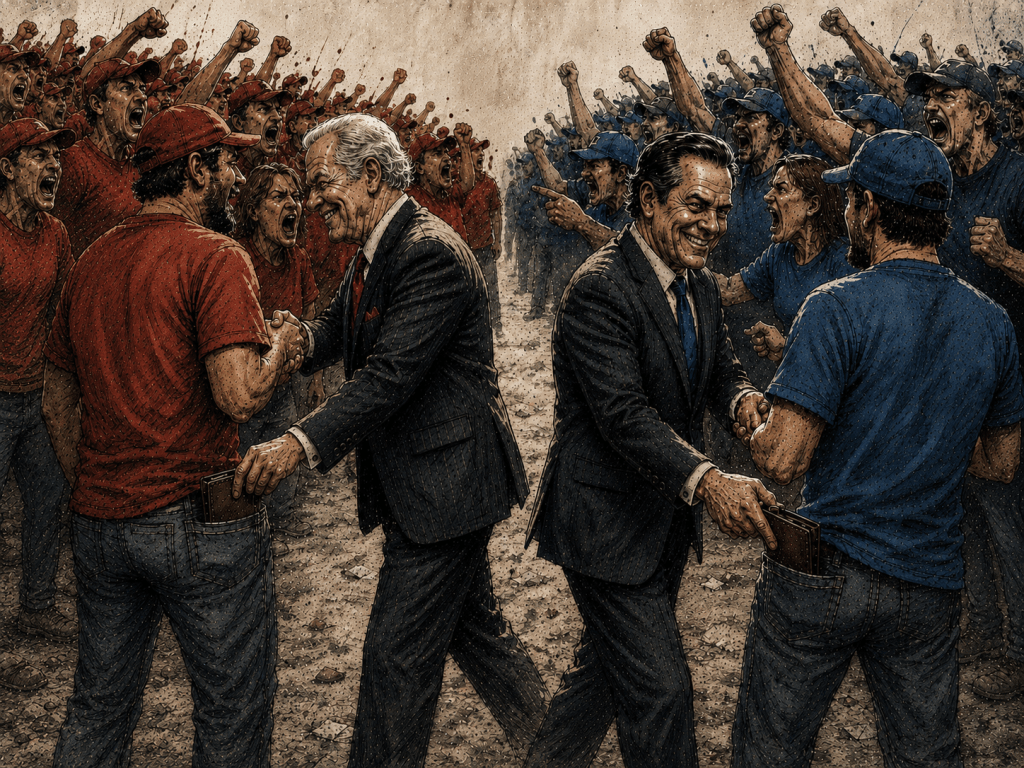
The killing was real and the grief around it was real and the substantive arguments about political violence were ones the country needed to have. The cycle that ran on top of those things was not the arguments. The cycle was the engagement, the firings, the threats, the legislative and executive amplification of all of it, and then the pivot away nine days later when the news economy needed the next thing. The substantive arguments did not get had. They got replaced by the cycle.
This is the same argument as the last nine posts. The lock just got cultural.
The Substance And The Cycle
The substance of the fights is, in most cases, real. The right of a trans kid in Tennessee to receive medical care that their doctor and their parents have agreed they need. The right of a woman in Texas, in 2026, to manage a miscarriage with the procedure that any obstetrician would have provided her in 2021. The right of a Black voter in Georgia to find a polling place open within reasonable distance of their home. The question of whether the country’s history of slavery and segregation gets taught honestly in the country’s public schools, or doesn’t. The question of how many guns the country should be flooded with, and at what political and human cost. These conflicts are not manufactured. The consequences are not symbolic. They land, in many cases, on the same bodies decade after decade.
The temptation, with the diagnosis this post is about to make, is to treat the cycle as something the country does to itself in roughly equal measure on both sides of the political spectrum. The research is no longer ambiguous, and the temptation should be refused.
The Berkman Klein Center at Harvard published a landmark study in 2017, analyzing 1.25 million stories around the 2016 election, that documented an asymmetric structure: a right-wing media ecosystem operating as a tightly coordinated network with Fox News at the center and a chain of partisan outlets feeding into and out of it, distinct in its propagation patterns and its correction behavior from the rest of the press. Yochai Benkler’s follow-on book Network Propaganda made the case at length, and subsequent work from the Reuters Institute and the Knight Foundation has held it up. The Republican Party has spent the last decade making culture-war content the central deliverable of its national strategy. Republican-controlled state legislatures have introduced more than 700 bills targeting transgender Americans since 2018, with well over a hundred enacted, and the trajectory is steepening rather than slowing. The party’s parallel media infrastructure — Fox, the talk-radio syndicates, the partisan podcast networks, the state-level conservative news startups funded by a handful of overlapping donor networks — was built deliberately, funded sustainably, and is now run as the marketing arm of the party’s political project.
The Democratic coalition has plenty of its own performative tendencies, and at the state and local level it has its own dependence on identity-coded politics. It does not have a coordinated equivalent of the machine the right built, because it did not build one. The asymmetry is in scale, in intent, and in the downstream policy consequences for the people on the receiving end of the legislation the cycle produces. Pretending the two situations are symmetric is itself a contribution to the problem the post is diagnosing.
The substantive positions taken inside these fights are also not equivalent. Defending trans kids from state harassment is not the same kind of political activity as harassing them. Defending the right to reproductive care is not the same kind of political activity as banning it. Teaching the actual history of the country is not the same kind of political activity as restricting how it can be taught. The argument that follows is about the way these issues get packaged into 24/7 cultural content for engagement and revenue, and about the institutional incentives that select for the most enraging framing of every fight. It is not an argument that the underlying conflicts are fake. It is not an argument that the positions being taken inside them are morally equivalent. The substance is real. The packaging is what’s being diagnosed.
With all of that on the table: the diagnosis is about a system of production, not about the people who get caught up in what it produces. Most of the people fighting culture-war fights, on every side, are responding to something real. They are not the problem. The institutions structuring the fights for engagement, for revenue, for political performance, and for the displacement of harder structural questions — those are the problem.
What Produces The Cycle
Three incentives, working together, produce most of what we see. The first creates the supply of the content. The second creates the political demand for it. The third describes what gets pushed off the page as a result.
The structure of the attention economy comes first. Cable news, talk radio, podcast networks, partisan news sites, and the algorithmic feeds of every major social media platform all operate on the same basic economics: time spent on the platform converts to revenue, and the most reliable producer of time spent is content that generates a strong emotional response. Anger does this better than reasoning, contempt does it better than empathy, and a sense of immediate stakes does it better than a sense of long-term importance.
Internal research from Meta, leaked in 2021 by the engineer Frances Haugen, showed that the company’s own engineers understood content provoking anger generated significantly more engagement than neutral content, and that the algorithm responded accordingly. The business model selects for the framing. The people inside the institutions who notice the pattern and try to redirect the algorithm tend not to last long in the role; the people who keep the role are the people who keep the engagement metrics up. Nobody has to be acting in bad faith for the system to produce what it produces. The metrics produce the output, and the output produces the cycle.
The asymmetry of cost between two kinds of political delivery is the second incentive. A politician can deliver a culture-war win — a state-level bill restricting how race is taught, an executive order on bathroom access, a judicial appointment of a culturally aligned judge, a confrontational hearing of a sympathetic-target witness, a public fight with a specific celebrity — at very low political cost, because none of those things crosses the major donor networks of either party.
A politician trying to deliver a structural economic win — a corporate tax increase, a serious antitrust action, a public option in housing or healthcare, a real wealth tax — faces immediate primary-challenge funding from the industries they would touch. The deliverable side of political life is therefore weighted disproportionately toward the cheap performances and away from the expensive deliveries. The politicians who learn this lesson early are the ones who get re-elected. Over time the chamber fills with people who are extremely good at the performance and not particularly good at the delivery, because the performance is what got them there.
What the first two incentives do to coverage of everything else is the third. The news cycle is bounded. Time on the air, slots in the daily lineup, lead positions on the front page, the limited attention of the press corps. A week of coverage of a viral school-board confrontation is a week of coverage not given to a regulatory rollback, a corporate tax-avoidance scheme, a private equity acquisition of a regional hospital chain, or an EPA enforcement decision.
Both kinds of stories exist. The structural stories are mostly carried by the trade press — American Banker for the financial industry, Modern Healthcare for the hospital sector, Politico Pro for the regulatory beat, the financial press more broadly. They reach the people directly affected and the people whose job is to lobby on the bills. They mostly don’t reach the general public, because the general-public media is selecting against them, in favor of the content the first two incentives reliably produce. This is the substitution. It is not the absence of structural journalism. It is the displacement of structural journalism out of the general-audience attention space, into specialist publications most voters will never see.
What’s Real
A few honest qualifications, because the strongest version of the argument is the one that doesn’t pretend the counter-arguments aren’t there.
Most of the people fighting culture-war fights, on every side, are responding to something real. The parent who shows up at a school board meeting because they are genuinely worried about what their kid is being taught is not the problem, even when the worry has been pointed in directions the cable channels selected for them. The trans adult who is exhausted by the relentless legislative attention is not the problem. The librarian getting threats over which books are on which shelves is not the problem. The Kirk supporters who turned out by the tens of thousands for his memorial were not, individually, the problem. The mechanism that converted all of that human substance into engagement, revenue, performance, and policy outcomes that mostly benefited the people running the mechanism — that is the problem.
Many of these fights are also intense because one side is genuinely escalating them. The wave of state legislation targeting transgender Americans since 2020 is real legislation passing real chambers and being signed by real governors. The overturning of Roe v. Wade in 2022 is a real decision with real consequences in the states currently restricting reproductive care. The book-banning campaigns are real campaigns with real lists of titles. The argument that the cycle is engineered for engagement and revenue does not mean the underlying actions are fake. It means the press infrastructure built around them is doing something other than informing the public about what is happening and why. The actions are real. The way the public learns about them, or doesn’t, is what this post is about.
What They’re Paying For
What the culture-war infrastructure delivers, in aggregate, is four things stacked together. Each of them is profitable to someone. The combination is what the people who own and operate the infrastructure are actually selling.
It is a sorting mechanism that organizes voters by cultural identity rather than economic interest. A working-class voter in rural Pennsylvania and a working-class voter in urban Philadelphia have most of the same material problems — healthcare costs they can’t afford, housing costs they can’t afford, wages that haven’t kept up, kids drowning in student debt. The structural extraction the last thirteen posts have documented falls on both of them, in different forms but in similar amounts. The sorting mechanism makes sure they see each other as enemies before they see what they share. A cross-class coalition organized around the question of who is taking the money is harder to assemble when both halves of it are convinced that the other half is the problem.
It is a vocabulary of political performance that does not require legislative delivery. A senator who passes a corporate tax increase has crossed donor networks who will fund a primary challenger in two years. A senator who delivers a confrontational hearing of a college president, an indignant floor speech about a children’s book, or a culturally aligned judicial confirmation has delivered for the base at no cost the donors will notice. The performance counts as a win in the political accounting that matters to the politician, even when no structural problem in any constituent’s life has changed. Over time this produces a class of politicians who are extremely good at the performance and not particularly good at the delivery.
It is continuous revenue for the platforms that carry the cycle. Fox Corporation’s most recent reported annual revenue was around $14 billion, of which Fox News is the most profitable single segment by a wide margin. The major social media platforms generate hundreds of billions in advertising revenue annually, most of it tied to engagement metrics that culture-war content reliably produces. The talk-radio syndicates, the partisan podcast networks, the conservative state-news startups, the smaller progressive-side equivalents — all of them depend on the cycle continuing. None of them benefits, financially, from a political environment in which voters are calm, informed, and focused on substantive policy fights they could reasonably win.
And it is the displacement of structural questions from general-public attention, into trade publications and policy journals most voters will never see. The 2017 corporate tax cut, the structural details of the Inflation Reduction Act, the private equity acquisition of regional hospital chains, the Federal Reserve’s reaction function to wage growth, the specific mechanics of how municipal bond markets respond to local news deserts — all of these are covered. They are covered in venues whose audiences are mostly the people already lobbying on them. The audience that would have to be mobilized to change any of them is, during the same hours those venues are publishing, watching the cycle.
The Fixes Are Boring
The fixes below address the economics of the cycle, not its content. Content regulation in the United States is mostly a trap, both because the First Amendment makes most versions of it unconstitutional and because the people currently in a position to write it have their own culture-war agendas that would deform anything they wrote. The path through is the structural economics of how the content gets made, paid for, and distributed. One specific content-regulatory proposal is worth taking off the table at the start: restoring the Fairness Doctrine, which was designed for an era of limited broadcast spectrum and would not touch the talk-radio, cable, podcasting, streaming, or social media infrastructure where most of the current cycle actually runs. Restoring it would also hand a regulatory weapon to whichever administration happened to be in office, and some of the people currently calling for its return are the people who currently control the FCC. The fix is elsewhere.
The reform list that follows sounds impossible because the people who profit from the current arrangement have spent decades making it sound impossible. Most of it is what comparable democracies already do, and most of the rest is what the United States itself did, in some form, before the deregulatory cycle that began in the late 1970s. Roughly in order from cheapest to hardest:
- Mandate algorithmic transparency and a non-algorithmic feed option on every major platform. Users should be able to see, in plain terms, what an algorithm is optimizing for when it ranks their feed, and should be able to switch to a chronological, non-curated feed with one click. The European Union’s Digital Services Act, in force since 2024, requires both. American platforms comply with the European version of the law for European users and decline to offer the same controls to American users, because they are not required to. Require it. Single act of Congress.
- Block private equity and hedge fund acquisitions of local news organizations. The single largest active cause of news desert expansion since 2010 has been the asset-stripping model that Alden Global Capital, Fortress Investment Group, and a handful of other PE firms have applied to newspapers they acquire — cut the newsroom by half on day one, sell off the real estate, extract the cash, leave the husk. The Save Local News Act and similar proposals have been introduced repeatedly and gone nowhere. This is regulatory action that does not require new statutory authority; existing antitrust and consumer protection law would support it. The reason it hasn’t happened is that the PE industry’s lobbying operation is well-funded and the local newspaper industry’s is not.
- Use existing antitrust authority to break up the media conglomerates and the platform giants. Not “promote media diversity,” which is the diluted version that emerged from the deregulatory consensus of the 1990s. Break up. The Lina Khan-era FTC pursued a serious antitrust agenda against the platform companies between 2021 and 2024; most of those cases did not survive into the successor administration. The reasons that posture didn’t last are themselves part of the story of how concentrated power protects itself. The next administration with the political will to pursue this agenda should pursue it. The legal authority has been on the books since 1890.
- Ban surveillance advertising as the default business model of the internet. The targeted advertising system — in which platforms collect detailed behavioral data on every user, sell access to that data to advertisers, and optimize the platform to maximize the engagement that produces more data — is the actual financial engine of the engagement-driven content economy. The Section 230 reform conversation is mostly a distraction; surveillance advertising is the structural problem. Contextual advertising, in which ads are matched to the content being viewed rather than to a profile of the viewer, works fine, generates real revenue, and does not require the same level of behavioral surveillance. The European Union has begun restricting some of the most aggressive forms of surveillance advertising through the GDPR and the Digital Markets Act. The United States has done nothing comparable. Do the comparable thing.
- Treat civics and media literacy as core curriculum, federally funded, taught from middle school through high school graduation. Not a unit. A subject. The skills involved — how to evaluate a source, how to distinguish news from opinion from propaganda, how an algorithmic feed differs from a chronological one, how to recognize when an outrage cycle is being run on you — are at least as foundational, in a 21st-century democracy, as the skills currently classified as foundational. This is a twenty-year fix that will not help with the next election cycle. The previous twenty years of not doing it are part of why the next election cycle looks the way it does.
- Fund public-interest journalism at the per-capita level of the comparable democracies, with structural insulation from political control. The BBC operates on a roughly £3.7 billion annual budget, derived from a mandatory license fee, with a board structure designed to make political capture difficult and a multi-year budget settlement designed to limit the ability of any single government to punish coverage it dislikes. Germany’s Deutsche Welle, Canada’s CBC, Australia’s ABC, and Japan’s NHK all operate on broadly comparable models at smaller scales. The per-capita equivalent in the United States would be on the order of $20 to $50 billion annually; the current Corporation for Public Broadcasting appropriation is approximately $500 million, roughly two orders of magnitude smaller. The institutional design that has worked elsewhere is the part to copy — not just the funding level, but the multi-year guaranteed budget, the independent board structure, the legal protection against per-coverage political retaliation. The dollar amount sounds large until it is set against what the country currently spends on the absence of that infrastructure.
Who Is This For
The sorting this post has described works on the secular dimensions of identity. It works harder, and produces more durable political results, when it can borrow theological vocabulary — when the line between cultural tribes can be framed not as a difference of opinion but as a difference between the faithful and the apostate, the saved and the damned. The people deploying that vocabulary in American politics are mostly not, by any consistent reading of the religion they invoke, practicing what its founding texts describe. The vocabulary still works. The question of why it works, and which doctrines get cited and which get conveniently omitted, is the next layer. Different layer. Same question.


Leave a Reply