
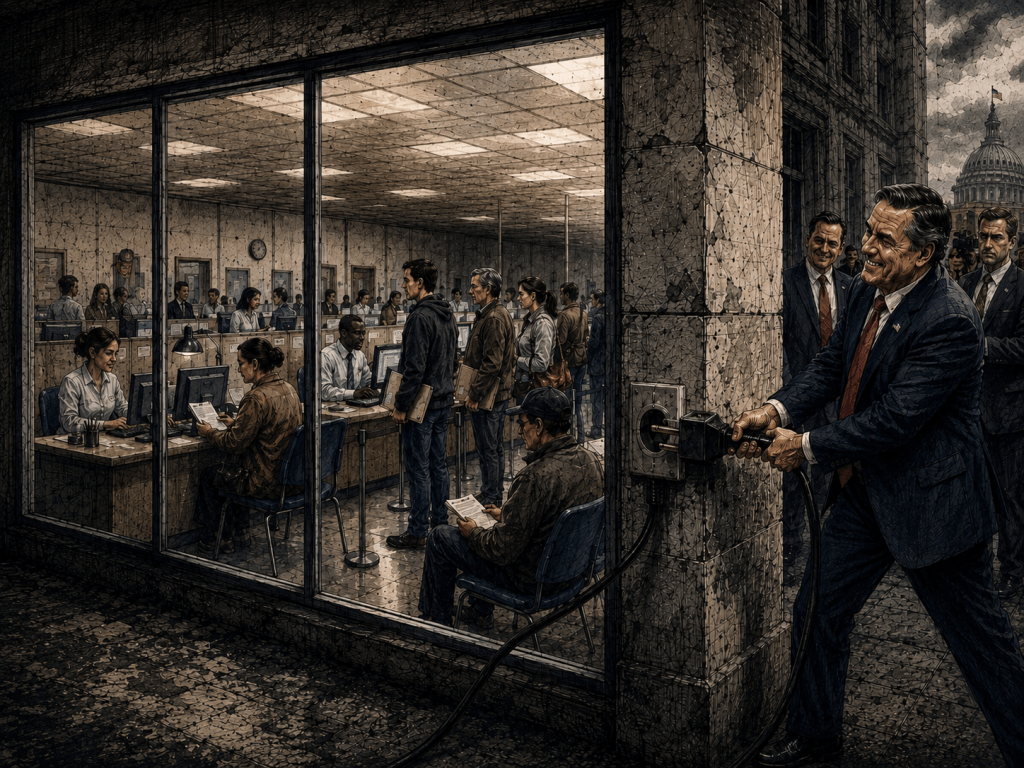
At one in the morning on Saturday, March 1, 2025, the federal office whose entire job was making the government work better got an email telling it that it was over. The notices had gone out the day before. The message came from a former Tesla engineer who had just been put in charge of the General Services Administration’s technology arm, and it said the office had been judged non-critical and was being eliminated under the administration’s workforce order. By the time most of them read it, they were already locked out. Their accounts had been cut around midnight. The website went down the same day.
The office was called 18F. It had been inside GSA for eleven years, about a hundred engineers and designers and product managers who got loaned out to other agencies to help them buy and build technology without getting fleeced. It did not run on appropriations. It charged the agencies it helped, by the hour, and brought in enough to cover itself — which means GSA arguably lost money by deleting it. Its own site, before it went dark, put the pitch in one line: as federal employees, we have no conflicts of interest. One of the people who worked there put it plainer afterward. The whole approach was saving the government money and time, and they never had an incentive to upsell.
Here is the part that matters. Weeks before the email, the official driving the cuts had posted that 18F “has been deleted.” He posted it in reply to someone explaining what 18F had built. The thing it had built was Direct File — the free tool that let Americans file their taxes straight to the IRS without paying anyone. The office that proved a public service could be cheap, fast, and good was removed, in the dark, by an operation that had named itself the Department of Government Efficiency, and the trigger was that it had made something free that competed with a company selling the paid version.
None of the official reasons hold up next to that sequence. Not “consulting waste” — the office paid for itself. Not “non-essential” — an inspector general later found GSA had cut its technologists before it had any plan for who would do the work, and it went about how you’d expect. The thing called efficiency reached in and removed the part of the government whose only job, and only incentive, was efficiency. And the only reason you know the sequence is that the people who lost their jobs stood up a new website by morning and wrote down what happened.
Twenty-three parts in, the picture doesn’t change. This is the part where the thing you’re told is too clumsy to ever do anything right turns out to be the thing they cut the fastest the moment it threatens to work — and the proof it could work is the budget line they delete first.
The DMV Line Is The Part You’re Allowed To Be Angry About
The loud fight is the wait. The DMV line that doesn’t move. The hold music. The form in triplicate. The agency everyone has a story about, and your uncle at Thanksgiving with the punchline already loaded. That fight is real, it runs every single day, and it is almost never where the decision got made. What you are handed is a symptom, presented as a diagnosis. The argument about whether government workers are lazy and whether bureaucracy is just like that runs forever, loud, while the question of who set the budget, who chose the technology, and who profits when the answer stays “it can’t” does not get asked, because the people who would have to ask it are not in the room and were never invited.
So the whole post is a contrast, and it holds the way the last several have. There is the fight you’re given — government is slow, government is dumb, the private sector does it better — and there is the thing underneath it: an inefficiency that was manufactured, by starving the money and refusing the tools, and then a second move on top of it, where the same companies that sell the private version both lobby to keep the public version broken and bankroll the studies that call the brokenness natural. The first is loud and on cable. The second is in lobbying disclosures and inspector-general reports and a one a.m. email, if you go look for it.
The last post ended on the thing they say underneath all of it: that none of this really matters, because the private sector simply does everything better than the government anyway, so why bother defending any of it. This is the answer. Private does it better — sometimes true, sometimes exactly backwards, and the comparison you’re shown is rigged in a specific, nameable way every time.
Before the cases, the honest part, because the argument is worthless without it. Plenty of government really is run badly, and not because anyone drew up a plan for it. A bureau with no competitor can carry a stupid process for thirty years because nothing ever forces the issue, and that is a real failure that nobody had to engineer. Not every budget cut is sabotage, and some reforms sold as efficiency were sincere and still failed. Not every move toward a private vendor is theft; the government has to buy real things from real companies, and most of that is just procurement. And “government can’t do anything” is the favorite blanket of every person whose specific claim falls apart the second someone checks it. One more concession belongs to this post in particular: the technology is not a magic wand, and it is not good by default. Drop modern automation into a starved agency pointed at the wrong goal and you do not get a faster service. You get a faster denial. Concede all of it. The pattern is still the tell.
And mostly the pattern is a consensus, and I’m not going to pretend it isn’t. “Starve the beast” is not a slogan one party invented last year; it traces to a Reagan budget shop in the 1980s, the move stated plainly — cut the money so the thing fails, then point at the failure. After that it ran through administrations of both kinds. The IRS was left technologically antique by Congresses of both parties. The federal government’s catalog of botched technology rollouts — the healthcare exchange that fell over on launch is only the famous one — is bipartisan and decades long. The tax-prep capture that kept free filing out of reach predates this administration by twenty years and survived every party in power. The procurement maze that makes government software cost what it costs was built and left standing by everyone. There is no clean villain there, and inventing one would be its own kind of lie.
One stretch is not symmetric, though, and pretending it is would be the opposite lie. In 2025 the doctrine stopped being a doctrine and turned operational. An operation that had named itself for efficiency spent its first months deleting 18F at one in the morning, cutting the rest of GSA’s technology service by roughly two-thirds, and killing a free tax tool that had just posted a ninety-four percent satisfaction rating, after two decades and on the order of a hundred million dollars in industry lobbying against it. The sitting Treasury Secretary, doubling as acting head of the IRS, gave the reason on the record: better alternatives, not used much, and the private sector can do a better job. The departing IRS commissioner put it less formally — that’s gone, he said, he wiped it out. The doctrine is forty years old and bipartisan. This turn is one-sided and barely a year old. You have to say both, and let neither cover for the other.
One more thing belongs here, because it is why none of this needs a smoke-filled room. There was never a meeting. There did not have to be. The company that sells you the paid version of the public service is the same company that funds the lobbying that kills the free version and bankrolls the institute that publishes the proof that government can’t. That is not a conspiracy you could expose. It is a customer-acquisition strategy you could read in a disclosure filing.
The Comparison Is Always Rigged. That Is The Whole Trick.
The cleanest way to see this is to walk it by how much disguise the rigging still bothers to wear. The first case has a full cover story and a control group sitting right next to it. The second had its disguise pulled off in public and the people who did it said the quiet part into a microphone. The third wears almost nothing, because the evidence is in the private company’s own internal spreadsheets. The fourth wears nothing at all, because the proof was deleted by the office named for the thing it proved. The excuse gets harder to say with a straight face as you go.
The first is the famous symptom, and the cover story is “that’s just bureaucracy.” The DMV, the passport that takes two months, the benefits line. The claim folded into the eye-roll is that this is what government is, structurally, by nature. But the symptom has a control group, and the control group is other government. Some states moved licensing and registration online and the wait collapsed; the same function, same level of government, different budget and different technology, different outcome. The cleaner control group is the IRS’s own. For two filing seasons there was a free federal tool that let people with simple returns file directly, and it worked — in its second year it took in roughly two hundred ninety-six thousand returns across twenty-five states, and ninety-four percent of the people who used it rated the experience excellent or above average. New Jersey’s innovation office found its residents who used it saved around a hundred fifty dollars apiece. The thing the eye-roll says is impossible was running, inside the most-hated agency in the country, getting some of the highest satisfaction numbers in government. “Bureaucracy” is not a property of government. It is a budget and a technology choice, and you can prove it by looking at the parts of the same government that made the other choice.
The second is that exact tool, and watch what happened to it, because the disguise comes off here entirely. Direct File was built with the modernization money from the 2022 law, piloted in a dozen states, expanded to twenty-five, proven, cheap, popular. It was aimed at something like thirty million Americans with simple returns. Against it ran one of the longest lobbying campaigns in the consumer-software business: the makers of the paid products spent a combined seven million dollars in 2025 alone, their highest joint total on record, in the year the tool died, with their quarterly filings naming Direct File or the statute that created it, on top of roughly a hundred million across the two decades they fought any version of this. In November 2025 the IRS told the twenty-five states it would not be available for the coming season and no future date was set. The reason was given on the record by the Treasury Secretary, who was also running the IRS: better alternatives, not used much, the private sector can do it better. That is not an analysis. That is the slogan from the top of this post, recited as a press statement, by the official with the authority to make it true by killing the counterexample. They didn’t have to argue the public option was worse. They removed it and called the absence proof.
The third drops the disguise to almost nothing, because the proof is in the private company’s own files. The standing argument is that government is too clumsy to use modern automation, while the private sector, lean and motivated, uses it well. The private sector does use it. We know exactly how, because it got reported out of the internal spreadsheets. One large health insurer ran a system that let its medical directors reject claims in bulk; over two months in 2022 it turned down something like three hundred thousand of them, at an average of about one and a half seconds per claim, with a single director signing off on tens of thousands in a month. The company disputes the framing, says it is simple code-matching on a small share of claims and not a denial of care. Take the narrowest version of its defense and the point survives intact: the same technology that government is supposedly too inept to deploy is already deployed, at scale, by the private alternative — pointed at denying you, fast. The tool was never the variable. “Efficient” was never the question. The question is efficient at what, and for whom, and the moment you ask it in those words the whole comparison stops being about government competence at all.
The fourth wears no costume, which is why it works, and it is where this post started. There is an existence proof. A whole country — small, yes, and we will come back to that — put essentially all of its citizen services online, got tax filing down to about three minutes with the forms pre-filled, and has run it for twenty years across changes of government. And the United States had the in-house capacity to move in that direction: a technology office that charged for its work, carried no upsell incentive, and had Direct File among the things it helped make real. That office is the one that was deleted by email at one in the morning by the operation named for efficiency, the same one that then killed the tool. There is no cover story available for this one. The proof that the public thing could be made to work was not argued down. It was removed, in the dark, by the people whose entire public claim is that it cannot be done. That is the most honest moment in the whole machine, and it is the one nobody put on the news.
What’s Real
A few honest qualifications, because the strongest version of this is the one that doesn’t pretend the other side has nothing.
Some public services genuinely are run badly, and not because anyone planned it. A monopoly bureau with no competitor can let a bad process ossify for a generation because nothing ever makes it stop, and a person can believe that and not be carrying anyone’s water. It is an argument for fixing the process, not for starving the agency until it collapses and then selling the rubble. But it is true, and the honest version says so.
The technology is not a wand, and this matters more here than anywhere. Put modern automation inside a starved agency with extraction incentives and you do not get Estonia. You get the claims system that denies in bulk at a second and a half a case. Automated error nobody can appeal, bias baked into the training, surveillance sold as service — those are real, and this post is not a brochure for spraying AI across the government and calling it fixed. The claim is narrower than that and has to stay narrow to be true: the same tool produces opposite outcomes depending on who runs it and what they are trying to do, and “government can’t” has been doing the work of “we won’t” for a very long time, said by people who know the difference.
Not every privatization is theft and not every public option would win on the merits. Direct File really did have modest uptake in its short life — though it’s worth saying in the same breath that the IRS had almost no money to tell anyone it existed. That’s the same obscurity that’s kept the older free-file deal unused for twenty years, and it’s a designed result, not a verdict on the idea. Concede the uptake. The ninety-four percent of the people who did find it, and what they thought of it, is the part that didn’t get killed by argument.
And the existence proof oversells if you push it too far. The country that digitized everything is small, was rebuilt from scratch after 1991, ran on European money, and did it with a cross-party agreement nothing the size of the U.S. government has lying around. “Just do what they did” is not a transplant you can perform in an afternoon, and pretending otherwise is its own dishonesty. But the only thing the existence proof has to carry is the word inherently. It doesn’t have to prove the move is easy. It only has to prove the move is possible, and “structurally impossible” is the exact claim it kills.
One last honest note, on a number you have heard your whole life. People say public administration runs at two percent overhead and private insurance at fifteen or more, full stop, like that ends the conversation. It’s softer than the slogan. Some of the public side’s cost is just parked on other agencies’ books and never shows up in the two, and people who do this for a living argue about the rest. Strip the bumper sticker and the real thing still stands. You don’t need the clean ratio. Public administration isn’t doomed to be the expensive one. That’s the whole claim, and it’s enough.
What They’re Paying For
So set what this actually produces against the fight you’re handed about the DMV line. It is four things stacked together, and each one has a beneficiary you can name, which is the difference between this and yelling about “the government.”
It is a symptom kept loud and kept unexplained. The beneficiary isn’t abstract. It is everyone who needs “government can’t” to land as a fact instead of an argument they would have to win on the evidence — because the wait stays exactly where it is, and the cause of the wait never gets a name, and the eye-roll does the work a debate would lose.
And it is a proven, cheap, popular public option strangled on schedule. The beneficiary is the tax-software companies that booked the revenue the free tool would have ended, the lawmakers who took the donations across twenty years of this, and the official who got to recite the slogan as the reason while holding the authority to make the slogan true by deleting the thing that disproved it.
And it is the same technology, already running, pointed at the public the other way. The beneficiary is the private firm that gets to call extraction efficiency and bill it back as savings, and a public trained to believe the tool itself is the danger so it never gets around to asking who is holding it and what they are aiming it at.
And it is the proof of concept deleted in the dark by the office named for it. The beneficiary is everyone who needed the existence proof gone so that “inherently impossible” stays sayable, the contractors who sell the expensive version into the gap, and the political actors who made the cut and then went on the surviving networks to be asked, gently, why government is so wasteful. That is the bill the fight about the DMV line has been keeping you from reading.
The Fixes Are Boring
The fixes are structural, not slogans, and the popular ones are mostly traps. “Just put AI in everything” is the loudest of them, and it is the tech-solutionist version of the same con: it changes nothing about the incentive or the funding, and dropped into a starved agency it builds the bulk-denial machine, not the three-minute filing. “Abolish the agencies, the private sector will handle it” is the populist version — it polls well and it is simply the sabotage finishing its own job out loud. Several of these are things the country actually had and then deleted. Roughly cheapest and most immediate to genuinely hard:
- Mandate pre-filled, return-free filing for simple filers by statute, permanently. The government already has the wage and withholding data; make it send the math. The watered-down version is on the record this year: it was built, hit ninety-four percent satisfaction, then suspended in favor of a fifteen-million-dollar study of whether to let the private sector do it instead.
- Put public-service technology on mandatory multi-year funding, not annual discretionary money the next cut can zero. Modernization that can be defunded by doing nothing will be. The diluted version already ran: the tool was built on modernization money, the money was clawed back, and the tool died with it.
- Protect a standing public technical corps by statute, not at executive whim. Keep an in-house team that builds and buys technology with no upsell incentive, and make it un-deletable by email. The toothless version is exactly what happened: that team existed, paid for itself by charging the agencies it helped, and was abolished at one in the morning anyway.
- Bar any firm that sells a competing private product from lobbying on, or funding research about, the free public alternative. If you sell the paid version, you do not get to write the rules for the free one. The rigged version is current events: a record seven million dollars in a single year, in the year the public tool died, from the companies whose product it threatened.
- Force every “modernize via contractor” or privatization decision to be scored against the adequately-funded public baseline, with the vendor’s profit margin counted as cost, not efficiency. The pitch is always the starved version against the contractor’s slide deck. Require the honest baseline. The rigged version is the only comparison anyone ever runs, which is the entire trick.
- Require digital-service performance metrics published on a fixed schedule by law — uptime, processing time, error and reversal rates — and apply the same disclosure to contractors holding the work. You cannot fix what you are allowed to stop measuring. The toothless version is recent history: when the numbers went bad, the public agency could simply stop releasing them, and the private contractors were never required to release any.
- Sever the pipeline between the firms that profit from “government can’t” and the proof that it can’t — and yes, this is the hard one. If the same money sells the private product, funds the lobbying, and bankrolls the institute that publishes the studies, the only fix that reaches the root is structurally separating the vendor ecosystem from the policy and research it pays for. It is last because the lines are genuinely contestable and the firms it reaches will fight it hardest. Saying that plainly is better than pretending the list is all easy.
Six of those seven are a statute, an appropriation, or an enforcement choice, things a Congress or an administration could do without inventing anything new, several of them just by undoing a deletion from the last year. The seventh is the genuinely hard one, and it is more honest to say so than to pretend otherwise. None of them is the radical position. The radical position, measured against the simple idea that a thing you already pay for should be allowed to work, is the one we’re already living in: starve it, deny it the tools, delete the proof it could work, then read the wreckage back to you as the nature of the thing.
Who Is This For
Twenty-three parts in, you’ve now watched the public thing get broken on purpose, the room where you’d have heard about it get emptied, the pipe that was left get paid to look away, and now the proof that any of it could ever work better get deleted in the dark by the people whose whole case is that it can’t. Which leaves the question this series keeps circling back to. They keep telling you the cost of all of this is just the cost of doing business — that someone always has to carry it, and better the public than the firm. So who actually ends up holding it, and for how long? That’s the next post. Part 24 is the environmental extraction: the cleanest example in the whole series of the cost of doing business getting quietly transferred onto everyone else — they profit today, we pay forever, including the people who aren’t born yet to vote on it. Different layer. Same question.


Leave a Reply