
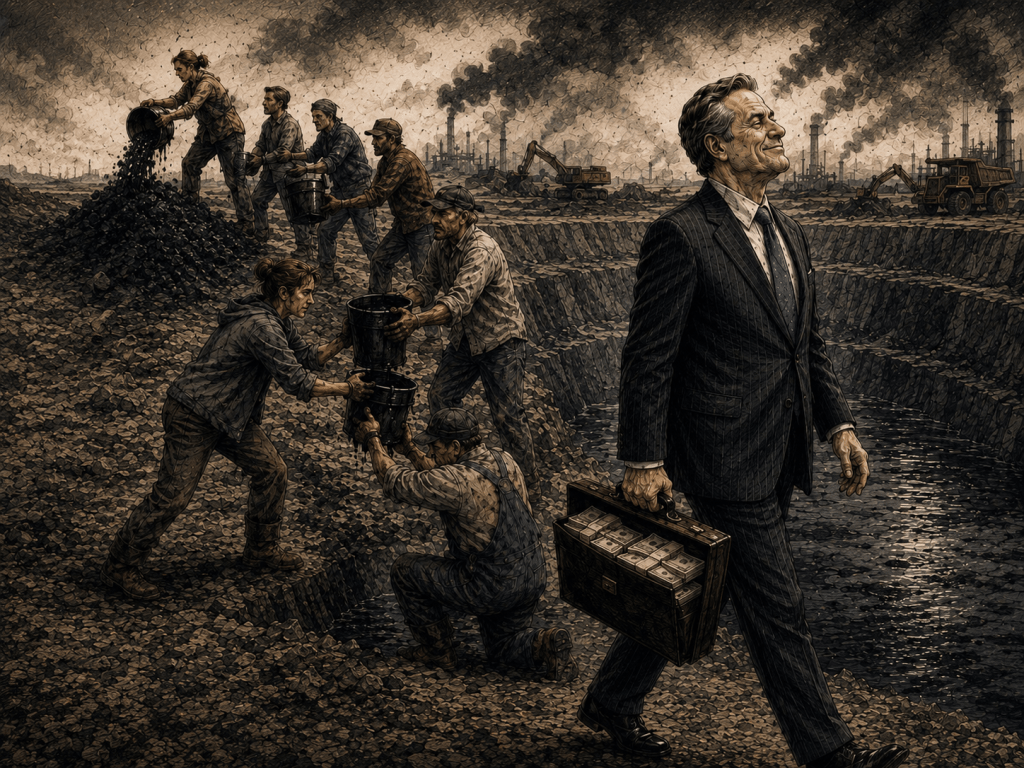
On August 3, 2015, Alpha Natural Resources filed for bankruptcy. In January 2016, Arch Coal did the same. On April 13, 2016, Peabody Energy — the largest coal company in the country, founded in 1883 selling coal off a cart in Chicago — filed too.
Between them, the three had promised to clean up their mines. The promise had a specific legal form. It was called a self-bond, and it meant a company had told regulators it was big and solvent enough that it did not need to set aside a dollar, post any collateral, or buy a surety. Its word was the guarantee. The states said fine.
The word, by April 2016, was worth what a bankrupt company’s word is worth. The reclamation behind those promises — strip mines and mountaintop sites across Wyoming and Appalachia — came to more than two billion dollars. Had the three liquidated instead of reorganized, every cent of it would have moved, in full, to the public.
Here is the part that matters. Nobody decided to do that to the public. There was no order, no memo, no meeting. A self-bond is a line in a file: the cost of an eventual cleanup, parked off the company’s books because the law let the company vouch for itself instead of funding it. The money was never set aside because it never had to be. It sat downstream, in a later year, addressed to whoever happened to be standing there when the company that made the mess stopped existing. The only reason it didn’t land in full is that the bankruptcies ran as reorganizations and not liquidations, and the public got lucky. Luck is not a system.
Twenty-four parts in, the picture doesn’t change. This is the part where the cost of doing business gets carried quietly downstream — to the next county, the next decade, the people not born yet to vote on it — because the law lets the company keep the cost off its own books until there is no company left to bill.
The Climate War Is The Part You’re Allowed To Be Angry About
The loud fight is the climate war. Believer versus denier. Jobs versus trees. They’re coming for your truck, your stove, your thermostat, your gas range, your gas can. That fight is real, it runs every night, and it is almost never where the decision got made. What you are handed is a culture war, presented as the whole story. The argument about whether the planet is warming and whose fault it is and who’s a hypocrite about it runs forever, loud, while the question of who actually pays for the mess — and when, and whether anyone is even allowed to add it up — gets settled somewhere with no cameras: in a bonding formula, a bankruptcy filing, a discount rate, a lapsed tax, a settlement schedule that runs to 2050.
So the whole post is a contrast, and it holds the way the last several have. There is the fight you’re given — the year 2100, the polar bears, your stove, the hypocrite on the other side — and there is the thing underneath it: a private profit that lands now and a public cost that lands later, pushed onto people downstream in space and in time, including the unborn, who can’t vote, can’t sue yet, and weren’t in the room. The first is loud and on television. The second is in bankruptcy dockets, bonding rules, and an Office of Management and Budget memo, if you go look for it.
And here is the door, held all the way open: you do not have to believe one single thing about the year 2100 to follow any of this. A climate skeptic can read every line and stay a skeptic. The argument here does not need a model of the next century. It needs a bankruptcy filing and a date. A bankrupt company stuck your county with a cleanup bill this year. A tax that made polluters pay for orphaned sites was switched off in 1995 and you’ve been covering it since. That happened whether or not the seas rise a foot. This isn’t a team you have to join. It’s an invoice you’ve been kept from reading.
The last post ended on the obvious question. They keep telling you the cost of all of this is just the cost of doing business, that someone always has to carry it, and better the public than the firm — so who actually ends up holding it, and for how long? This is the answer. The someone is whoever stands furthest downstream and is least able to say no. And the “for how long” turns out to be the exact part they have fought hardest to keep you from pricing.
Before the cases, the honest part, because the argument is worthless without it. Real environmental wins happened, and the government did them. Lead came out of gasoline. The acid-rain program worked and cost less than anyone predicted. The ozone treaty is why the hole is closing. That is not a footnote here; it is the spine of the whole series showing through — government can do this, when it is made to. Not every plant closure is extraction; some businesses just lost. Some environmental rules genuinely are dumb or captured, written by the very industry they pretend to bind. Cleanup really is slow and hard, for real engineering reasons and not only sabotage. And “corporations are poisoning us” is also the favorite blanket of people whose specific claim folds the second anyone checks it. Concede all of it. The pattern is still the tell.
And mostly the pattern is a consensus, and I’m not going to pretend it isn’t. Self-bonding — the move from the top of this post — is written into the Surface Mining Control and Reclamation Act of 1977 and was waved through for decades by states run by both parties. The federal minimum bond an oil and gas company had to post before drilling on public land sat unchanged from the 1960s until June 2024: ten thousand dollars to cover every well on a lease, while plugging one well runs the government somewhere between seventy thousand and a hundred sixty thousand dollars. Every administration of both kinds left that number where it was. The Superfund taxes that made the chemical and petroleum industries pay to clean up orphaned poison sites expired on December 31, 1995; Reagan, the first Bush, and Clinton had all asked to keep them, and Congress let them die anyway, and then nobody brought them back for a generation. Obama talked climate and expanded offshore drilling. Biden ran against drilling on federal land and then approved the Willow Project and more federal permits than the man before him. The structure is fifty years deep and bipartisan. There is no clean villain in it, and inventing one would be its own kind of lie.
One stretch is not symmetric, though, and pretending it is would be the opposite lie. Starting in 2025 the deferral stopped being a habit and became a program. On January 20, 2025, an executive order ordered the “social cost of carbon” — the government’s own dollar figure for the deferred bill — struck from federal decisions, and a May 5, 2025 budget memo finished the job by telling agencies to stop counting the economic damage of climate change at all unless a statute forces them. In March 2025 the EPA administrator announced what he called the greatest day of deregulation in the agency’s history, said he intended to drive a dagger through the heart of “climate-change religion,” and shut the agency’s environmental-justice offices. Congress repealed the methane waste-emissions charge by simple resolution, signed March 14, 2025, walking away from roughly seven billion dollars the oil and gas industry would have owed over a decade. The EPA pushed the deadline on the two best-known forever chemicals out to 2031, went to court in September 2025 to throw out the limits on four others, and this spring formally proposed to erase those four outright and start the rulemaking over from nothing — chemicals found above those limits in water systems serving more than seventy million Americans. And on February 12, 2026, the EPA finalized the repeal of its own sixteen-year-old finding that greenhouse gases endanger public health, the legal trigger that obligated it to regulate them at all, scrapping a decade of vehicle standards in the same package. The structure is bipartisan and fifty years old. This last turn is one-sided and barely a year old. You have to say both, and let neither cover for the other.
One more thing belongs here, because it is why none of this needs a conspiracy. Nobody signs an order to poison a town. There is no room where they decide to leave a county the cleanup bill. The cost simply is not on the company’s books, because the law lets it sit off them. The cleanest version of the trick is a phrase from a balance sheet: present value. Run a catastrophe due in 2080 through a discount rate and it costs almost nothing in this year’s filing — not because it isn’t real, but because money later is counted as worth less than money now, and “later” is where the harm lives. A self-bond does the same thing. So does a bonding minimum frozen at 1960s dollars, a tax allowed to lapse, a settlement paid in installments out to 2050. None of it requires a smoke-filled room. It requires a spreadsheet convention. That is not a conspiracy you could expose. It is an accounting boundary you could read.
The Bill Was Never Hidden. It Was Just Addressed To Later.
The cleanest way to see this is to walk it by how far downstream the bill gets pushed and how little disguise the push still bothers to wear. The first case hides behind a bond and a formula and looks like ordinary financial paperwork. The second is a tax that was simply switched off, in the open, by both parties. The third was hidden on purpose for decades and then settled with the harm scheduled out past the lifespan of the people drinking it. The fourth wears no disguise at all anymore, because the fight is now openly about whether anyone is even allowed to write the number down. The excuse gets harder to say with a straight face as you go.
The first is the bonding gap, and the cover story is “financial assurance,” which is the most boring phrase available on purpose. A company that drills a well or strips a mine is supposed to post money up front to guarantee the cleanup. The numbers do not come close. On federal land the minimum bond sat at ten thousand dollars a lease from the 1960s until June 2024, while the government’s own estimate to plug a single well runs seventy thousand dollars and up, and as high as a hundred sixty thousand in the deep ones. The Government Accountability Office found the average bond actually held was around two thousand dollars a well. The country now has close to four million abandoned oil and gas wells, more than two million of them unplugged, and the established move is for a big operator to sell its dying marginal wells cheap to a small company that predictably goes bankrupt, at which point the wells are nobody’s and the bond covers a rounding error of the cost. Same pattern in coal: that is the self-bond from the top of this post. Here is the tell. The reform finally raised the federal minimums in June 2024 — and it is already under organized pressure to be rolled back, because the gap is not a bug somebody forgot to fix. The gap is the product. It is the mechanism by which the value comes out now and the cleanup goes downstream a few years, to the same county, addressed to no one in particular.
The second is Superfund, and the cover story was a budget vote, which is a thinner costume because everyone can see it. When Congress built the toxic-waste cleanup program in 1980, it funded it with taxes on the chemical and petroleum industries — the polluter pays, the slogan the program was named for — pooled into a trust fund that paid to clean “orphan” sites, the ones where the responsible company was gone or broke. Those taxes expired on December 31, 1995. Three presidents of both parties had asked to keep them. Congress let them go, and the trust fund drained from a peak near five billion dollars to under seventy million by 2022. By the Government Accountability Office’s count, taxpayers now cover roughly four-fifths of Superfund costs, and the pace of cleanups collapsed with the money: from around seventy completed sites a year in the 1990s to about a dozen a year in the 2010s, to eight in one recent year. One in six Americans lives within three miles of one of these sites. The tell here is simple: nothing was hidden. A tax that moved the bill onto the people who made the mess was switched off, and the bill moved onto everyone else, and it stayed moved for thirty years while the fight on television was about everything except that.
The third is forever chemicals, and the disguise comes off here entirely, because the documents exist. The companies that made PFAS — 3M, DuPont and its spinoff Chemours — ran toxicity studies on these compounds in the 1970s and did not hand the science to the EPA for more than twenty years. DuPont concealed decades of its own internal research linking the chemical to disease and to contamination of the water around its plants. A study out of the University of California, San Francisco found the industry ran the tobacco playbook almost move for move: know, doubt, delay. Then came the settlements. DuPont, Chemours, and Corteva agreed in June 2023 to pay water systems about one and a fifth billion dollars. 3M agreed, days later, to up to roughly ten billion, paid out over thirteen years, the figure quoted as a present value so the future is shrunk to something payable today. In May 2025, 3M settled with New Jersey with payments scheduled to start in 2030 and run through 2050. Read that schedule again. The harm was done decades ago, the revenue was booked decades ago, and the bill is metered out in installments two and three decades into the future — for chemicals that, by definition, do not break down. They are called forever chemicals. The settlement is not forever. That gap, between how long the poison lasts and how briefly the company pays, is the whole machine in one line.
The fourth wears no costume, which is why it is the most honest one, and it is where this whole series has been heading. It is the deferred climate bill itself, and the government had exactly one official tool for putting a number on it: the social cost of carbon, the dollar figure for the damage one ton of emissions does to everyone downstream in time. Under Obama it was set around forty dollars a ton. The first Trump administration cut it to roughly a dollar or two by changing how the future gets counted. Biden adjusted it to about a hundred ninety. Then, in 2025, the second Trump administration did not argue it down. It ordered the figure out of federal decisions by executive order in January and effectively to zero by memo in May, and in February 2026 finalized the repeal of the underlying finding that greenhouse gases endanger anyone at all — the legal hook that made counting mandatory in the first place. Here is the tell, and it is the cleanest one in the post. You do not spend an administration’s political capital deleting a number you believe is fake. A number you believe is fake, you ignore. You only reach in and zero out a number that is in your way. They did not lose the bill. They turned off the thing that printed it.
What’s Real
A few honest qualifications, because the strongest version of this is the one that doesn’t pretend the other side has nothing.
The government really has done this, and done it well, and that cuts against the gloom as hard as it cuts against the deniers. Lead came out of gasoline and the country’s blood-lead levels fell off a cliff. The 1990 acid-rain program cut the pollution faster and cheaper than industry’s own forecasts. The Montreal Protocol phased out the chemicals eating the ozone layer and the layer is recovering. Those were not accidents and they were not the market. They were laws, enforced, against companies that fought them. Anyone telling you nothing can be done is selling the same resignation the polluters need you to buy, and the record says otherwise.
The coal story from the top of this post is also a concession, not just an indictment. The public did not, in the end, eat the full two-billion-dollar self-bond bill. The three companies reorganized rather than liquidated, and at the end of the bankruptcies they were forced to replace most of those worthless promises with real bonds; western self-bonding fell something like three-quarters in the years after. That is real, and worth saying plainly. But notice what saved the public: a bankruptcy structure and a market accident, not a rule that required the money up front. The system did not catch it. The dice did. A near-miss is not a safeguard, and “it mostly worked out that time” is not a design.
Some environmental rules genuinely are dumb or captured, and the honest version says so. The corn-ethanol mandate is mostly an agribusiness subsidy wearing a green vest; plenty of “clean” programs are written with industry’s pen. A serious person can believe that and still see the pattern, because the pattern is not “every rule is good.” The pattern is who ends up holding the cost when the rule is missing.
Cleanup really is slow and hard for reasons that have nothing to do with anyone’s bad faith. Pulling forever chemicals out of an aquifer, or restoring a strip mine so the watershed survives, is genuinely difficult, genuinely expensive, and genuinely takes years even when everyone is trying. Not every delay is sabotage. The argument here is narrower than that, and has to stay narrow to be true: the difficulty is real, and the difficulty is also exactly why leaving the money off the books until the company is gone is the move that does the damage.
And the companies have a real defense, which is the uncomfortable part. Most of this was legal. Self-bonding was authorized by statute. The bonding minimums were the ones on the books. Letting the Superfund tax lapse was an act of Congress, not a crime. A board that posts the minimum the law allows and present-values a settlement down to what it can pay today is not breaking a rule; it is following one, the way its job tells it to. That is exactly the problem, not the exception to it. When the rational, legal, fiduciary move is to leave the cost downstream, “they should have done the decent thing” is a wish, not an argument — and the thing to fix is the rule that made the indecent thing the rational one.
One last honest note, on a number you have heard thrown around. People quote the social cost of carbon like scripture — a hundred ninety dollars a ton, full stop, as if the figure itself settles the argument. It does not, and the strongest version of this says so out loud. That number is model-dependent and genuinely contested; it swings on a discount rate that reasonable economists fight about, and serious people who accept the science in full will tell you a single national dollar figure is the wrong instrument for the job. Strip the slogan. The plain thing underneath it does not move: there is a real cost, it lands later, it lands on people who did not choose it, and the actual fight in 2025 and 2026 was never about whether the precise figure is a hundred ninety or forty. It was about whether anyone in the federal government is allowed to write down any figure at all. You do not need the exact number to notice that the people who profit from the bill are the ones who just outlawed the calculator.
What They’re Paying For
So set what this actually produces against the fight you’re handed about the climate war. It is four things stacked together, and each one has a beneficiary you can name, which is the difference between this and yelling about “the environmentalists” or “the deniers.”
It is a cleanup left off the driller’s books by a bond worth a fraction of the job. The beneficiary isn’t abstract. It is the operator that pulled the value out of the ground and posted ten thousand dollars against a hundred-thousand-dollar problem, and the shell company it sold the exhausted wells to on the way out so the bankruptcy would be somebody else’s name. The money was never set aside because the law never made it be, and the silence cost the company nothing and was worth everything.
And it is a poison present-valued and scheduled out past the lifespan of the people drinking it. The beneficiary is the chemical maker that booked the revenue decades ago, hid the science for twenty years, and now pays the bill in installments running to 2050 — for compounds that do not leave the body or the water, ever, which is the one thing the payment schedule is built to ignore.
And it is a tax switched off so the public funds the orphans. The beneficiary is every chemical and petroleum firm that stopped paying into the Superfund trust in 1995, and the line of taxpayers who quietly replaced them and have covered roughly four-fifths of the cost ever since, while living, one in six of them, within three miles of the sites the fund was supposed to clean.
And it is the one number that put the future cost on the page, ordered to zero. The beneficiary is everyone who needed the deferred bill to be uncountable so it could keep being deferred — including the political actors who took the donations, killed the methane fee, repealed the endangerment finding, and then went on the surviving networks to be asked, gently, about gas prices. That is the bill the fight about the climate war has been keeping you from reading.
The Fixes Are Boring
The fixes are structural, not slogans, and the popular ones are mostly traps. “Ban fossil fuels, pass the whole thing now” is the loudest of them, and whatever you think of the goal, it does exactly nothing about the two million unplugged wells already in the ground or the orphan sites already on the books — it polls in some rooms, changes nothing about who holds the existing liability, and hands the people who profit a wild idea to point at so the boring ones never get a hearing. “Sue them for the whole climate bill, make them pay for 2100” is the other one, and it is a trap for a specific reason: the exact long-run number is genuinely contestable, which is the defendants’ favorite door, and the case disappears into a thirty-year fight about a discount rate instead of collecting the dated, local, already-collectible bills sitting right there. Several of these are things the country actually had and then loosened. Roughly cheapest and most immediate to genuinely hard:
- Set the bond to the real, current cost of cleanup, and index it. The money to plug the well or restore the mine has to equal the job, adjusted for depth and inflation, posted before the first hole. The diluted version is on the record: the federal minimum sat at ten thousand dollars a lease from the 1960s until June 2024 against a job that averages far more, and the fix is already under organized pressure to be rolled back.
- End self-bonding outright. A promise to clean up backed by nothing is not a guarantee; require real collateral or a real surety, with no exception for being big. The watered-down version is the status quo: the 1977 statute still authorizes it, several states still take it, and only a chain of bankruptcies and plain luck pulled more than two billion dollars of worthless IOUs back off the public.
- Reinstate and inflation-index the polluter-pays taxes. Turn the chemical and petroleum levies that funded orphan-site cleanup back on, so the public stops covering four-fifths of it. The toothless version already ran: a piece of the chemical tax came back in the 2021 infrastructure law, the broader structure did not, and even a funded trust still hangs on a yearly appropriation anyone can squeeze.
- Make end-of-life liability follow the company that drilled it. You cannot launder a cleanup obligation by selling the dying wells to a firm with a hundred dollars a well in assurance and waiting for it to fail. The rigged version is the documented industry norm: large operators offload marginal wells to undercapitalized buyers precisely because the buyers predictably go bankrupt and the wells go orphan.
- Require the deferred cost to be counted in every federal energy decision, by statute, with no discount rate allowed to define the future to nothing. Put the number back on the page and take away any administration’s power to set it to zero by memo. The rigged version is current events: the social cost of carbon was struck from federal decisions by executive order in January 2025 and zeroed for regulatory purposes by a memo that May.
- Put the duty to regulate greenhouse gases in the statute, not in a finding an agency can rescind. The obligation should not turn on one administration’s science of the month. The watered-down version already ran and failed: the 2009 endangerment finding stood sixteen years across both parties and was finalized away in February 2026, with a decade of vehicle standards scrapped in the same package.
- Make extraction carry full lifecycle liability — bonded, insured, and non-dischargeable in bankruptcy — and yes, this is the hard one. If the cost is real and lands later, the only fix that reaches the root is making it impossible to take the value now and discharge the cleanup later through a courtroom. It is last because it is genuinely hard, the line-drawing about how far liability runs is real, and the firms it touches will fight it hardest. Saying that plainly is better than pretending the list is all easy.
Six of those seven are a statute, an appropriation, or an enforcement choice — things a Congress or an administration could do without inventing anything new, several of them just by undoing a loosening from the last few years. The seventh is the genuinely hard one, and it is more honest to say so than to pretend otherwise. None of them is the radical position. The radical position, measured against the simple idea that whoever makes the mess pays to clean it up, is the one we’re already living in: take the value now, leave the bill downstream, sell the wells to a shell, and zero out the number that would have let anyone read it.
Who Is This For
Twenty-four parts in, you’ve now watched the public thing get broken on purpose, the room where you’d have heard about it get emptied, the pipe that was left get paid to look away, the proof that any of it could work get deleted in the dark — and now the cost of all of it carried downstream onto the people with the least power to send it back, including the ones who can’t vote on it because they aren’t here yet. Which leaves the question this series keeps circling toward. Was there ever anything inside the system actually built to push back on this — one institution that, when it was strong, made the people doing the extracting carry their own bill — and what happened to it? That’s the next post. Part 24B is Rebuilding Worker Power — unions as the one institutional counterweight that ever actually worked, and fifty years of taking them apart getting us exactly here. Different layer. Same question.


Leave a Reply