
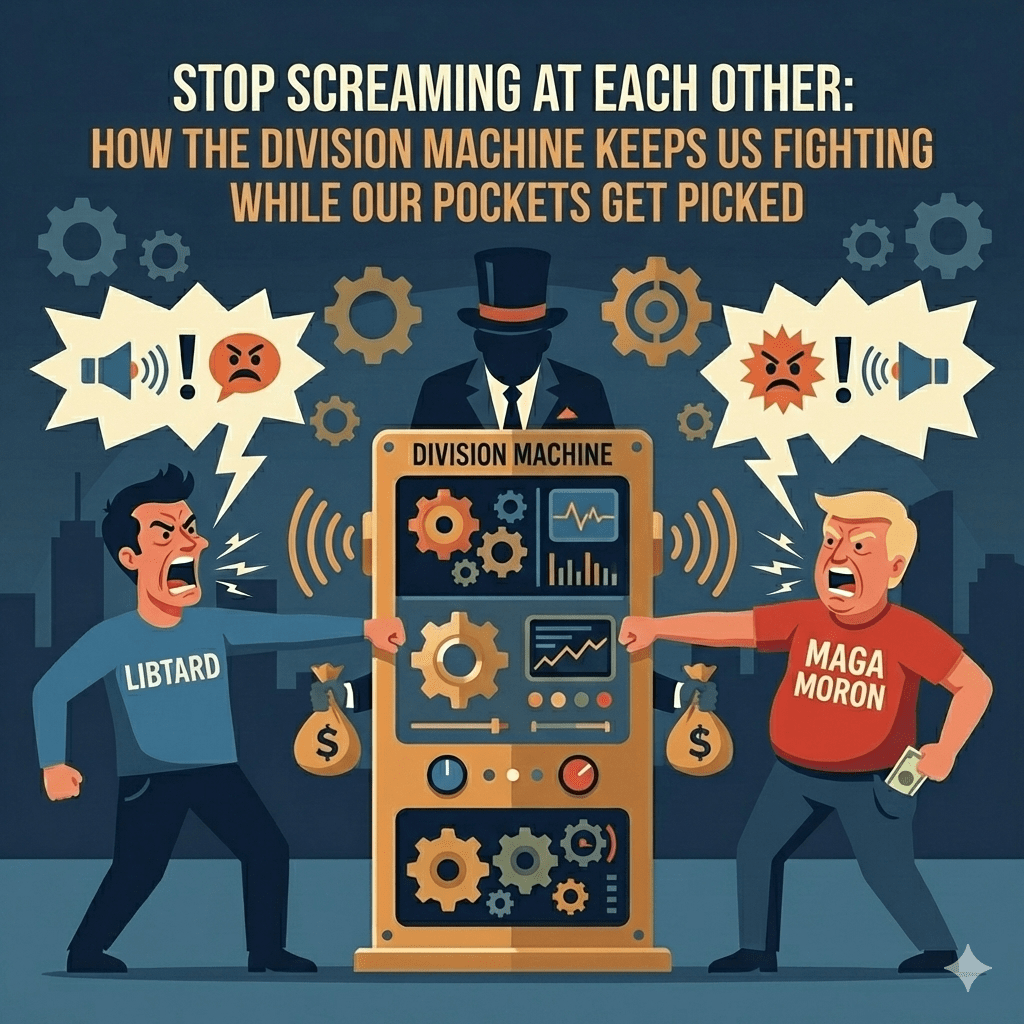
The Name-Calling Trap
Libtard. Right-wing nut. Snowflake. MAGA moron. Commie. Fascist.
We’ve all heard it. Many of us have said it. And every time we do, someone wins – but it’s not you, and it’s not the person you’re yelling at.
Americans have become increasingly polarized by design. When you’re pissed off, it’s hard to see the strings being pulled. Division keeps things exactly the same, so ask yourself: who benefits from the status quo? Not you. Not me. Not the person you’re arguing with on Facebook.
The people extracting wealth from the bottom 90% of Americans – they benefit. And they need you angry at your neighbor instead of looking up at them.
The Hard Truth: We’re All Being Played
Here’s what’s critical to remember when you’re ready to call someone a name: that person is a citizen, just like you. Most of us genuinely want to make things better. The person who disagrees with you has been coerced into having inflexible opinions – just as you may have been.
This isn’t about equivalence. The manipulation isn’t equal from “both sides” – it operates differently, targets different vulnerabilities, and serves different immediate purposes. But the outcome is the same: we keep screaming at each other while the machine keeps running.
The Right-Wing Manipulation
On the right, the coercion is sophisticated and well-funded. You’re sold “freedom” through gun rights while the rest of the platform makes you economically captive. You’re told you’re a “job creator” defender while policies ship your actual job overseas. You’re convinced that billionaires earning your yearly salary in 3 hours is “freedom” while your kid’s insulin costs $300.
The messaging is clear, simple, and repeated constantly: Government bad. Regulation bad. Taxes bad. Freedom good. It doesn’t matter that “freedom” means freedom for corporations to poison your water and freedom for your boss to fire you for getting cancer.
The Left-Wing Manipulation
On the left, the coercion is subtler but still real. You’re sold the Affordable Care Act as “healthcare reform” when it’s actually a government-mandated gift to insurance companies. You’re told incremental change is “realistic” while the top 1% extracts $79 trillion from the bottom 90% since 1975 (according to the 2023 update of the RAND Corporation study – in 2023 alone, $3.9 trillion was redistributed upward). You’re convinced that means-tested programs with Byzantine qualifications are “progressive” when universal programs would be simpler and cheaper.
The messaging is: Compromise. Be realistic. Take what you can get. Don’t scare the moderates. Meanwhile, the same corporate donors fund both parties and nothing fundamentally changes.
The Common Thread
Both manipulations serve the same master: keeping the current wealth extraction system running. One side is told the system is perfect and any change is socialism. The other side is told the system is broken but fixing it is impossible. Both messages protect the status quo.
What the Words Actually Mean (And Why That Matters)
Let’s look at what we’re actually screaming at each other:
Liberal
Modern American usage (how it’s used today): Someone who supports progressive policies including social safety nets, government regulation of business, environmental protection, expanded civil rights, and using government power to address inequality and protect vulnerable populations. Associated with the political left/Democratic Party.
Classical/True definition (original meaning): Someone who believes in individual liberty, free markets, limited government interference, personal freedom, and protection of individual rights from state power. This is closer to what Americans now call “libertarian” – emphasizing freedom from government control rather than government intervention for social good.
The contradiction: These definitions are nearly opposite on the role of government. Classical liberals wanted freedom from government tyranny. Modern American liberals want government intervention to protect people from corporate tyranny.
Why the shift happened: In the early 1900s, as corporate power grew, American progressives argued that protecting individual liberty now required government action to counterbalance concentrated wealth and power. They kept the “liberal” label but reversed its application – using government to protect freedom rather than limiting government to preserve freedom.
Progressive
Modern American usage (how it’s used today): Someone on the left wing of American politics who supports substantial government intervention to address inequality, corporate power, and systemic injustices. Advocates for policies like Medicare for All, free college, aggressive climate action, wealth taxes, strong labor protections, and breaking up monopolies. Associated with figures like Bernie Sanders and Elizabeth Warren. Often used interchangeably with “liberal” but implies more ambitious/structural reforms.
Classical/True definition (original meaning): Someone who believes in social and political reform through government action to improve society and address problems created by industrialization and concentrated power. The original Progressive Era (roughly 1890s-1920s) focused on:
- Breaking up monopolies and trusts
- Protecting workers and consumers
- Ending political corruption
- Using evidence-based policy and expertise
- Improving living conditions through practical reforms
Key similarity: Unlike “liberal,” these definitions actually align pretty well. Both classical and modern progressives see concentrated power (corporate or political) as the enemy of ordinary people and believe government should actively intervene to level the playing field.
The evolution: Original progressives like Teddy Roosevelt literally broke up Standard Oil and went after monopolies. Modern progressives want to break up Amazon and Google. The targets have changed but the core idea – that unchecked concentrated power harms society and needs aggressive government action to counter it – remains consistent.
Conservative
Modern American usage (how it’s used today): Someone who supports the Republican Party platform including: lower taxes (especially for corporations/wealthy), reduced government regulation, traditional social values, strong military, strict immigration controls, gun rights, and opposing abortion. Often paradoxically combines calls for “small government” with support for increased military/police spending and government intervention in personal decisions.
Classical/True definition (original meaning): Someone who believes in preserving existing institutions, traditions, and social structures; favoring gradual change over radical reform; skepticism toward untested ideas; fiscal responsibility; and caution about unintended consequences. Emphasis on stability, proven practices, and conserving what works.
The massive contradiction: True conservatism would mean fiscal responsibility (balanced budgets, paying down debt), preserving institutions that work (Social Security, Medicare, public education), caution about radical change (like massive tax cuts with no evidence they work), and protecting traditions (like fair competition, antitrust enforcement, worker protections).
Modern American “conservatism” often does the opposite: explodes deficits with tax cuts, attacks long-standing successful institutions, pursues radical deregulation with no concern for consequences, and abandons century-old antitrust traditions.
Right/Right-wing
Modern American usage (how it’s used today): The political right, generally synonymous with conservative/Republican positions: lower taxes, less regulation, free market capitalism, traditional values, strong military, nationalism, and opposition to progressive social policies. The “right” end of the left-right political spectrum.
Classical/True definition (original meaning): The term comes from the French Revolution, where supporters of the monarchy and aristocracy sat on the right side of the National Assembly. “Right-wing” originally meant supporting:
- Hierarchy and established power structures
- Preserving the privileges of existing elites
- Traditional authority (monarchy, church, aristocracy)
- Skepticism of equality and democratic reforms
The uncomfortable truth: The classical definition is actually more honest about what modern right-wing politics often does – it supports and preserves elite power and wealth concentration, just with different rhetoric.
Original right-wing (1789): “The king and nobles deserve their wealth and power by divine right and tradition”
Modern right-wing: “CEOs and billionaires deserve their wealth and power by market forces and merit”
Both defend extreme inequality and concentrated power, just with different justifications.
Left/Left-wing
Modern American usage (how it’s used today): The political left, generally synonymous with liberal/progressive/Democratic positions: higher taxes on wealthy, more regulation, expanded social programs, environmental protection, civil rights, labor protections, and government intervention to address inequality. The “left” end of the left-right political spectrum.
Classical/True definition (original meaning): Also from the French Revolution, where supporters of revolution and reform sat on the left side of the National Assembly. “Left-wing” originally meant supporting:
- Equality over hierarchy
- Democratic reform and expanded voting rights
- Dismantling aristocratic privilege
- Power for common people rather than elites
- Skepticism of concentrated wealth and inherited power
The consistency: Unlike “conservative” and “liberal,” this one actually stayed pretty true to its roots. Original left-wing was about reducing inequality and opposing elite power. Modern left-wing is about reducing inequality and opposing elite power.
The left-right divide has always fundamentally been about one question: Should we accept or challenge extreme inequality and concentrated power?
Why the Definitions Matter
When you understand what these words actually mean, you start to see the manipulation more clearly:
True conservatives would look at your healthcare costs tripling while outcomes get worse and say: “The old system worked better and cost less – let’s conserve what worked.” Instead, modern “conservatives” defend the radical transformation that broke these systems. They’re not conserving anything except wealth concentration.
True liberals (classical definition) would oppose government-granted monopolies and corporate subsidies as violations of free markets. Instead, modern “conservatives” who claim to love free markets defend corporate socialism – government protection for favored corporations.
True right-wing aristocrats were at least honest about defending elite privilege through heredity and divine right. Modern right-wing messaging pretends billionaires earned it all through merit while ignoring inherited wealth, rigged markets, regulatory capture, and systemic advantages. The function is the same – defending elite extraction – but the branding changed from “noble blood” to “job creators.”
The progressive label has stayed remarkably consistent – breaking up concentrated power whether it’s Standard Oil in 1911 or Amazon in 2025. The fact that both eras’ progressives are attacked as “radicals” tells you how threatening this agenda is to elite wealth.
The labels have been weaponized to keep you confused and angry. When you call someone a “liberal,” are you attacking someone who wants individual liberty and free markets, or someone who wants government protection from corporations? The word means both, which makes it perfect for sowing confusion.
The Asymmetry Problem
Here’s where we have to be honest: the manipulation isn’t symmetrical.
The right-wing apparatus is more disciplined, better funded, and more willing to lie. Fox News, talk radio, and social media algorithms create a sealed ecosystem where people genuinely believe Democrats are running child trafficking rings out of pizza parlors. The propaganda is industrial-scale and coordinated.
The left-wing apparatus is more fragmented, often elitist, and terrible at simple messaging. It gets lost in academic language and purity tests while Republican strategists reduce complex issues to three-word slogans that stick.
But here’s what matters: both keep you from looking up.
One tells you the system is perfect. One tells you the system can’t be fixed. Both are lying. Both serve the same wealthy donors. Both keep you fighting each other.
The Empathy Challenge
So how do we move past this?
First, recognize that anger is a powerful and tribal emotion. When someone believes something you find outrageous, your instinct is to attack them as stupid or evil. Resist that instinct.
That person grew up in a specific media environment. They’ve been fed specific narratives for years or decades. Their friends and family reinforce certain beliefs. Social media algorithms show them content designed to trigger outrage and confirm their existing views.
You would believe the same things if you’d been subjected to the same inputs.
This doesn’t mean their beliefs are right. It doesn’t mean you have to accept harmful policies. It means you have to shift blame from the individual to the machine that created their beliefs.
The Gun Rights Example
Take gun rights. Many Americans genuinely believe gun ownership is what keeps them free. They’ve been sold this narrative their entire lives. It feels true because it’s tied to identity, masculinity, rural culture, and genuine concerns about self-protection.
What they haven’t been sold: the rest of the platform that comes with “gun rights” actually makes them economically captive. Right-to-work laws that destroy unions. Tax cuts that explode deficits and cut services. Healthcare costs that bankrupt families. Wage stagnation while productivity soars.
The gun is the bait. The economic extraction is the trap. But you can’t reach someone by calling them stupid for taking the bait. You reach them by showing them the trap.
The “Free Stuff” Example
On the left, many Americans have been convinced that universal programs are “unrealistic” or “radical” despite working perfectly well in every other developed country. They’ve internalized that wanting healthcare without bankruptcy is “wanting free stuff” – even though they’re already paying more than anyone else in the world for worse outcomes.
This isn’t stupidity. This is decades of messaging from insurance company-funded think tanks, “centrist” politicians funded by the same corporations, and media outlets owned by billionaires who benefit from the status quo.
The Real Division: Up vs Down, Not Left vs Right
Here’s what the machine doesn’t want you to see:
A rural conservative factory worker in Ohio has more in common with an urban progressive barista in Portlandthan either has with the billionaire funding their division.
Both are:
- Working harder for less money than their parents’ generation
- Paying more for healthcare, housing, and education
- Watching wealth concentrate at the top while they struggle
- Being told their economic anxiety is someone else’s fault (immigrants, or billionaires, depending on the narrative)
The real divide isn’t left vs right. It’s the bottom 90% vs the top 1% extracting their wealth.
Breaking Free: Real Solutions
So how do we actually break the division machine? Not with better arguments or more facts – we’ve tried that. We need structural changes that remove the tools of manipulation:
1. Ranked Choice Voting
The problem: Our current system forces binary choices and punishes third parties. You can’t vote your conscience; you have to vote strategically. This creates artificial polarization.
The solution: Ranked choice voting lets you rank candidates by preference. You can vote for who you actually want without “wasting” your vote. This:
- Reduces negative campaigning (you want to be people’s second choice too)
- Allows more diverse candidates and ideas
- Breaks the two-party stranglehold
- Makes politicians appeal to broader coalitions instead of just their base
States already using it: Alaska, Maine, and multiple cities. It works.
2. Campaign Finance Reform
The problem: Politicians spend more time fundraising from wealthy donors than listening to constituents. The same corporations fund both parties. Money isn’t speech; it’s a megaphone that drowns out regular people.
The solution:
- Public financing of campaigns
- Strict limits on individual contributions
- Complete ban on corporate political spending
- Overturn Citizens United
- Real-time transparency for all donations
The impact: When politicians don’t need billionaire money, they stop serving billionaire interests. They start serving voters.
3. Break Up Media Monopolies
The problem: Six corporations control 90% of American media. This isn’t accidental – media consolidation was enabled by the 1996 Telecommunications Act. When a handful of billionaires control what you see and hear, democracy dies.
The solution:
- Restore the Fairness Doctrine (required broadcasters to present contrasting viewpoints)
- Break up media conglomerates
- Enforce antitrust against tech platforms
- Fund independent, nonprofit journalism
- Require algorithmic transparency from social media
4. Algorithmic Accountability
The problem: Social media algorithms are designed to maximize engagement, which means maximizing outrage. They create filter bubbles that radicalize people by feeding them increasingly extreme content.
The solution:
- Require platforms to reveal how algorithms work
- Ban engagement-maximizing algorithms in favor of chronological feeds
- Hold platforms liable for algorithmic amplification of disinformation
- Give users control over what they see
5. Restore Genuine Journalism Standards
The problem: “News” outlets can lie without consequences. Opinion is packaged as news. Entertainment is packaged as journalism.
The solution:
- Restore licensing requirements for broadcasters
- Require clear labeling of opinion vs news
- Create consequences for provably false reporting
- Fund investigative journalism through public grants
- Break the advertising-dependent business model
6. Education Reform Around Media Literacy
The problem: Most Americans never learned how to evaluate sources, identify manipulation, or think critically about media.
The solution:
- Mandatory media literacy education starting in elementary school
- Teaching logical fallacies and propaganda techniques
- Critical thinking skills about statistics and data
- Understanding how algorithms and social media work
7. End Gerrymandering
The problem: Politicians choose their voters instead of voters choosing politicians. This creates safe seats where politicians only need to appeal to their base, increasing polarization.
The solution:
- Independent redistricting commissions in every state
- Mathematical standards for district compactness
- Legal challenges to partisan gerrymandering
- Multi-member districts (another electoral reform option)
8. Mandatory Voting (Or Make Election Day a Holiday)
The problem: Low turnout means politicians only need to appeal to the most motivated (often most extreme) voters. Working people can’t afford to take time off to vote.
The solution:
- Make Election Day a federal holiday
- Automatic voter registration
- Mail-in voting available to all
- Or adopt mandatory voting like Australia (with “none of the above” option)
The impact: Higher turnout = politicians must appeal to median voters, not just the base = less polarization
The Path Forward: Choosing a Better Fight
Here’s the bottom line: you’re going to fight someone. That’s human nature. The question is: who?
Option A: Keep fighting your neighbors, your family, the person who disagrees with you on Facebook. Stay angry. Stay divided. Watch nothing change while your paycheck buys less, your costs rise, and your kids inherit a broken country.
Option B: Redirect that anger where it belongs – at the system designed to keep you fighting. At the politicians who serve donors instead of constituents. At the media monopolies feeding you outrage. At the billionaires extracting wealth while you argue over pronouns and flags.
The person you’re calling names isn’t your enemy. They’re a fellow victim of the same con.
Your Mission (If You Choose to Accept It)
- Stop taking the bait. When you feel the urge to call someone a name or dismiss them as stupid, pause. Ask yourself: who benefits from this division?
- Shift your language. Instead of “those idiots believe X,” try: “the propaganda machine has convinced people that X.” Attack the manipulation, not the manipulated.
- Find common ground. That conservative who hates government? They probably also hate corporate bailouts and monopolies. That liberal who wants government programs? They probably also want those programs to be efficient and non-corrupt. Start there.
- Focus on the bottom 90%. When discussing any policy, ask: “Does this help or hurt regular people?” Not corporations. Not billionaires. Regular people. That’s your coalition.
- Support structural reforms. Ranked choice voting. Campaign finance reform. Breaking up monopolies. These aren’t sexy, but they’re how you actually break the machine.
- Practice empathy without surrender. Understanding why someone believes something doesn’t mean accepting harmful policies. But you can’t change minds by attacking people – only by showing them they’ve been lied to.
- Look up, not sideways. Every time you’re about to blame immigrants, or blame rural voters, or blame “the libs,” or blame “the deplorables” – stop. Look up. The people extracting your wealth are up there, not next to you.
The Choice
We can keep playing the game we’ve been handed – left vs right, liberal vs conservative, red vs blue. We can keep screaming at each other while the top 1% extracts another $79 trillion from the bottom 90%.
Or we can realize we’ve all been had. We can stop fighting each other and start fixing the system.
The machine wants you angry at your neighbor. Don’t give it what it wants.
Choose a better fight. Choose the bottom 90% vs the system extracting our wealth. Choose empathy for the manipulated and fury at the manipulators. Choose structural reform over tribal warfare.
The people you’re fighting with on social media? They’re not your enemy.
The system that keeps you fighting? That’s your enemy.
Now stop yelling and let’s fix this thing.
Take Action
- Support ranked choice voting in your state or city
- Demand campaign finance reform from your representatives
- Share this post with someone you disagree with politically – start the conversation
- Join Fix America Now – a movement for the bottom 90%
- Vote in every election, especially primaries where structural reforms are decided
- Support independent journalism that investigates power instead of creating division
The system only works if we stay divided. Let’s break it.
 Even that's Odd
Leave a comment