
The Manufactured Outrage Economy
Every morning, millions of Americans wake up angry. Not about their own lives necessarily, but about something they saw online, something Tucker Carlson said, something AOC tweeted, or some university policy they read about in a viral post. The outrage is real. The threat feels immediate. But the machinery creating and amplifying that outrage? That’s something most people never see.
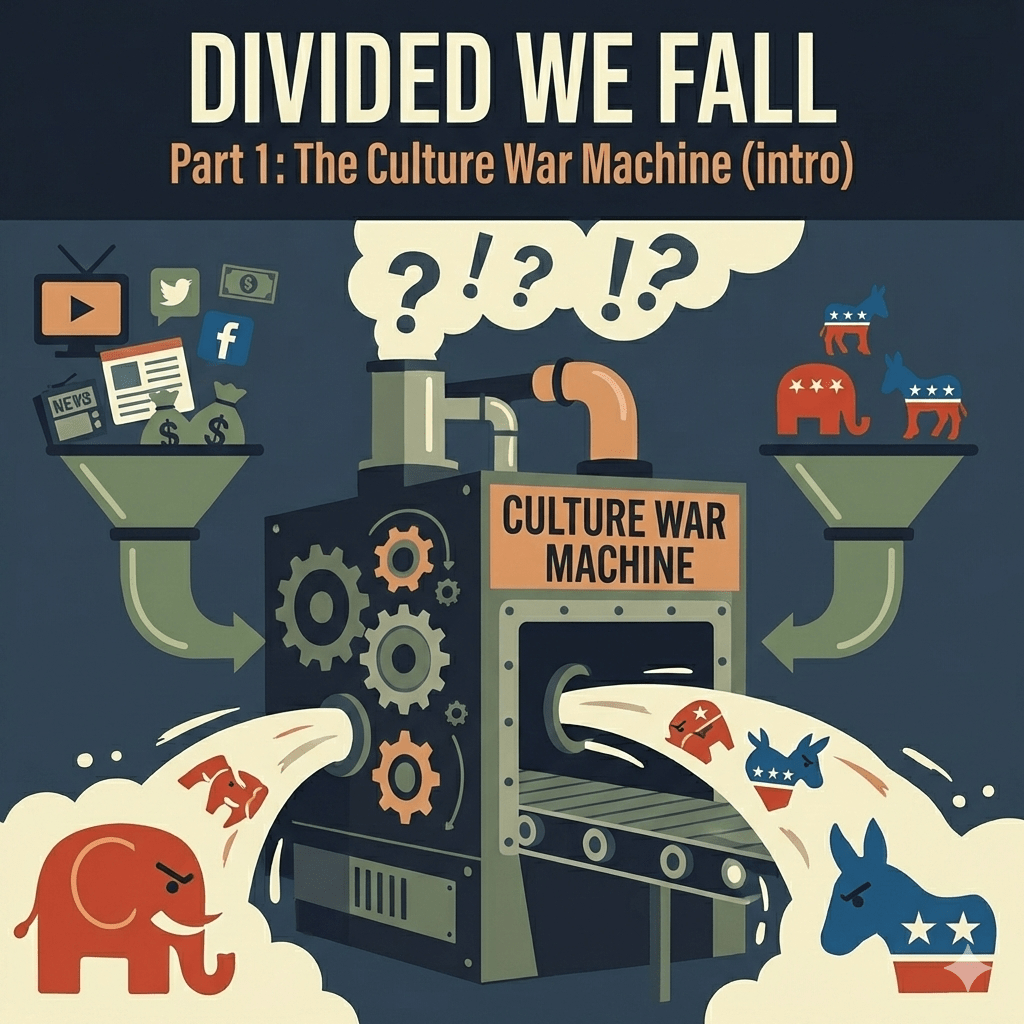
Welcome to the culture war machine—a sophisticated ecosystem of media outlets, political operatives, think tanks, and social media algorithms designed to keep Americans perpetually enraged at each other over symbolic issues while structural problems go unaddressed.
This isn’t a conspiracy. It’s a business model. And it’s working exactly as intended.
How We Got Here
The culture war isn’t new. Americans have always fought over values, identity, and the direction of the country. What’s different now is the infrastructure. The internet and social media didn’t just amplify existing tensions—they monetized them. Outrage generates clicks. Clicks generate revenue. And revenue incentivizes more outrage.
In the 1990s and early 2000s, conservative talk radio and Fox News pioneered the outrage business model on the right. Rush Limbaugh made a fortune keeping listeners angry about feminists, environmentalists, and “the liberal media.” Fox News refined this into a 24/7 operation, turning every story into a battle between “real Americans” and coastal elites trying to destroy their way of life.
The left developed its own ecosystem too, though it took longer to coalesce. MSNBC, progressive podcasts, and activist Twitter created spaces where every Republican policy was framed as an existential threat to democracy, civil rights, or the planet itself.
But the real acceleration came with social media algorithms. Facebook, Twitter, and YouTube discovered that emotional content—especially anger and fear—keeps users engaged longer than rational discourse. So their algorithms learned to promote it. A nuanced take on immigration policy gets 50 likes. “THEY’RE DESTROYING AMERICA” gets 5,000 shares and tens of thousands of comments. The algorithm learns: outrage wins.
The Anatomy of a Culture War Issue
Not every political disagreement becomes a culture war flashpoint. The issues that do share specific characteristics:
They’re symbolic rather than material. Culture war issues are about identity, values, and “who we are as a country.” They’re about flags and pronouns and what gets taught in schools. They’re rarely about wages, healthcare costs, or the price of housing—issues that directly affect people’s material well-being but don’t generate the same emotional heat.
They’re easily simplified into tribal markers. You can tell which “side” someone is on based on their stance. Support for trans rights, opposition to Critical Race Theory, views on police funding, opinions about Christmas greetings—these become badges of tribal affiliation more than carefully considered policy positions.
They allow for endless engagement without resolution. Unlike policy debates that can end with legislation, culture war issues can be relitigated infinitely. There’s always a new university controversy, a new corporate diversity initiative, a new children’s book to be outraged about. The content is inexhaustible.
They benefit from ambiguity and anecdote. Culture war narratives thrive on stories rather than statistics. One viral video of a college student saying something extreme becomes “this is what they’re teaching our kids.” One corporate training document becomes “woke capitalism has taken over.” The plural of anecdote isn’t data, but in the culture war, anecdotes are more powerful.
The Economic Incentives
Here’s what most people don’t realize: the culture war is extraordinarily profitable. Not for you or me, but for the people operating the machinery.
Conservative media outlets raise hundreds of millions through outrage-driven fundraising. Every email about “woke mobs” or “cancel culture” ends with a donate button. Every segment about critical race theory or drag queens in schools drives viewers to buy gold, supplements, or survival gear from advertisers who know their audience is already primed for fear-based purchasing.
Progressive media and activist organizations operate similarly, just with different villains. Every alert about Republican threats to democracy, voting rights, or reproductive freedom generates donations. The business model is identical: keep the base frightened and angry, then convert that emotion into revenue.
Political consultants and think tanks have discovered that culture war content is cheaper to produce than serious policy analysis and generates far more engagement. Why fund a detailed white paper on healthcare reform when a tweet about pronouns will get 10,000 times more attention?
Social media platforms profit from the engagement. The angrier you are, the more you scroll. The more you scroll, the more ads you see. Facebook and Twitter aren’t neutral platforms—their business models depend on keeping you emotional and engaged.
“Fake News”: Destroying Shared Reality
One of the most effective tools in the culture war machine is the weaponization of “fake news.” The term itself has been turned into a weapon: any information that challenges the narrative can be dismissed as “fake news” without engaging with its actual content.
Donald Trump popularized the modern use of “fake news” during his 2016 campaign and presidency. Any negative coverage—even coverage based on his own documented words and actions—could be dismissed as “fake news.” The term evolved from describing actual misinformation to meaning “news I don’t like.”
This serves a crucial function in the culture war machine: it destroys shared reality. When people can’t agree on basic facts, productive debate becomes impossible. Everything becomes tribal. You don’t evaluate information based on evidence—you evaluate it based on whether it comes from “your side” or “their side.”
How the playbook works: The process works like this:
1. Attack credible sources: When news organizations report something unflattering but true, label it “fake news.” Don’t engage with the actual facts—just attack the source.
2. Promote alternative sources: Push your audience toward sources that tell them what they want to hear, regardless of accuracy. Fox News, OAN, Newsmax on the right. Partisan outlets on the left. These sources prioritize confirming existing beliefs over challenging them.
3. Encourage “do your own research”: Encourage people to “do your own research”—which in practice means finding sources that confirm what you already believe. This sounds like critical thinking but often leads people down conspiracy theory rabbit holes.
4. Delegitimize fact-checking: Frame any attempt at fact-checking or media literacy as itself biased. Fact-checkers are “liberal.” Media literacy programs are “indoctrination.” This immunizes people against correction.
The result: separate realities. The result: people live in separate information ecosystems. An event happens. One ecosystem reports it accurately. Another ecosystem denies it happened, claims it was staged, or frames it completely differently. There’s no shared set of facts to even begin a conversation.
This isn’t just about political disagreement—that’s always existed and is healthy. This is about the inability to agree on what actually happened. And without shared reality, democracy can’t function.
Social media accelerates this: Misinformation and propaganda have always existed. What’s changed is the speed and scale. Social media algorithms amplify emotionally charged content—true or false—because it drives engagement. A false story that makes people angry spreads faster than a true story that makes them think.
Studies show false news spreads 6 times faster on Twitter than true news. The most viral content isn’t the most accurate—it’s the most emotionally provocative. Platforms have tried to address this, but their business models still depend on engagement, and outrage engages.
Why this matters for wedge issues: Here’s the critical point: “fake news” accusations serve the culture war machine perfectly. They enable all the other wedge issues we’ll examine in this series:
• Climate science? Fake news from biased scientists.
• Voter fraud data showing it’s rare? Fake news from the liberal media.
• Studies on gun violence? Fake news from anti-gun activists.
• Economic data on inequality? Fake news from socialists.
• Public health information? Fake news from Big Pharma.
Once you can dismiss any inconvenient truth as “fake news,” you can maintain any belief regardless of evidence. This is how the culture war machine sustains itself: by making it impossible to have factual disagreements, it ensures everything becomes tribal warfare.
The Wedge Strategy
Here’s how culture war issues are deliberately manufactured and deployed:
Step 1: Find the wedge. Find a complex issue with legitimate concerns on both sides. Healthcare, immigration, education—these are genuinely difficult policy questions with trade-offs.
Step 2: Remove nuance. Strip away all nuance. Turn it into a binary choice. You’re either pro-life or pro-abortion. Either you back the blue or you support criminals. Either you support parental rights or you want the government to indoctrinate children. There’s no middle ground, no room for complexity.
Step 3: Make it tribal. Attach moral weight. Make it a test of character, values, and tribal loyalty. This isn’t about policy anymore—it’s about what kind of person you are. Good people believe X. Bad people believe Y.
Step 4: Amplify extremes. Feed the outrage machine. Find the most extreme examples from the other side. Amplify them. Make them seem representative. Use them to prove that the other side is not just wrong but dangerous.
Step 5: Never let it end. Repeat endlessly. Every news cycle, every election, every fundraising email. Keep it in front of people constantly so they never have time to think about material issues like wages, healthcare costs, or housing affordability.
What gets ignored: While we’re fighting about pronouns, abortion, guns, and whether Mr. Potato Head should be gender-neutral, here’s what gets less attention:
• Wages have been stagnant for 40 years while productivity increased 60%
• Healthcare costs are bankrupting families
• Housing is unaffordable in most major cities
• Student debt totals $1.7 trillion
• Infrastructure is crumbling
• Climate change is accelerating
• Wealth inequality is at historic highs
These are material issues that affect people’s daily lives. They’re also issues where the public might find common ground across party lines if they talked about them. Working-class Trump voters and working-class Biden voters both struggle with healthcare costs and stagnant wages. But if they’re focused on fighting each other over culture war issues, they’ll never realize they have shared interests.
Both Sides Participate
This isn’t a “one side is good, one side is bad” analysis. Both major political parties benefit from culture war politics. Both participate in the outrage economy. Both use wedge issues to avoid addressing structural problems.
Republicans use culture war issues to distract their base from economic policies that primarily benefit the wealthy. When Republican voters are focused on fighting over CRT, trans athletes, and “woke corporations,” they’re less likely to notice that Republican tax cuts overwhelmingly benefit the rich or that Republican healthcare proposals would leave millions uninsured.
Democrats use culture war issues to energize their base and avoid difficult conversations about economic policy that might alienate corporate donors. When Democratic voters are focused on fighting racism, protecting voting rights, and defending LGBTQ+ people, they’re less likely to push for policies like Medicare for All or wealth taxes that powerful interests oppose.
The culture war serves both parties’ establishments by ensuring we argue about symbolic issues rather than material redistribution. Both sides profit from keeping us divided.
Moving Forward
The culture war isn’t going away. The incentives are too strong, the infrastructure too established, the business model too profitable. But understanding how it works is the first step toward not being manipulated by it.
In this series, we’ll examine specific wedge issues: abortion, guns, immigration, climate change, voting rights, and more. In each case, we’ll look at:
• What the actual evidence shows
• How the issue is deliberately polarized
• Who benefits from the division
• What gets ignored while we fight
The goal isn’t to tell you what to think about these issues. The goal is to show you how you’re being manipulated to think about them in unproductive ways. You can still hold strong positions. You can still have genuine disagreements. But you should recognize when those disagreements are being manufactured, amplified, and monetized by people who benefit from keeping you angry.
The culture war machine doesn’t help us resolve genuine policy disagreements. It profits from making them worse. It turns neighbors into enemies. It replaces persuasion with performance. It makes us all dumber and angrier.
Both sides participate in this. Both sides profit from it. And both sides are doing damage to our political culture in the process.
But once you see how the machine works, you can’t unsee it. And that’s where change becomes possible.
 Even that's Odd
Leave a comment