
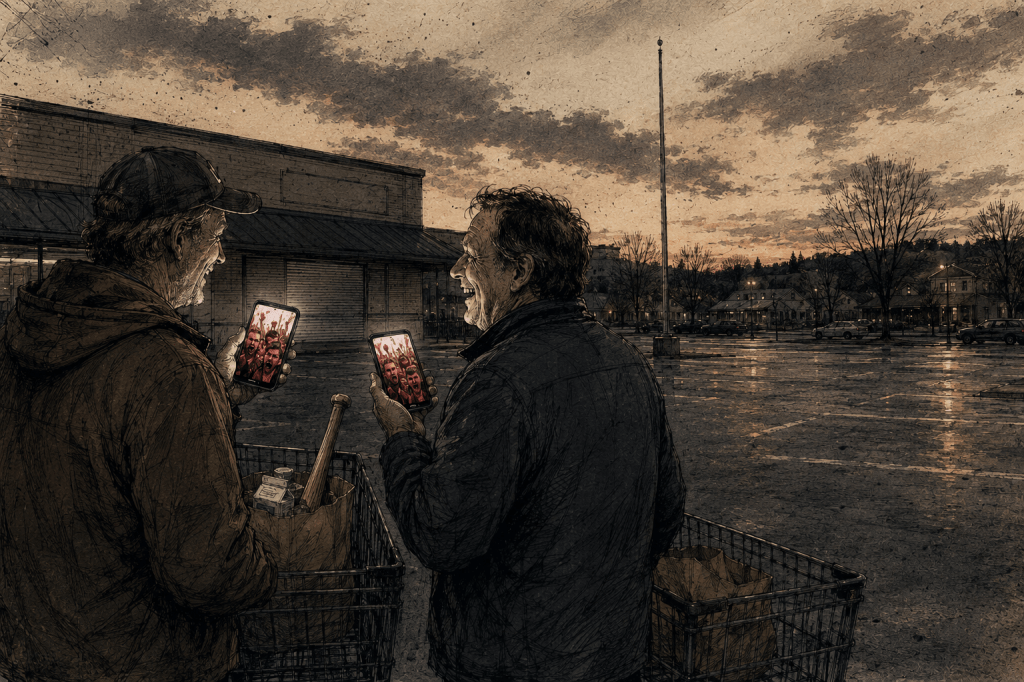
This is going to be a ten-part series. Part 1 is the framing post — the thing about the culture war machine that explains the rest. Let me start where I live.
I write this blog from a town in the Hudson Valley with a population under six thousand. I spent twenty-five years working in cable television, the last fifteen of those inside the NBCUniversal building in Manhattan. I have two kids in middle school and high school. I coach a travel baseball team on weekends. I shop at the same grocery store as people who voted for Trump twice and people who consider the second term a national emergency. We talk about youth baseball, the weather, the road work on 208, whose kid hurt their wrist. We don’t talk about politics, and when we do it’s quick and careful. None of us are screaming at each other in real life.
But online we are. Or rather, somebody is, in our names. Every morning a few million Americans wake up angry about something they saw on a phone — what some senator said, what some university did, what some kid’s TikTok suggested, what some retail chain put on a shelf. The outrage feels real because the emotion is. The thing creating and amplifying it, though, is something most people never see.
The culture war isn’t new. Americans have always argued about values, identity, and direction. What changed is the infrastructure. Outrage generates clicks. Clicks generate revenue. Revenue incentivizes more outrage. In the 1990s Rush Limbaugh proved you could make a fortune keeping listeners angry at feminists, environmentalists, and “the liberal media.” Fox News scaled that into a twenty-four-hour operation. MSNBC eventually built a left-leaning version of the same model. Then social media discovered that emotionally charged content — especially anger and fear — keeps people scrolling longer than thoughtful content does, so the algorithms learned to promote it. A nuanced piece on immigration gets fifty likes. A capital-letters tweet calling the other side a threat gets fifty thousand. The platform isn’t neutral. It’s optimized.
I noticed it most clearly from inside the television business. I helped run creative operations at Bravo, Oxygen, and Universal Kids. The ad-supported model decides what gets produced and what doesn’t. Programming that keeps a viewer through the commercial break wins. Programming that doesn’t dies. The math is brutal and honest. And once you understand it from the production side, you can’t watch cable news without seeing it everywhere. The shouting isn’t an editorial accident. It’s the format performing.
Why these issues, specifically
Not every disagreement becomes a flashpoint. The ones that do tend to share a few features. They’re about symbols and identity rather than money — flags, pronouns, what gets taught in a fifth-grade classroom, what’s printed on a coffee cup at Christmas. They sort cleanly into tribes, so you can read someone’s lawn signs and predict their other positions accurately ninety percent of the time. They have no resolution point, the way a tax-rate fight has a resolution point, so they can be re-litigated forever. And they run on stories more than statistics: one viral video of a college student saying something absurd becomes “this is what they’re teaching our kids,” even when the kid in the video isn’t representative of anything except that they were filmed.
The issues that don’t run this way — wages, housing, healthcare costs, what a hospital bill looks like — affect everyone’s lives more concretely. They also generate far less heat per dollar of attention, which is why they get less coverage. There’s no good villain in a housing-cost story. There’s a great villain in a pronoun story. Cable news producers and social media algorithms pick accordingly.
Money flows downstream of all of that. Conservative outlets raise hundreds of millions on outrage-driven email lists ending in a donate button. Progressive outlets and activist groups operate on the same model with different villains. Political consultants discovered that culture-war content is cheaper to produce than serious policy analysis and gets ten thousand times the engagement. Social media platforms take a cut. The whole stack is incentivized to keep us angry, because angry is engaged, and engaged is monetizable.
What the fight is for
While the culture war runs on cable, on the phone, and in the comment section, here’s what we don’t talk about. American wages have been roughly flat in real terms for forty years while productivity grew about sixty percent. Healthcare costs are a leading cause of personal bankruptcy. Housing in most cities and increasingly most suburbs is unaffordable for an entry-level worker. Student debt totals around $1.7 trillion. Infrastructure is past replacement age in most of the country. Wealth concentration is at a level not seen since the 1920s.
Those are issues with real material consequences. They’re also issues where a Trump voter and a Harris voter at the next Little League game would, if they got past two beers, probably agree on more than they’d disagree. They both think the system is rigged. They disagree about who’s doing the rigging and what to do about it. But the agreement on the underlying problem is real, and the people who benefit from the current rigging would prefer that agreement never get noticed. Keeping us focused on pronouns and Christmas greetings and what some celebrity did at the Oscars accomplishes exactly that.
Both parties benefit from this. The Republican establishment uses culture war material to keep a working-class base mobilized around symbolic issues, which lets them keep passing tax policy that benefits the very top. The Democratic establishment uses culture war material to keep a college-educated base mobilized around symbolic issues, which lets them avoid economic positions that might alienate the corporate donors who fund them. It’s not a both-sides-are-equally-bad claim. The flavors are different and the policy stakes are not symmetric. But the structural dynamic — keep the base hot about symbols, leave the wallet alone — runs through both.
Fake news, and shared reality
Worth saying out loud what “fake news” became. It started as a real category — fabricated stories built to look like journalism. Then Donald Trump turned the phrase into a weapon and used it to mean “any reporting I don’t like.” A negative story about him became fake news. A negative story about his administration became fake news. Eventually any inconvenient fact — climate science, voting integrity reports, vaccine data, economic statistics — could be dismissed without engaging it. The label was the argument.
What that did, slowly and then quickly, was destroy shared reality. When two people watching the same event can’t agree the event happened, you can’t have a debate about it. You can only have a fight. A 2018 MIT study found false news spreads about six times faster on Twitter than true news, because the false stuff is engineered to make you feel something. The platforms knew this and adjusted around it. The result is two news ecosystems with almost no factual overlap, both convinced the other one is the propaganda. Democracy needs at least some agreement on the underlying facts. We have less and less of that.
I don’t have a tidy answer for any of this. The incentives are too strong, the infrastructure too built out, and the people who profit from it are well-funded and reasonably good at what they do. But I can tell you what this series is going to try.
Each part takes one specific wedge issue — abortion, guns, immigration, climate, public media, voter fraud, CRT and DEI, cancel culture, schools — and looks at what the actual evidence says, how the issue is being deliberately polarized, who benefits from keeping it hot, and what gets ignored while we’re fighting about it. The goal isn’t to tell you what to believe. It’s to show you how you’re being managed.
You can still hold strong positions on any of these. You can disagree with me on most of them. But once you can see the machinery operating, you can’t really un-see it. That’s the part I want to get to.


Leave a Reply