
2010-2026
So we had a well. It produced water. The lab said the water was safe. We were good to go, right?
We were not good to go.
The lab test for your certificate of occupancy checks for bacteria and major contaminants. What it doesn’t test for is whether you’ll be living with hard water deposits, sulfur smell, iron staining, sediment in your kids’ bath, and a years-long odyssey through every water filtration option known to modern plumbing.
This is the story of how I went from “the water tested fine” to having seven stages of filtration before water reaches our house. It’s a tale of trial and error, untrustworthy local experts, and learning that sometimes you just have to figure it out yourself.
The Honeymoon Period
At first, the water seemed fine. Clear. No obvious smell. We moved in, started using it, and thought we’d dodged a bullet.
Then we started noticing things.
Mineral deposits on the shower glass. White crusty buildup around faucets. A faint sulfur smell—not overwhelming, but definitely there. Hard water spots on dishes.
“We should get a water softener,” Jennifer said.
I agreed. This seemed like a normal, solvable problem. People have hard water. People get softeners. Problem solved.
Oh, how naive we were.
The Water Softener Solution (That Solved Nothing)
I did my research online. I found US Water Systems, read reviews, and ordered a salt-backwash water softener system. The company assured me it would handle hard water AND low levels of sulfur. Two birds, one stone!
I would have preferred a salt-free system, but those got mixed reviews at the time. Looking back, our water probably wasn’t hard enough that a salt-free system wouldn’t have worked perfectly fine.
First mistake: Self-diagnosing based on internet research instead of getting proper local water testing and expertise.
Second mistake: Trusting that one system would solve all our problems.
My friend installed the softener in the first year or two after we moved in. The softener did its job—the hard water problem went away. The sulfur smell was occasionally still there, and we still got red stains. But at least the water was softer.
2011: Adding the First Filter
In 2011, I added a Big Blue particle filter after the well tank and before the water softener. This was a 10-5 micron stepped filter.
Then I noticed something weird: the particle filter housing was filling up with pebbles. Actual pebbles. From 250 feet underground in my well.
The water got softer. The egg smell was still there occasionally. We still got red stains.
This was not going according to plan.
The Untrustworthy Local Expert #1
At some point I called the guy who drilled our well. “Could tannins be getting into our water?”
“No,” he said. “Call this local water treatment company. They know the area and deal with problem wells.”
The water treatment company came out. Tested the water. I also sent a sample to a lab to test for iron and tannins.
His test: negative for iron.
Lab test: low levels of iron AND tannins.
The water treatment guy insisted it wasn’t iron. He suggested we swap out the softener media for something that would remove tannins.
We did. It didn’t work.
I called him back. He became unresponsive. Just stopped returning calls. I’d already paid him, so I was out that money and no closer to a solution.
The Untrustworthy Local Expert #2
I found another highly-reviewed local company. The owner started out very helpful. He suggested I flush everything with bleach, then with Iron Out.
I did. It didn’t solve the problem.
When it became clear I needed an iron filter, he stopped responding too.
Local “experts” were apparently allergic to actually solving problems once the easy fixes didn’t work.
2015: The Filter Explosion
By 2015, I’d had enough. I decided to go nuclear on filtration.
First, I added a Rusco spin-down filter before the well tank. Yes, I know you’re not supposed to do this. The pressure tank needs unrestricted flow from the well. But I didn’t know that yet, and I was desperate.
I started the Rusco filter at maybe 5 or 10 microns. It clogged almost immediately—probably from fine clay sediment from the fracking we’d done. The well driller never mentioned this might be an issue.
I kept bumping up the micron rating—10, 20, 50, 100—until it basically just caught large pebbles and let everything else through.
I’m lucky I didn’t burn out the well pump during this trial-and-error period. The filter did clog a few times while I was sizing it up, but somehow the pump survived.
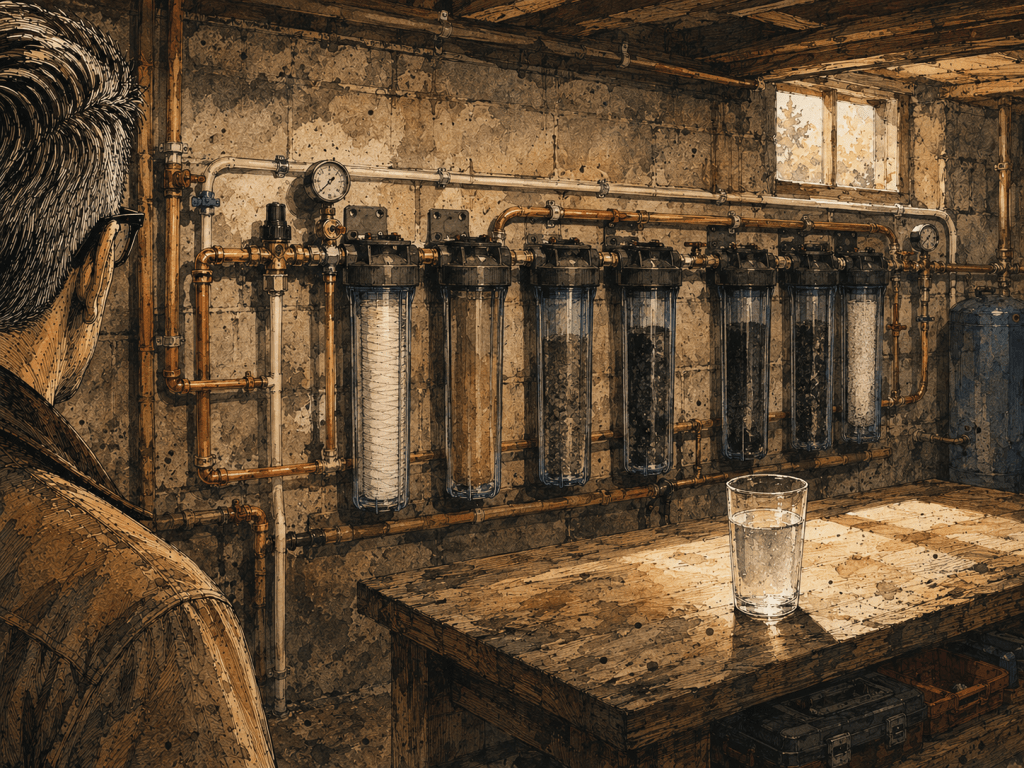
Then I went crazy with Big Blue filters. I added TWO MORE Big Blue filter housings after the single one I already had, for a total of THREE Big Blue housings before the water softener:
- 50-5 micron particle filter – First stage
- 10-1 micron particle filter – Second stage
- 5 micron carbon filter – For taste and odor
The carbon filter helped with the sulfur odor, but nothing else was noticeable. The filters still turned red from iron. The particles were reduced, but we still had the red staining problem.
Current system (2015): Rusco spin-down (before tank—wrong but working) → Well Tank → 50-5 micron particle → 10-1 micron particle → 5 micron carbon → Water Softener → House
2022: The Iron Filter Finally Arrives
By 2022—yes, ELEVEN YEARS after we moved in—I finally broke down and got an iron filter.
Back online I went. I researched iron filters. I found one that would backwash on a set schedule instead of every evening (important because I had well regeneration issues and needed to time backwash cycles so they didn’t overlap with the softener).
The company suggested adding a Rusco spin-down filter before the iron filter. But I’d learned my lesson about clogged filters, so instead I bought another Big Blue housing to put before the iron filter.
I hired our tile guy (more on him in the bathroom post) to install it because at this point I trusted him more than any water treatment company.
Here’s what I did with all those filters:
- I took all the filters OUT of the triple Big Blue housings except for a 10-1 micron particle filter to catch anything getting into the system from the well tank
- I left the other two Big Blue housings in place but EMPTY—just empty filter housings sitting there in the line
- Added the new Big Blue housing with a particle filter before the iron filter
Current system (2022): Rusco spin-down → Well Tank → 50-5 micron Big Blue → Iron Filter → 10-1 micron Big Blue → Empty Big Blue housing → Empty Big Blue housing → Water Softener → House
Finally—FINALLY—the red staining started to clear up.
But the 10-1 micron filter was still catching a lot of debris, so I eventually swapped things around again and went back to 50-5 micron, then 10-1 micron, then empty filter housing.
The Indirect Water Heater Problem
Here’s something nobody tells you: even after you fix your water treatment, you still have years of accumulated iron and sediment in your water heater tank and well tank.
We had an indirect water heater tank that had been collecting iron and sediment for 15 years. Same with the well tank bladder. So we’d still get rust coloration in our hot water even after the iron filter was working.
Eventually both our boiler and well tank bladder died (because of course they did). We switched to a combi-boiler and lost the indirect tank, and we swapped out the well tank.
With fresh tanks, the only residual iron was what was left in the pipes and in our water treatment tanks. But even that staining finally cleared up, and the egg odor is now completely gone.
The Current System (After 11 Years of Evolution)
Here’s what we have now, in order from well to house:
- Rusco spin-down filter (before pressure tank) – Catches large rocks and sediment
- Yes, I know this is wrong. It works. I’m not changing it.
- Pressure Tank – Does pressure tank things
- 50-5 micron Big Blue particle filter – First stage of real filtration
- Iron filter – Removes iron through backwash cycle
- 10-1 micron Big Blue particle filter – Fine particle filtration
- Empty Big Blue housing – Monument to overengineering
- Water Softener – Handles hardness
Then to the house for use.
Is it complicated? Yes.
Is it ridiculous? Probably.
Does it work? Absolutely.
Did it take 11 years to get here? Unfortunately, yes.
What I Should Have Done
Looking back with the clarity that only comes from years of suffering: get comprehensive water testing from a reputable lab before you buy anything—not just the CO test, but a full panel for iron, hardness, pH, sulfur, tannins, and sediment levels. Install a salt-free softener with an iron filter from day one (our water wasn’t that hard; salt-free would have been fine and wouldn’t require backwash drainage). Plan proper space in the basement for filtration. Leave room for expansion. Accept that well water means filtration. Budget for it. Embrace it.
What I actually did: spent ELEVEN YEARS adding filters one at a time, trusting untrustworthy local companies, doing my own research, making mistakes, and eventually stumbling into a system that works through sheer persistence.
The Costs Add Up
Let’s talk money (spread over 11 years):
- Initial water softener: $1,500
- First failed media swap: $400
- Rusco spin-down: $150
- Various Big Blue housings: $600
- Iron filter (2022): $1,200
- Filters (ongoing): $200-300/year × 11 years = $2,500-3,300
- Wasted money on unhelpful “experts”: $800
- Time spent researching and installing: Incalculable
Total invested in water filtration: ~$7,000-8,000+
What it would have cost if I’d done it right the first time: Probably $2,500
The Things Nobody Tells You
Filter maintenance is real. Every 3-6 months, I’m changing filters. It’s a whole production. Turn off water. Depressurize system. Unscrew giant filter housings. Replace filters. Clean housings. Reassemble. Repressurize. Check for leaks. It’s like an oil change for your house.
Backwash timing matters. The iron filter and softener both backwash. They can’t run at the same time or you run out of water. I had to program them on offset schedules. This took way more thought than it should have.
Sediment never stops. That fracked well? It’s the gift that keeps giving. The spin-down filter catches rocks. Actual rocks. From 250 feet underground. How are there still rocks down there?
Empty filter housings haunt you. I have an empty Big Blue housing in the line. I installed it thinking I’d need it. I don’t. But it’s there. Plumbed in. Empty. Mocking me. I keep meaning to use it for something. Maybe reverse osmosis? Another carbon filter? A time capsule?
Residual contamination is real. Even after you fix the source problem, you still have years of accumulated crud in your tanks and pipes. Budget for replacing those tanks eventually.
What Actually Matters Now
Fifteen years later, with perspective:
The water is clean. It doesn’t stain. It doesn’t smell. Our kids bathed in it without mysterious particles appearing. We can drink it. Dishes come clean. Showers don’t leave residue.
Yes, I have an absurdly complicated filtration system. Yes, it cost too much. Yes, it took 11 years to get right. Yes, I could have avoided half of it with better planning.
But it works. And in a house full of things that broke or needed redoing, the water system—once I finally got it right—has been reliable.
The empty filter housing still bothers me though.
Grade: A- on the destination, C+ on the path. Eleven years to clean water. Two local “experts” who ghosted me when the easy fixes failed. Big Blues stacked one at a time as new symptoms appeared. Iron filter finally in 2022. Fresh well tank in 2026. The water is clean now. The empty Big Blue housing is still in the line, still empty, still mocking me.
Next up: Part 6 — Foundation, Basement, and Future Regrets. In which we pour concrete, make decisions we’ll regret about ceiling heights, and learn that “we’ll finish the basement later” is a lie we tell ourselves.


Leave a Reply