
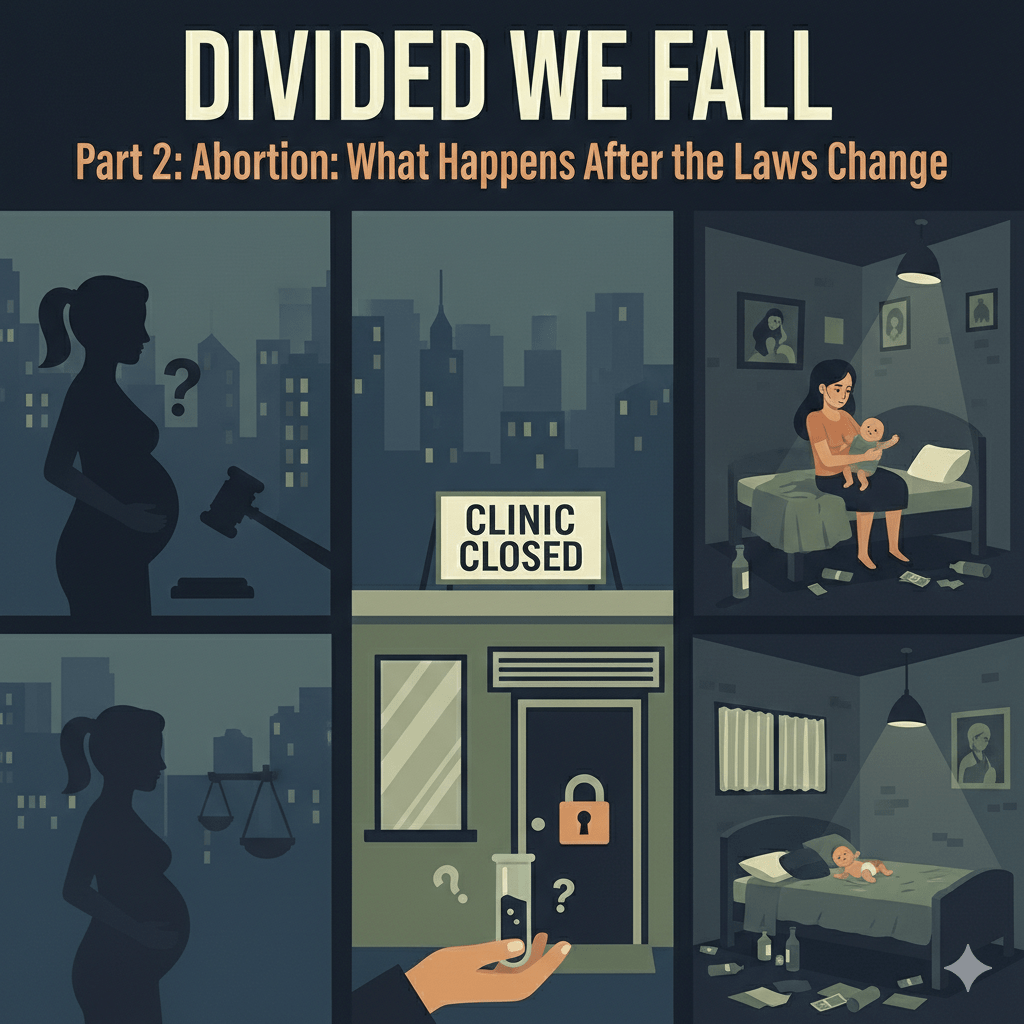
Regardless of Where You Stand, Here’s What the Data Actually Shows
For eventhatsodd.com – What Is Wrong With Us?
The abortion debate is deeply personal. People hold strong moral and philosophical beliefs about when life begins and what rights should take precedence. Those beliefs are legitimate and deserve respect, even when we disagree.
But regardless of where you stand on the moral question, we should all be able to agree on this: when laws change, they create real consequences for real people. And we should look honestly at what those consequences are.
This isn’t about telling you what to believe about abortion. It’s about examining what actually happens in measurable, documented ways when abortion access is restricted or expanded. Some of these consequences might surprise you. Some might challenge assumptions on both sides of the debate. But they’re worth knowing about, whatever your position.
Let’s look at what the evidence shows.
Who Gets Abortions and Why
Understanding who seeks abortions and their circumstances helps us think clearly about policy. The stereotype often doesn’t match the data:
Most are already mothers. About 60% of abortion patients already have at least one child. They know what parenthood entails and have determined they can’t handle another child—financially, emotionally, or practically.
Most are economically struggling. About 75% of abortion patients are low-income or poor. Nearly half live below the federal poverty line. Many are already choosing between rent and food.
Most are in their 20s and 30s. About 60% are in their twenties, another 25% in their thirties. Teenagers account for less than 10% of abortions.
Most happen early in pregnancy. About 93% of abortions occur at or before 13 weeks. About 66% happen at or before 8 weeks. Less than 1% occur after 20 weeks, and these almost always involve severe fetal abnormalities or threats to the mother’s health.
The reasons are practical. Can’t afford a baby (73%), would interfere with work/education/caring for other children (74%), not ready to be a parent (48%), relationship problems (31%), health concerns (12%). These are serious considerations, not casual convenience.
Whatever your moral position on abortion, these facts about who seeks them and why are worth understanding when thinking about policy.
Medical Complications That Get Caught in Bans
Abortion restrictions don’t just affect elective terminations. They create serious problems for women experiencing pregnancy complications. Since Roe was overturned, we’ve seen documented cases of:
Ectopic pregnancies. About 2% of pregnancies implant outside the uterus and are never viable. These will kill the mother if not terminated. Doctors in states with abortion bans have reported delays in treatment while consulting lawyers, and women have nearly died waiting for legal clarity.
Miscarriage management. About 10-20% of known pregnancies end in miscarriage. Sometimes the tissue doesn’t pass completely, requiring a D&C procedure that’s medically identical to an abortion. Women have been forced to wait until they develop life-threatening infections before doctors would intervene, resulting in lost fertility and near-death experiences.
Severe fetal abnormalities. Some abnormalities are incompatible with life—the baby will die during pregnancy or immediately after birth. Forcing women to carry these pregnancies to term means months of grief and often traumatic deliveries. Many state bans don’t allow exceptions for these cases.
These aren’t hypotheticals. Maternal mortality has measurably increased in states with abortion bans. Whatever your position on elective abortion, these medical consequences are worth considering.
The Policy Disconnect
Here’s where examining actual policy outcomes gets complicated. Many of the same politicians and organizations pushing hardest for abortion restrictions also consistently oppose the programs that would help the resulting children and mothers. This isn’t a “both sides” issue—it’s a specific, documentable pattern in Republican policy positions.
Look at the voting records: states with the strictest abortion bans also tend to have:
The weakest social safety nets
The most restrictive Medicaid programs
No paid family leave
The least funding for childcare assistance
Opposition to expanding SNAP and WIC
The highest maternal mortality rates
This creates a situation where states force women to give birth but provide minimal support once the child is born. You can verify this yourself—look at which states have banned or severely restricted abortion, then look at their rankings on child poverty, maternal mortality, food insecurity, and healthcare access.
The question isn’t about moral positions on abortion. It’s about whether the policy approach is internally consistent. If the goal is protecting life, shouldn’t that concern extend past birth?
The Planned Parenthood Story
Understanding what happened with Planned Parenthood helps illustrate how evidence and policy can disconnect. In 2015, videos surfaced claiming PP was “selling baby parts for profit.” The videos went viral and led to state-level defunding efforts. Many people still believe this happened.
Here’s what the investigations found:
The videos were deceptively edited. Independent forensic analysis found significant manipulation. Key statements were edited out, context was removed.
Thirteen states investigated. Multiple Congressional committees investigated. Even Republican-led investigations found no evidence of illegal sales. What PP did was donate fetal tissue to medical research with patient consent and accept reimbursement for processing costs—which is explicitly legal.
The video makers faced charges. David Daleiden and Sandra Merritt were charged with using fake IDs, illegal recording, and fraud. A jury found they violated federal racketeering laws. They pleaded no contest to felony charges in 2025.
Despite these findings, the campaign succeeded politically. Multiple states defunded PP, clinics closed, and many people still believe the original claims. This raises a question worth considering: when policy is based on claims that investigations disproved, what does that tell us about the actual goals?
What Planned Parenthood Actually Provides
Whatever your view on abortion, it’s worth knowing what PP actually does. The numbers from their 2022-2023 annual report:
Out of approximately 9.5 million services provided, about 392,000 were abortions—roughly 4%. The rest:
STI testing and treatment (millions of tests)
Contraception (preventing unwanted pregnancies)
Cancer screenings (breast exams, Pap tests)
Wellness exams, pregnancy testing, prenatal care
HIV testing and prevention, UTI treatment, vaccines
About 85-90% of PP’s services are preventive healthcare. For 2 million patients annually, many low-income or uninsured, PP is often the only accessible healthcare option.
Here’s the part worth thinking about carefully: by providing contraception to millions who otherwise couldn’t afford it, Planned Parenthood prevents hundreds of thousands of unintended pregnancies each year. If reducing abortions is the goal, PP’s contraception services accomplish that more effectively than any ban.
What Happens When Clinics Close
We have real-world data on what happens when states defund Planned Parenthood:
Texas 2011: When Texas excluded PP from its family planning program, use of long-acting contraception dropped 35% among women who had used PP services. Medicaid-covered births increased. Removing access to contraception didn’t reduce abortions—it increased unintended pregnancies.
Healthcare gaps: The claim that community health centers can absorb PP patients hasn’t materialized. Health centers are already overwhelmed. When PP clinics close in rural areas, there’s often no alternative within 50+ miles.
STI rates: Testing capacity disappears when clinics close, and disease rates increase.
These are measurable outcomes. Whatever your position on abortion, the question is whether these consequences are acceptable trade-offs.
What We Know Works
If the goal is reducing abortions—and most people across the political spectrum would agree that’s desirable—we have evidence about what actually works:
Comprehensive sex education: States with comprehensive sex ed have lower rates of teen pregnancy and abortion than states with abstinence-only programs. The evidence is consistent.
Access to contraception: Colorado’s program providing free long-acting contraception to low-income women led to a 54% drop in teen births and 64% drop in abortions over seven years, while saving the state millions in healthcare costs.
Economic support: Countries with robust childcare, healthcare, and family support have lower abortion rates than the U.S. When parenthood doesn’t mean poverty, fewer women feel abortion is necessary.
Healthcare access: Universal pregnancy coverage removes a major financial barrier to carrying pregnancies to term.
These policies prevent more abortions than bans do. The data supports this across multiple countries and time periods.
Moving Forward
People can hold different moral views about when life begins and whether abortion should be legal. These are legitimate philosophical disagreements.
But we should all be able to agree that:
Women experiencing pregnancy complications deserve timely medical care
Children who are born deserve support to thrive
Preventing unwanted pregnancies reduces abortions
Policy should be based on accurate information
Healthcare access shouldn’t depend on political battles
The question isn’t just whether you believe abortion is morally right or wrong. It’s whether you’re willing to look honestly at what happens in the real world when laws change, and whether you’re willing to support the systems that would address the consequences.
If someone opposes abortion on moral grounds, that’s a defensible position. But that position becomes harder to defend when it’s paired with opposition to the very programs that would:
Prevent unwanted pregnancies
Support women through pregnancy
Help children thrive after birth
Ensure safe medical care for pregnancy complications
The data shows measurable consequences from abortion restrictions: increased maternal mortality, more children in poverty, more strain on foster systems, and eventually higher crime rates. These aren’t theoretical—they’re documented outcomes.
Whatever your moral position on abortion, these consequences are worth reckoning with. You can disagree about values, but the factual outcomes of policy choices are measurable. And they matter for real people living real lives.
That’s what this is really about: looking honestly at what actually happens, and deciding whether those outcomes align with our stated values—regardless of which side of the debate we’re on.
 Even that's Odd
Leave a comment