I’ll be honest about where I’m coming from on this one. I thought about abortion the way a lot of people think about it — abstractly — until I didn’t. I had pregnancy scares as a young person, the kind that focus your attention in a hurry. Later I watched my wife actually carry our two boys, which I just want to say plainly: I have nothing but respect for any woman who pulls that off. I didn’t have those kids. Jennifer did. I was a supporting actor at best, and watching what pregnancy and childbirth and recovery actually do to a body left me with a permanent baseline humility about who should be making those calls.
I’m starting there because the abortion conversation in this country has gotten more abstract over the last few years, not less. People hold strong moral and philosophical beliefs about when life begins, and those beliefs are real and deserve respect. But the policy fight has drifted away from what actually happens to actual people when the laws change. I think that’s where it’s worth staying for a minute.
This isn’t an attempt to tell anyone what to believe about abortion. It’s an attempt to look at what the data shows about the policies we already have, the ones we just enacted, and the ones being proposed — because at some point a moral position has to make contact with the world it produces.
who actually gets abortions, and what bans actually do
The picture most of us carry around doesn’t match the data. About 60% of abortion patients are already mothers. Roughly 75% are low-income or poor, with nearly half below the federal poverty line. Most are in their twenties or thirties. Teenagers account for less than one in ten. About 93% of abortions happen at or before 13 weeks, two-thirds by 8 weeks, and less than 1% after 20 weeks — and those almost always involve severe fetal abnormalities or a threat to the mother’s life. The reasons people give are practical, not casual: can’t afford a baby, would interfere with work or school or other children, not ready, relationship problems, health concerns.
Whatever your moral position, those are the actual people the policies are about.
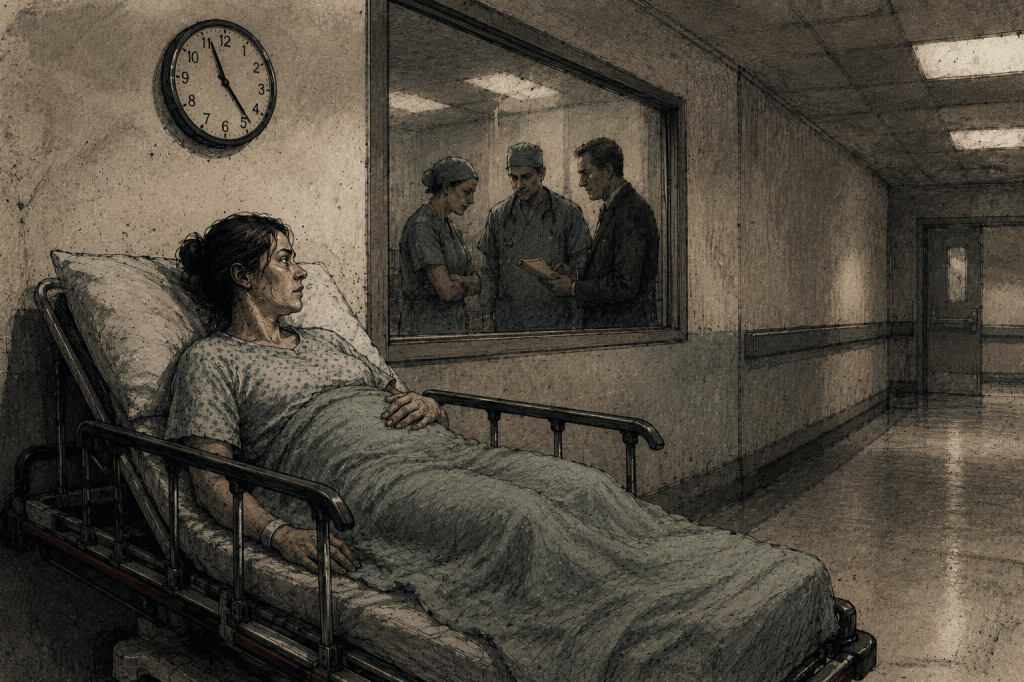
The other thing the bans do is get tangled up in the care of women who very much wanted to be pregnant. Ectopic pregnancies — about 2% of all pregnancies — implant outside the uterus, are never viable, and will kill the mother if not terminated. Miscarriage management sometimes requires a procedure that’s medically identical to an abortion. Some fetal abnormalities are incompatible with life. Since Roe was overturned, doctors in ban states have publicly described delays while they consult hospital lawyers. Women have nearly died waiting for legal clarity. Josseli Barnica, a 28-year-old in Texas, waited 40 hours in a hospital while doctors monitored her dying fetus during an inevitable miscarriage at 17 weeks. She didn’t survive.
The Gender Equity Policy Institute looked at CDC data and found that in the first full year of the Texas six-week ban, maternal mortality in the state rose 56%. Nationwide, the rise over that window was 11%. Among White women in Texas, it rose 95%. Maternal sepsis — life-threatening infection — jumped 50% in Texas during the same period. A 2025 literature review found that maternal mortality actually fell 21% in states where abortion remained accessible. The Milbank Memorial Fund’s 2025 research summary estimates ban states have produced 22,000 additional births, 59 excess maternal deaths, and 478 excess infant deaths since Dobbs. These aren’t partisan estimates. They’re peer-reviewed.
And here’s the thing I personally can’t get past. You can hold a moral position that abortion is wrong — that’s defensible, with a long philosophical and religious history behind it. But when I look at the actual policy package that comes with the most vocal anti-abortion politicians, the consistency falls apart. States with the strictest bans also tend to have the weakest social safety nets, the most restrictive Medicaid programs, no paid family leave, the least funding for childcare, the most pushback against SNAP and WIC, and the highest maternal mortality rates. You can check this yourself — pull up the abortion-law map and the rankings on child poverty, maternal mortality, food insecurity, and healthcare access. They overlap almost perfectly. The policy combination, in practice, is: women are required to give birth, and then they’re largely on their own. If the underlying value is protecting life, I keep waiting for that concern to extend past delivery.
what actually happened with the Planned Parenthood videos
This matters because a lot of current policy traces back to a single set of 2015 videos that I think a lot of people still misunderstand.
David Daleiden and Sandra Merritt, working through an organization called the Center for Medical Progress, secretly recorded Planned Parenthood staff and edited the footage to suggest the organization was selling fetal tissue for profit. The videos went viral. Thirteen states investigated. Multiple Congressional committees investigated. Several of those investigations were led by Republican attorneys general. None of them found evidence of illegal sales. What PP actually did was donate fetal tissue to medical research with patient consent and accept reimbursement for processing costs — which is explicitly legal under federal law.
A 2019 federal civil jury found Daleiden, Merritt, and CMP liable under federal racketeering statutes and other claims, and ordered them to pay Planned Parenthood about $2.4 million in damages. In January 2025, California’s criminal case against the two ended with a no-contest plea on one count of illegal recording — under the deal, the plea will be reclassified as a misdemeanor and eventually expunged. So the popular “they were convicted of felonies” version of the story is fuzzier than it sounds. What is not fuzzy is the underlying factual finding: every actual investigation that examined the videos concluded they misrepresented what they were depicting.
The campaign still worked politically. States defunded PP. Clinics closed. In July 2025, Trump signed the One Big Beautiful Bill, which included a one-year moratorium on Medicaid funding for Planned Parenthood. PP sued. A lower court briefly blocked it; the First Circuit reversed that block in December 2025; in January 2026, the main federal lawsuit was dismissed. As of late 2025, Planned Parenthood reported that 20 of its health centers had closed since the bill passed.
What PP actually does, by the way, is mostly not abortion. Out of roughly 9.5 million services it provides annually, about 4% are abortions. The other 96% is STI testing and treatment, contraception, cancer screenings, wellness exams, pregnancy testing, prenatal care, HIV testing, vaccines. Two million patients a year use it, many low-income or uninsured, often because there isn’t another accessible option. And by providing contraception to people who couldn’t otherwise afford it, PP prevents hundreds of thousands of unintended pregnancies every year. If the goal is fewer abortions, that math is hard to ignore.
We also know what happens when clinics close, because we’ve already run that experiment. When Texas excluded PP from its family planning program in 2011, use of long-acting contraception among women who’d been using PP dropped 35%. Medicaid-covered births went up. The argument that community health centers would absorb PP patients didn’t hold up — health centers were already overwhelmed. In rural areas, when a PP closes, there’s often no alternative within 50 miles.
what actually reduces abortions
If you genuinely want fewer abortions — and most people across the political spectrum say they do — the evidence on what works is pretty consistent. Comprehensive sex education lowers teen pregnancy and abortion rates. Access to free or low-cost long-acting contraception lowers them further. Colorado ran a program providing free LARCs to low-income women and saw teen births drop 54% and abortions drop 64% over seven years, while saving the state millions in healthcare costs. Economic support matters too — countries with robust childcare, healthcare, and family support have lower abortion rates than the US. Universal pregnancy coverage removes one of the biggest financial barriers to carrying a pregnancy to term.
These policies prevent more abortions than bans do. The data is consistent across multiple countries and multiple time periods. The trouble is that they cost money and require political coalitions willing to spend it, and the same political coalition that’s pushed hardest for bans has generally opposed them.
People can hold different moral views about when life begins and whether abortion should be legal. Those are legitimate disagreements I don’t expect to settle here. But the empirical questions underneath the moral ones — what reduces abortion, what the consequences of bans actually look like, what’s true about the organizations being defunded — aren’t matters of opinion. They have answers, and the answers are knowable.
A moral position against abortion is defensible. It becomes harder for me to defend when it’s paired with opposition to the contraception programs that prevent pregnancies, the medical care that protects women going through complications, and the social supports that help children who get born. Josseli Barnica isn’t an abstract concern. The 56% maternal mortality jump in Texas isn’t an abstract concern. The moral disagreement is real and probably permanent. The factual record is something we can at least look at together.


Leave a Reply