
I’m an NPR listener. Have been for years. Morning Edition while I make coffee. All Things Considered if I’m in the truck at five. WNYC out of New York carries it most days for me up here in the Hudson Valley. The voices are familiar in a way commercial radio voices never quite are, because they’re not selling me anything. They’re not screaming. They’re not ad-blocking out the next segment. They’re just telling me what happened today and, when there’s time, what it might mean.
I spent twenty-five years working in cable television — Bravo, Oxygen, Universal Kids, network gigs going back to the VH1 era. I know how commercial media works. The ad-supported model decides what gets produced and what doesn’t. You can dress it up, you can have great people, you can have integrity, and the math will still pull you toward the stuff that holds eyeballs through commercial breaks. Public broadcasting was built specifically to do the things commercial television couldn’t or wouldn’t. Long-form journalism. Kids’ shows that teach something. In-depth coverage of state government. Rural news where there’s no audience large enough to pay for it. That was the whole point.
On May 1, 2025, Trump signed Executive Order 14290 — “Ending Taxpayer Subsidization of Biased Media” — directing the Corporation for Public Broadcasting to cease all federal funding to NPR and PBS. Congress followed up by voting to eliminate the federal appropriation entirely, which forced the closure of CPB itself. NPR and three Colorado public radio stations sued, calling the order textbook First Amendment retaliation. In March 2026, a federal judge blocked the executive order, ruling that the president doesn’t get to defund news organizations because he doesn’t like their coverage. The legal fight isn’t over, and the damage already done isn’t unwound by a court ruling. PBS Kids laid off about a third of its staff after the Education Department funding was cut. Stations across rural America started cutting hours and staff before the ink was dry.
So now is a useful moment to ask what it is they were actually defunding.
What public broadcasting actually is
Most Americans don’t know how the system works, which is part of why it’s easy to mischaracterize. NPR isn’t a single network that beams directly into your radio. It’s a programming distributor that produces national shows — Morning Edition, All Things Considered, the podcast catalog — that local public radio stations choose to air. Those local stations are independent nonprofits, each with its own board, its own funding, its own editorial control. PBS works the same way for television. Sesame Workshop, Frontline, PBS NewsHour come from various production companies and get distributed through the PBS system to local stations.
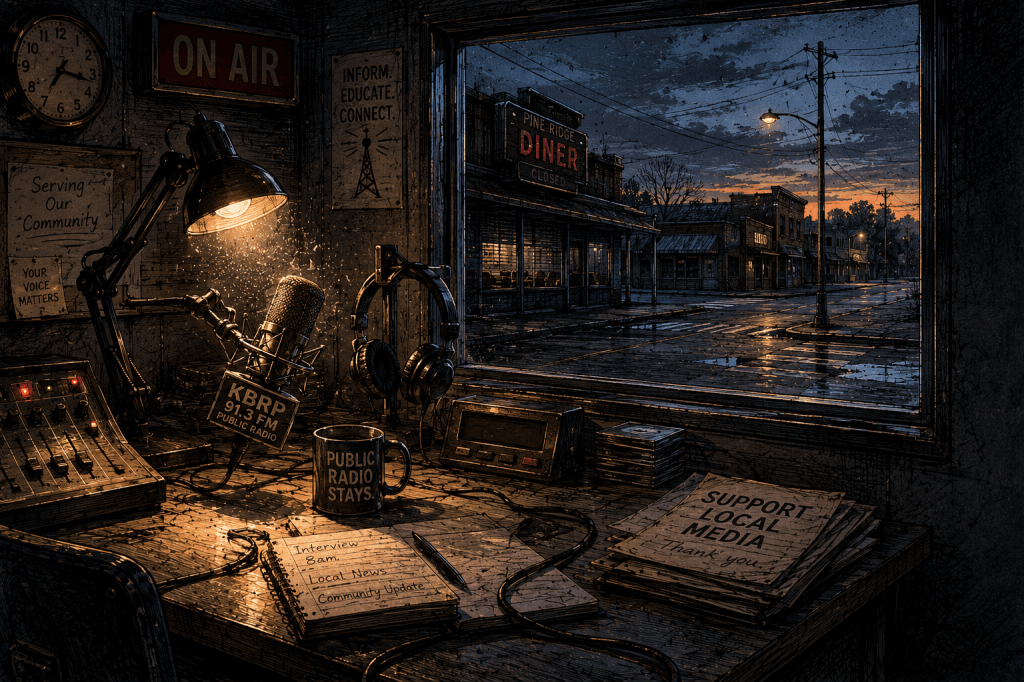
Federal money through CPB made up about 15% of the total public media system budget. The rest came from member donations, foundation grants, corporate underwriting, and state and local sources. For NPR specifically, direct federal funding was about 1% of the budget. But that 15% systemwide number is misleading low, because the federal money disproportionately kept the smallest stations alive — rural stations in Montana, Mississippi, Wyoming, eastern Kentucky, that couldn’t raise enough from listener pledges because there weren’t enough listeners. Cut the federal funding and NPR headquarters survives. The station in Pine Ridge or Cookeville or Yuma is the one that goes dark. In a lot of those communities, after the local paper folded and the commercial AM signal flipped to syndicated talk, public radio was the only news source left.
The bias question, honestly
I’ll grant the obvious point: NPR newsrooms lean left. National survey work on journalists has shown that for decades. Roughly half identify as liberal, a third as moderate, and somewhere between seven and fifteen percent as conservative. That’s a real skew. It’s worth being honest about it instead of pretending otherwise.
But “the staff leans left” is not the same as “the coverage is propaganda,” and the difference matters. The thing most people don’t say out loud is that journalism, as a career, doesn’t pay. Reporters starting out in cities make thirty or forty thousand dollars before taxes. Mid-career reporters who haven’t gone into PR or speechwriting make maybe sixty. The profession self-selects for people who want to do public-interest work and are willing to accept lower pay to do it. Those people tend, on average, to be more sympathetic to collective-good arguments than to individual-wealth-building arguments. The same selection effect runs through teaching, nursing, public defense, and the nonprofit sector. It’s not indoctrination. It’s who walks in the door.
The other thing reporters do is investigate institutions. They cover corporate misconduct, police shootings, environmental violations, wage theft, regulatory failures, government corruption. If you spend ten years documenting what powerful organizations do when nobody’s watching, you tend to leave that decade with a healthy skepticism of concentrated power. That skepticism shows up more often in arguments about regulation and oversight than in arguments about deregulation. Again, not indoctrination — pattern recognition from the actual work.
The question that matters for public broadcasting isn’t whether the people who work there have personal politics. Everyone does. The question is whether the on-air product reflects those politics or works against them. The independent media-bias trackers that score sourcing balance and language framing have consistently put NPR’s news coverage closer to the center than essentially any cable network on either side. PBS NewsHour rates even more centrally. That doesn’t mean either is perfect. Cultural programming — feature stories, arts coverage, human-interest stuff — does skew toward an urban, educated, coastal sensibility, and that’s a real critique worth taking seriously. But news coverage and cultural programming aren’t the same thing, and the defunding push isn’t actually trying to fix the cultural-programming problem. It’s trying to get rid of the news.
What the attack is actually about
If the goal were better balance, the campaign would look completely different. It would push for more rural-station funding, expanded hiring in conservative regions, more programming time devoted to non-coastal stories. It would try to make public broadcasting better. Instead it’s trying to make it gone. Project 2025 — the Heritage Foundation policy roadmap the second Trump administration has been following closely — explicitly called for defunding both NPR and PBS. The May 2025 executive order followed it almost word for word.
What you lose, if this succeeds, is not NPR headquarters in Washington. NPR will survive on listener support and foundation money. The big metropolitan stations will be fine. What you lose is the system underneath. Local public radio in rural counties where it’s the only news. PBS Kids programs that demonstrably move the needle on early literacy for low-income children. Long-form investigative journalism that commercial outlets have spent two decades proving they won’t fund. State legislature coverage in places where no commercial newsroom exists. Documentary work that takes two years to make and doesn’t optimize for clicks.
You also lose something subtler. Public broadcasting, by sitting mostly outside the rage-bait economy, has always sat slightly to the side of the cable-news fight. When everything else is incentivized to make you angry, NPR’s incentive is to keep you listening — which sounds like the same thing but isn’t, because the way you keep an NPR audience is to be reliable and reasonable, not to inflame. Removing that as an option leaves us with a media diet that’s nothing but the rage version. I don’t think that’s an accident. People who benefit from a tribally polarized electorate would rather not have a calm, fact-based broadcaster in the room.
I’m not naive about NPR. There are stories I think they handle poorly and tones I find tiring. I’d push for more genuine ideological diversity in cultural coverage tomorrow. But I can hold both of those criticisms and still notice that the people coming for it aren’t doing so to improve it. They’re doing so to be rid of a competing source of information that doesn’t reflect their preferred narrative. That’s not a debate about balance. That’s a different thing entirely.
The fight is in the courts right now. The March ruling helped. Congress’s appropriation cut is harder to unwind. The stations that have already laid off staff aren’t getting them back automatically. If you’ve been meaning to give to your local station, this is the moment. I gave to WNYC. Pick yours.


Leave a Reply