
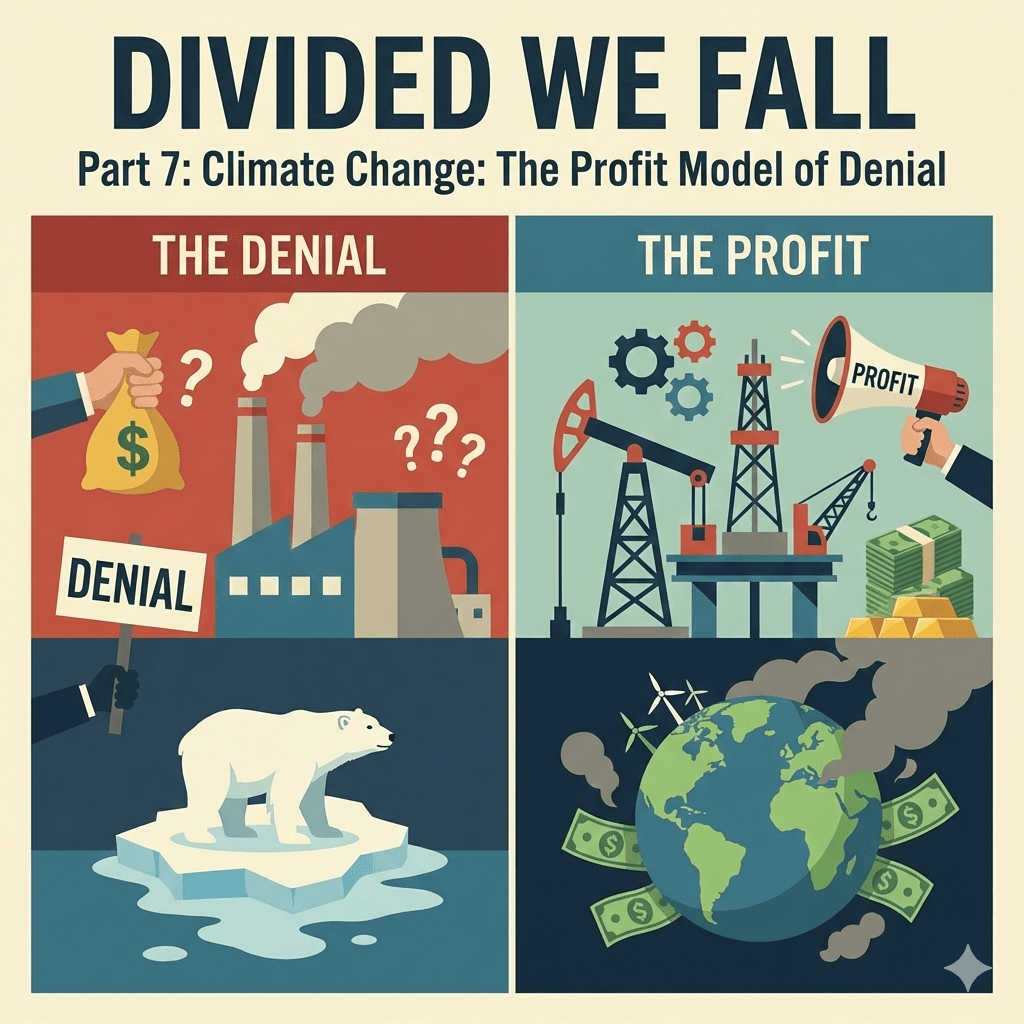
What Fossil Fuel Companies Knew—And When They Knew It
For eventhatsodd.com – What Is Wrong With Us?
In 1977, a senior scientist at Exxon named James Black briefed company executives on carbon dioxide and climate. His message was clear: burning fossil fuels was increasing CO2 in the atmosphere, this would cause global warming, and the effects could be catastrophic. Exxon’s own research confirmed it. They knew. In 1977.
In 1988, NASA scientist James Hansen testified before Congress that global warming had begun. The science was settled. The evidence was overwhelming. Major oil companies had known for over a decade.
What happened next wasn’t denial born of ignorance. It was a deliberate, coordinated campaign to manufacture doubt, funded by the very companies whose own scientists had confirmed the threat. This wasn’t a scientific debate. It was a business decision: protect profits by delaying action, regardless of the cost to everyone else.
Let’s look at what they knew, when they knew it, and what they did with that knowledge.
What They Knew and When
The fossil fuel industry’s own scientists understood climate change decades before it became public knowledge.
1970s-1980s: Exxon began researching CO2 and climate in the 1970s. Internal documents show their scientists accurately predicted warming, sea level rise, and disruption to ecosystems. A 1982 internal Exxon memo stated that doubling atmospheric CO2 would increase global temperatures by 3°C and noted this “can have significant economic effects.” They knew the science. They knew the consequences.
The American Petroleum Institute (API), the industry trade group, received similar warnings from their own researchers. A 1980 API task force report stated: “There is unanimous agreement in the scientific community that a temperature increase of this magnitude would bring about significant changes in the Earth’s climate.”
Shell’s internal documents from 1988 acknowledged that CO2 “could have major environmental implications” including sea level rise that would threaten low-lying countries. They understood the physics. They understood the risks.
By the late 1980s, the scientific consensus was clear, and fossil fuel companies knew it. Their own research confirmed it. But instead of acting on that knowledge—or even being honest about it—they chose a different path.
The Deliberate Campaign to Manufacture Doubt
When the science became public and pressure for action grew, fossil fuel companies didn’t admit what they knew. They launched a decades-long campaign to manufacture doubt, delay regulation, and protect profits.
The playbook wasn’t new—it was copied directly from the tobacco industry.
The tobacco playbook: In the 1950s-60s, tobacco companies faced overwhelming scientific evidence that smoking caused cancer. Their own research confirmed it. Instead of acknowledging this, they created a campaign to manufacture doubt: fund alternative research, amplify uncertainty, create the appearance of ongoing scientific debate even after the science was settled. The goal wasn’t to prove smoking was safe—it was to delay regulation long enough to protect profits.
The fossil fuel industry hired many of the same PR firms, think tanks, and even some of the same scientists who had worked for tobacco. The strategy was identical:
• Fund research that questions climate science, even if it’s methodologically flawed
• Amplify uncertainty and disagreement, even among a tiny minority
• Create front groups and think tanks that sound scientific but exist to spread doubt
• Promote “skeptic” scientists and give them platforms disproportionate to their credibility
• Frame the issue as “unsettled science” requiring more research before action
• Attack climate scientists personally to undermine their credibility
The API strategy memo: In 1998, the American Petroleum Institute created an internal memo outlining their strategy to “maximize the impact of scientific views consistent with ours on Congress, the media and other key audiences.” The goal: “Victory will be achieved when average citizens understand uncertainties in climate science.” Not when they understand the science—when they understand “uncertainties.”
This was explicit. This was documented. This wasn’t a good-faith scientific disagreement. It was a coordinated campaign to manufacture confusion.
The Infrastructure of Denial
The fossil fuel industry didn’t just fund individual scientists—they built an entire ecosystem to spread doubt and block action.
Think tanks: Organizations like the Heartland Institute, Competitive Enterprise Institute, and George C. Marshall Institute received millions from fossil fuel companies to produce reports questioning climate science. These groups sound academic, but they’re funded by industries with a financial interest in delaying action.
These aren’t peer-reviewed scientific institutions. They’re advocacy organizations producing reports designed to create the appearance of scientific controversy.
Dark money networks: Between 2003 and 2010, foundations linked to Charles and David Koch and ExxonMobil gave over $120 million to organizations casting doubt on climate science. The American Legislative Exchange Council (ALEC), funded by fossil fuel interests, created model legislation for states to block climate action.
This money funded conferences, publications, and media campaigns all designed to convince the public that climate science was uncertain, that action was premature, that the costs of addressing climate change outweighed the benefits.
Media amplification: Fox News, talk radio, and conservative media outlets gave platforms to climate skeptics while marginalizing actual climate scientists. Every extreme weather event was met with: “Weather isn’t climate.” Every cold snap was treated as evidence against warming. Every uncertainty in climate models was amplified.
The result: Americans were exposed to a false debate. Actual climate scientists said one thing. Industry-funded skeptics said another. Media presented it as a he-said-she-said controversy, even though one side had the evidence and the other had the money.
Political capture: Politicians, mostly Republicans, received campaign contributions from fossil fuel companies and adopted their talking points. They blocked climate legislation, questioned the science in hearings, and framed action as economically destructive. The money created political alignment.
The Cost of Delay
The campaign to manufacture doubt worked. It delayed action for decades. And delay has costs.
Every year of delay made the problem harder: We’ve known about climate change since the 1980s. If we had acted then—when fossil fuel companies’ own scientists said we should—the transition would have been gradual, manageable, and far cheaper. We could have slowly shifted to renewables, updated infrastructure, and adapted. Instead, we delayed for 40 years. Now the transition must be rapid, expensive, and disruptive because the window for gradual change has closed.
The longer we wait, the more CO2 accumulates in the atmosphere. The more it accumulates, the more warming we lock in. The more warming we lock in, the worse the impacts and the more expensive adaptation becomes. Delay compounds.
The impacts are here: We’re already seeing the effects fossil fuel companies predicted in their own research:
• Record heat waves killing thousands
• More intense hurricanes causing hundreds of billions in damage
• Prolonged droughts destroying agriculture
• Wildfires burning millions of acres
• Sea level rise threatening coastal cities
• Ecosystem collapse affecting food systems
These aren’t future predictions. These are current events, happening now, exactly as the science predicted.
The human cost: Poor countries and poor people bear the brunt. They contributed least to emissions but suffer first and worst. Small island nations face extinction. Agricultural communities lose livelihoods. Climate refugees are already being created. The injustice is profound.
What Could Have Been Different
Imagine if fossil fuel companies had been honest in 1977. Imagine if Exxon had said: “Our research shows burning fossil fuels will cause catastrophic warming. We need to transition to alternatives.”
We would have had 40+ years for a managed transition. We could have invested in solar, wind, and nuclear starting in the 1980s. We could have updated the grid, redesigned transportation, improved building efficiency—all gradually, without crisis, with time to adapt.
The technology would have developed faster with earlier investment. The costs would have come down sooner. The infrastructure would already exist. We’d be decades ahead of where we are now.
Instead, we lost 40 years to a deliberate campaign to protect fossil fuel profits. And now we’re scrambling to do in 10-20 years what we could have done in 40.
Follow the Money
Why would companies do this? Why manufacture doubt about something their own scientists confirmed? The answer is simple: money.
The profits at stake: Fossil fuel companies are some of the most profitable corporations in history. ExxonMobil’s profits in 2022: $55.7 billion. Chevron: $35.5 billion. Shell: $39.9 billion. These are annual profits, not revenue. Every year of delay meant another year of record profits.
Acknowledging climate change meant acknowledging their product was destroying the planet. It meant regulation, carbon pricing, and transition to alternatives. It meant their business model had an expiration date. Better to delay, deny, and extract every dollar possible before being forced to change.
The cost-benefit calculation: The amounts spent on denial campaigns—hundreds of millions—sound large until you compare them to the profits at stake: trillions. Spending $500 million to protect $50 billion per year in profits? That’s a good investment.
This wasn’t ignorance. This wasn’t good-faith disagreement. This was a calculated business decision: protect profits now, let future generations deal with the consequences.
Where We Are Now
The scientific debate is over. The evidence is overwhelming. Climate change is happening, it’s caused by human activity (primarily burning fossil fuels), and it’s already causing harm.
The science is settled: 97% of actively publishing climate scientists agree on human-caused climate change. Every major scientific organization in the world—NASA, NOAA, the National Academy of Sciences, the Royal Society, and hundreds of others—confirms it. The evidence includes:
• Direct CO2 measurements showing increase from 280 ppm (pre-industrial) to 420 ppm (current)
• Temperature records showing 1.1°C warming since 1880
• Satellite data, ice core data, tree ring data all confirming the trend
• Observable impacts matching predictions from decades ago
The messaging evolved: Yet denial persists because the industry that profited from delay is still fighting. The messaging has shifted from “It’s not happening” to “It’s not that bad” to “It’s too expensive to fix” to “China should go first.” The goal remains the same: delay action, protect profits.
But reality doesn’t care about PR campaigns. The physics works whether you believe it or not. CO2 traps heat. More CO2 means more heat. More heat means disruption. This isn’t politics—it’s thermodynamics.
What Needs to Happen
The solutions exist. We have the technology. What’s missing is political will—and that’s missing because fossil fuel interests block it.
The technology exists: Solar and wind are now cheaper than fossil fuels in most markets. Battery storage is improving rapidly. Electric vehicles are becoming cost-competitive. Heat pumps can replace gas furnaces. The technology is here.
What we need: We need massive investment in:
• Renewable energy infrastructure
• Grid modernization and energy storage
• Public transportation and EV charging networks
• Building efficiency and electrification
• Research and development for remaining challenges
None of this is technically impossible. It’s economically feasible. The cost of action is far less than the cost of inaction. But it requires political decisions that fossil fuel companies oppose.
• Stop subsidizing fossil fuels (currently $5.9 trillion globally per year in direct and indirect subsidies)
• Price carbon to reflect true environmental costs
• Invest public money in clean energy infrastructure
• Regulate emissions and mandate transition timelines
• Hold fossil fuel companies accountable for damages and deception
Every one of these faces opposition from fossil fuel interests and the politicians they fund.
The Bottom Line
Climate change isn’t a mystery. It’s not a scientific uncertainty. It’s a problem we’ve understood for decades, caused by burning fossil fuels, and solvable with existing technology.
What’s happened instead is a deliberate campaign by fossil fuel companies to protect profits by manufacturing doubt, funding denial, and blocking action. They knew the truth—their own scientists told them. They lied about it anyway.
This isn’t both sides. This isn’t a legitimate scientific debate. This is a small number of companies with a financial interest in delay, using the tobacco playbook to protect profits while the planet warms.
The cost of their campaign is measured in lives lost, ecosystems destroyed, communities displaced, and futures stolen. The benefit went to shareholders and executives of companies that knew better.
We can still act. The window is closing, but it’s not shut. Every fraction of a degree matters. Every year of delay makes it harder, but action now is still better than action later.
But first, we have to be honest about why we’ve delayed this long. It wasn’t ignorance. It wasn’t scientific uncertainty. It was a deliberate choice by fossil fuel companies to protect their profits, regardless of the consequences for everyone else.
They knew. They lied. And we’re all paying the price.
 Even that's Odd
Leave a comment