
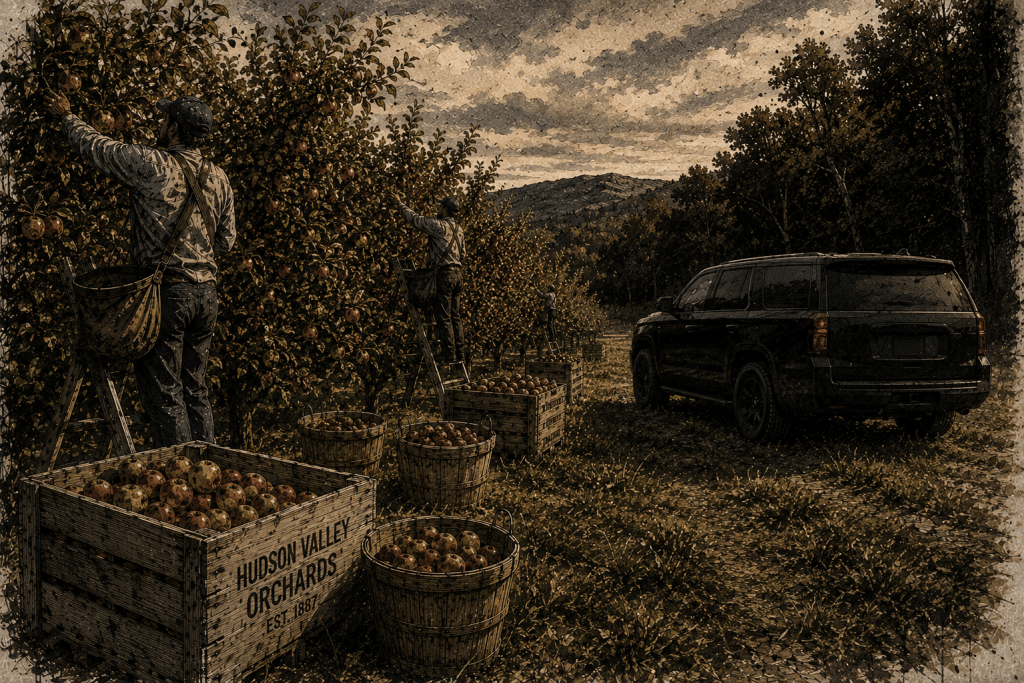
I live in Gardiner, New York — population under six thousand, surrounded on every side by Hudson Valley farms. If you’ve spent any time up here in late summer or early fall, you’ve eaten an apple, drunk a wine, or watched a sunset over a hayfield that exists because of immigrant labor. Some of it is H-2A visa labor. A lot of it is undocumented labor. This isn’t a secret. Everyone who lives here knows it. The owners of the farms know it. The local restaurants where the workers eat know it. The local school district that educates their kids knows it.
I’m starting there because the immigration conversation gets weirdly abstract the further you get from the actual places where the work happens. Once you’ve watched the apple harvest, the gap between the cable-news version of immigration and the actual one becomes pretty hard to un-see.
Here’s what I think is true, after a lot of reading and a lot of looking around my own town: immigration isn’t the existential threat the right makes it out to be, and it isn’t the pure unmixed economic blessing the left sometimes implies. There are real costs, real benefits, real legitimate concerns, and a tremendous amount of bad-faith fear-mongering. There are also obvious solutions that haven’t happened in forty years because the issue is more valuable as a weapon than as a problem to fix.
who is actually coming, and why
The journey across the southern border illegally is brutal, expensive, and dangerous. People pay smugglers thousands of dollars. They risk assault, robbery, sexual violence, and death. Nobody does this on a whim. Nobody does this because they heard there was a generous welfare program.
The actual drivers are pretty consistent. Most people crossing from Central America are coming from Guatemala, Honduras, and El Salvador, where rural wages are $3 to $5 a day, gang violence is widespread, and government institutions can’t or won’t protect ordinary people. The same agricultural work that pays $3 a day in rural Guatemala pays $60 to $80 a day in the US, even paid under the table. That’s the difference between your kids eating and your kids not. Climate change is making it worse — multi-year droughts have wiped out subsistence farming in regions that had nothing else to fall back on. Family reunification matters too. Once one person crosses successfully and finds work, they often help relatives follow. That’s how human migration has always worked, everywhere.
The standard right-wing frame — that the people coming are mostly criminals, gang members, or welfare seekers — does not match what the data actually shows. Multiple studies across multiple methodologies find that immigrants, including undocumented ones, commit crimes at lower rates than native-born Americans. They’re ineligible for most federal benefits. And they pay billions in taxes they will never see again — the Social Security Administration’s most recent estimate is that unauthorized workers contribute about $12 billion a year to Social Security under fake or borrowed numbers, with no ability to ever collect.
the part that gets left out
Here’s the part of the immigration conversation that almost never makes it onto cable news, and it’s the part I find hardest to ignore living where I live.
The current system works exactly as designed for certain powerful interests. By making legal immigration nearly impossible while rarely prosecuting employers who hire undocumented workers, we have created a permanent underclass of exploitable labor. Estimates put somewhere between 50% and 70% of US farmworkers as undocumented. About 15% of construction workers. A significant share of food service, hospitality, and meatpacking. These workers can’t complain about wage theft, can’t report unsafe conditions, can’t unionize, can’t even consistently call the police when something happens to them, because reporting anything means risking deportation. The arrangement is enormously profitable for the businesses that depend on it.
Between 2008 and 2018, ICE conducted roughly 6,000 workplace raids and investigations. Thousands of workers were arrested and deported. The number of employers criminally prosecuted across that entire decade: eleven. Not eleven thousand. Eleven. The system punishes the workers and almost never the businesses that built their margins on hiring them.
This is the piece I genuinely don’t understand about the politics. “Illegal immigrants are taking your jobs and lowering your wages” is a sentence people will yell at you, but the actual mechanism for the wage suppression isn’t the workers — it’s the employers who choose to hire vulnerable people they can underpay. American workers and immigrant workers are both getting squeezed by the same hand. If you genuinely care about wages, the policy that would do the most to raise them is the one that almost never gets talked about: prosecute the employers, give the workers status so they can refuse exploitation, enforce labor law equally across the workforce. Republicans don’t push that because their donor base profits from the current setup. Democrats don’t push it for similar donor reasons and because they’re afraid of being called soft on enforcement. The status quo holds.
what’s actually happening right now
I want to be careful here, because the situation in 2025–2026 has changed enough that pretending it’s politics-as-usual would be dishonest.
The second Trump administration has, in its first year, dramatically expanded immigration enforcement. ICE arrests roughly quadrupled compared to the last year of the Biden administration. Street arrests — sweeps in neighborhoods, at immigration court check-ins, at ICE field offices — went up by roughly eleven times. As of mid-November 2025, ICE was detaining about 65,000 people, and approximately 73.6% of them had never been convicted of any criminal offense. Not “minor” criminal offenses. None at all.
In May 2025, Stephen Miller convened ICE leadership and set quotas: 3,000 arrests per day and a target of one million deportations in the first year. ICE then hired 12,000 new officers. Federal immigration sweeps moved through Los Angeles, Chicago, Portland, Washington DC, and other cities, with confrontations between agents and residents becoming common. In separate incidents in Los Angeles, Chicago, and Minneapolis, federal officers shot and killed two US citizens during immigration operations. The Laken Riley Act, signed in early 2025, broadened the categories of immigrants eligible for mandatory detention. The administration has also invoked the Alien Enemies Act and sent hundreds of Venezuelan migrants to a prison in El Salvador, in many cases without standard due process.
Whatever you think about the underlying policy, this is the largest peacetime expansion of interior immigration enforcement in American history. The volume of removals is high but not dramatically higher than prior years yet — actual FY2025 removal figures are about 7% above FY2024 — because building the deportation infrastructure to match the rhetoric takes time. The bigger story is the shift in who’s being arrested. The promise was deportation of “the worst of the worst.” The actual practice is overwhelmingly the arrest and detention of people with no criminal record.
This matters because the people being picked up off jobsites in California and out of immigration court hearings in New York are, in very large numbers, the same people who pick the apples three miles from my house.
why it doesn’t get fixed
If the obvious move is to create legal pathways for the people we already depend on, prosecute the employers who profit from their illegality, enforce labor laws equally, and secure the border with orderly processes — why hasn’t that happened?
It hasn’t happened because both parties have, historically, found the unsolved version more useful than the solved one. Republicans have run for office on border crisis rhetoric for twenty years, knowing the crisis would still be there when they got into office because their donors benefit from the cheap labor. Democrats have run as the compassionate alternative without ever passing comprehensive reform when they had the votes for it, in part because their donors include some of the same businesses. The 2013 Senate bill that came closest — a bipartisan deal that included legalization, employer accountability, and significant border enforcement — was killed in the House. The 2024 bipartisan border bill was killed in the House at the request of a presidential candidate who needed the issue alive for the campaign.
So the structural critique that this is a wedge maintained by both parties is, I think, basically correct as a long-term analysis. But the specific moment we’re in is not symmetrical. One party is currently running the largest interior enforcement operation in American history with the explicit goal of removing one million people a year, and the other party is mostly responding to that. Calling that “both sides” doesn’t survive contact with the actual numbers. The history is shared. The present is not.
Most Americans, when you get past the cable-news framing, want something pretty reasonable. They want a secure border. They want enough legal immigration to meet the actual labor needs of the actual economy. They want humane treatment of people who come, and orderly removal of people who don’t qualify to stay. They want long-term residents who’ve built lives here — paid taxes, raised citizen children, never committed a crime — to get a path to legal status. They want the American workers who do compete with immigrant labor to be protected through real enforcement of labor law against the businesses that profit from exploiting both. None of this is radical. Most of it has had majority support in polling for two decades.
You can do all of that. Other countries have. We choose not to, again and again, because the politicians and the media and a significant chunk of corporate America benefit more from the fight than from the fix. Once you can see how the wedge actually works — how it benefits employers by keeping workers exploitable, how it pits American and immigrant workers against each other, how it distracts from trade policy and tax policy that did more to ship your job overseas than any farmworker ever did — it gets harder to participate in it the way the people running the wedge want you to.
I think about that pretty often when I’m driving past the orchards. Most of the people doing that work have been there for years. Their kids go to school with my kids. Their bosses know exactly who they are. The system they’re stuck inside isn’t an accident, and the political fight about them is, more than anything, a fight about whether we’re willing to look at the system honestly.


Leave a Reply