
I put a heat pump in my house last year. Bosch 5-ton, replaced an oil-fired system that came with the place. I’m not telling you that to flex green credentials — I’m telling you that because the math finally penciled out, the technology has gotten genuinely good, and the federal tax credits at the time (since rolled back in 2025) made it cheaper than another oil system would have been. I live in Gardiner, New York, in a Connor Homes kit house built around 2008. I’ve got two growing boys, a wife with strong opinions about how the house looks and feels, and a 14-acre property whose weather I pay close attention to because it tells me whether I need to be out there with a chainsaw.
The weather is different than it used to be. The summers up here are hotter and wetter. The big storms hit harder. My neighbors who farm will tell you the growing season has shifted. My friends who plow will tell you the snow pattern has changed. This isn’t speculation. It’s also not really arguable anymore for anyone who has lived in one place for more than a couple of decades and is paying attention.
I’m starting there because the climate conversation in this country has gotten so tangled in politics that we sometimes forget the underlying thing is just the weather, and the weather is something everyone notices. The reason the politics is tangled is not because the science is unclear. The reason the politics is tangled is because a small number of very profitable companies spent the last fifty years making sure it would be tangled. That part of the story is what I want to walk through, because I don’t think most people know how documented it is.
what the companies actually knew, and when
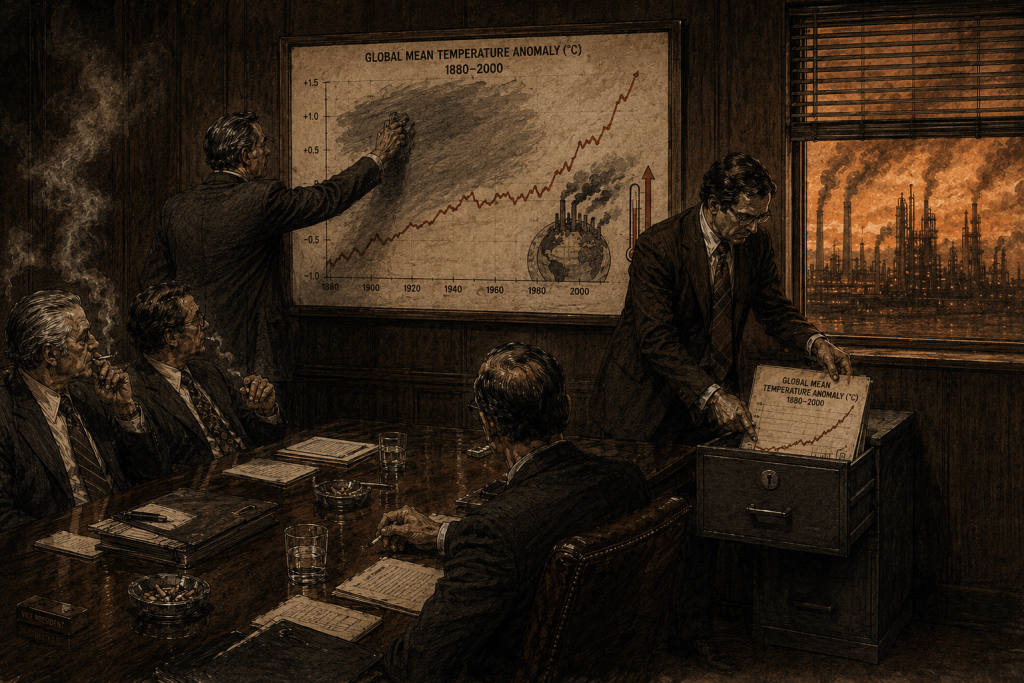
In 1977, a senior scientist at Exxon named James Black briefed company executives. His message: burning fossil fuels was raising atmospheric CO2, this would cause significant warming, and the consequences were likely to be severe. Exxon’s own internal research over the next several years confirmed it. A 1982 internal Exxon memo stated that doubling atmospheric CO2 would raise global temperatures by about 3°C and noted this would have “significant economic effects.” A 1980 American Petroleum Institute task force report acknowledged “unanimous agreement in the scientific community” that warming of that magnitude would significantly change Earth’s climate. A 1988 internal Shell document acknowledged that CO2 from their products “could have major environmental implications” including sea level rise threatening low-lying countries.
These aren’t conspiracy-theory documents. They’re company records that have come out in litigation, FOIA requests, and the work of academic researchers including Naomi Oreskes and Geoffrey Supran at Harvard. The science was internally settled inside Exxon by the mid-1980s. The company’s own modeling, declassified by Supran and Oreskes in a 2023 Science paper, was remarkably accurate — Exxon’s scientists predicted the warming trajectory of the next 50 years with the same precision as outside academic models.
In 1988, NASA’s James Hansen testified before Congress that warming had begun. By the early 1990s, the international scientific consensus was clear. The companies had a choice. They could acknowledge what their own scientists had told them, lead the transition to alternatives, and probably still make plenty of money over a longer horizon. Or they could deny what they knew, slow the transition down, and extract maximum profit from the fossil fuel business model for as long as possible.
They chose the second one. They were very explicit about it.
the playbook, and where it came from
A 1998 American Petroleum Institute internal strategy memo, since made public, laid out the goal in plain language: “Victory will be achieved when average citizens understand uncertainties in climate science.” Not “understand the science.” Understand the uncertainties. The aim was not to win a scientific debate but to convince the public that there was one.
The playbook wasn’t new. It was lifted, sometimes literally with the same people, from the tobacco industry. In the 1950s and 1960s, tobacco companies faced the same dynamic: their own research had confirmed that smoking causes cancer, and their challenge was to delay regulation long enough to keep selling cigarettes. The strategy they invented — fund alternative research, amplify uncertainty, promote handpicked dissenters to media, attack mainstream scientists personally, and frame the issue as “more research needed” indefinitely — became the standard template for protecting any product from inconvenient science. The fossil fuel industry hired some of the same PR firms, some of the same think tanks, and in a few documented cases the same individual scientists.
The infrastructure that grew out of that strategy is huge. Think tanks like the Heartland Institute, the Competitive Enterprise Institute, and the George C. Marshall Institute received millions from fossil fuel interests to produce reports questioning climate science. Between 2003 and 2010, foundations linked to Charles and David Koch and ExxonMobil channeled over $120 million to organizations casting doubt on climate science, much of it through donor-advised funds that obscured the original source. ALEC, the American Legislative Exchange Council, produced model state legislation to block climate policy. Fox News and conservative talk radio gave climate skeptics enormous airtime while marginalizing climate scientists. The result was that American audiences were presented with a “two sides” debate that wasn’t actually a debate in any of the rooms where the science was being done.
I want to be careful about one thing here, because I think it’s the easiest place for the conversation to fall apart. The point isn’t that everyone who has questions about climate policy is a stooge for ExxonMobil. The point is that the version of “skepticism” you and I were handed for thirty years through cable news and political fundraising wasn’t organic. It was engineered. There’s a difference between an honest disagreement about the cost or pace of climate policy — which is a legitimate conversation — and inheriting a worldview about the underlying science that was deliberately constructed to delay action.
what the actual delay has cost
If we had started a serious managed transition to renewables in the late 1980s, when the companies’ own scientists were telling them what was coming, the process would have been gradual and the costs would have been spread over four decades. Solar and wind technology would have matured faster with earlier investment. Grid infrastructure would already be modernized. The pain of changing industrial economies would have been absorbed over a generation. Instead, we lost about 40 years.
Atmospheric CO2 stood at roughly 350 parts per million in 1988. It is now approximately 424 ppm. 2024 was the warmest year in the instrumental record, the first year in which the global average exceeded 1.5°C of warming above pre-industrial levels, the threshold the Paris Agreement was structured around. The list of effects predicted in those 1980s internal industry documents now reads like a description of the daily news: more intense hurricanes, longer and hotter fire seasons, prolonged droughts disrupting agriculture, accelerating sea level rise, heat waves that kill thousands, ecosystem disruption affecting food systems. None of this is a surprise. The companies that hid it knew it was coming.
And the people who pay first and worst are the people with the least to do with causing it. Small island nations, agricultural communities in the global south, low-income coastal communities here in the United States. Climate change is profoundly regressive in its impacts. The injustice is hard to overstate.
where we are right now
The scientific debate is over and has been for a long time. Roughly 97% of actively publishing climate scientists agree that human activity is causing the current warming. Every major scientific organization in the world — NASA, NOAA, the National Academy of Sciences, the Royal Society, the IPCC — confirms it. The underlying physics is genuinely simple. CO2 traps infrared radiation. More CO2 means more trapped heat. More trapped heat means a warmer system. This was established in the 1850s. The dispute, to the extent there ever was one in the actual science, was never about whether but about how much and how fast.
The fossil fuel industry’s messaging has evolved over the decades but not the underlying goal. We went from “it’s not happening” to “it’s happening but it’s natural” to “it’s happening but it’s not that bad” to “it’s happening but it would cost too much to fix” to “it’s happening but China should go first.” Each version was tactical retreat from a position no longer defensible. The strategic objective — delay action — has stayed constant.
The 2025–2026 federal response makes that picture more urgent, not less. On Inauguration Day 2025, Trump signed Executive Order 14162, directing US withdrawal from the Paris Agreement; that withdrawal became effective in January 2026. He declared a national energy emergency, imposed a moratorium on new wind power projects on federal lands, rolled back significant portions of the Inflation Reduction Act including many of the consumer tax credits for heat pumps and EVs, ordered agencies to reopen offshore drilling, and revoked the Biden-era executive order requiring federal regulators to assess climate-related financial risk. Whatever you think about any individual one of those moves, the policy direction is, at this moment, a deliberate acceleration of fossil fuel production and a deliberate dismantling of the transition that was just beginning to scale.
what’s actually possible
The good news, and there is some, is that the technology side of this problem is almost solved. Solar and onshore wind are now cheaper than new fossil fuel generation in most markets, including in much of the US. Battery storage costs have dropped roughly 90% over the last decade. Electric vehicles are reaching cost parity with internal combustion vehicles in segment after segment. Heat pumps are now genuinely better than the systems they replace in most climates — I’m running one in upstate New York, which everyone said wouldn’t work, and it works fine. The transition is no longer waiting on technology. It’s waiting on policy and on capital allocation.
What that means concretely: ending the very large direct and indirect subsidies fossil fuels still receive globally, pricing carbon to reflect actual environmental costs, investing public money in grid modernization and storage, regulating emissions on a clear timeline, and holding the companies that knew accountable for the documented deception. Every single one of those faces well-funded opposition from the same companies that knew in 1977.
I don’t know how this resolves politically. I do know what the documents say. Exxon’s own scientists told them in the 1970s. They lied about it anyway, for fifty years, and the price of that decision is being paid now by people who had nothing to do with making it — including, eventually, the grandchildren of the executives who made the call.
That’s the part I want people to hold onto when they hear the next round of “uncertainty” arguments. There isn’t uncertainty about the underlying physics. There’s a long, expensive, documented campaign to make us think there is. Knowing that doesn’t fix the climate. But it does change what kind of conversation we’re capable of having about it.


Leave a Reply