
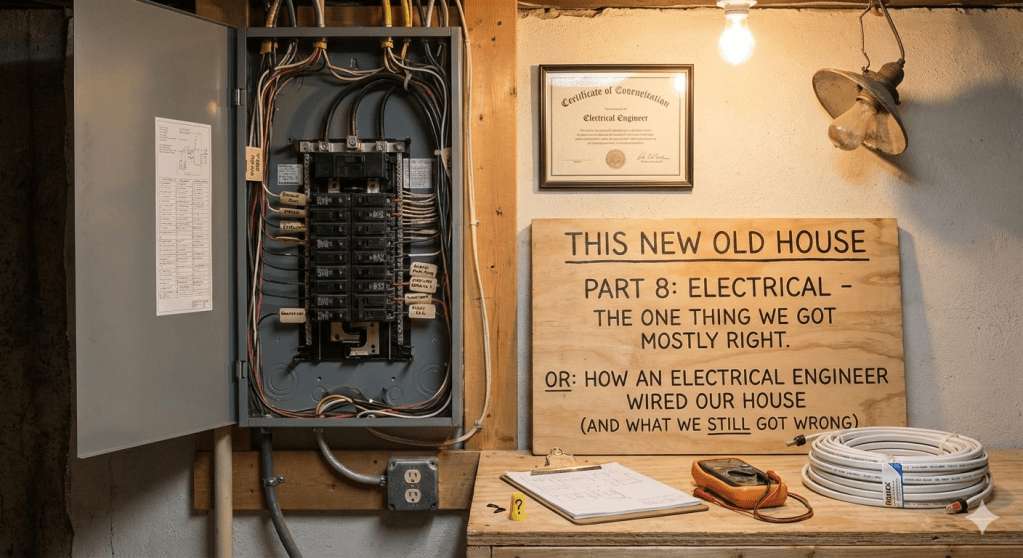
Or: How an Electrical Engineer Wired Our House (and What We Still Got Wrong)
Winter 2009-2010
After framing was complete, it was time for electrical. This is where having a friend with an electrical engineering degree really paid off.
Actually, let me rephrase: this is where we got more things right than wrong, which for this build was a massive victory.
The Friend Who Actually Knew What He Was Doing
My friend went to school for electrical engineering. He had the knowledge and skills to wire the house properly. He just needed a licensed electrician to inspect the work and sign off on it for code compliance.
This was one area where we had the least issues or concerns. The wiring was done right. The work was solid. The licensed electrician inspected and signed off without major corrections.
This was actually a win.
What We Got Right: Running Wire Everywhere
One of the smartest decisions we made was running wiring initially, even to spaces we wouldn’t finish right away.
Where we ran wiring:
- Basement (unfinished at the time, still unfinished now)
- Attic (unfinished at the time, still unfinished now)
- All walls before they were closed up
- Tech wiring (Cat cable) throughout the house
- Conduit where entertainment setups might go
The philosophy: wire it now while walls are open, because adding it later is exponentially more expensive and difficult.
This was absolutely the right call. Even 15+ years later, we have electrical where we need it because we planned ahead.
The Tech Center
We set up a tech center in a little nook at the top of our basement stairs. All the tech wiring runs from this central point.
This was 2009-2010, so we were thinking about:
- Hardwired internet (Cat cable)
- Potential for whole-house audio
- Central distribution point for all tech
We used the top-end wiring available at the time without going for the just-released bleeding-edge stuff. Technology moves fast—we knew whatever we installed would eventually be outdated, but we wanted it to last as long as possible.
Looking back in 2026: The wiring still works. Yes, WiFi has gotten much better and handles a lot of what we thought would need hardwired connections. But having the option is worth it, especially for reliability and bandwidth-heavy applications.
We’re glad we ran the wiring.
More Lights Than You Think You Need
We added more lights than the minimum. The idea: you don’t have to turn them all on, but as you get older, you find you need more light more often than not.
This turned out to be prophetic.
When we were younger, we loved dim, moody lighting. We installed dimmer switches on most of our living space lights so we could have that warm, atmospheric feel.
Now that we’re older? We need it brighter. A lot brighter.
The dimmers let us have both—turn them down when we want atmosphere, crank them up when we need to actually see what we’re doing.
But here’s what we got wrong: We should have wired for even MORE ceiling lights. Even though we didn’t plan to install them initially, we should have run the wiring.
There are rooms now where we wish we had ceiling lights. We didn’t install them 10 years ago because we didn’t think we needed them. Now we want to add them, but the wiring isn’t there. Adding it means opening walls, running wire, patching, repainting.
Lesson: Wire for lights you don’t plan to install yet. Run the wire while walls are open. Install the fixture later when you want it. The wire is cheap. Opening walls later is expensive.
What We Got Wrong: The 240V Regrets
This is where we got short-sighted.
Kitchen: We Got This Right
- We have 240V in the kitchen for our dual fuel stove
- Gas cooktop, electric oven
- Needed the 240V, ran it, works great
Second Floor Laundry: We Got This Wrong
- We ran a gas line for the dryer
- We have a gas dryer
- We did NOT run 240V at the same time
Why this was short-sighted:
- Gas dryer works fine
- But we have no option to switch to electric if we ever wanted to
- The walls were open
- Running 240V at the same time would have been easy
- Now if we ever want an electric dryer option, we’d have to run wiring through finished walls
We should have run BOTH gas and 240V. It would have cost maybe $200-300 more in wire and a breaker. Now it would cost thousands to add.
What we should have done: Wire the kitchen, laundry, basement, and any outbuilding for 240V. Even if you’re using gas appliances. Even if you don’t think you’ll need it. Run the wire while walls are open.
The Whole House Surge Protector We Didn’t Install
My friend didn’t think we needed a whole house surge protector.
We didn’t install one.
This was a mistake.
Whole house surge protection is relatively inexpensive (a few hundred dollars) and protects everything in your home from power surges—lightning strikes, utility issues, etc.
We’ve been lucky. We haven’t had a major surge event that fried electronics.
But we should have installed it anyway. The cost is minimal compared to replacing computers, TVs, appliances, HVAC controls, and everything else with circuit boards.
Lesson: Listen to the internet on this one, not your friend’s opinion. Install whole house surge protection. It’s cheap insurance.
What We Didn’t Plan For: Backup Power
We didn’t wire for backup power initially. No generator hookup. No thought about load splitting. No conduit to the box for future runs.
We also didn’t think about solar panels at all. Didn’t consider roof slope or direction in relation to solar potential. Didn’t plan for where an inverter or battery backup might go.
What happened later:
We eventually ordered an 11KW Generac generator from Ziller Electric and had it installed. There was an issue with a loose wire during installation that took some time to resolve—the generator would run fine but would shut down generating power once a load was put on it. Eventually got it fixed.
We also added solar panels last year (2024-2025).
Looking back, if we were doing it today:
- Plan for backup power from the start
- Run conduit to the electrical box for future additions
- Wire so the load can be easily split for generator use
- Consider solar panel potential (roof slope, direction, placement)
- Plan for battery backup location and wiring
- Add whole house surge protector (especially important with solar)
The technology and economics of solar and battery backup have changed dramatically since 2009. If we were building today, we’d plan for it from day one even if we didn’t install it immediately.
The Dimmer Switch Reality
We put dimmer switches on most of our living space lights because we preferred nice warm moody lighting.
This was the right choice, but not for the reason we thought.
When we were young, we used the dimmers to keep things dim and atmospheric. That warm, cozy glow seemed perfect.
Now that we’re older, we need it bright. Much brighter.
The dimmers let us adjust—bright when we need to see, dim when we want atmosphere.
But the real lesson isn’t about dimmers. The real lesson is: when you get older, you NEED more light. Your eyes don’t work as well. You need more lumens to see details, read comfortably, work on tasks.
We should have wired for MORE ceiling lights. More fixtures. More options.
Lesson: Light is cheap when you’re wiring. Add more circuits for lights than you think you’ll ever need. You can install the fixtures later, but running wire later is a nightmare.
What We Got Right (Summary)
- Friend with electrical engineering degree did solid work
- Licensed electrician inspected and signed off
- Ran wiring to unfinished spaces (basement, attic) from day one
- Tech wiring throughout (still useful 15+ years later)
- Tech center for central distribution
- More lights than minimum code
- Dimmer switches for flexibility
- 240V in kitchen for dual fuel stove
- Conduit where entertainment setups might go
What We Got Wrong (Summary)
- No 240V to second-floor laundry (just gas line)
- Didn’t wire for enough ceiling lights (want to add more now)
- No whole house surge protector (friend said not needed, was wrong)
- Didn’t plan for generator hookup initially
- Didn’t plan for solar panels (roof direction, inverter location, battery backup)
- Didn’t run conduit to electrical box for future additions
- Short-sighted about backup power options
The Licensed Electrician Inspection
The licensed electrician came to inspect my friend’s work and sign off for code compliance.
He found minor things to correct—the kind of detail issues that always come up in inspections. Nothing major. Nothing that indicated the work was done wrong.
He signed off.
This was a huge relief. Having your friend do electrical work is only a good idea if the work is actually correct. The licensed inspection confirmed it was.
The Long-Term Verdict
Fifteen years later, the electrical system works. We haven’t had major issues. Circuits don’t trip randomly. Nothing has caught fire. The wiring to unfinished spaces means we have options.
But we have regrets:
- Wish we had 240V in the laundry
- Wish we’d wired for more ceiling lights
- Wish we’d installed whole house surge protection
- Wish we’d planned for backup power from the start
- Wish we’d thought about solar potential
None of these are disasters. All of them would have been easy and cheap to do during initial wiring.
This was one of our better outcomes. The electrical work was done right. We planned ahead more than we did in most areas. We just didn’t plan ahead quite enough.
__________________________________________________
Next up: Part 9 – Insulation and Air Sealing: The Spray Foam Debate
(In which we discover that making your house tight has consequences, that spray foam is expensive, and that you really do need mechanical ventilation when you build a house this well-sealed)
__________________________________________________
Quick Takeaways
Hiring Friends with Actual Expertise:
✅ WORKS WHEN:
- Friend has relevant education/training (like electrical engineering)
- Work can be inspected by licensed professional
- Friend takes pride in doing it right
- You trust their technical knowledge
❌ DOESN’T WORK WHEN:
- Friend has general construction experience but no specific expertise
- No inspection requirement to verify work
- You can’t separate friendship from quality concerns
Running Wire During Construction:
✅ DO THIS:
- Wire ALL spaces, even unfinished ones
- Run 240V to kitchen, all laundry locations, basement, outbuildings
- Run it even if using gas appliances (future flexibility)
- Wire for more ceiling lights than you plan to install
- Run conduit where entertainment setups might go
- Use top-quality (not bleeding-edge) tech wiring
- Plan for central distribution point
- Run conduit to electrical box for future additions
❌ DON’T DO THIS:
- Skip wiring to unfinished spaces (“we’ll add it later”)
- Only wire for appliances you’re currently installing
- Wire for minimum lighting
- Assume WiFi will handle everything tech-related
- Skip planning for backup power options
240V Planning:
✅ RUN 240V TO:
- Kitchen (range, wall ovens)
- ALL laundry locations (even if using gas dryer)
- Basement (future workshop, appliances)
- Garage/outbuildings (tools, EV charging)
- Any location where heavy appliances might someday go
The cost to run 240V during construction: $200-300 per location
The cost to add 240V later: $2,000-5,000 per location
Lighting Lessons:
- Wire for MORE lights than you think you need
- Install dimmers for flexibility (bright when needed, dim when wanted)
- You will want/need more light as you age
- Ceiling lights you don’t install now: wire for them anyway
- Light fixtures are cheap, running wire later is expensive
Surge Protection:
- Whole house surge protector: $300-500 installed
- Protects everything with circuit boards
- Cheap insurance against lightning, power surges
- Should be standard on every new build
Backup Power Planning:
✅ PLAN FOR:
- Generator hookup location and wiring
- Load splitting capability
- Solar panel potential (roof slope, direction, space for inverter)
- Battery backup location and wiring
- Conduit for future power runs
- Whole house surge protection (essential with solar)
Technology Planning:
- Hardwired connections still matter (reliability, bandwidth)
- WiFi improves but isn’t perfect (interference, range, reliability)
- Run better wiring than you think you need
- Central distribution point makes troubleshooting easier
- Plan for obsolescence but wire for longevity
Budget Reality:
- Friend with electrical engineering degree: Saved labor cost, got quality work
- Licensed inspection: $150-300 (required, worth it)
- Wiring to unfinished spaces: +$500-1,000 (massive future savings)
- 240V to laundry: Would have been +$200 then, $2,000+ now
- Whole house surge protector: $300-500 (should have done it)
- Extra ceiling light circuits: +$50-100 each (would add now for $2,000+ each)
What Actually Matters:
The electrical system works. The wiring to unfinished spaces gives us options. The tech wiring is still useful.
The 240V to laundry? Annoying but not critical—gas dryer works fine.
The extra ceiling lights we didn’t wire for? Frustrating when we want to add them.
The whole house surge protection? We’ve been lucky, but we should have done it.
Most of the electrical work was done right. The regrets are about opportunities we missed during initial wiring when it would have been cheap and easy.
Our Grade: B+
Solid electrical work, good planning for unfinished spaces, smart tech wiring. Lost points for not running 240V to laundry, not wiring for enough lights, and skipping whole house surge protection. But one of our better outcomes overall.
Final Thought:
Having a friend with actual electrical engineering expertise (not just “I’ve done electrical work before”) made a huge difference. The work was done right. The inspection passed.
Our mistakes weren’t about the quality of the work. They were about not thinking far enough ahead about future needs.
Wire is cheap during construction. Everything is expensive later.
Run the wire now. Install the fixture/appliance later. Your future self will thank you.
Also: install a whole house surge protector. Don’t listen to anyone who says you don’t need it. You need it.
 Even that's Odd
Leave a comment