
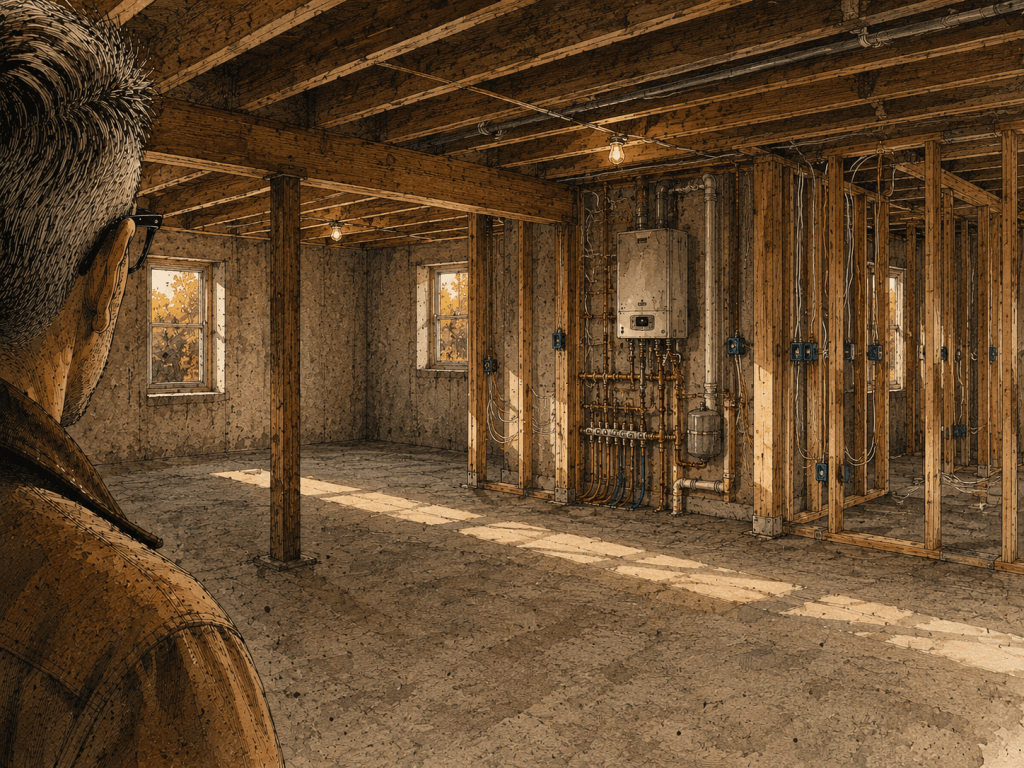
Winter 2009-2010.
After the plumbing nightmares, it was time for HVAC. We installed radiant floor heating throughout the house — hot water running through tubes in the floors, heated by our Triangle Tube boiler.
It’s actually very nice to have warm floors in the winter. Walking barefoot on toasty floors is lovely.
It’s also the wrong call.
European-style radiators would have been the way to go. Individual thermostats on each unit, room-by-room temperature control, fast response, easy to repair, no need for a whole supplemental air system to bail them out. We did none of that. We did the warm floors.
The Radiant Floor Reality
Radiant floor heating runs hot hydronic fluid through tubes embedded in the floors. The floor heats up. The floor radiates heat into the room. The floor is, technically, a giant low-grade thermal battery.
Which is also the problem.
Thermal mass is slow. Wake up cold and bump the thermostat? You’re waiting hours for the floor to come up to temperature. Coming home to a cold house? Not getting warm quickly. You can’t adjust room by room. And when something breaks, the repair is somewhere under the floor.
So we needed supplemental air heat. Which meant central air. Which meant a blower, a hydro coil, ductwork through the whole house, an outdoor compressor — a complete second HVAC system, built specifically to compensate for the slow-response problem of the first one.
The hydro coil heats air fast. Air also cools fast. So it cycles constantly — heat the air, the air cools, heat it again. Inefficient by design. The radiant floors do the steady-state work; the air system does the panic response.
Individual radiators with their own thermostats would have done both jobs in one system, faster, with room-by-room control, and without an attic full of ductwork. I was even curious whether we could run cold water through radiant tubing for summer cooling — apparently you can. We didn’t explore it. We did central air instead.
The Air Handler in the Attic
When we planned the HVAC, I asked for the air handler in the basement. Easy access. Comfortable working conditions. Room to actually pull equipment out when it inevitably needed replacing.
“That’s inefficient,” they told me. “It has to go in the attic.” Something about cold air dropping and heat rising and the laws of physics demanding it.
I should have pushed for the basement.
The attic location has been a nightmare. Limited access. A small access hole that wasn’t big enough to actually get the equipment out for replacement. A 120-degree workspace in summer. I eventually cut my own larger access panel when we had to swap the hydro coil, because the original opening physically couldn’t pass the unit through it.
Plan access for replacement, not just for maintenance. The people installing your HVAC will not think about how anyone is going to get it back out.
The HRV That Couldn’t
Spray foam insulation makes a very tight house. Tight house is great for energy efficiency. Tight house is terrible for air quality and humidity, because you’ve engineered out all the unintentional ventilation.
So you need an HRV — a Heat Recovery Ventilator. It pulls fresh air in, pushes stale air out, and recovers heat from the outgoing air so you’re not just throwing your heating budget out the wall.
Our contractor undersized it.
We ran the HRV 24/7 just trying to keep up with humidity and air exchange, and it never quite caught up. Some of that was the unit being too small for the house. The rest was the Pella windows, which had moisture, condensation, and mold issues from day one. (More on those in Part 11. Buckle up.)
Sixteen years later, I don’t use the HRV anymore. I use a dehumidifier and the bathroom fans, and I do the German burp method — open the windows for ten minutes, swap all the air, close them again. That is not what you are supposed to do with a tight, modern house. It’s what you do when the HRV can’t keep up and the windows are working against you.
Don’t let the contractor size your HRV down to hit a number. Size it for the house you actually built.
Five Years.
The coil on the AC needed to be replaced after five years.
Five.
We built a brand new house specifically so we wouldn’t have to repair anything for a long time. And here we were, five years in, replacing a major HVAC component.
I asked the technician about it.
“All of that equipment is only built to last 5–10 years,” he said. Casually. Like he was telling me it might rain.
What the fuck?
This is when something broke in my head about new construction. If everything is going to need major repairs in five to ten years anyway, the value proposition of paying premium prices for new equipment evaporates. A renovation with ten-year-old HVAC gives you the same five-year window before things start failing — and you didn’t spend twenty grand to get there.
We paid for new. We got a five-year warranty on the math.
Emergency Service, Defined Loosely
After the coil replacement we had a leaky valve. The company that did the coil didn’t have the diagnostic equipment to find it, so I switched companies. Again.
The new one advertised emergency service. I asked what that meant.
Emergency service during business hours.
That’s not emergency service. That’s regular service, with urgency. Every HVAC company I dealt with had their own definition of “emergency,” and none of them matched mine. Mine being: my house is currently a problem and it is not currently business hours.
Five Small Installation Mistakes
Beyond the big structural choices, there were five smaller things the installers got wrong that I’ve been living with ever since.
The wire run to the outdoor unit was sized for AC only, not heat pump capable. When heat pump tech caught up and we wanted to upgrade, the wiring wouldn’t support it. Cost: a future rewire job that should have cost nothing in 2009.
The refrigerant supply line to the outdoor condenser had a crimp in it. I didn’t notice until the AC started underperforming. Cost: the install of a system that should have worked at 100% from day one didn’t.
The coolant pipes running up to the attic blower vibrated audibly through the wall. Had to add vibration dampening after the fact, which should have been part of the original install.
The emergency drain pan under the air handler wasn’t sloped properly. Over the years it rusted out, and the condensate drained down the outside of the house, leaving rust stains running down the siding.
And the coolant pipes and wires to the attic were run inside an exterior wall. Which sounds fine until you replace the AC and the new installers can’t get new lines through the finished wall, so they run them on the outside of the house and cover them with white plastic conduit. It looks exactly as bad as it sounds.
None of these are catastrophic on their own. All of them are the kind of detail you discover years later, when you’re trying to fix something else.
The Verdict, Sixteen Years In
The floors are still warm. The house heats. The house cools. The systems, broadly, work.
We’ve replaced the coil, fixed the valve, dampened the vibrations, patched rust, cut our own access panel, abandoned the HRV, and learned that “new equipment” means “we’ll see you back here in five years.” European radiators would have been more efficient, more controllable, and wouldn’t have required building a second HVAC system to compensate for the first one. If I could do this over, the air handler goes in the basement. The radiators go on the walls. And the contractor doesn’t get to undersize the HRV to save himself line items.
I’ll do a separate post eventually about replacing the Triangle Tube boiler. That’s its own adventure.
Grade: C. Warm floors are nice. Everything else is a slow-motion lesson. Radiant heat too slow to react, so we built a whole supplemental air system around it. Air handler in the attic instead of the basement. HRV undersized. Wire run that couldn’t handle a heat pump. Crimped refrigerant line. Drain pan that wasn’t sloped. Coolant pipes in an exterior wall, now hidden behind ugly white conduit. And the coil failed in five years — which is apparently fine, because “all of that equipment is only built to last 5–10 years.” That sentence broke something in me. We paid for new and got a five-year warranty on the math. The floors are still warm, though.
Next up: Part 11 — Pella Windows. The review I should have posted fourteen years ago.
 Even that's Odd
Leave a comment