
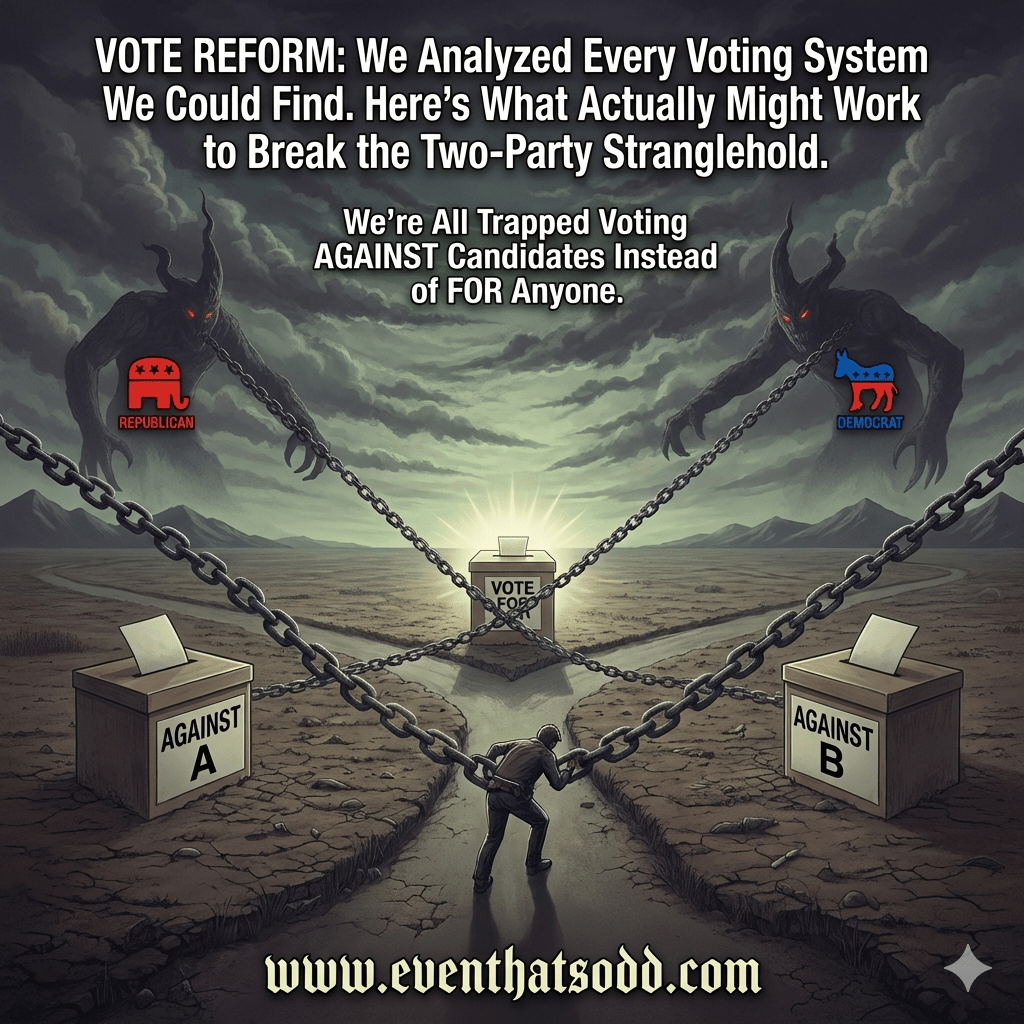
We’re All Trapped Voting AGAINST Candidates Instead of FOR Anyone
When’s the last time you actually wanted to vote for someone?
For most of us, voting has become damage control. We’re not voting FOR our candidate—we’re voting AGAINST the one that scares us more.
About 70% of Americans think the country is heading in the wrong direction. Both parties blame each other. But here’s what they’re not telling you: They both benefit from keeping you trapped in this choice between bad and worse.
Sometimes gridlock is better than passing terrible laws—we get that. When both parties answer to the same corporate donors and neither represents working people, yeah, maybe gridlock stops some truly awful ideas.
But here’s what we lose:
- No action on healthcare costs bankrupting families
- No action on housing costs pricing out entire generations
- No action on jobs paying less while costs skyrocket
- No action on anything that would help the bottom 90%
Meanwhile, when the donors want something—tax cuts, deregulation, corporate bailouts—both parties find a way to make it happen.
We all lose. The only people winning are the ones who were already winning.
And you know what? There are candidates you might actually like—third parties, independents, different voices. But you can’t vote for them because “that would waste your vote” and help elect the candidate you hate most.
This is the trap. And both parties built it on purpose.
So we did a comprehensive analysis of every voting system we could find—not just reading about them, but actually modeling them, testing scenarios, trying to break them, looking for flaws.
We looked at systems used in other countries. We studied historical systems that failed. We explored cutting-edge proposals. We tried combining the good parts of different systems.
Here’s what we learned, system by system.
When People Try to Fix It, Both Parties Unite to Ban Reform
Before we dive into the systems themselves, you need to understand this: When reformers try to implement better voting, both parties team up to make it illegal.
Ranked Choice Voting: They Literally Made It ILLEGAL in 7 States
You might have heard of Ranked Choice Voting (RCV). It’s used in Maine and Alaska. You rank candidates in order of preference—1st choice, 2nd choice, 3rd choice. If your favorite can’t win, your vote goes to your next choice.
Simple. Fair. Gives you real options without “wasting” your vote.
The two parties’ response?
They made it ILLEGAL in multiple states:
- Florida – banned 2022
- Tennessee – banned 2022
- Montana – banned 2023
- South Dakota – banned 2024
- Idaho – banned 2024
- Missouri – banned 2024
- North Dakota – banned 2025
All Republican-controlled states. All passed AFTER seeing it work in Maine and Alaska.
They’ll tell you it’s “too confusing” or “undermines election integrity.”
The real reason? Alaska used it in 2022 and elected Mary Peltola, a Democrat, in a deeply red state—because she had broad cross-party appeal. It worked. So they banned it.
Fusion Voting: Both Parties United to Ban It in 43 States
Here’s an even more revealing story about how both parties protect their duopoly.
Fusion voting allows multiple parties to nominate the same candidate. Your vote counts for both the candidate AND the specific party line you voted on.
How it works:
- Hillary Clinton nominated by Democrats AND Working Families Party
- You vote for Clinton on the WFP line
- Clinton gets your vote
- But the results show: “Working Families Party delivered 50,000 votes”
Why this matters: Third parties can prove their value and actually move major party candidates on issues.
In New York (one of only two states where it’s still actively used), the Working Families Party has moved Democrats on:
- Minimum wage increases
- Paid family leave
- Tenant protections
- Marijuana legalization
Because they could say: “We delivered your margin of victory. Now you listen to our priorities or we run our own candidate next time.”
The Coordinated Attack on Fusion Voting
Late 1800s:
- Fusion voting was legal in ALL 50 states
- Third parties (Populist, Socialist, Labor, Progressive, Farmer-Labor) were gaining real power
- They used fusion to endorse major party candidates and demand policy concessions
- It was working
1890s-1920s (The “Progressive Era”):
- Over 40 states banned fusion voting
- Why? Third parties were threatening the two-party system
- Agrarian and labor coalitions were challenging urban political machines
- Both Democrats AND Republicans agreed: Third parties having leverage is too dangerous
The excuse: “We’re reforming elections to eliminate corruption”
The reality: Eliminating the mechanism that gave third parties power
States that banned it:
- New Jersey (1922)
- Kansas (1920s)
- Nebraska (1930s)
- And 40+ others by the 1920s
Which States Still Allow Fusion Voting Today?
Full fusion voting (candidate appears multiple times on ballot):
- New York – Actively used, Working Families Party has real influence
- Connecticut – Actively used
- Mississippi – Technically legal, but not used
- South Carolina – Legal
Partial fusion (candidate appears once with multiple party labels): 5. Vermont – Vermont Progressive Party uses this 6. Oregon – Rarely used
Limited fusion (specific elections only): 7. California – Presidential elections only 8. Pennsylvania – Certain elections (like judicial races) 9. Maryland – Certain elections
That’s it. 9 states out of 50.
And of those, only New York and Connecticut actually use it regularly.
What This Tells Us
Fusion voting was legal everywhere until third parties started winning.
Then—suddenly—during the “Progressive Era” when we were supposedly “reforming” elections:
- 43 states banned it
- Both parties agreed
- Within 30 years, it went from universal to nearly extinct
If fusion voting was so terrible, why did both parties allow it for 100+ years?
Answer: It wasn’t terrible. It was effective. And that’s exactly why they banned it.
The Supreme Court Blessed the Two-Party System
1997: Timmons v. Twin Cities Area New Party
A new progressive party (literally called “The New Party”) challenged Minnesota’s fusion ban.
They argued: Banning fusion violates First Amendment rights (freedom of association)
Supreme Court said: States have an interest in “political stability”
Translation: Protecting the two-party system is more important than your constitutional rights.
The court literally said the government’s interest in maintaining the two-party system justifies restricting your freedom of association.
Let that sink in.
Recent Attempts to Bring It Back
People are trying. As of 2024-2025:
New Jersey: Moderate Party filed lawsuit to overturn 1922 ban
- New Jersey Superior Court rejected it (February 2025)
- Currently appealed to NJ Supreme Court
Wisconsin: United Wisconsin coalition filed lawsuit (April 2025)
- Arguing the ban violates state constitution
- Case pending
Kansas: United Kansas Party filed lawsuit (2025)
- District court upheld the ban
- Appeals continuing
Michigan: Common Sense Party attempting to bring it back (2023)
Every single one has been rejected or is facing massive resistance.
Why? Because both parties benefit from keeping fusion voting illegal.
So here’s where we are:
- Ranked Choice Voting: Better than what we have, but literally illegal in 7 states and counting
- Fusion Voting: Worked great, so both parties banned it in 43 states
Both parties will unite to kill anything that threatens their monopoly.
That’s why whatever solution we found had to be:
- Simple enough voters would demand it
- Effective enough it actually breaks party control
- Hard enough to ban that states couldn’t easily outlaw it
Now, let’s look at every system we analyzed…
System #1: Plurality Voting (What We Have Now)
How it works:
- Vote for ONE candidate
- Whoever gets the most votes wins
- You don’t need a majority—just more than anyone else
The fatal flaw: THE SPOILER EFFECT
Example: 2000 Presidential Election (Real Results):
- Al Gore (Democrat): 48.4%
- George W. Bush (Republican): 47.9%
- Ralph Nader (Green): 2.7%
Bush won. But most Nader voters preferred Gore to Bush. If Nader hadn’t run, Gore probably wins.
Nader “spoiled” the election by splitting the left-leaning vote.
This creates the two-party trap:
- You like the Green candidate best
- But if you vote Green, you help elect the Republican
- So you vote Democrat (lesser evil)
- Green Party never grows because everyone’s afraid to vote for them
The problems:
- ❌ Forces “lesser of two evils” voting
- ❌ Spoiler effect mathematically locks out third parties
- ❌ Plurality winners (Trump won with 46.1% in 2016—53.9% didn’t want him)
- ❌ Vote splitting in primaries (2016 GOP: 17 candidates, Trump wins states with 35%)
- ❌ Primaries give party bosses gatekeeping power
Verdict: This system mathematically guarantees two-party dominance. It’s not a bug—it’s the design.
System #2: Ranked Choice Voting (RCV / Instant Runoff)
How it works:
- Rank candidates in order of preference (1st, 2nd, 3rd)
- If nobody gets 50%+, eliminate the last-place candidate
- Their votes transfer to voters’ next choices
- Repeat until someone has a majority
Used in: Maine, Alaska (until recently), some cities
The promise:
- Vote for your favorite without fear
- If they can’t win, your vote transfers to your backup
- No spoiler effect
- Winner needs majority support
The Flaw: Center Squeeze (The Consensus Candidate Problem)
RCV can eliminate the candidate who would have beaten everyone else head-to-head.
Real Example: 2009 Burlington, Vermont mayoral race
Three candidates: Kurt Wright (Republican), Bob Kiss (Progressive), Andy Montroll (Democrat)
Round 1 – First-choice votes:
- Wright: 33.6%
- Kiss: 29.4%
- Montroll: 29.1% ← Eliminated for having fewest first-choice votes
Round 2: Wright vs Kiss → Kiss won
But when you look at ALL the ballots and compare candidates head-to-head:
- Montroll beat Kiss: 54% to 46%
- Montroll beat Wright: 56% to 44%
Montroll would have beaten either finalist head-to-head, but he got eliminated first because he wasn’t enough people’s #1 choice.
Real Example: 2022 Alaska Special Election
Three candidates: Mary Peltola (Democrat), Sarah Palin (Republican), Nick Begich (Republican)
Round 1 – First-choice votes:
- Peltola: 40%
- Palin: 31%
- Begich: 29% ← Eliminated for having fewest first-choice votes
Round 2: Peltola vs Palin → Peltola won
But when you look at ALL the ballots head-to-head:
- Begich beat Peltola: 52.5% to 47.5%
- Begich beat Palin: 61% to 39%
Again: The candidate who would have beaten both finalists got eliminated before the final round.
Why This Happens:
In a three-way race, the moderate/consensus candidate often:
- Gets fewer passionate first-choice votes (people like them fine, but aren’t excited)
- Is broadly acceptable as a second choice to many voters
- Gets eliminated early before those second-choice preferences can help them
This is called “center squeeze.” The consensus candidate gets squeezed out between two candidates with stronger bases.
Is This Actually Bad?
That’s debatable.
You could argue:
- RCV worked as designed – it rewards candidates who motivate passionate supporters AND can build coalitions
- Being “acceptable to everyone” isn’t the same as earning support
- Peltola won because she had the most first-choice support AND built to a majority
Or you could argue:
- Elections should pick the candidate most people find acceptable
- Montroll and Begich were consensus picks who could have united more people
- Eliminating them meant more polarized final choices
Neither view is “wrong” – they’re different philosophies about what elections should do.
The PRACTICAL Problems With RCV:
These are harder to debate:
1. Already illegal in 7+ states:
- Florida, Tennessee, Montana, South Dakota, Idaho, Missouri, North Dakota
- All banned AFTER 2020
- All Republican-controlled states
- You’d have to fight to repeal bans before you could even start
2. More complicated = more errors:
- 5% ballot error rate (vs 0.5% for simple voting)
- Ballots 10x more likely to be rejected
- NYC’s first RCV election: accidentally included 135,000 test ballots in official results
- Results often delayed days or weeks
3. Ballot exhaustion:
- Study of 182 RCV elections: 95 elections (52%) didn’t produce a true majority
- When voters don’t rank all candidates, their ballots get “exhausted” and stop counting in later rounds
- Alaska 2022: Peltola won with 91,277 votes out of 189,000 cast = only 48% of all voters
4. Requires special software and equipment:
- Poll worker training more complex
- Tabulation software can fail or be attacked
- More moving parts = more things that can break
Verdict: RCV is better than plurality voting. It eliminates the spoiler effect and gives voters real choices. But it has implementation problems, creates new complexities, and is being actively banned by Republicans who see it as a threat. We can do better with a simpler system that hasn’t already been poisoned.
System #3: Fusion Voting (Cross-Endorsement) – Why It’s Not Enough
We already covered how fusion voting was banned in 43 states. But even where it still exists, it has problems:
Flaw #1: Major Parties Can Hold Third Parties Hostage
Scenario that actually happens:
- Working Families Party wants to run their own candidate
- Democrats threaten: “Endorse our candidate or we’ll pass a law eliminating fusion voting”
- Or: “Endorse us or we’ll challenge your ballot access”
- WFP forced to endorse a Democrat they don’t actually support
The threat is real because Democrats control NY state government and could eliminate fusion voting any time.
Flaw #2: Still Uses Plurality Voting
You still only vote for ONE candidate (on whichever party line). Whoever gets the most votes wins—no majority required.
All the plurality problems still exist:
- Spoiler effect if third party runs their own candidate
- Vote splitting
- Minority winners possible
- Strategic voting still necessary
Flaw #3: Doesn’t Solve the Primary Problem
New York still has primaries. Parties still control who gets nominated in the first place.
Working Families Party can only endorse candidates who survived a Democratic primary.
Flaw #4: Backroom Dealing
Third parties can be bought off:
- “Endorse us and we’ll give your people patronage jobs”
- “Endorse us and we’ll include one of your priorities in the platform”
- Endorsements become transactions, not genuine representation
Verdict: Gives third parties a foothold where legal, but they can still be manipulated, controlled, and bought off. Doesn’t solve spoiler effect or plurality winner problems. And it’s been systematically eliminated by both parties working together.
System #4: Germany’s Multi-Party System (Proportional Representation)
How it works in Germany:
- Mixed-Member Proportional Representation (MMP)
- You cast TWO votes:
- First vote: Direct candidate for your district
- Second vote: Party list (this is the key)
- If a party gets 15% of national party-list votes, they get 15% of parliament seats
- 5% threshold to keep out fringe parties
Results: Germany currently has 6 parties in parliament:
- SPD (Social Democrats) – center-left
- CDU/CSU (Christian Democrats) – center-right
- Greens – environmental/progressive
- FDP (Free Democrats) – libertarian/pro-business
- AfD (far-right) – controversial
- Die Linke (The Left) – democratic socialist
Coalition governments are the norm. Current government: SPD + Greens + FDP (three parties working together).
This looked amazing. Multi-party democracy! Real choices! Coalition building!
Why can’t we do this in the US?
The Constitutional Wall
Germany’s system requires structural changes the U.S. Constitution doesn’t allow:
Problem #1: Winner-Take-All Districts
- U.S. House: One representative per district, winner takes all (Article I, Section 2 of Constitution)
- Germany: Multi-member proportional districts
- Changing this requires Constitutional amendment
Problem #2: The Senate
- Two senators per state, winner-take-all
- Structurally impossible to make proportional without rewriting the Constitution
Problem #3: The Presidency
- Separate executive election (not chosen by parliament)
- Electoral College = winner-take-all in most states
- Germany’s system is parliamentary—parliament chooses the Chancellor
- Completely different structure
Problem #4: The Electoral College
- Most states: Winner takes ALL electoral votes
- Maine and Nebraska are exceptions (district system)
- Eliminating this requires Constitutional amendment
Problem #5: State-by-State Control
- U.S. elections are run by 50 different state governments
- Germany has national election standards
- Getting all 50 states to coordinate on proportional representation = practically impossible
What Would It Take to Implement German-Style System?
You would need to:
- Amend the Constitution to allow multi-member House districts
- Eliminate or fundamentally restructure the Electoral College (Constitutional amendment)
- Get all 50 states to adopt proportional representation simultaneously
- OR eliminate federalism and create a national election system (Constitutional rewrite)
Constitutional amendments require:
- 2/3 of both House and Senate
- Ratification by 3/4 of state legislatures (38 states)
With our current polarization and small states benefiting from Electoral College overrepresentation?
This will never happen.
The Historical Timing Problem
Germany got their system by:
- Losing World War II
- Being occupied by Allied forces
- Having their entire government restructured from scratch by outsiders
- Post-war constitution written in 1949
The U.S. missed our chances to redesign our electoral system:
- After the Civil War (Reconstruction – didn’t happen)
- After World War II (if we’d lost – didn’t happen)
- Never happened
We’re stuck with the Constitutional structure we have.
Verdict: Germany’s multi-party system is great for Germany. It’s constitutionally impossible in the United States without a complete governmental restructuring that will never happen.
System #5: Combining RCV and Fusion (Our First Big Idea)
After analyzing all these systems, we thought: What if we took the GOOD parts of each and combined them?
The system we designed:
- Eliminate primaries – Anyone can run with enough signatures (open ballot access)
- Fusion element – Parties can cross-endorse candidates; endorsements shown on ballot
- Voters rank candidates – 1st, 2nd, 3rd choice
- Count by endorsement line first – Track how many votes each party line delivered
- Then combine for RCV instant runoff – Run ranked-choice elimination across all endorsement lines
- Winner must get majority
On paper, this looked perfect:
- ✅ No party gatekeeping (no primaries)
- ✅ Third parties get credit (fusion tracking shows their delivered votes)
- ✅ No spoiler effect (ranked choice prevents vote splitting)
- ✅ Majority required to win
- ✅ Consensus candidates rewarded
We were excited. Then we stress-tested it.
Flaw #1: The Math Becomes Absurdly Complicated
Try explaining this to a regular voter:
“First, you rank candidates in order. But you’re also voting on a party line, so your ranking applies to that line. Then we count first-choice votes separately by party line to show each party’s contribution. Then we combine all the votes for each candidate across all party lines. Then we do instant runoff elimination—whoever has the fewest combined votes is eliminated. Then we look at the second-choice votes, but only from the voters whose first choice was eliminated. But wait, if their second choice was on a different party line than their first choice, we have to… uh…”
Eyes glaze over.
If voters can’t understand it, they can’t trust it. If they can’t trust it, it fails.
Flaw #2: Still Has RCV’s Center Squeeze Problem
Adding fusion tracking doesn’t fix instant runoff’s fundamental flaw: moderate consensus candidates still get eliminated early for not being enough people’s #1 choice.
Flaw #3: Gaming Through Strategic Endorsements
Attack vector we discovered:
- Republicans strategically endorse the WEAKEST Democrat (the one they think will lose)
- Democrats strategically endorse the WEAKEST Republican
- Both parties game the system by pumping up bad candidates
This creates incentives for sabotage instead of honest endorsement.
Flaw #4: Massive Legal Challenge Surface
Any system this complex gives both parties ammunition for lawsuits:
- “The tabulation method violates one-person-one-vote”
- “The party line tracking violates secret ballot requirements”
- “Voters couldn’t have understood what they were voting for”
- “The endorsement display on the ballot constitutes party favoritism”
Both major parties would LOVE to tie this up in court for a decade.
And honestly? Some of these challenges might win.
Flaw #5: Implementation Nightmare
Different voting machine vendors would implement this differently. Training poll workers becomes incredibly complex. Recounts would be nightmares.
The more complex the system, the more places it can break.
Verdict: Too complex to explain, too vulnerable to legal challenge, still has RCV’s flaws, creates new gaming opportunities. Back to the drawing board.
System #6: Borda Count (Like MVP Voting)
After the fusion-RCV hybrid failed, we looked at something simpler: point-based systems.
How it works:
- Rank candidates in order
- 1st choice = 3 points, 2nd choice = 2 points, 3rd choice = 1 point
- Add up all the points
- Most points wins
Used for: Sports rankings (Heisman Trophy, MLB MVP, NASCAR), some organizational elections
Why we liked it:
- ✅ Simple math (just add up points—everyone understands this)
- ✅ Rewards consensus (being everyone’s #2 choice can beat being 40%’s #1)
- ✅ Familiar (people already understand sports rankings)
- ✅ Counts ALL preferences (your 2nd and 3rd choices matter)
- ✅ No instant runoff complexity
- ✅ No weird monotonicity failures
We modeled several elections with this. It looked great… until we found the exploit.
The Fatal Flaw: Clone Candidates (Strategic Multiplication)
The attack:
Republican Party runs 10 candidates who are essentially identical clones.
Democratic Party runs 2 candidates.
What happens:
Republican voters rank all 10 Republicans at the top:
- Trump: 10 points
- Trump-lite: 9 points
- Trump Jr: 8 points
- Neo-Trump: 7 points
- Trump 2.0: 6 points
- Trumpy: 5 points
- Trumpian: 4 points
- Trumpesque: 3 points
- Trump Classic: 2 points
- Trump New Formula: 1 point
- Total Republican points from one voter: 55 points
Democratic voters rank their 2:
- Bernie: 10 points
- AOC: 9 points
- Total Democratic points from one voter: 19 points
Even though Democrats and Republicans have equal voter support, one of the Republican clones wins because the Republicans gamed the system by running duplicates.
This is called “cloning your way to victory.”
Historical Note: Even the Inventor Gave Up On It
Jean-Charles de Borda invented this system in 1770. The French Academy of Sciences used it to elect members.
It was abandoned in 1800 after members figured out they could manipulate results by nominating similar candidates.
Borda himself said: “My system is meant only for honest men.”
Translation: “This only works if nobody cheats.”
If your voting system requires everyone to be honest, it’s not a voting system—it’s wishful thinking.
Verdict: Too easily gamed through strategic nomination. Any party can “clone their way to victory” by running multiple similar candidates.
System #7: STAR Voting (Score Then Automatic Runoff)
We were running out of options. Then we found STAR Voting—a newer proposal.
How it works:
- Rate each candidate 0-5 stars (like rating a restaurant)
- Top 2 candidates by total stars advance to automatic runoff
- In the runoff: Whoever more voters preferred (ranked higher) wins
Why this intrigued us:
- ✅ Familiar format (everyone rates things with stars)
- ✅ Expressive (can show strength of preference—5 stars vs 3 stars)
- ✅ Two-step process prevents strategic exaggeration
- ✅ Finds consensus (runoff ensures head-to-head winner)
- ✅ Hard to game (giving your favorite 5 stars and everyone else 0 is safe, but doesn’t manipulate results much)
We modeled this extensively. The math checked out. But:
Problem #1: Zero Real-World Electoral Data
STAR voting has been used in:
- Organizational elections
- Online polls
- Theoretical simulations
It has NOT been used in any government election anywhere.
Maine uses RCV. Alaska uses RCV. Fargo and St. Louis use Approval Voting.
Nobody has actually implemented STAR in a real election with real consequences.
We wanted something proven, not theoretical.
Problem #2: Still Requires Two Explanations
You have to explain:
- The scoring phase (“rate each candidate 0-5 stars”)
- The runoff phase (“then the top 2 are compared head-to-head”)
While not as complex as RCV-Fusion hybrid, it’s still two mechanisms instead of one.
More to explain = more to challenge = more for voters to misunderstand.
Problem #3: The “Honest Rating” Problem
STAR advocates claim voters will honestly rate candidates across the spectrum.
But research on human behavior suggests:
- Many voters will “bullet vote” (5 stars for favorite, 0 for everyone else)
- This is rational—maximizes your favorite’s chance
- If enough people do this, STAR devolves into something closer to Approval Voting anyway
Why add the complexity of star ratings if people bullet vote?
Problem #4: Implementation Uncertainty
How do different voting machine vendors implement the runoff? How do you handle recounts? What if there’s a tie in the scoring phase?
With no real-world implementations, all the edge cases are theoretical.
Verdict: Promising in theory, but unproven in practice. More complex than necessary if bullet voting is common. We wanted something with a track record.
System #8: Approval Voting – Which We’re Calling “Open Choice Voting”
After our comprehensive analysis of every system, modeling elections, trying to break them, looking for exploits—we kept returning to Approval Voting.
At first, we thought it was too simple. Surely there had to be a catch.
How it works:
Check ALL the candidates you approve of. Most approvals wins.
That’s it. That’s the whole system.
Used in: Fargo, North Dakota (2018-present) and St. Louis, Missouri (2020-present) for city elections
We’re calling it Open Choice Voting because:
- Open ballot access – no party gatekeepers
- Your choice – you decide who to approve
- Every choice counts – all your preferences are tallied
Why this is different from everything else:
Advantage #1: It’s Dead Simple
“Check all the candidates you’d be okay with.”
A 5-year-old can understand this. No ranking. No points. No runoffs. No instant elimination rounds. No two-step processes.
Just: Would you approve of this person as your representative? Yes or no.
We tested this explanation on people with no political background. 100% understood it immediately.
Advantage #2: It’s Impossible to Game
We did a deep dive trying to break this system. Here’s what we tried:
Gaming Attempt #1: “I’ll only approve my #1 candidate to give them maximum advantage”
Result: This backfires.
Other voters who approve multiple candidates have more influence over the final outcome. You’ve limited your own voice.
Example:
- You approve only Trump (trying to maximize his advantage)
- Other voters approve Trump AND Kasich (hedging)
- In a close race between Trump and Sanders, those voters who approved both Trump and Kasich have influence over both candidates
- You only have influence over Trump
- You’ve actually reduced your own impact
Gaming Attempt #2: “My party will run 10 clone candidates to multiply our approvals”
Result: Doesn’t work at all.
If Republicans run 10 Trump clones:
- Republican voters approve all 10 clones: Each gets the same 40% approval
- Democratic voters approve none of them
- All 10 clones tie at 40% approval
Unlike Borda Count, there’s no point multiplication. Running clones doesn’t help—it just splits your potential winners.
Gaming Attempt #3: “I’ll approve everyone to dilute the results”
Result: You’ve just abstained.
If you approve all 10 candidates, you’ve given each one +1.
Net effect on relative standings: Zero.
It’s like voting “present”—you’ve removed yourself from the decision.
Gaming Attempt #4: “Third party candidates will split the vote”
Result: No spoiler effect at all.
You can approve the Green candidate AND the Democrat. Both get your approval.
The Green candidate doesn’t “steal” votes from the Democrat because you’re not choosing between them—you’re approving both.
This is the whole point. The spoiler effect is eliminated.
Gaming Attempt #5: “Parties will manipulate through strategic endorsements”
Result: Backfires.
If Republicans endorse a weak Democrat hoping to boost them:
- That Democrat gets some Republican approvals
- But all the Democrats still get Democratic approvals
- The “weak” Democrat needs to actually be broadly acceptable to win
- If they’re truly weak, they won’t get enough approvals overall
Strategic endorsement doesn’t work because you can’t force voters to approve someone they don’t actually approve of.
Advantage #3: Third Parties Get Real, Measurable Numbers
When 25% of voters approve the Libertarian candidate, that shows up clearly in the results.
Not “eliminated in Round 1.” Not “spoiler candidate.”
Actual measured support: 25%
Media coverage follows. Legitimacy follows. Donor interest follows. Next election, they’re stronger.
Third parties can finally demonstrate viability and grow organically.
Advantage #4: It Rewards Consensus Over Extremism
We modeled a typical three-way race:
Scenario:
- Progressive candidate: 35% approve (just their base)
- Moderate candidate: 55% approve (broadly acceptable across spectrum)
- Conservative candidate: 35% approve (just their base)
Under plurality voting: Could be a three-way split, progressive or conservative wins with 35%
Under Approval Voting: Moderate wins with 55%
Being acceptable to more people beats being the favorite of fewer people.
This naturally discourages extremism and rewards bridge-builders.
Advantage #5: No More “Lesser of Two Evils” Psychology
This is subtle but important.
Under plurality voting:
- You’re voting AGAINST someone (picking lesser evil)
- Defensive, fearful, negative
Under Approval Voting:
- You’re expressing genuine support for everyone you’d be okay with
- Positive, honest, constructive
The psychological shift is real. You’re not strategizing against your enemy—you’re expressing your actual preferences.
Advantage #6: It’s Already Working in Real Elections
Fargo, North Dakota adopted Approval Voting in 2018. They’ve now used it in multiple city elections.
Results:
- Higher voter satisfaction
- More candidates running
- Winners with genuinely broad support
- No confusion, no problems
St. Louis, Missouri adopted it in 2020.
These aren’t simulations. These are real elections with real results.
And it works.
Advantage #7: Can’t Be Easily Banned
Unlike RCV (banned in 7 states) or Fusion (banned in 43 states by both parties working together), Approval Voting is:
- So simple it’s hard to argue it’s “confusing”
- Not associated with any political party
- Already used in organizational elections everywhere (corporate boards use it)
- Hard to claim it’s “un-American” when we use it constantly
States would struggle to justify banning it.
The Key Principle: Every Voter’s Preference Gets Counted
Under the current system:
- You vote for Green Party → “wasted vote,” doesn’t count toward stopping Republican
- Your preference is thrown away
Under Open Choice Voting:
- You approve Green Party AND Democrat
- Both preferences count
- Green Party gets credit for your support
- Democrat gets your backup support
- Nothing is wasted
This is the fundamental difference: Your preferences aren’t discarded as “spoilers” or “wasted votes.” They’re all counted. They all matter.
How Open Choice Voting Actually Works: Real Example Using 2016 Data
Let’s show you exactly how this would work using REAL polling data.
The Actual Favorability Numbers (February-March 2016)
These are REAL poll numbers among ALL REGISTERED VOTERS (not just Democrats or Republicans):
Source: CNN/ORC Poll, March 2016 – 920 registered voters nationwide:
- Donald Trump: 38% favorable, 59% unfavorable
- Hillary Clinton: 44% favorable, 53% unfavorable
- Bernie Sanders: Highest favorability of any candidate in the field
Source: Brown University Poll, February 2016 – 600 registered voters in Rhode Island:
- Bernie Sanders: 56-59% favorable, 32-37% unfavorable
- Hillary Clinton: 47-49% favorable, 46-49% unfavorable
- John Kasich: 36-37% favorable, 31-36% unfavorable
- Marco Rubio: 33-36% favorable, 51% unfavorable
- Donald Trump: 32% favorable, 63% unfavorable
- Ted Cruz: 22-23% favorable, 63-66% unfavorable
Why These Numbers Are Actually Perfect for Testing Open Choice Voting
Here’s the key insight: When pollsters asked voters “Do you have a favorable or unfavorable opinion of this candidate?” – that’s essentially the same question as Open Choice Voting asks: “Would you approve of this person?”
And critically, these polls surveyed ALL registered voters:
- Democrats
- Republicans
- Independents
- Everyone together
This is EXACTLY how Open Choice Voting works. There are no party-only primaries. Everyone votes together. Everyone gets asked the same question about every candidate.
So when we see:
- Bernie Sanders: 56% favorable = In Open Choice, ~56% would likely approve him
- Donald Trump: 32% favorable = In Open Choice, ~32% would likely approve him
These favorability ratings are the closest real-world data we have to actual Approval Voting results.
It’s not a perfect match (favorability ≠ approval exactly), but it’s pretty damn close. You’re selecting who you like from everyone running, regardless of party.
Now Let’s Run The Hypothetical Using These Real Numbers
If we had eliminated primaries and used Open Choice Voting in 2016, here’s how it would have played out:
Step 1: Open Primary (June 2016) – Or Skip It Entirely
Actually, you could eliminate the primary entirely and just do this in November. But let’s use a top-4 primary to keep the general election ballot manageable.
All candidates who get enough signatures appear on ONE ballot:
- Bernie Sanders (I/D)
- Hillary Clinton (D)
- Donald Trump (R)
- John Kasich (R)
- Marco Rubio (R)
- Ted Cruz (R)
- Gary Johnson (L)
- Jill Stein (G)
Every registered voter in America gets this ballot – Democrat, Republican, Independent, everyone.
The question: Check ALL the candidates you would approve of as President.
Primary Results – Based on Actual Favorability Data:
Top 4 advance to November:
1. Bernie Sanders: ~56% approval
- Favorability data: 56-59% favorable among ALL voters
- This means Democrats who liked him + Independents + even some Republicans found him acceptable
- Highest favorability of any candidate in the entire field
2. John Kasich: ~45% approval (estimated)
- Favorability data: 36-37% favorable among all voters
- Add moderate Democrats and Independents who found him acceptable
- Only Republican with net-positive favorability
- Broadly seen as reasonable even by non-Republicans
3. Hillary Clinton: ~47% approval
- Favorability data: 47-49% favorable among all voters
- Strong Democratic support
- But 49% unfavorable hurt her
4. Marco Rubio: ~36% approval
- Favorability data: 33-36% favorable among all voters
- Republican support
- But 51% unfavorable limited his appeal
ELIMINATED:
Donald Trump: ~32% approval
- Favorability data: 32% favorable, 63% unfavorable
- Only his passionate base approved him
- With 63% unfavorable, he couldn’t get broad approval to advance
Ted Cruz: ~23% approval
- Favorability data: 22-23% favorable, 63-66% unfavorable
- Even lower than Trump
- Extremely polarizing
Gary Johnson & Jill Stein:
- Lower name recognition in primaries
- Would show their real support levels but likely not make top 4
What Just Happened?
Under the actual closed primary system:
- Trump won Republican primaries with pluralities (35-40%) in divided fields
- Only Republicans voted in Republican primaries
- Sanders couldn’t overcome Clinton’s establishment support
- Only Democrats voted in Democratic primaries
- We ended up with Trump vs Clinton in November
Under Open Choice Voting using these same favorability numbers:
- Trump doesn’t advance – 32% approval vs 63% unfavorable
- Sanders advances easily – highest favorability of any candidate
- Kasich advances – only Republican broadly acceptable to non-Republicans
- Top 4 are actually broadly acceptable, not just beloved by party bases
The favorability data told us who was broadly acceptable. The primary system ignored it.
Step 2: General Election (November 2016)
The ballot has the 4 finalists:
- Bernie Sanders
- John Kasich
- Hillary Clinton
- Marco Rubio
Check ALL you would approve of as President.
How Different Voters Would Approve:
Progressive voter:
- ✓ Bernie Sanders (56% of all voters found him favorable)
- ✓ Hillary Clinton (she’s acceptable)
- Maybe ✓ Kasich (if really anti-Trump, Kasich seems reasonable)
- Total: 2-3 approvals
Never-Trump Republican:
- ✓ John Kasich (only Republican with positive favorability among all voters)
- ✓ Marco Rubio (acceptable)
- Maybe ✓ Hillary Clinton (to stop extremism)
- Total: 2-3 approvals
Moderate Democrat:
- ✓ Hillary Clinton (prefer her)
- ✓ Bernie Sanders (like him too)
- ✓ John Kasich (seems reasonable for a Republican – 36% of ALL voters found him favorable)
- Total: 3 approvals
Conservative Republican:
- ✓ Marco Rubio (prefer him)
- ✓ John Kasich (acceptable)
- Total: 2 approvals
Independent voter:
- ✓ Bernie Sanders (authenticity, 56% favorable among all voters)
- ✓ John Kasich (moderation, net-positive favorability)
- Maybe ✓ Clinton (experience)
- Total: 2-3 approvals
Trump supporter (disappointed he didn’t advance):
- ✓ Marco Rubio (I guess…)
- Maybe ✓ Kasich
- Total: 1-2 approvals
General Election Results – Based on Favorability:
1. Bernie Sanders: ~54% approval (WINS POPULAR VOTE)
- Started with 56% favorable among ALL voters
- Progressives: ~25% approve
- Moderate Dems: ~15% approve
- Independents: ~12% approve
- Some Never-Trump Republicans: ~2% approve
2. John Kasich: ~50% approval
- Started with 36% favorable, but acceptable to many more
- Republicans: ~30% approve
- Moderate Dems: ~10% approve
- Independents: ~10% approve
3. Hillary Clinton: ~48% approval
- Started with 47% favorable among all voters
- Democrats: ~35% approve
- Some Independents: ~8% approve
- Few Never-Trump Republicans: ~5% approve
4. Marco Rubio: ~38% approval
- Started with 33-36% favorable among all voters
- Republicans: ~30% approve
- Some Independents: ~5% approve
- Few crossovers: ~3% approve
But Wait – What About the Electoral College?
Great question. This is critical.
The Electoral College is in the U.S. Constitution (Article II, Section 1). Here’s what that means:
What Each State CONTROLS (No Amendment Needed):
States decide HOW to allocate their electoral votes.
This means a state can:
- Use Open Choice Voting to determine who wins their state
- Allocate electors based on that result
- No Constitutional amendment required
Example:
- California adopts Open Choice Voting
- Voters approve candidates
- Whoever wins California’s Open Choice vote gets California’s 54 electoral votes
- This is perfectly legal right now
Maine and Nebraska already do something different (congressional district method) – proving states have this power.
How the Electoral College Would Have Affected Our 2016 Scenario
Remember our hypothetical General Election results:
- Bernie Sanders: 54% national approval (WINS popular vote)
- John Kasich: 50% national approval
- Hillary Clinton: 48% national approval
- Marco Rubio: 38% national approval
But the Electoral College doesn’t care about national approval percentages.
It cares about who wins each STATE.
The Critical Question: Would Sanders Win the Electoral College?
The honest answer: We can’t know for sure without state-by-state favorability data.
The favorability polls we used were:
- National (CNN/ORC – all voters)
- Rhode Island (Brown University)
We don’t have state-by-state favorability data for all 50 states.
But we can work through the logic:
Scenario Analysis: State by State
SOLID BLUE STATES (CA, NY, IL, MA, etc.):
2016 actual result: Clinton won these
Under Open Choice Voting:
- Democrats would approve both Sanders AND Clinton
- Sanders had higher favorability than Clinton even among all Democrats
- Most Democrats would approve Sanders as #1, Clinton as backup
- Sanders almost certainly wins these states
Electoral impact:
- Blue state electoral votes go to Sanders instead of Clinton
- No net change in party control, but different Democrat wins
SOLID RED STATES (TX, AL, MS, OK, etc.):
2016 actual result: Trump won these
Under Open Choice Voting:
- Trump didn’t make the top 4 (only 32% favorable, 63% unfavorable)
- Kasich and Rubio are the Republican options
- Kasich had higher favorability (36% vs 33%)
- Kasich probably wins these states
Electoral impact:
- Red state electoral votes go to Kasich instead of Trump
- No net change in party control, but different Republican wins
PURPLE/SWING STATES (PA, MI, WI, FL, OH, NC, AZ):
This is where it gets really interesting.
2016 actual result in Pennsylvania:
- Trump: 48.2%
- Clinton: 47.5%
- Trump wins by 0.7% (~44,000 votes)
Under Open Choice Voting in Pennsylvania:
Democrats would likely:
- Approve Sanders (he had 56% favorable nationally among ALL voters)
- Approve Clinton (backup)
- Some might approve Kasich (moderate, acceptable)
Republicans would likely:
- Approve Kasich (only R with positive favorability)
- Approve Rubio (backup)
- Some moderates might approve Sanders or Clinton
Independents would likely:
- Approve Sanders (very high favorability among independents)
- Approve Kasich (moderate)
- Maybe approve Clinton
Result: Probably Sanders or Kasich wins PA
But which one? We don’t have Pennsylvania-specific favorability data to know for sure.
The Three Possible Electoral College Outcomes:
Scenario 1: Sanders Wins Electoral College (Most Likely)
If swing states break for Sanders:
- Sanders wins: Blue states + most swing states = 300+ electoral votes
- Kasich wins: Red states = 200-238 electoral votes
Why this is likely:
- Sanders had highest favorability (56%) among ALL voters nationally
- He was particularly strong with independents
- Swing states have lots of independents
- Working-class voters in Rust Belt (PA, MI, WI) liked Sanders more than Clinton
- Sanders wins popular vote AND Electoral College
Scenario 2: Kasich Wins Electoral College (Possible)
If swing states break for Kasich:
- Kasich wins: Red states + some swing states = 270+ electoral votes
- Sanders wins: Blue states + some swing states = 260-268 electoral votes
Why this is possible:
- Kasich was seen as moderate, acceptable to independents
- Only Republican with net-positive favorability
- Might win moderate suburbs in swing states
- Sanders wins popular vote, Kasich wins Electoral College
Scenario 3: Depends on Individual Swing States (Most Realistic)
More likely breakdown:
- Sanders wins: Blue states + PA, MI, WI, NV = 278 electoral votes
- Kasich wins: Red states + FL, OH, NC, AZ = 260 electoral votes
Or:
- Kasich wins: Red states + FL, OH, PA, NC = 273 electoral votes
- Sanders wins: Blue states + MI, WI, NV, NH = 265 electoral votes
The point: It would come down to a handful of swing states, just like it does now.
The Critical Insight: Electoral College Still Distorts Results
Even with Open Choice Voting, the Electoral College creates problems:
Problem 1: Winner of National Approval ≠ Winner of Electoral College
Sanders might get 54% national approval but lose the Electoral College if:
- Blue states approve him by 70%+ (wasted approvals)
- Red states approve Kasich by 55% (efficient approvals)
- Swing states split
This is the same problem we have now – Gore won popular vote, lost Electoral College. Clinton won popular vote, lost Electoral College.
Problem 2: Swing States Still Matter Most
Even with Open Choice:
- Candidates focus on PA, MI, WI, FL, OH, NC
- Safe states get ignored
- Your approval in California doesn’t matter if CA is already going to Sanders 70-30
Open Choice doesn’t fix this – only eliminating Electoral College does.
The Honest Answer
Would Sanders have won the Electoral College in our scenario?
Probably yes, but we can’t be certain without state-by-state data.
What we know:
- Sanders had highest national favorability (56%)
- He was strong with independents (crucial for swing states)
- He was strong with working-class voters (crucial for Rust Belt)
- Clinton lost MI, WI, PA by tiny margins – Sanders would likely flip these
Best estimate:
- Sanders wins popular approval: 54%
- Sanders wins Electoral College: 280-300 electoral votes
- Sanders defeats Kasich
But it’s possible Kasich wins Electoral College even while losing national approval.
The Three Options For Presidential Elections:
Option 1: Open Choice Voting State-by-State (No Amendment Needed)
How it works:
- Each state adopts Open Choice Voting
- Winner of each state gets that state’s electoral votes
- Electoral College stays in place
Advantages:
- ✅ No Constitutional amendment needed
- ✅ Can happen state by state
- ✅ States control their own elections
Disadvantages:
- ❌ Still have Electoral College problems (winner can lose popular vote)
- ❌ Swing states still matter more than safe states
- ❌ But at least within each state, you get consensus candidates
Option 2: National Popular Vote Interstate Compact (No Amendment Needed)
How it works:
- States pass laws agreeing to give their electoral votes to whoever wins the national popular vote
- Compact only takes effect when states totaling 270+ electoral votes sign on
- Then those states’ electors all go to national popular vote winner
Current status:
- 17 states + DC have joined (209 electoral votes)
- Need 61 more electoral votes to activate
Combined with Open Choice:
- Use Open Choice Voting nationally
- States in compact give electors to national Open Choice winner
- Effectively creates national popular vote without Constitutional amendment
Advantages:
- ✅ No Constitutional amendment needed
- ✅ Creates national popular vote
- ✅ Could combine with Open Choice nationally
Disadvantages:
- ❌ Needs states totaling 270+ electoral votes to agree (hard, but possible)
- ❌ Legal challenges likely (though probably Constitutional)
- ❌ Could be repealed if states change their minds
Option 3: Eliminate Electoral College Entirely (REQUIRES Amendment)
How it works:
- Amend Constitution to eliminate Electoral College
- Direct national popular vote
- Use Open Choice Voting nationally
Advantages:
- ✅ True one-person-one-vote
- ✅ Every vote counts equally
- ✅ No swing state distortion
Disadvantages:
- ❌ Requires 2/3 of Congress + 3/4 of states
- ❌ Small states will never agree (they’d lose power)
- ❌ Will never happen in our lifetimes
Our Recommendation: Start With Option 1, Build Toward Option 2
Phase 1: State-by-State Open Choice (No Amendment Needed)
Start where it’s easiest:
- Cities adopt Open Choice (already happening in Fargo, St. Louis)
- Counties adopt it
- States adopt it for state elections
- States adopt it for presidential elections (allocate electors based on Open Choice results)
This proves it works and builds momentum.
Phase 2: National Popular Vote Compact + Open Choice
Once enough states use Open Choice:
- Push for National Popular Vote Interstate Compact
- Combine it with Open Choice Voting nationally
- When compact hits 270 electoral votes, it activates
- Suddenly you have national Open Choice popular vote for President
This is actually achievable – we’re already at 209 electoral votes for the compact.
Phase 3: (Maybe) Constitutional Amendment
If/when Open Choice works nationally via the compact:
- Build case for Constitutional amendment to formalize it
- But this isn’t necessary – the compact does the job
We don’t need to wait for a Constitutional amendment to fix presidential elections.
Bottom Line on Electoral College
Open Choice Voting improves presidential elections even with Electoral College:
- ✅ Eliminates extreme candidates (Trump wouldn’t make ballot)
- ✅ Produces consensus candidates (Sanders, Kasich both broadly acceptable)
- ✅ Gives third parties real support numbers
- ✅ Makes every voter’s preferences count within their state
But Electoral College still causes problems:
- ❌ Winner of national approval might lose Electoral College
- ❌ Swing states still matter more than safe states
- ❌ Could still have winner with minority of support (though less likely)
To fully fix presidential elections, you need:
- Open Choice Voting (fixes candidate selection)
- National Popular Vote or eliminate Electoral College (fixes winner selection)
You can do #1 without #2, and it still helps a lot.
But to completely fix it, you need both.
Why This Hypothetical Is Actually Valid
These aren’t made-up numbers. These are real favorability ratings from real polls of ALL voters.
The question “Do you have a favorable opinion of this candidate?” is functionally the same as “Would you approve of this candidate?”
And the polling methodology (all voters together) matches Open Choice Voting methodology (all voters together).
What we’re seeing is:
- 56% of all voters found Sanders favorable = Would likely approve him
- 32% of all voters found Trump favorable = Would likely approve him
- 36% of all voters found Kasich favorable = Would likely approve him
In Open Choice Voting, you’d get similar results because you’re asking the same voters the same basic question.
The System Ignored What Voters Actually Wanted
The favorability data shows clearly:
Sanders was the most broadly acceptable candidate:
- 56% favorable among ALL voters (D+R+I together)
- Lost Democratic primaries due to party establishment control
- Never got to test his broad appeal in a general election
Trump was among the least acceptable:
- 32% favorable, 63% unfavorable among ALL voters
- Won Republican primaries because only Republicans voted
- In divided field, 32% was enough to win pluralities
- Never needed broad approval, just passionate minority
Kasich was the most acceptable Republican:
- 36% favorable, net-positive rating (rare for Republicans in 2016)
- Couldn’t win Republican primaries (got crushed)
- Never got to show he was acceptable to Democrats and Independents
Our current system:
- Elevated the candidate with 32% favorable, 63% unfavorable
- Eliminated the candidate with 56% favorable, 37% unfavorable
- Gave us the least popular matchup in modern history
Open Choice Voting would have:
- Advanced candidates based on broad acceptability (the favorability data)
- Given us a general election between broadly acceptable people
- Ensured every voter’s preferences counted
What Would Need to Change
Changes Required for Open Choice Voting:
- State law change allowing Approval Voting (via ballot initiative or legislature)
- Primary reform (eliminate partisan primaries OR adopt open top-4 primary)
- Ballot access reform (reasonable signature requirements, not party-controlled petitioning)
- Ballot design standards:
- Clear instructions: “Check all candidates you approve of”
- “You may approve one candidate, several candidates, or all candidates”
- Simple checkbox format
- Tabulation rules (just count approvals—simplest possible)
Changes We Should Make Anyway (Basic Election Security):
These aren’t “Open Choice problems”—we should already be doing this regardless of voting method:
- Paper ballots only (hand-marked by voters, no touchscreens generating votes)
- Immediate scanning (ballot scanned when cast, image stored cryptographically)
- Risk-limiting audits
- Hand-count random sample (typically 5%)
- Compare to machine count
- Statistical verification
- If discrepancy detected → hand count more
- Full hand recount if audit fails (paper ballot is source of truth)
- Voter registration security
- Offline backups of registration database
- Protection against hacking/deletion
- Same-day registration as backup
- Clear voter education
- Counter misinformation campaigns
- Simple explanations everywhere
- Poll worker training
- Multilingual materials
- Transparent counting
- Multiple party observers
- Video recording of ballot handling
- Public results reporting by precinct
Not blockchain. Not biometric scanning. Not armed guards at ballot printers. Not multi-spectral ink analysis.
Just proven, basic election security that works for ANY voting method.
Why Both Parties Will Fight This
Get ready for their arguments:
“It’s confusing!” → Checking boxes is confusing? We do it on every form in America.
“It’s untested!” → Fargo and St. Louis have been using it for years. It works.
“It’ll elect extremists!” → It literally does the opposite—requires broad approval, not just passionate minority.
“Voters won’t understand how to use it!” → “Check all you approve” is simpler than “rank in order of preference.”
“We need to study it more!” → Translation: “We need time to kill this before it spreads.”
“It violates one-person-one-vote!” → No it doesn’t. Every voter gets to approve the same number of candidates (as many as they want). Everyone has equal power.
The real reason they’ll fight it:
It ends their monopoly.
Third parties become viable. Independents can compete. Moderate coalition-builders win over polarizers. Voters stop being afraid to vote their conscience.
They lose control. That’s why they’ll fight it with everything they have.
Just like they fought (and banned together) fusion voting in 43 states.
Just like they’re banning RCV in 7+ states.
Any time a voting system threatens the two-party duopoly, both parties unite to kill it.
This Can Happen State by State (We Don’t Need Congress)
You don’t need Congress to agree. You don’t need a Constitutional amendment. States control their own elections.
Three paths forward:
Path #1: Ballot Initiatives (26 states allow this)
- Citizens can put measures directly on the ballot
- Need signature gathering
- Voters decide directly
- Both parties can’t block it
States with ballot initiatives include: California, Florida, Arizona, Colorado, Ohio, Michigan, and 20 others
Path #2: State Legislatures
- Bill introduced to adopt Approval Voting
- Pressure legislators to pass it
- Harder because parties control legislators
- But possible, especially in purple states
Path #3: Start Local
- City council elections
- School board elections
- County positions
- Prove it works, then scale up
This is how Fargo and St. Louis did it.
The Path Forward
We did a comprehensive analysis of everything. We tested it all. We tried to break every system.
Current plurality system: Mathematically designed for two-party control
Ranked Choice Voting: Better, but has center squeeze, monotonicity problems, complex tabulation, and is literally banned in 7 states
Fusion Voting: Gives third parties leverage, but can be manipulated, uses plurality voting, and is banned in 43 states – both parties worked together to kill it
Multi-party proportional (Germany): Great for Germany, constitutionally impossible here without complete governmental restructuring
RCV + Fusion hybrid: Too complex, vulnerable to legal challenges, still has RCV’s flaws
Borda Count: Easily gamed through clone candidates, abandoned even by its inventor
STAR Voting: Promising but unproven, more complex than necessary
Open Choice Voting (Approval Voting):
- ✅ Simple enough everyone understands it
- ✅ Impossible to game (we tried everything)
- ✅ Eliminates spoiler effect completely
- ✅ Rewards consensus over extremism
- ✅ Gives third parties real numbers
- ✅ Already working in real elections
- ✅ Hard for states to justify banning
- ✅ Requires only basic election security we should have anyway
- ✅ Every voter’s preference gets counted
This is the answer.
Not because it’s perfect—no system is. But because it’s:
- Simple enough voters will demand it
- Effective enough it actually works
- Proven enough we’re not guessing
- Secure enough it can’t be easily rigged
Enough Is Enough
You’re tired of voting against people instead of for anyone.
You’re tired of watching third parties you actually like get dismissed as “spoilers.”
You’re tired of two private clubs controlling every option you get.
You’re tired of nothing changing no matter who wins.
There’s a way out. Open Choice Voting breaks the trap.
Simple enough that voters trust it.
Secure enough that it can’t be easily rigged.
Effective enough that both parties are terrified of it.
That’s how you know it works.
Let’s build this. State by state. City by city. Until the two-party stranglehold is broken for good.
Enough is enough. Time to vote FOR something.
SHARE THIS. Let’s make both parties fight for our approval instead of counting on our fear.


Leave a comment