
Part 5 of Do Unto Others, a 5-part series. Read the complete series →
This is the last installment of the series, and I want to do something I have been putting off for the previous four pieces — actually try to land the question of what all of it means.
Quick recap of what I have been documenting. Empathy in our politics is being applied selectively, with the deciding factor being which side the dead person was on. The President has stated that his own internal moral compass is the only check on what he can do, and that compass — by his own quotes — does not include forgiveness, the Golden Rule, turning the other cheek, loving your enemy, or any of the actual content of the Christian framework his strongest supporters claim he is defending. Both parties have hypocrites, but only one has an internal opposition that primaries hypocrites out; the other has total unity around the contradiction. And the daily news cycle is structured around a documented strategy of flooding the field with contradictory claims to overwhelm the people whose job it is to keep track. None of these is a hot take. Each is sourced. I have linked the receipts where they were available.
What I want to do here is sit with the question that runs underneath all of it, which is: what does this mean for the country my kids are going to inherit?
Three things democracy needs
If I had to name what is actually under stress here, I would name three things. None of them is partisan. None of them is even particularly American. These are conditions any functioning democratic society needs to keep going.
The first is a shared sense of what happened. We can disagree on what to do about climate change, but we have to be able to agree on whether last year was the hottest one on record. We can argue about immigration policy, but we have to be able to agree on what the federal data shows about who is crossing the border. We can argue about whether a particular shooting was justified, but we have to be able to agree on what the video shows. When two people watching the same footage describe two completely different events because their information ecosystems have already loaded the answer for them, democracy does not have anything left to operate on.
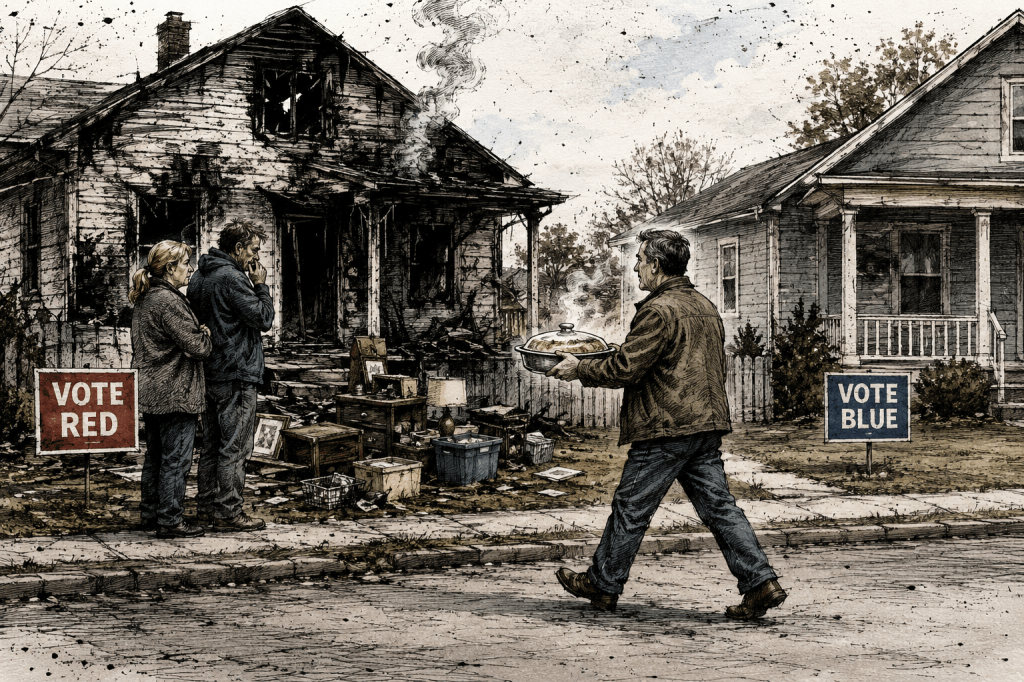
The second is the assumption that everyone in the country is a person with the same basic worth as you. Not a citizen of the same party — a citizen of the same country. You can disagree with your neighbor about everything from school board to the price of gas, and when his house burns down you bring him a casserole because that is what you do. That instinct is the floor under everything else. If the answer to a fellow citizen being killed is did they vote the right way first, then there is not actually a country anymore. There is just a set of competing tribes that happen to share a border.
The third is that the rules apply the same way to everyone, especially the people in power. Not as an aspirational goal but as an enforced norm. When the President can mock a murdered critic by name with no consequence, while six hundred private citizens are fired in two days for making the same kind of comment about a different death, the rules are no longer rules. They are weapons aimed selectively. That is a different system, and it is operating openly.
The previous four installments documented all three of these under sustained pressure. I am not catastrophizing. The pressure is in the news cycle every day.
Where this lands historically
I do not want to draw a straight line between this moment and any particular dark chapter in another country’s history. Those analogies tend to obscure as much as they reveal. Every situation has its own facts on the ground, and the American Constitution is genuinely a more durable document than what Weimar Germany was working with. The Founders built actual fail-safes into the structure. We still have an independent judiciary, under enormous pressure but holding. We still have a free press, even though every major outlet is in the middle of a lawsuit. We still have elections that change who is in power, even though their legitimacy is openly attacked by the people who win them. We still have career federal employees who resign rather than carry out illegal orders. None of those things existed in Stalin’s Russia or Rwanda in 1994 or the late Weimar Republic. They exist here.
What history is honest about, though, is that the slide does not happen the day the tanks roll in. The slide happens during the period when the institutions are still standing and the techniques used to dismantle them are being normalized inside the institutions. By the time everyone agrees there is a problem, the institutions are too weakened to resist on their own. Democratic recovery is much harder than democratic decay.
I do not think America is going to become Russia. I do think we are demonstrably further down the path of normalized authoritarian techniques than we were five years ago, and that the next few years are when we either reverse the trend or accept it as the new baseline.
The honest part
I want to be honest about something, because if I am not honest about it then I am doing the same thing I am criticizing.
I am tired. The reason this series took five installments instead of two is that the cumulative weight of documenting what has happened in the past year wore me down. Every time I sat down to write a section, I had to read the receipts again, and the receipts are exhausting. Knowing what happened to Renee Good is harder than not knowing. Watching the President’s response to Rob Reiner’s murder, with his wife’s name attached, is worse than not having watched it. The strategy works on me too. I am not above it. I have been writing this blog about politics for a few years now, and a real part of me wants to go back to writing about Hudson Valley restoration projects and the baseball season and the dog. Those things are also true. They are also part of the country.
I bring this up because the central recognition that has to come out of this series is that the flooding strategy is not aimed at making you believe anything in particular. It is aimed at making you tired. It is aimed at making me tired. Exhaustion is not a failure of character; it is the predictable outcome of being on the receiving end of a system designed to produce it. The question is not whether you can stay outraged forever — you cannot, and neither can I. The question is whether you can find a way of paying attention that does not burn you out before the work is done, and whether enough of us together can pay attention to enough things together that the institutions hold.
I do not have a tidy answer for that. I am working it out the same way you are.
What I do know
A few things I am reasonably sure of after this past year of paying close attention.
The “both sides are the same” framing is not, on the present evidence, accurate, and I cannot honestly tell you that it is. I have looked at the records of both major parties carefully, and I have written about Democratic hypocrisy in this very series. They are not equivalent. Saying so is not partisan — it is the obligation honest documentation imposes.
The institutions that are under attack still have real value. The fact that the courts have ruled against the executive branch dozens of times in the past year matters. The fact that career prosecutors resigned rather than manufacture evidence against Renee Good’s widower matters. The fact that the National Guard has not actually rolled into Minneapolis matters. None of those things are guaranteed to keep holding. They hold because individual people inside those institutions decide to make them hold, every day. Those people deserve our support and our attention. They are doing the most important work in the country right now, and most of them are doing it for civil-service pay with no profile and no expectation of thanks.
The everyday choice for the rest of us — for me in my kitchen in Gardiner, for you wherever you are reading this — is mostly small. Subscribe to a real newspaper. Push back at the cookout when someone says something that you know is false, even if it makes things uncomfortable. Do not share things you have not checked. Do not dehumanize the people who disagree with you, even when they do it to you. Show up at the school board meeting. Show up at the polls. Send the postcard. Make the call to your representative even when you are certain it will not move them. The accumulated weight of small honest actions is, historically, what holds democracies together when the wind is blowing in the other direction. The accumulated weight of small dishonest actions is what hollows them out.
That is not a stirring closing line, and I am not going to give you one, because the moment does not deserve a stirring closing line. The moment deserves to be looked at clearly.
My boys are nine and eleven. They are going to inherit whatever country we leave them. I would like for that country to be one in which they can disagree with a neighbor about something important without either of them deciding the other one is no longer a fellow citizen. I would like for that country to be one where the rules apply the same way to the President as to a guy who runs a hardware store. I would like for that country to be one where a video is a video, and not “manipulated” the moment it is inconvenient. None of those is guaranteed. They have to be earned, by the people who happen to be alive at the time.
We are the people who happen to be alive at the time.
That is the only point I have, in five parts.
 Even that's Odd
Leave a comment