
Part 4 of Do Unto Others, a 5-part series. Read the complete series →
In 2018, Steve Bannon gave an interview to Michael Lewis. It was during Trump’s first State of the Union, and Lewis was writing for Bloomberg. Asked about the Trump media strategy, the line that came out — and that has been quoted ever since — was this:
“The Democrats don’t matter. The real opposition is the media. And the way to deal with them is to flood the zone with shit.”
That line is the unlock for everything I have been documenting in the previous three parts. I want to spend this installment on it, because once you see what it actually means, you stop being surprised at the daily news cycle and you start understanding the shape of the thing.
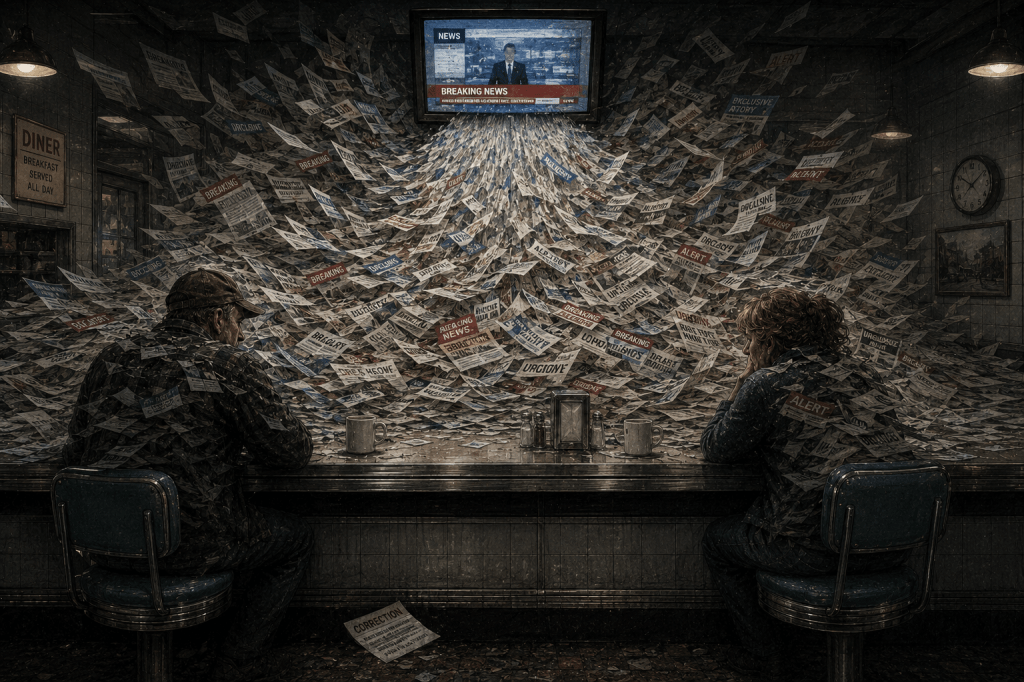
The first thing to notice about Bannon’s quote is what it isn’t saying. He is not saying the goal is to make people believe lies. He is saying the goal is to overwhelm the media’s ability to cover anything. He is not trying to persuade you of a specific story. He is trying to exhaust your ability to keep track. And once you can’t keep track, the people you would normally rely on to tell you what’s true — local news, network news, a wire service, a public broadcaster — also can’t keep track. They start covering twelve things at half-depth instead of three things in full depth. They miss details. They chase the loudest thing in any given hour. And at some point, the average person reading the headline gives up and goes back to whatever they already believed, because life is short.
This is not persuasion. It is disorientation. And it is the explicit, stated strategy of one wing of American politics, told on the record to a respected journalist seven years ago, and applied consistently since.
What flooding actually looks like
I worked in cable broadcasting for twenty-five years. I have watched media saturation strategies of every kind — paid, organic, viral, manufactured. The thing that’s different now isn’t the volume in any single hour. The thing that’s different is that the volume is no longer in service of selling a thing or making a network’s flagship show a hit. The volume is the product. The chaos is the deliverable. Whoever is paying attention loses.
Let me walk through what this has looked like in the period covered by this series.
Take Melissa Hortman. She was murdered on June 14, 2025, in her home, by a right-wing extremist with a hit list of seventy people, mostly Democratic lawmakers. The initial story circulating in pro-administration media was that the shooter was a leftist activist. This was false, but it was the first version out, before federal charging documents were public. By the time the actual political motivation was confirmed, the original story had already moved through several iterations: false flag, Walz himself somehow complicit, then eventually a presidential shrug — “I’m not familiar. The who?” — three months later, then a conspiracy theory blaming the governor six months after that. Each new claim contradicts the last. None of them are issued with corrections. Each one circulates among the audiences that want it to be true. By the time you would want to fact-check anything, the conversation has moved three more times.
That is flooding.
Take Renee Good. The initial federal claim, issued the same evening she was shot in Minneapolis, was that she was a “domestic terrorist” who had tried to “weaponize her vehicle” to kill federal agents. The bodycam footage, released two days later, showed her stopped in the street, turning the wheel away from officers, and being shot through the side window as her car pulled past. The first claim was false. The President’s response to the contradiction was that the video was “manipulated,” “fake news,” “don’t believe what you see.” Then, separately, the Justice Department opened investigations of the federal prosecutors who refused to manufacture evidence against Good’s family. Three lines of story, each contradicting the others, with no acknowledgment that any of them is being walked back. The people running the story understand that the original headline does most of the work, and that confusion does the rest.
That is flooding.
Or take the cleanest case I have documented in this series — Iranian protesters and Minneapolis protesters in the same two weeks. Iranians protesting their government were called “patriots” and “freedom fighters” by the President, who urged them to “TAKE OVER YOUR INSTITUTIONS.” Americans protesting our government were called “insurrectionists” and “domestic terrorists” by the same President in the same news cycle, who threatened to invoke the Insurrection Act against them. The two statements are technically contradictory. They went out, they did not get reconciled, they were both reported, and nobody on the issuing side has been asked to choose between them. They just sit there, doing their work on different audiences.
That is flooding.
Why this beats fact-checking
There is a temptation, when you see this pattern, to look for the lie at the center of it and disprove it. This is the natural instinct of any honest person. It is also why honest people have lost ground in this fight for a decade.
The technique does not depend on any one lie being persuasive. It depends on the volume of contradictory claims being unmanageable. By the time you have fact-checked claim one, claim three has been issued, and claims one and two have been disowned anyway. The fact-checker’s report comes out three days later, by which point nobody who was animated by the original story is reading it. The original story has done its work. The retraction is shouting into an empty room.
It works on a second mechanism too. When you read enough mutually contradictory statements from the same source, you stop trying to evaluate any of them. You file the whole topic under “it’s complicated, who knows” and you move on. That isn’t a failure of intelligence — it is how any normal person manages information when they have a job and a family and dinner to make. The strategy is designed to make you give up. Once you give up, the field is open to whoever shouts the loudest, which is usually the side that doesn’t care whether what they are shouting is true.
The third move, which sits underneath the other two, is the steady attack on the people whose job it is to sort fact from fiction. Fake news. Enemy of the people. Attacks on individual reporters by name. Lawsuits against the New York Times, the Wall Street Journal, the BBC, the Des Moines Register. FCC probes opened against NPR, PBS, ABC, NBC, CBS. The point is not to win any of these. The point is to make the institutional referees afraid, busy, and underfunded. Once the referees are weak, all the other techniques work twice as well.
What it does to people
The reason I keep coming back to this is that it is not an abstraction for the people in my life. I have family members and old friends whose information environment looks completely different from mine. I have people I love who heard that Renee Good had tried to kill an ICE agent and never heard that the video showed otherwise. I have people who heard the first story about Melissa Hortman — leftist activist — and never heard the actual federal charging document. They are not stupid people. They are people whose news diet consists of headlines on platforms whose algorithms are not optimizing for truth.
When I try to talk with them, what I run into is not a disagreement about values. It is a disagreement about what happened. We are arguing from different sets of facts, and theirs were issued first and amplified more. By the time the real facts catch up — if they do — the conversation has moved on. They go back to whatever they were doing. I go back to writing. Neither of us is closer to a shared sense of what is true.
Bannon told Michael Lewis exactly how this was going to work, on the record, seven years ago. It works because it works. The cost is not borne by Bannon, or by Trump, or by the people running the strategy. The cost is borne by people who used to be able to walk down to the diner and have a reasonable conversation with a neighbor about what was happening in their country, because they were both reading from something resembling the same page. That America is going away. Whether it can be brought back is, in my estimation, the most consequential question we are not openly asking.
That is the wrap-up question for Part 5. When shared reality dissolves, can democracy survive?
 Even that's Odd
Leave a comment