
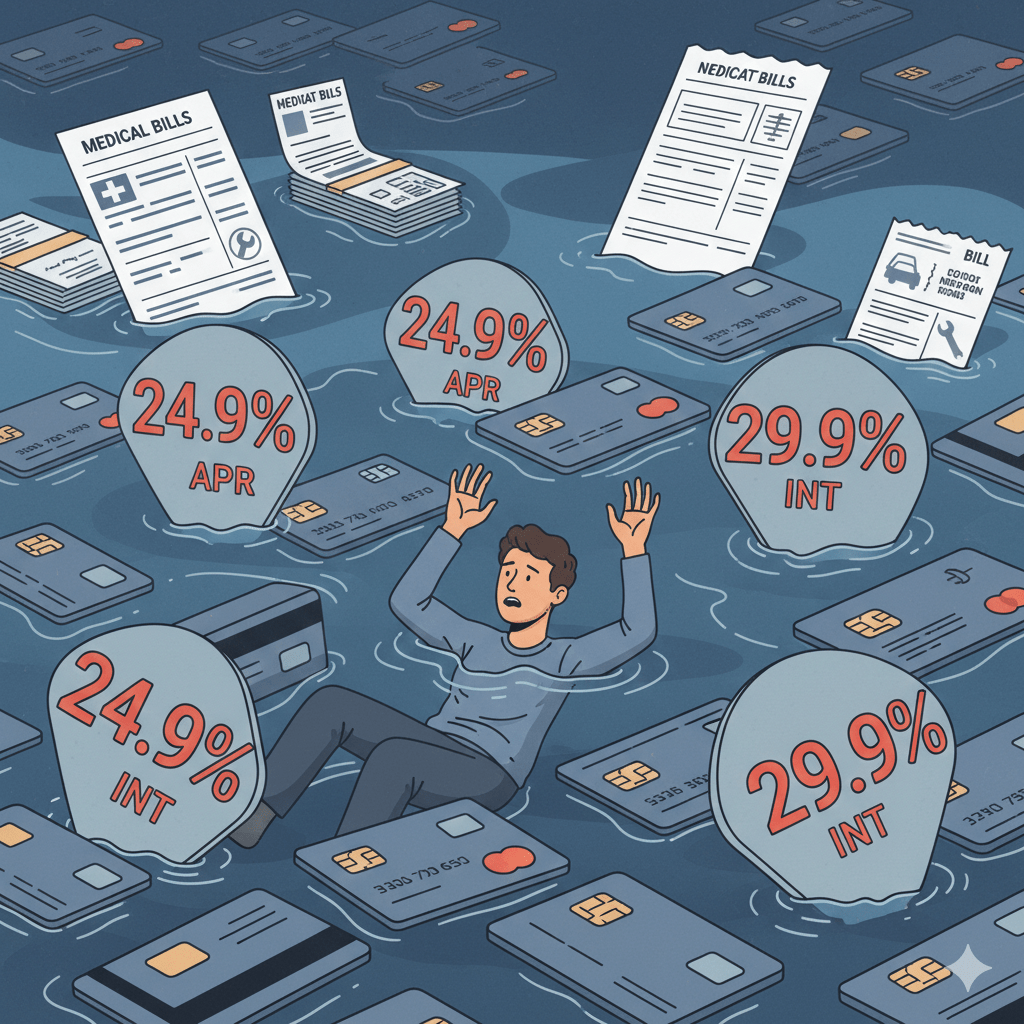
The Debt Trap
Jason is a high school teacher in Arizona. He makes $48,000 a year, which is about what teachers make there. He’s 32, married, has a two-year-old daughter. His wife works part-time as a medical records clerk, bringing in another $22,000. Combined household income: $70,000.
They’re not living extravagantly. They rent a two-bedroom apartment. They drive used cars. They don’t take vacations. They’re doing everything right.
Five years ago, Jason had zero credit card debt.
Today, he has $11,400 spread across three cards.
Here’s how it happened—and it’s not what you think.
The Slow Accumulation
Year 1: Jason’s car needed a new transmission. The mechanic quoted $2,800. Jason had $400 in savings.
He could either:
- Not fix the car (can’t get to work without it)
- Take a payday loan at 400% APR
- Use a credit card at 18.99% APR
He chose the credit card. Seemed responsible. He’d pay it off over time.
Starting balance: $2,400 Monthly payment: $100 Interest rate: 18.99%
At $100/month, $38 went to interest, $62 to principal. He was paying it down. Slowly. It would take 31 months and cost $694 in interest, but he was handling it.
Year 2: His daughter got sick. Really sick. Five days in the hospital. After insurance:
- Emergency room: $1,200
- Hospital stay: $2,800
- Follow-up specialists: $600
- Medications: $180
Their health insurance has a $5,000 deductible. They hit it.
Total medical bills: $4,780. They paid $500 upfront. The hospital offered a “payment plan” at 12% interest, or they could use a credit card.
The credit card was 18.99%, but at least they could manage the payments themselves. And they’d get rewards points. (The irony isn’t lost on Jason now.)
New balance: $4,280 Previous card balance: $1,800 (he’d been paying it down) Total credit card debt: $6,080
His $100/month payment now barely covered the interest ($95/month at 18.99% on $6,080).
Year 3: The air conditioning died in their apartment. Arizona in July. Landlord said it would take three weeks to fix (it took six). They couldn’t stay there with a two-year-old.
Hotel for a week: $840. On the credit card.
They fought with the landlord, eventually got $400 back. Still out $440.
Total debt: $6,520
Year 4: They tried to pay it down. They really did. But the minimum payment was now $195/month. They were paying $150/month in interest alone.
Then Jason’s wife got laid off. Her part-time medical records job was eliminated when the clinic merged with a hospital system. She was out of work for four months.
They lost $7,300 in income. Rent, groceries, utilities, daycare—none of that stopped.
The credit cards kept them afloat:
- Groceries: $1,200
- Rent shortfall: $1,800
- Utilities: $400
- Car insurance and gas: $600
New charges: $4,000 Previous balance: $6,520 Total debt: $10,520
Year 5 (now): Jason’s wife is working again, same hours, slightly better pay. They’re trying to dig out.
But they had another $880 in expenses this year:
- School supplies and fees for his teaching position (teachers pay for their own supplies): $320
- Daughter’s birthday and Christmas: $280
- Car registration and repairs: $280
Current total: $11,400 across three cards
Monthly minimum payments: $342 Monthly interest: $200 Amount actually reducing debt: $142/month
At this rate, paying just minimums, Jason will:
- Be in debt for 12 years
- Pay $15,450 in interest
- Pay $26,850 total to clear $11,400 in charges
And that’s only if he never uses the cards again. Which he will. Because his savings account has $180 in it.
The Math of the Trap
Let’s break down what’s happening to Jason:
The Three Cards:
Card 1 (Chase Freedom): $4,200 balance
- Interest rate: 21.99%
- Minimum payment: $126
- Interest per month: $77
- Principal reduction: $49
Card 2 (Capital One Quicksilver): $4,100 balance
- Interest rate: 18.99%
- Minimum payment: $123
- Interest per month: $65
- Principal reduction: $58
Card 3 (Citi Double Cash): $3,100 balance
- Interest rate: 19.99%
- Minimum payment: $93
- Interest per month: $52
- Principal reduction: $41
Total monthly payment: $342 Total interest per month: $194 Total principal reduction: $148
Jason is paying $342/month and only $148 of it reduces his debt. The other $194—56% of his payment—goes straight to the banks as profit.
If he could afford to pay $600/month instead:
- Time to payoff: 23 months
- Total interest: $1,840
- Total paid: $13,240
But he can’t afford $600/month. He can barely afford the $342 minimums.
So he’ll pay minimums for 139 months (11.5 years) and pay $15,450 in interest.
The banks will collect $15,450 in profit from Jason’s car transmission, daughter’s medical emergency, broken AC, and groceries during his wife’s layoff.
What Credit Cards Used To Be
In the 1980s, credit cards were different:
1980s Credit Cards:
- Average interest rate: 17.3%
- Used for: Large purchases, travel, emergencies
- Most people paid in full each month
- “Revolving balance” was considered poor financial management
- Credit limits were conservative
2024 Credit Cards:
- Average interest rate: 21.47% (28.93% if you have “fair” credit)
- Used for: Groceries, gas, medical bills, rent, utilities—basic survival
- 45% of cardholders carry a balance month-to-month
- Revolving balances are normal and expected
- Credit limits are aggressively high to encourage spending
The shift wasn’t just in how we use cards. It’s in what we use them for.
Credit cards used to be for things you wanted but didn’t need yet. A vacation. A new TV. A nice dinner.
Now they’re for things you need to survive. Medical care. Groceries. Rent.
45% of Americans put basic living expenses on credit cards and can’t pay them off.
The National Picture
Jason isn’t unique. He’s the median American with credit card debt:
Total U.S. Credit Card Debt: $1.13 trillion (Q3 2024)
Average credit card debt per borrower: $6,501
Average APR: 21.47% (up from 16.65% in 2019)
At 21.47% APR on $6,501, you pay:
- Monthly interest: $116
- Annual interest: $1,395
If you pay the typical minimum (3% of balance, or $195/month):
- Time to payoff: 17 years
- Total interest paid: $8,400
- Total paid: $14,900 to clear $6,500 in charges
But here’s the thing: People aren’t using cards for luxuries.
Why Americans carry credit card debt:
- Medical expenses: 35%
- Car repairs: 29%
- Basic living expenses (groceries, utilities): 45%
- Home repairs: 26%
- Emergency expenses: 40%
These aren’t flat-screen TVs and trips to Vegas. These are transmissions, broken bones, and groceries.
More damning statistics:
- 60% of credit card holders have carried a balance for at least a year
- 50% have held debt for over two years
- 35% have held debt for five years or more
- 40% say they need credit cards to afford basic necessities
This isn’t people being irresponsible. This is people surviving.
The Profit Machine
2023 Credit Card Industry Profits:
Total interest and fees collected: $120 billion
Let that sink in. Credit card companies collected $120 billion in interest and fees from Americans in one year. Much of it from people charging groceries and medical bills.
Top Credit Card Issuers (2023):
Chase (JPMorgan):
- Cards in circulation: 95 million
- Outstanding balances: $220 billion
- Revenue from cards: $26 billion
Bank of America:
- Cards in circulation: 65 million
- Outstanding balances: $110 billion
- Revenue from cards: $14 billion
Citigroup:
- Cards in circulation: 58 million
- Outstanding balances: $140 billion
- Revenue from cards: $18 billion
Capital One:
- Cards in circulation: 72 million
- Outstanding balances: $145 billion
- Revenue from cards: $21 billion
American Express:
- Cards in circulation: 55 million
- Outstanding balances: $85 billion
- Revenue from cards: $19 billion
Notice something? Three of these banks (Chase, Bank of America, Citi) are the same banks from Part 3—the ones charging overdraft fees.
They’re extracting from both ends:
- Charge you $35 for overdrafting by $5
- Charge you 21% interest when you have to use credit to survive
- Pay you 0.01% interest on savings
- Borrow from the Federal Reserve at 5.33%
- Lend to you at 21.47%
The spread is the scam.
How We Got Here: The Deliberate Design
Credit cards didn’t become predatory by accident. Every feature was designed to maximize debt and profit.
Variable Interest Rates
In the 1970s, most credit cards had fixed rates around 18%.
Today, almost all cards have variable rates—meaning the bank can raise your rate whenever they want (with 45 days notice buried in fine print).
Your rate goes up if:
- You’re 30 days late on ANY credit account (even a different card)
- Your credit utilization goes above 30% (you’re using your credit because you need it)
- The Fed raises rates (you pay more; they borrow cheaper)
- The bank feels like it (literally—read your cardholder agreement)
Jason started at 18.99% on one card. After his wife’s layoff made him 35 days late on a payment (they paid, just late), his rate jumped to 28.99%.
He called to ask why. They said it’s “risk-based pricing.” He asked what risk—he’d never missed a payment entirely, just was late once.
They said his credit utilization was too high. Because he was using credit. Because he needed it.
The Minimum Payment Trap
In 2003, federal regulators forced credit card companies to show customers how long it would take to pay off balances making only minimum payments.
The industry fought it. Hard.
Why? Because minimum payments are designed to keep you in debt forever.
The minimum payment formula: Typically 2-3% of your balance, or $25-35, whichever is higher.
On a $5,000 balance at 21% APR:
- Minimum payment: $150 (3%)
- Interest that month: $88
- Principal reduction: $62
- Next month’s balance: $4,938
- Next minimum payment: $148
- Interest: $86
- Principal reduction: $62
You’re barely making progress. And if you use the card for anything—even $50 in groceries—you’ve wiped out that progress.
By design.
Pre-Approved Offers and Credit Limit Increases
Jason didn’t seek out three credit cards. They found him.
Card 1: Pre-approved offer in the mail. 0% APR for 12 months. He figured he’d transfer the car repair balance and pay it off. The 0% period ended while his wife was laid off. Rate jumped to 21.99%.
Card 2: Pre-approved offer. $200 cash back if he spent $500 in first 3 months. He used it for medical bills. Kept it.
Card 3: Offered at checkout in a department store. “Save 20% on today’s purchase.” They were buying a car seat ($280). Saved $56. Seemed smart.
Then the medical emergency hit and he had three cards available.
All three regularly offer to increase his credit limit:
- “Congratulations! You’ve been approved for a credit line increase to $8,000”
- “Good news! Your responsible use has earned you a higher limit”
They want him to have more access to credit. Not because they trust him. Because higher limits mean higher balances mean more interest.
Rewards Programs: The Bait
Jason’s cards offer rewards:
- 1.5% cash back on everything
- 2% on gas and groceries
- Points for travel
Sounds great, right?
Here’s the math:
- Jason charges $1,000/month on cards (groceries, gas, necessities)
- Gets $15-20/month in rewards
- Pays $200/month in interest
He’s paying $200 to earn $15. But the rewards make him feel like he’s winning.
Studies show people with rewards cards:
- Spend 12-18% more than without rewards
- Carry higher balances
- Are less likely to pay in full
The rewards aren’t for you. They’re to encourage behavior that profits the bank.
Credit Scores: The Weapon
Your credit score used to matter for one thing: borrowing money.
Now it affects:
- Renting an apartment (bad credit = denied or higher deposit)
- Getting a job (many employers check credit)
- Insurance rates (bad credit = higher premiums)
- Security deposits for utilities
- Cell phone plans (bad credit = prepay or deposit)
So you NEED good credit to function in society.
But here’s the trap: Using credit hurts your score.
Credit utilization (how much of your available credit you’re using) is 30% of your score.
Using more than 30% of your limit lowers your score. But if you need to use credit—because you can’t afford medical bills or car repairs with cash—you hurt your credit by using it.
Jason’s credit score dropped from 720 to 640 because he used his available credit during his wife’s layoff. Now:
- His interest rates are higher
- He can’t refinance to a lower rate
- If he applies for a new card, his score drops more (hard inquiry)
- He’s trapped in high-interest cards
The system punishes you for needing it.
The Shift: From Emergency to Essential
1990s:
- Credit cards for emergencies and large purchases
- Most households had 1-2 cards
- Average balance: $2,900 (inflation-adjusted: $5,700)
- Cards were a backup, not a budget line
2024:
- Credit cards for groceries, gas, medical bills, rent
- Average household has 3-4 cards
- Average balance: $6,501
- Cards are essential to surviving month-to-month
What changed?
Wages stagnated (from Parts 1 & 2) Costs increased (from Parts 1-3) Savings evaporated (40% can’t cover $400 emergency)
So when the car breaks down, when someone gets sick, when the AC dies—there’s no savings to cover it. There’s only credit.
And once you’re on credit, you don’t get off. Because:
- Minimum payments barely touch principal
- Interest compounds
- Any new expense goes on the card
- You’re paying interest on last year’s groceries
The trap closes.
Jason’s Future
Jason is stuck. He knows it.
He can’t afford to pay more than minimums. If he pays down one card, the next emergency goes on another card. He’s treading water in quicksand.
If he gets one more major expense—if the car really dies, if his daughter needs surgery, if he loses his job—he’ll have to choose between:
- Bankruptcy (ruins credit for 7-10 years)
- Debt settlement (pays some, destroys credit)
- Keep paying minimums forever while the balance grows
He makes $48,000/year as a teacher—a profession society claims to value.
He’s paying $4,100/year in credit card interest on his family’s car repair, medical emergency, and groceries during a layoff.
That’s 8.5% of his gross income going to banks as interest. Not reducing debt—just interest.
For comparison: The average American pays 8.9% of income in federal income tax.
Jason pays almost as much to credit card companies as he pays in federal taxes.
And he’s not unusual.
The Bigger Picture
Remember Maria from Part 3? The home health aide paying $150 in overdraft fees?
She also has $4,200 in credit card debt at 24.99% APR (her credit score is lower because she’s been overdrafting).
Annual interest: $1,050
Remember Sarah from Part 1? The nurse with $625/month to cover everything?
She has $3,800 in credit card debt at 19.99% APR.
Annual interest: $760
These aren’t people living beyond their means. These are people for whom the means don’t cover survival.
The same banks are collecting from all of them:
- Overdraft fees (Part 3)
- Credit card interest (Part 4)
- They’ll collect on student loans (coming)
- They’ll collect on auto loans (coming)
- They’ll collect on everything
This isn’t separate problems. It’s one designed system of extraction.
What’s Next
We’ve shown you the impossible math (Part 1). We’ve shown you how costs shifted (Part 2). We’ve shown you banking fee extraction (Part 3). Now you see the credit card debt trap.
In Part 5, we’re looking at the auto trap—how car ownership went from 4 months of salary to 10 months of salary, and why public transit was deliberately destroyed to force you to buy a depreciating asset you can’t afford.
Spoiler: You’re about to see why Jason, Sarah, and Maria all have car payments, car insurance, gas costs, and maintenance bills totaling $700-900/month.
And why they have no choice.
Because the same industries that profit from your debt also lobbied to eliminate your alternatives.
Passing the Buck: Why We Pay More But Make Less is a 15-part series examining how corporations and government systematically shifted costs onto working Americans—while wages stagnated and benefits disappeared.
 Even that's Odd
Leave a comment