
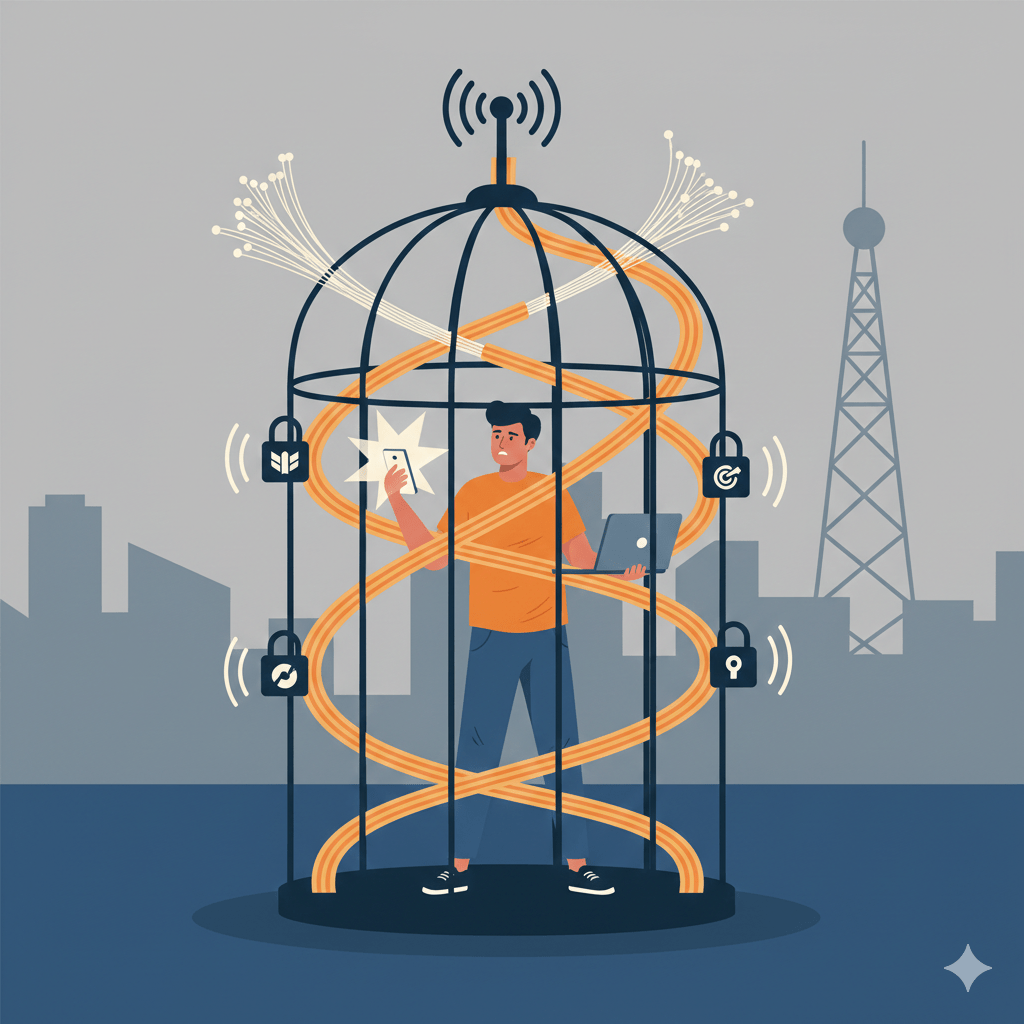
The Monopoly You Can’t Escape
Rachel lives in suburban Atlanta. She works from home as a customer service rep for a health insurance company. Her job requires reliable high-speed internet—it’s not optional. She’s on video calls, accessing patient records, processing claims in real-time.
When she moved into her apartment, she called to set up internet service.
“Who provides internet here?” she asked the apartment office.
“Comcast,” they said.
“What are my other options?”
“Comcast.”
“No, I mean who else offers service?”
“Comcast is your only option.”
Rachel called around anyway. AT&T doesn’t service her building. Verizon Fios isn’t available in her area. T-Mobile Home Internet shows “not available at your address” when she checks online.
She has one choice: Comcast.
Here’s what that monopoly costs her:
Internet: $89/month
- Advertised as $65/month for “Performance Pro” (200 Mbps)
- Equipment rental (required): $15/month
- “Broadcast TV fee” even though she doesn’t have cable: $0 (not this time, but common)
- Taxes and fees: $9/month
- Actual bill: $89/month
Cell phone: $85/month
- T-Mobile Magenta plan (unlimited data, but throttled after 50GB)
- One line, bring your own phone
- Taxes and fees included
Total: $174/month ($2,088/year)
Rachel makes $38,000/year as a customer service rep. After taxes, she takes home about $29,000 ($2,417/month).
She spends 7.2% of her take-home pay on internet and phone service.
That’s mandatory. She can’t do her job without internet. She can’t function in modern society without a phone.
And she has no choice in who provides it or what it costs.
The American Reality: Paying More for Less
Rachel’s $89/month for internet is actually cheap by American standards. And it’s still a terrible deal.
U.S. Internet Prices (2024):
Average cost for high-speed internet:
- 100 Mbps: $50-80/month
- 300 Mbps: $65-90/month
- 1 Gbps (1000 Mbps): $80-120/month
Plus equipment fees ($10-15/month), installation ($50-100), and various surcharges.
International Comparison:
South Korea:
- 1 Gbps internet: $30/month
- Average speed: 245 Mbps
- 99.5% of population has access to high-speed internet
Romania:
- 1 Gbps internet: $10/month
- Average speed: 232 Mbps
France:
- 1 Gbps internet: $35/month
- Average speed: 227 Mbps
Japan:
- 1 Gbps internet: $40/month
- Average speed: 190 Mbps
United States:
- 1 Gbps internet: $80-120/month
- Average speed: 242 Mbps (driven up by fiber in cities; rural areas are much slower)
- We pay 3-12 times more than other developed countries for the same speeds
Cell Phone Plans:
United Kingdom:
- Unlimited data, talk, text: $20-25/month
Germany:
- Unlimited data: $35/month
France:
- Unlimited data: $25/month
Canada (even worse than U.S.):
- Unlimited data: $75-85/month
United States:
- Unlimited data (single line): $65-85/month
- Unlimited data (family of 4): $140-180/month total ($35-45 per line)
We pay 2-3 times more than Europeans for cell service.
Why U.S. Prices Are So High: The Monopoly
Rachel has one internet provider because telecom companies don’t compete. They divide territory and extract maximum profit from captive customers.
The Big Three (Internet/Cable):
Comcast (Xfinity):
- 32 million internet subscribers
- Operates in 40 states
- Doesn’t compete with other cable companies in most markets
Charter Communications (Spectrum):
- 32 million internet subscribers
- Operates in 41 states
- Doesn’t compete with Comcast in most markets
AT&T:
- 14 million internet subscribers (fiber and DSL)
- Mobile: 240 million connections
In most U.S. cities:
- You have one cable internet provider (Comcast OR Charter, not both)
- Maybe one phone company DSL/fiber option (AT&T or Verizon)
- That’s it
83% of Americans have zero or one choice for high-speed internet provider.
The Big Three (Wireless):
Verizon:
- 143 million subscribers
- 2023 revenue: $134 billion
- 2023 profit: $11.6 billion
AT&T:
- 240 million connections (includes connected devices)
- 2023 revenue: $122 billion (mobile)
- 2023 profit: $14.6 billion (total company)
T-Mobile:
- 117 million subscribers
- 2023 revenue: $79 billion
- 2023 profit: $13.0 billion
Combined mobile market share: 99%
There used to be more. Sprint existed until T-Mobile bought it in 2020. Before that, there were regional carriers. They’ve all been absorbed.
Three companies control nearly all wireless service in America.
How We Got Here: From Utility to Monopoly
Telecommunications used to be regulated as a utility. Like water or electricity. Because it is—it’s essential infrastructure.
The Bell System (1877-1984):
AT&T (Ma Bell) was a legal monopoly. One company, one network, regulated rates.
But here’s what you got:
- Universal service (phone service available everywhere, including rural areas)
- Regulated, affordable rates
- Company had to maintain infrastructure
- Profit margins were limited
- In exchange: guaranteed monopoly, no competition
Everyone had phone service. It was cheap. It worked.
1984: The Breakup
The government broke up AT&T into:
- AT&T (long distance)
- 7 regional “Baby Bells” (local service)
Goal: Create competition.
What actually happened:
- The Baby Bells immediately started buying each other
- Regional monopolies became national monopolies
- Today: AT&T and Verizon are reconstituted from those Baby Bell pieces
We broke up the monopoly, then let it reform. Except now it’s unregulated.
1996: Telecommunications Act
The big one. This law was supposed to increase competition and lower prices.
What it actually did:
- Eliminated most regulations on telecom companies
- Allowed cable companies to offer internet
- Allowed phone companies to offer cable TV
- Removed ownership limits on how many stations a company could own
The promise: Competition will lower prices and improve service.
The reality:
- Companies divided territory instead of competing
- Prices increased 3-4x faster than inflation
- Service quality declined
- Rural areas were abandoned (not profitable enough)
Between 1996-2024:
- Average internet price increased 182%
- Average internet speed increased 2400% (but that’s technology improvement, not company investment)
- Real infrastructure investment (as % of revenue): Down 35%
They took the deregulation, divided the country into fiefdoms, and extracted maximum profit while minimizing investment.
2015: Net Neutrality (briefly)
The FCC classified internet as a utility under Title II. This meant:
- Internet providers couldn’t block content
- Couldn’t throttle speeds selectively
- Couldn’t create “fast lanes” for companies that pay more
- Had to treat all data equally
Telecom companies lost their minds.
They spent $572 million lobbying against it between 2015-2017.
2017: Net Neutrality Repealed
Trump’s FCC chairman (Ajit Pai, former Verizon lawyer) repealed net neutrality.
What changed:
- Internet providers can now throttle streaming services unless they pay fees
- Can block websites
- Can create “fast lanes” and “slow lanes”
- No regulation preventing anti-competitive behavior
The companies that lobbied for this claimed it would increase investment and innovation.
2018-2023 infrastructure investment vs. 2013-2017:
- Down 3%
They lied. They wanted the freedom to extract without regulation.
The Territorial Division: Why You Have No Choice
Here’s the scam: Telecom companies don’t compete in the same territories.
Example: Atlanta metro area
Rachel lives in Suburban area A:
- Cable internet: Comcast only
- No Charter, no other cable
- AT&T fiber available in some neighborhoods (not hers)
- That’s it
10 miles away, Suburban area B:
- Cable internet: Charter only
- No Comcast
- AT&T fiber in some areas
- That’s it
They carved up the map.
It’s not explicit collusion (that would be illegal). It’s “rational market behavior”:
- Building infrastructure is expensive
- Competing in the same territory means both companies spend money and split customers
- Not competing means each company gets 100% of customers in their territory and faces no pricing pressure
Result: Geographic monopolies everywhere.
In 40% of U.S. markets, one company has 75%+ market share for internet service.
Blocking Municipal Competition
Some cities tried to solve this by building their own internet infrastructure.
Municipal broadband:
- City builds fiber network
- Offers service at cost (no profit motive)
- Typical price: $50/month for 1 Gbps
- Typical private company price: $100-120/month for same speed
Chattanooga, Tennessee built municipal fiber in 2010:
- 1 Gbps for $70/month
- 10 Gbps available for $300/month (fastest residential internet in U.S. at the time)
- Comcast charged $140/month for 100 Mbps in same city
Comcast’s response:
Lobbied Tennessee legislature. In 2014, Tennessee passed a law prohibiting cities from expanding municipal broadband beyond their current service areas.
Same story in 20+ states:
- Telecom companies lobby state legislatures
- States pass laws restricting or banning municipal broadband
- Private companies face no competition
- Prices stay high
States with laws restricting municipal broadband:
- Arkansas, Florida, Louisiana, Michigan, Minnesota, Missouri, Nebraska, Nevada, North Carolina, Pennsylvania, South Carolina, Tennessee, Texas, Utah, Virginia, Washington, Wisconsin
The companies that claim to love free markets lobbied to ban competition.
The Rural Abandonment
Remember, telecom companies got massive government subsidies to build infrastructure.
Subsidies received (1996-2024):
- Direct subsidies: $400+ billion
- Tax breaks: Additional billions
- Free access to public rights-of-way
- Exclusive franchises (monopoly protection)
In exchange, they promised to:
- Build out broadband to rural areas
- Upgrade infrastructure nationwide
- Provide universal service
What they actually did:
- Focused on profitable urban/suburban areas
- Left rural areas with slow or no internet
- Pocketed the subsidies as profit
Current state of rural internet:
- 24% of rural Americans lack access to high-speed internet (25 Mbps download)
- Those who have access pay 30-50% more than urban areas for slower speeds
- Many rural areas only have satellite (expensive, slow, high latency) or DSL (outdated, slow)
Meanwhile:
- Verizon CEO Hans Vestberg: $22.5 million (2023)
- AT&T CEO John Stankey: $21.5 million (2023)
- Comcast CEO Brian Roberts: $32.5 million (2023)
They took $400 billion in subsidies, abandoned rural America, and paid their CEOs tens of millions.
The Hidden Fees Extraction
Rachel’s bill says $65/month. Her actual bill is $89/month. Here’s how that works:
Equipment Rental Fee: $15/month
The modem/router costs Comcast about $80. They charge Rachel $15/month to rent it.
Over 2 years: $360 paid for an $80 device.
Rachel could buy her own modem for $100. But:
- Comcast’s website makes it confusing
- They claim not all modems are “compatible”
- If she has any service issue, they blame her equipment
- Most people just rent
Comcast’s equipment rental revenue (2023): $3.2 billion
For equipment that costs them $80 per unit and lasts 5+ years, they collect $180/year, per customer, indefinitely.
Broadcast TV Fee: $20-30/month (even if you don’t have cable TV)
Many cable internet customers get charged this even though they don’t subscribe to TV. It’s buried in the fine print.
It’s called a “fee” not a “price increase” so they don’t have to advertise it.
Regional Sports Fee: $10-15/month
Same deal. Comcast pays for sports broadcast rights, then charges customers a separate “fee” instead of including it in the advertised price.
Taxes and Fees: $5-15/month
Some legitimate (actual government taxes). Some made-up (Comcast calls them “franchise fees” or “regulatory recovery fees”—they’re just price increases with official-sounding names).
Data Caps and Overage Fees
Comcast imposes a 1.2 TB monthly data cap in most markets. If you go over:
- $10 for each additional 50 GB
- Or pay $30/month for unlimited
Cost to Comcast of that extra data: Approximately $0.01
Bandwidth costs them about $0.01 per gigabyte. They charge $10 for 50 GB.
That’s a 50,000% markup.
The Real Price
Rachel’s bill breakdown:
- Advertised price: $65
- Equipment rental: $15
- Taxes/fees: $9
- Actual price: $89 (37% higher than advertised)
This is standard. Telecom bills are designed to deceive.
What You’re Actually Paying For
Rachel pays $89/month for internet. What does that money buy?
Not infrastructure improvement:
- Comcast’s capital expenditure (infrastructure investment): 8.7% of revenue (2023)
- Down from 13.2% in 2015
- They’re investing less while charging more
Not customer service:
- Comcast customer satisfaction score: 60/100 (among lowest of any industry)
- Average hold time: 23 minutes
- Resolving an issue requires average of 3 calls
Not competitive pricing:
- They charge what they want
- You have no alternative
- They know it
What you’re paying for:
Stock buybacks and dividends (2023):
- Comcast: $11.9 billion in buybacks and dividends
- AT&T: $16.1 billion
- Verizon: $10.4 billion
Executive compensation (2023):
- Comcast CEO: $32.5 million
- AT&T CEO: $21.5 million
- Verizon CEO: $22.5 million
- T-Mobile CEO: $54.4 million (yes, really)
Lobbying (2023):
- Comcast: $15.7 million
- AT&T: $13.1 million
- Verizon: $11.8 million
- Charter: $4.8 million
They’re paying politicians to prevent competition, block municipal broadband, and kill net neutrality.
With your money.
The Cell Phone Trap
Rachel pays $85/month for one cell phone line. That’s actually competitive for U.S. prices.
It’s also insane compared to the rest of the world.
The Three-Company Oligopoly
Verizon, AT&T, and T-Mobile control 99% of the wireless market. They don’t compete on price—they compete on marketing.
Their pricing:
- Verizon: $70-80/month (single line unlimited)
- AT&T: $65-75/month
- T-Mobile: $70-85/month
Notice how similar those prices are? That’s not coincidence.
When three companies control the entire market, they don’t need to collude on prices. They just match each other.
T-Mobile raises prices → AT&T sees they can too → Verizon follows.
No competition. Just coordination through observation.
The “Unlimited” Lie
Rachel has an “unlimited” data plan. Here’s what that means:
- First 50 GB: Full speed (5G/LTE)
- After 50 GB: Throttled to 3G speeds during “congestion”
- Video streaming: Limited to 480p (DVD quality) unless you pay $10/month more for HD
- Mobile hotspot: 5-40 GB, then throttled to unusable speeds
That’s not unlimited. That’s limited with an unlimited label.
The Real Cost of Wireless Service
What does it actually cost T-Mobile to provide Rachel’s service?
Industry estimates:
- Network cost per subscriber: $5-8/month
- Customer service and support: $3-5/month
- Administrative overhead: $2-4/month
- Total cost to provide service: $10-17/month
Rachel pays $85/month.
Gross margin: $68-75 per month (80-88%)
T-Mobile’s wireless service profit margin: 50% (after all costs).
They’re charging 5-8x what it costs them to provide the service.
Because they can. Because you have no choice.
The Shift: From Regulated Utility to Extraction
1980s telecommunications:
- Phone service: Regulated utility
- Prices: Set by public utility commissions
- Required: Universal service, infrastructure maintenance
- Profit margins: Limited but guaranteed
- Result: Everyone had service, prices were stable
2024 telecommunications:
- Internet/mobile: Unregulated monopolies/oligopolies
- Prices: Whatever the market will bear (and you have no choice)
- Required: Nothing (abandoned rural areas, minimal infrastructure investment)
- Profit margins: 40-50%
- Result: High prices, terrible service, geographic monopolies
The shift:
- From serving the public to extracting from the public
- From regulated rates to “market pricing” (monopoly pricing)
- From infrastructure investment to stock buybacks
- From universal service to cherry-picking profitable customers
Who benefits:
- Shareholders (stock buybacks increase share prices)
- Executives (compensation tied to stock price)
- Lobbyists (paid to protect the monopoly)
Who pays:
- Rachel: $2,088/year for internet and phone (7.2% of her take-home pay)
- Everyone who needs internet and cell service to function in modern society (all of us)
Connecting the Dots
Let’s check in on our people from previous parts and add their internet/phone costs:
Sarah (nurse, Part 1):
- Internet: $95/month (Comcast, only option)
- Cell phone: $75/month (Verizon)
- Total: $170/month ($2,040/year)
- Already struggling with $625/month after mandatory expenses
- Internet/phone takes another $170
Jason (teacher, Part 4):
- Internet: $105/month (AT&T fiber, one of two options)
- Cell phones (2 lines): $140/month (AT&T family plan)
- Total: $245/month ($2,940/year)
- Carrying $11,400 in credit card debt
- Another $245/month in mandatory expenses
Jennifer (pharmacy tech, Part 5):
- Internet: $90/month (Charter, only option)
- Cell phone: $80/month (T-Mobile)
- Total: $170/month ($2,040/year)
- Already $220/month short
- Internet/phone makes it worse
Maria (home health aide, Part 3):
- Internet: $70/month (only option: Comcast in her building)
- Cell phone: $50/month (prepaid, limited data)
- Total: $120/month ($1,440/year)
- Hit with $150 in overdraft fees
- Needs phone for work, can barely afford it
Tom (dairy farmer, Part 6):
- Internet: $80/month (DSL, slow, only option in rural Wisconsin)
- Cell phones (2 lines): $120/month (limited coverage, expensive)
- Total: $200/month ($2,400/year)
- Makes $13.30/hour after farm costs
- Pays more for worse internet than city residents
Rachel (customer service rep, Part 7):
- Internet: $89/month (must have for work)
- Cell phone: $85/month
- Total: $174/month ($2,088/year)
- 7.2% of her take-home pay
- No alternatives
Every single one of them is forced to pay monopoly prices for essential services they can’t function without.
The International Embarrassment
Rachel’s $89/month for 200 Mbps internet would get her:
- South Korea: 1 Gbps for $30 (5x faster, 1/3 the price)
- Romania: 1 Gbps for $10 (5x faster, 1/9 the price)
- France: 1 Gbps for $35 (5x faster, 40% the price)
Rachel’s $85/month cell phone plan would cost:
- UK: $20-25 (1/3 to 1/4 the price)
- Germany: $35 (41% of the price)
- France: $25 (29% of the price)
We pay 3-4 times more than other developed countries for worse service.
And when asked why, telecom companies say:
- “America is bigger” (so is Canada, and they’re just as bad)
- “We have more rural areas to serve” (but they don’t serve rural areas)
- “Infrastructure costs more here” (but they invest less than European companies)
The real reason: They can charge whatever they want because you have no choice.
What’s Next
We’ve now covered seven major cost categories:
- The impossible math (Part 1)
- The baseline shift (Part 2)
- Banking fees (Part 3)
- Credit card debt (Part 4)
- Forced car ownership (Part 5)
- Food monopolies (Part 6)
- Phone/Internet monopolies (Part 7)
All showing the same pattern:
- Consolidation into monopolies/oligopolies
- Elimination of alternatives
- Prices rising while costs fall
- Record profits
- You have no choice
In Part 8, we’re looking at insurance—health, auto, home, life. Another set of mandatory purchases where prices keep increasing, coverage keeps shrinking, and you’re forced to buy from companies that profit by denying your claims.
Because once you’re required to buy something and have limited choices, extraction becomes inevitable.
Passing the Buck: Why We Pay More But Make Less is a 15-part series examining how corporations and government systematically shifted costs onto working Americans—while wages stagnated and benefits disappeared.
 Even that's Odd
Leave a comment