
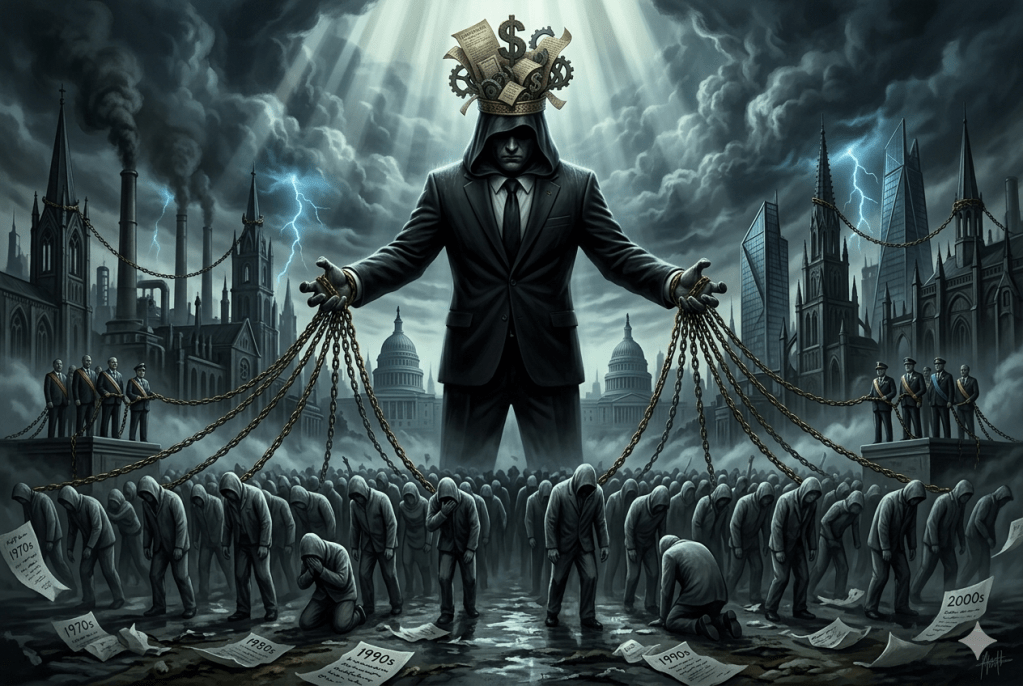
50 Years of Deliberate Policy
The system we’ve documented in Parts 1-12 didn’t happen by accident. It wasn’t natural market forces. It wasn’t inevitable.
It was built. Deliberately. Over 50 years. By people with names. Who passed specific laws. Made specific court decisions. Implemented specific policies.
Let’s trace exactly how it happened.
1971: The Corporate Counterattack Begins
August 23, 1971: The Powell Memo
Lewis Powell, a corporate lawyer (soon to be Supreme Court Justice), wrote a confidential memo to the U.S. Chamber of Commerce titled “Attack on the American Free Enterprise System.”
Powell’s warning: The corporate system was under attack from:
- Environmentalists
- Consumer advocates (Ralph Nader)
- Labor unions
- College campuses
- Media
Powell’s solution: Corporations must organize to fight back through:
- Political power
- Legal action
- Education (funding business schools, think tanks)
- Media influence
The Chamber of Commerce distributed this memo to corporate leaders nationwide.
Within 5 years:
- Corporate lobbying spending increased 500%
- Business Roundtable founded (1972) – CEOs organizing for political power
- Heritage Foundation founded (1973) – conservative think tank
- American Enterprise Institute expanded massively
- Dozens of corporate-funded think tanks created
This was the beginning of the organized corporate political movement.
1978-1981: Breaking the Unions
In 1970, 27% of American workers were union members.
By 2023, only 10% are union members (6% in private sector).
What happened?
1978: Failure of Labor Law Reform
The bill:
- Would have made union organizing easier
- Faster union elections
- Penalties for companies that illegally fire organizers
- Majority support in both houses
The result:
- Filibustered by Republicans
- Some Democrats voted against (corporate-funded)
- Died in Senate
Why it mattered: This was labor’s last chance to strengthen organizing rights before the corporate counterattack succeeded.
1981: PATCO Strike – Reagan Breaks the Unions
August 3, 1981: Professional Air Traffic Controllers Organization (PATCO) went on strike for better pay and working conditions.
August 5, 1981: President Reagan gave them 48 hours to return to work or be fired.
August 7, 1981: Reagan fired all 11,345 striking air traffic controllers. Banned them from federal employment for life.
This was legal but unprecedented.
Previous presidents had negotiated with striking federal workers. Reagan fired them all.
The message to American workers: Strike and lose your job.
The message to corporations: You can break unions. The government will help.
What followed:
Corporate union-busting:
- Hiring anti-union consultants (industry exploded post-PATCO)
- Firing union organizers (illegal but rarely prosecuted)
- Closing unionized plants
- Moving production to non-union states or overseas
Union membership collapsed:
- 1981: 20.1% of workers
- 1990: 16.1%
- 2000: 13.5%
- 2023: 10.0%
When union membership falls, wages stagnate. That’s not coincidence—that’s cause and effect.
Union workers earn 10-20% more than non-union workers in the same industries. When unions die, that wage premium dies.
1981-1986: The Reagan Tax Revolution
Economic Recovery Tax Act of 1981:
Top marginal income tax rate:
- Before: 70%
- After: 50%
Corporate tax rate:
- Cut from 48% to 46%
Capital gains tax:
- Cut from 28% to 20%
Who benefited: The wealthy and corporations
How it was sold: “Trickle down economics” – tax cuts for the rich would create jobs
What actually happened:
- Federal deficit exploded ($738 billion added to debt)
- Wages stagnated (we showed this in Part 2)
- Corporate profits soared (we showed this in Part 11)
- Nothing trickled down
Tax Reform Act of 1986:
Top marginal rate:
- Reduced from 50% to 28%
The wealthiest Americans saw their top tax rate cut from 70% to 28% in just 5 years.
Meanwhile:
- Payroll taxes (FICA) increased (hitting workers harder than wealthy)
- Corporate tax loopholes expanded
- Capital gains (investment income) taxed lower than wages
The shift: From taxing wealth to taxing work.
1982: Stock Buybacks Legalized
Before 1982: Stock buybacks were considered stock manipulation and were illegal.
SEC Rule 10b-18 (1982): Legalized stock buybacks under specific conditions.
Why it matters:
From Part 11, remember corporations spent $795 billion on stock buybacks in 2023. That money could have gone to:
- Worker wages
- Research and development
- Capital investment
Instead it went to:
- Boosting stock prices
- Enriching shareholders
- Increasing executive compensation (tied to stock price)
This rule change shifted corporate priorities from long-term investment to short-term stock price.
1990s: Democrats Embrace Corporate Power
1993: NAFTA
Signed by: President Clinton (Democrat) House vote: 234-200 (132 Republicans yes, 102 Democrats yes) Senate vote: 61-38 (34 Republicans yes, 27 Democrats yes)
What it did:
- Eliminated tariffs between U.S., Mexico, and Canada
- Made it easier for companies to move manufacturing to Mexico
The promise:
- More trade = more jobs
- Higher wages
- Economic growth
The reality:
- 682,900 U.S. jobs lost (Economic Policy Institute)
- Manufacturing moved to Mexico (lower wages, weaker regulations)
- Remaining manufacturing workers lost bargaining power (threat of moving plants)
- Wages stagnated in manufacturing
Who benefited: Corporations (lower labor costs) Who lost: Manufacturing workers
Clinton also signed:
- Telecommunications Act (1996) – we covered this in Parts 7 and 12
- Gramm-Leach-Bliley Act (1999) – banking deregulation that led to 2008 crisis
Why did Democrats shift?
Democratic Leadership Council (DLC):
- Founded 1985
- Goal: Move Democrats toward “business-friendly” policies
- Key members: Bill Clinton, Al Gore, Joe Biden
The strategy:
- Accept corporate money
- Embrace “free trade”
- Support deregulation
- Abandon labor unions
- Win elections with corporate funding
It worked (for winning elections). Clinton won twice.
But it meant Democrats stopped fighting corporate power.
2001-2003: Bush Tax Cuts
Economic Growth and Tax Relief Reconciliation Act of 2001:
Top income tax rate:
- Reduced from 39.6% to 35%
Estate tax:
- Phased elimination (later restored but weakened)
Jobs and Growth Tax Relief Reconciliation Act of 2003:
Capital gains tax:
- Reduced from 20% to 15%
Dividend tax:
- Reduced from ordinary income rates to 15%
Total cost: $1.35 trillion in lost revenue over 10 years
Who benefited:
- Top 1% received 24% of total tax cuts
- Top 20% received 66% of total tax cuts
The result:
- Federal deficit exploded
- Didn’t create promised jobs
- Widened wealth gap
The pattern repeats: Cut taxes on the wealthy, promise it will help everyone, it doesn’t, but the cuts remain.
2005-2006: Bankruptcy “Reform” and the Student Loan Trap
Bankruptcy Abuse Prevention and Consumer Protection Act (2005):
Signed by: President Bush (Republican) Vote: Bipartisan support (73 senators, including 18 Democrats)
What it did:
- Made it harder to discharge debt in bankruptcy
- Required means testing
- Made it nearly impossible to discharge student loans
Who lobbied for it: Credit card companies, banks
Who it hurt: People drowning in debt (from Parts 3, 4, and 10)
The student loan piece: Student loans were already difficult to discharge. This made them nearly impossible.
Result: $1.77 trillion in student loan debt (2024), people paying loans into their 50s and 60s
Emma from Part 10 pays $4,080/year in student loans. She can’t discharge them even if she went bankrupt. This law made that permanent.
Democrats who voted for it included:
- Joe Biden (Delaware – credit card company headquarters)
- Hillary Clinton
- Many others
Why? Financial industry donations.
2008: The Financial Crisis – Bailouts Without Accountability
September 2008: Financial system collapsed due to:
- Subprime mortgages
- Risky derivatives
- Fraud at multiple levels
- Lack of regulation (thanks to 1999 deregulation)
October 2008: TARP (Troubled Asset Relief Program)
Signed by: President Bush (Republican) Cost: $700 billion in taxpayer money
Who got bailed out:
- Banks: JPMorgan Chase, Bank of America, Citigroup, Wells Fargo
- AIG (insurance)
- Auto companies (GM, Chrysler)
Who didn’t get bailed out:
- Homeowners losing their houses
- Workers losing their jobs
- Retirement accounts losing value
2009-2010: Obama’s Response
What Obama did:
- Stabilized financial system (worked)
- Dodd-Frank Act (weak reform, covered in Part 12)
- Auto bailout (saved jobs)
What Obama didn’t do:
- Prosecute bank executives (zero went to jail)
- Break up “too big to fail” banks
- Provide principal reduction for homeowners
- Use TARP money to help homeowners instead of banks
Attorney General Eric Holder (2013): “I am concerned that the size of some of these institutions becomes so large that it does become difficult for us to prosecute them when we are hit with indications that if you do prosecute, if you do bring a criminal charge, it will have a negative impact on the national economy.”
Translation: Banks too big to fail are also too big to prosecute.
The result:
- Banks paid fines (cost of doing business)
- No executives went to jail
- Banks got bigger
- Same banks from Part 3 still charging overdraft fees
- Same banks from Part 4 still charging 21% on credit cards
2010: Citizens United – Money Becomes Speech
Supreme Court decision (5-4):
Ruled: Corporations have First Amendment rights. Spending money on political campaigns is “free speech.” Therefore, limits on corporate political spending are unconstitutional.
Result:
- Unlimited corporate spending on elections (through Super PACs)
- Dark money groups (donors hidden)
- Corporate influence exploded
Money in politics (before and after):
- 2008 election spending: $5.3 billion
- 2012 election spending: $6.3 billion
- 2016 election spending: $6.5 billion
- 2020 election spending: $14.4 billion
- 2024 election (projected): $16+ billion
Where does the money come from now?
- Corporate super PACs
- Billionaire donors
- Dark money groups
The corporations funding both parties (from Part 12) can now spend unlimited amounts.
2017: Trump Tax Cuts
Tax Cuts and Jobs Act:
Corporate tax rate:
- Cut from 35% to 21%
Individual taxes:
- Top rate cut from 39.6% to 37%
- Doubled standard deduction (helped many people)
- Capped state and local tax (SALT) deductions (hurt some)
Who benefited most:
- Corporations: Saved $1.5 trillion over 10 years
- Top 1%: Saved $61,000 per year on average
- Top 0.1%: Saved $193,000 per year on average
- Bottom 20%: Saved $60 per year on average
What corporations did with the savings:
- Stock buybacks: Record highs
- Dividends: Increased
- Worker wages: Minimal increases (one-time bonuses, then nothing)
The promise: Tax cuts would lead to $4,000 raise for average family
The reality: Median wage increase: ~$300
Federal deficit increase: $1.9 trillion over 10 years
Same pattern: Cut taxes on corporations and wealthy, promise it helps workers, it doesn’t, deficits explode.
2020-2024: Biden – Better Rhetoric, Limited Action
What Biden has done (positive):
Infrastructure Investment and Jobs Act (2021):
- $1.2 trillion for infrastructure
- Roads, bridges, broadband, water systems
- Real investment after decades of neglect
Inflation Reduction Act (2022):
- Climate investments
- Drug price negotiation (weak, but something)
- Medicare savings
FTC/Antitrust:
- Lina Khan aggressively pursuing monopolies
- Blocked some mergers
- Investigating corporate consolidation
NLRB:
- More pro-union than previous administrations
- Supporting union organizing
These are real improvements.
What Biden hasn’t done:
No structural changes:
- Banks still too big to fail (bigger than 2008)
- No breakup of monopolies (FTC can challenge, but hard to win)
- No Medicare for All
- No free college
- Minimum wage still $7.25 federally
- No net neutrality restoration
- Student loan forgiveness mostly blocked by courts
Why?
Biden still operates within the corporate-funded system:
- 2020 campaign: Raised $1.6 billion (much from large donors)
- Corporate Democrats in Congress block progressive priorities
- Senate parliamentarian blocked minimum wage increase (could have overruled, didn’t)
- Republican opposition (but Democrats had control 2021-2022)
The fundamental problem remains: Both parties funded by corporations, neither willing to fundamentally challenge corporate power.
The Systematic Dismantling
Let’s trace one example through 50 years: Healthcare
1970: Employer-paid, comprehensive coverage, no deductibles (Part 2)
1973: HMO Act – allowed for-profit health maintenance organizations
- Shifted from comprehensive care to managed care
- Cost controls, but also denied care
1980s: Employers started shifting costs to employees
- Higher premiums
- Deductibles introduced
- Co-pays increased
1990s: Insurance consolidation allowed
- Fewer companies, less competition
- Higher prices, more denied claims
2000s: High-deductible plans became standard
- Lower premiums, higher out-of-pocket costs
- Insurance companies profit from denials (Part 8)
2010: ACA – expanded coverage but protected insurance companies
- Helped millions (real)
- But locked in private insurance model
- Deductibles continued rising
2024: Emma pays $6,300/year total healthcare costs (Part 10)
- Insurance companies profit $43.4 billion (Part 11)
Each step was a deliberate policy choice. Nothing was inevitable.
What All These Policies Have in Common
Look at the pattern across 50 years:
Tax policy:
- Cut taxes on wealthy and corporations
- Increase taxes on workers (payroll taxes)
- Result: Revenue loss, deficits, less money for public services
Labor policy:
- Break unions (PATCO)
- Block labor law reform
- Allow corporate union-busting
- Result: Wages stagnate, workers lose bargaining power
Trade policy:
- NAFTA and other “free trade” deals
- No protections for workers
- Result: Manufacturing jobs lost, wage pressure
Financial regulation:
- Repeal Glass-Steagall
- Allow bank consolidation
- Weak Dodd-Frank
- Result: Banks too big to fail, financial instability, fee extraction (Parts 3, 4)
Antitrust:
- Stop enforcing antitrust laws
- Allow consolidation in every industry
- Result: Monopolies in food, telecom, healthcare, banking (Parts 5-8)
Bankruptcy law:
- Make it harder to discharge debt
- Protect creditors over debtors
- Result: Permanent debt for millions (Part 4)
Political money:
- Citizens United
- Unlimited corporate spending
- Result: Corporate capture of both parties (Part 12)
Every single policy shifted costs FROM corporations TO workers.
Every single policy was lobbied for by corporations.
Every single policy was passed by both parties (or at minimum, not reversed when the other party had power).
The Architects
Who built this system? People with names:
Lewis Powell – Powell Memo, Supreme Court Justice who voted to expand corporate rights
Ronald Reagan – Union busting, tax cuts, deregulation
Alan Greenspan – Fed Chairman who opposed regulating derivatives, supported deregulation
Bill Clinton – NAFTA, telecom deregulation, banking deregulation, embraced corporate money
Phil Gramm – Senator, authored banking deregulation
Mitch McConnell – Senate Republican leader, blocked reform, supported corporate tax cuts
Chuck Schumer – Senate Democratic leader, represents Wall Street interests, corporate-funded
Chamber of Commerce – Lobbying arm of corporate America, spent billions on influence
Business Roundtable – CEO organization, coordinated corporate political strategy
Koch Brothers – Funded think tanks, politicians, anti-union efforts
All with support from:
- Corporate lobbyists ($1.3 billion annually, from Part 11)
- Corporate-funded think tanks (Heritage, AEI, Cato, etc.)
- Corporate media (owned by same companies)
- Both political parties (taking corporate money)
The Deliberate Strategy
This wasn’t random. It was coordinated:
1970s: Organize corporate political power (Powell Memo)
1980s: Break unions, cut taxes, deregulate
1990s: Democrats join the corporate consensus, pass more deregulation
2000s: More tax cuts, financial crisis, bailouts without accountability
2010s: Citizens United, unlimited money, more consolidation
2020s: System locked in, both parties funded by corporations, incremental changes only
At each step:
- Corporations identify a policy they want changed
- Fund think tanks to provide intellectual justification
- Lobby Congress (both parties)
- Fund candidates who support their position
- Policy gets passed
- Costs shift to workers
- Corporations profit
Repeat for 50 years.
Why It Worked
The corporate strategy succeeded because:
1. They organized
- Powell Memo created coordination
- Chamber of Commerce unified corporate lobbying
- Business Roundtable gave CEOs political voice
2. They funded both parties
- Ensured access regardless of election results
- Made both parties dependent on corporate money
3. They played the long game
- 50 years of consistent pressure
- Think tanks providing ideology
- Funding academic positions, media, politics
4. They divided workers
- Culture war issues (abortion, guns, immigration)
- Racial division
- Urban vs. rural
- While quietly shifting costs to all workers regardless of politics
5. They captured the narrative
- “Free markets” (while creating monopolies)
- “Personal responsibility” (while shifting corporate costs to individuals)
- “Job creators” (while wages stagnated and profits soared)
The Result
Emma from Parts 10 and 11:
- Makes $77,000/year (30% above median)
- Has $253/month left after mandatory expenses
- Can’t buy a house, can’t save, one emergency from debt
This is the result of 50 years of deliberate policy.
Not bad luck. Not market forces. Not inevitable.
Deliberate.
What’s Next
Now you know how we got here. 50 years of corporate-funded policy changes that shifted costs from corporations to workers.
In Part 14, we’re going to show you it doesn’t have to be this way.
Other countries face the same global economy, the same technology, the same challenges. And they’ve made different choices.
Countries where:
- Healthcare doesn’t bankrupt people
- Education is affordable or free
- One job is enough to live on
- Workers have real bargaining power
- Wages track productivity
These countries exist. Right now. They work.
We’re going to show you exactly what they do differently. And prove that it’s not pie-in-the-sky dreaming—it’s working policy that we could adopt.
Because if it works in Germany, France, Denmark, Japan, and Canada, it can work here.
The question isn’t whether it’s possible. It’s whether we have the political will to fight for it.
Passing the Buck: Why We Pay More But Make Less is a 15-part series examining how corporations and government systematically shifted costs onto working Americans—while wages stagnated and benefits disappeared.
 Even that's Odd
Leave a comment