
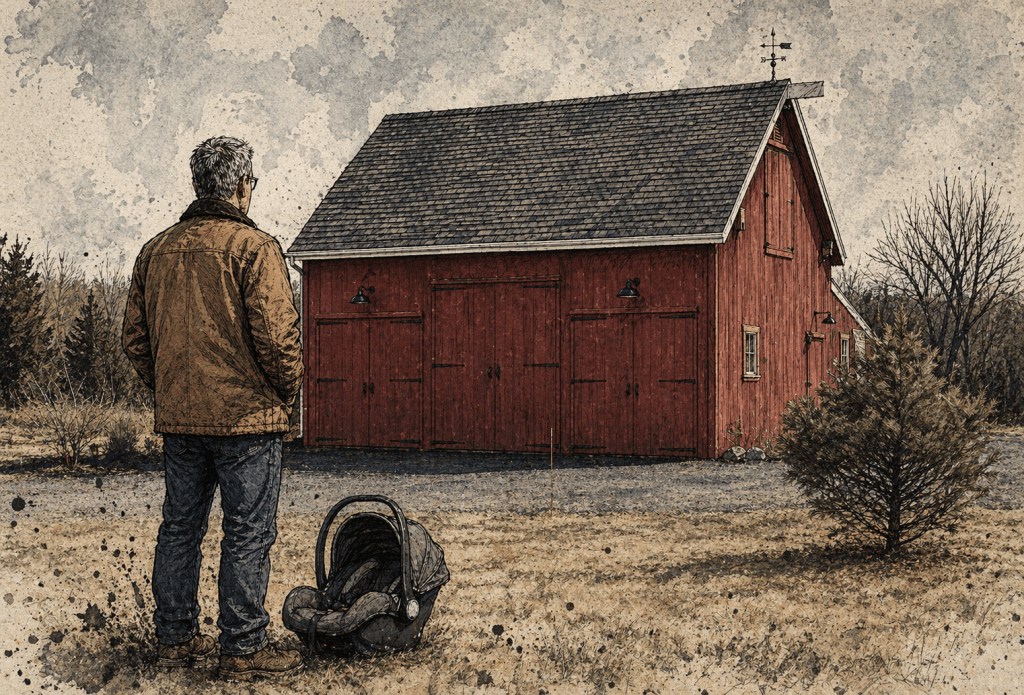
From the moment we started planning the house, we knew there would eventually be a barn. Eventually being the operative word — we were already stretching to build the house, so the barn was going on the someday list alongside retirement and peace of mind.
What we knew for certain: no attached garage. I know how that sounds. Attached garages are convenient and the case for them is obvious. But there are real downsides that don’t get enough airtime. You lose an entire side of your house — a wall that can’t have windows, can’t have light. And more practically: rodents. An attached garage is basically a welcome mat with a covered walkway straight to your kitchen. Mice don’t need a formal invitation, but why make it easier? No thank you.
So we planned around a detached barn from day one. We left space for it in what was supposed to become a circular driveway — whether we measured that space with any real precision at the time is, let’s say, an open question. But the intention was locked. It was happening. Just not yet.
Creative Financing
A few years in, an opportunity presented itself in the form of an outstanding debt. The concrete contractor who had done our chimney — work that had some serious flaws that cost me real money to fix — wasn’t getting a lawsuit from me. But when I reached out I had a simple proposal: you don’t owe me cash, but when I build the barn, you’re doing the slab. No charge. No argument.
He wasn’t happy about it. He did it begrudgingly. But he did it. I never got a price on what that work would have cost me otherwise because I didn’t want to know. I just wanted the whole thing behind me and something to show for it. That might be the most adult I’ve ever handled anything, and I’m only slightly proud of the fact that it took me that long to get there.
The Kit
We went with a post and beam kit from American Country Barns out of Bethlehem, Connecticut — the “Country Farmer with Loft,” 24 by 30 feet. Around $25,000 at the time for almost everything: framing, siding, windows, hardware, most of the fasteners. Foundation not included, obviously — see above. No shingles either, which we sourced separately to match the house.
The joinery is mostly long structural lag screws with some mortise and tenon at the key connections. Standing inside and looking up at the post and beam structure still does something for me. American Country Barns appears to be out of business now, but it looks like they may have merged into Post and Beam Barns out of Connecticut (postandbeambarns.com) — the kits look very similar if you’re shopping.
The Build
Same GC friend who did the house. We set a fixed number up front — no overruns, this is the budget, can you do it. He said yes. Site prep started in early June. The chimney contractor did the slab.
Henry was born June 10th. You can see him in the photos — he is extremely new. The barn went up around him and by July 31st I was painting it. About three weeks of actual work with a break in the middle while my friend picked up another job and came back. I finished some things myself at the end — the stairs into the loft, some other bits I honestly can’t fully reconstruct at this point. Which is on brand. That’s basically been the throughline of this entire series.
Finish Details (and Finish Problems)
To tie the barn to the house we used the same GAF Slate Line shingles on the roof and added half-round gutters. White trim. The siding is rough-cut knotty pine — vertical board and batten — which looks great right up until it doesn’t. Some of the knots dried out and fell out completely, leaving small voids. Not structural, just irritating.
For the stain I used oil-based Cabot solid stain, rolled on July 31st — almost certainly before the wood had fully cured, which contributed to the gapping. Cabot solid stain looks good but five-year reapplication cycles on rough knotty pine is not a casual weekend commitment. File that under: things I knew and chose not to think too hard about.
We also added a decorative horizontal waist board, the kind you see running across the middle of traditional barns. It looks the part. It also collected water, split, and started to rot. Repaired it, then had my friend clad it in aluminum sheet — essentially flashing it the way you’d wrap a window surround. It seems to be holding but that was an entirely avoidable problem if I had thought for five minutes about horizontal wood in a climate that gets real weather.
The Lean-To
Off one side there’s a lean-to with a gravel floor, which is where one of the cars parks in winter — makes it easier to snow blow without doing slalom around vehicles. The gravel is functional but it’s also an open invitation: rodents, carpenter bees, and barn swallows all enjoy the space. I’ve made peace with the swallows — they eat their weight in bugs and there’s something cosmically right about barn swallows living in a barn. The rodents and carpenter bees I’m less sentimental about. A poured concrete floor under the lean-to would make that whole space dramatically more usable and I’m still working on how to make that happen.
The Loft
The loft has become an archive of every leftover material from the house: wide plank pine flooring, extra barn siding, roofing, 2x8s. All of it just sitting up there. This turned out to be the right call — when we did the porch expansion, a significant amount of what we needed was already in the loft. Nothing on this property gets thrown away. Mostly because we’re stubborn, occasionally because it pays off.
The Cupola We Didn’t Do
The original plans included a cupola. At some point it stopped making sense — structural issues, or it felt like an embellishment for its own sake, probably some of both. I’m glad we skipped it. The barn looks right without it. Simple reads as intentional when you get the proportions right, and I’d rather have a building that earns its details than one that’s dressed up to impress.
The Grade
The barn is genuinely one of the best things we did with this property. It’s beautiful from the outside, it functions the way a barn should function, and stepping inside with the posts and beams overhead still gets me. Better siding material — something less prone to knot failure and shrinkage — and a more thoughtful approach to that waist board, and this is a clean A+. As it stands: A-. No complaints.


 Even that's Odd
Leave a comment