
Ten years ago, right around our older son’s third birthday, a microburst tore through our road. We saw it coming — our nanny at the time, who was from the Midwest, took one look at a tail of cloud forming in dead-still air and said, “That’s a tornado, we need to get inside.” She was right to worry. Within minutes the wind picked up, the rain came in sideways, and it blew our heavy Adirondack chairs clean off the porch. We didn’t lose any trees ourselves, but plenty came down along our road, and the next road over got hit even harder — trees down on wires, trees down on a neighbor’s house.
We lost power for four days. No water either, which meant no toilets, which with a three-year-old and an 18-month-old in the house was the real wake-up call. The stuff in the fridge going bad, that we could manage — cooler, ice, eat what you can. Not being able to flush a toilet is a different kind of problem.
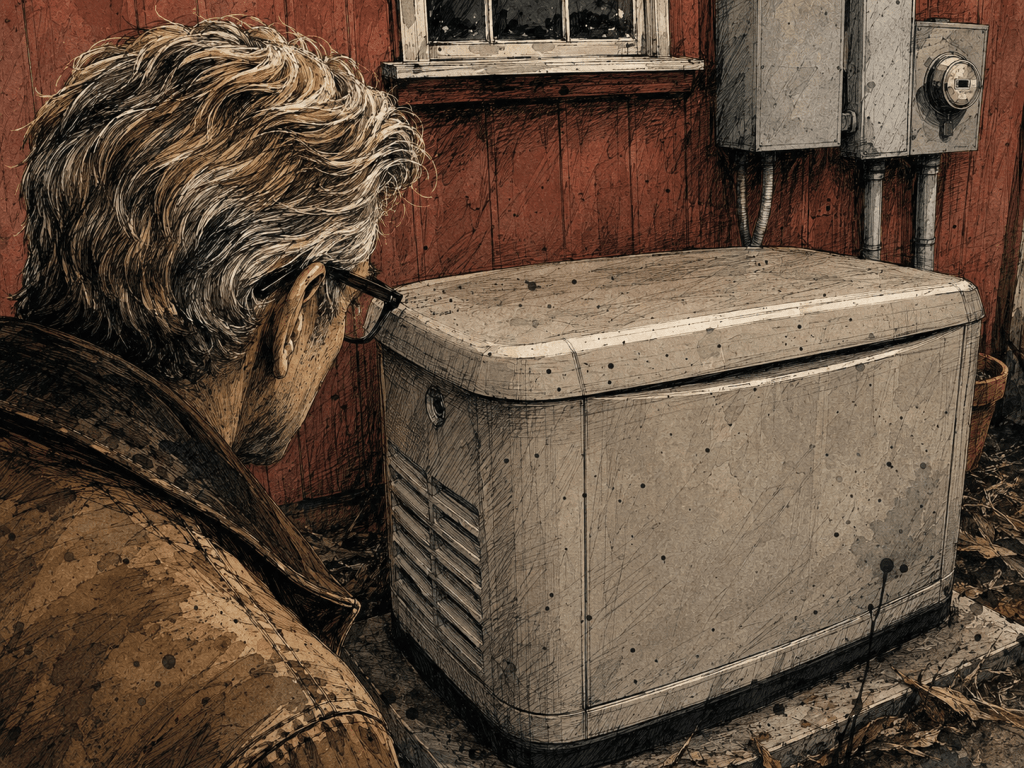
So we got a generator. 11 kW Generac, propane-fed since we already had propane on site, with an automatic transfer switch so it kicks on by itself the moment the power drops. What we didn’t get was any kind of load management system. I didn’t oversize the generator, so the plan was the analog version of load management: shut things off manually, don’t run everything at once, keep the fridge and the boiler going and don’t freeze to death. In hindsight, maybe I should have spent the extra money and not thought about it again. That’s a running theme with this house.
Installation had a loose wire in it that took a while to track down — nothing catastrophic, but the kind of thing where the generator would run fine on small loads and then trip out the second something like a toaster oven kicked on. A service call eventually found the loose wire. What it didn’t find was the buzzing.
The generator buzzes, occasionally, for no reason anyone can identify. It’s never happened once while a technician’s been standing there — it’s random, and the only way I know it’s happening is if I happen to walk near the generator at the right moment. It exercises every Thursday morning, and sometimes that exercise cycle is exactly what triggers it. It seems to come down to where the engine happens to stop — that’s what decides whether it’ll buzz or not — so starting it again gets rid of the noise, at least until the next time it lands wrong. A few years ago a service tech floated some possibilities: stepper motor, start relay, on-board charger, maybe pull the T1 fuse. I replaced the stepper motor. Still buzzes. The last guy who came out had never heard of any of this. So the plan now is to call the office or hope someone with more institutional memory shows up next year.
Fast forward to this July 4th — a heat wave, days of dangerous real-feel temperatures, and a serious storm that rolled through that evening. Power went out on our road, and on plenty of others around us, for a couple of days. It had just cooled off enough that we weren’t scrambling for AC, though we do have a portable unit we could’ve crammed into a bedroom if we’d needed it. The generator did its job — showers, bathrooms, the burner instead of the oven, life more or less normal minus the internet, which held on for a while on battery backup somewhere upstream before it, too, gave out.
What nobody tells you about a generator is that it trades one kind of stress for another. You stop worrying about whether your family can flush a toilet or whether the food in the fridge is going to survive, and you start worrying about fuel levels, when to shut it down to check the oil, and running a constant mental inventory of what can and can’t be running at once. During this storm I completely forgot the car was plugged in and charging — we didn’t even have an EV when we bought the generator a decade ago, so it was never part of the math. It happened to be fully charged already, which meant it wasn’t actively pulling power, but it easily could have been. Turns out an 11kW generator and a Tesla pulling a full 32-amp charge are not exactly friends; that one car alone can eat something like 70% of what the generator makes, before the fridge, the well pump, or anything else so much as thinks about turning on.
And here’s the part that still bugs me: we had solar panels installed in the last year or so. No battery backup with them, because the cost hadn’t come down enough to justify it on top of a generator we already had. So during an outage, the solar panels are actively generating power, and that power goes… nowhere. Not to the grid, not to the house. It’s made and then it’s wasted, which feels like an absurd way to run a system, but that’s how it’s built until the day the generator finally dies and we make the jump to battery storage — which comes with its own asterisk, since batteries generally get less efficient in temperature extremes. I’ve seen the same thing in my own Tesla — the AC struggled to keep up in the recent heat wave, not because it’s a bad system, but because extreme temperatures just take a bite out of battery performance across the board.
Ten years in, the lesson isn’t really about the generator. It’s that every fix in this house buys you a new, smaller problem to manage. The generator solved the water and power problem and left me with a buzz nobody can diagnose. The solar solved the electricity bill and left me with power we can’t use exactly when we need it most.
 Even that's Odd
Leave a comment