
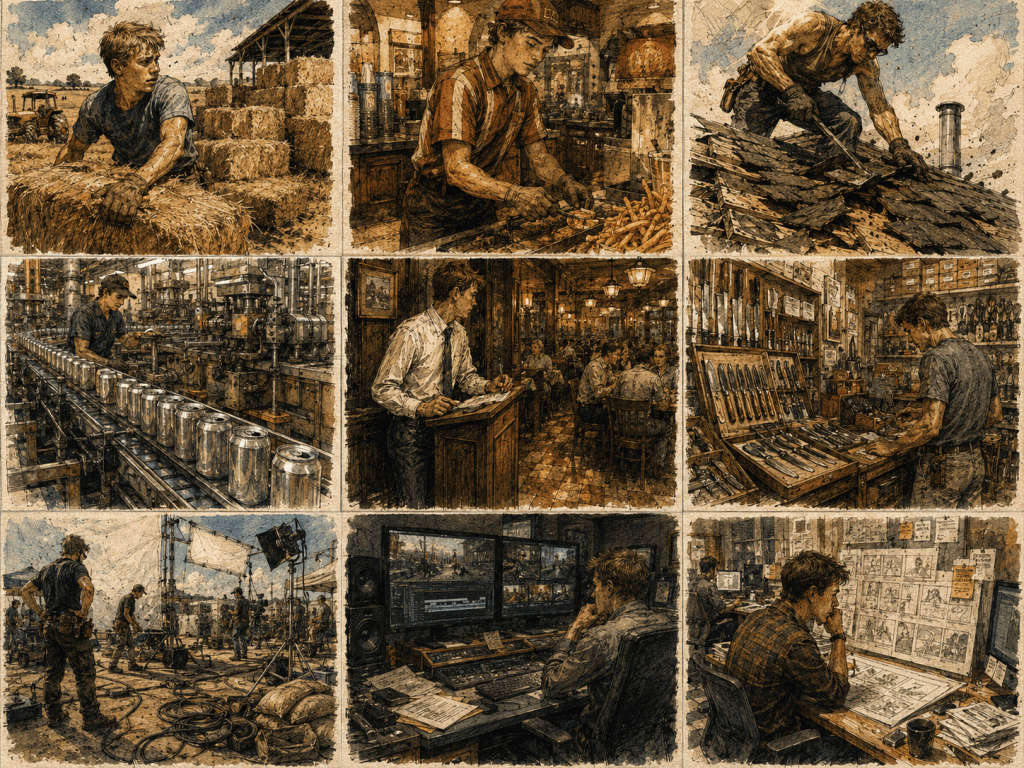
If you laid my resume out chronologically, it would not look like a career. It would look like someone who couldn’t make up his mind. Farm chores starting around age four or five. Lawn mowing. Hay bales. McDonald’s. Roofing. Decks. Handyman. A summer in a Reynolds Metals can plant in Middletown, New York in 1988. A finance degree from SUNY New Paltz in 1989. A financial analyst job at Fleet Bank in Newburgh. A backpacking trip through Europe. NYC by late 1991. Stardust Diner. The cutlery counter at Hoffritz. Office temping. Personal training. A commercial shoot on Santorini. And then twenty-five years in film and television production that moved through PA, grip, set dresser, studio manager, coordinator, producer, executive producer, head of production, director of production — and finally over to the brand side as a brand manager, director of design, and now a consultant running my own shop.
I don’t present this as a master plan because there wasn’t one. I did what had to be done, and I took the opportunities that came my way. What I didn’t realize until much later is that this is the through-line. Not the variety itself, but what the variety gave me.
The Farm Started It
I grew up on a small farm, which means work was the default condition of being awake from about the time I could walk. Four or five years old, doing whatever a four-or-five-year-old can do on a farm, which is more than people who didn’t grow up on one would guess. By the time other kids were starting their first paper routes, I’d been working for a decade. It wasn’t framed as character-building. It was just what life on a farm was.
The neighborhood-and-summer jobs layered on top of that — mowing lawns, stacking hay bales for someone else’s farm, McDonald’s at some point, roofing and decks and general handyman work for whoever needed a pair of hands. None of it was glamorous. All of it was the same lesson, which is that a job is a job and the people who do them are the people who do them, and once you’ve spent a summer pulling shingles off a roof in August you stop pretending any kind of work is beneath you.
The Reynolds Metals summer in 1988 was its own piece of the foundation. Union plant, real factory work, real paycheck — the kind of summer job that existed in Middletown for college kids in the eighties and that, broadly speaking, doesn’t exist anymore. That was the first time I had any sense of what organized labor actually meant — what it looked like on the floor, how people talked about it, what changed when you had it. Decades later, when I wrote about being a union-skeptical guy who came around on what unions do, that summer was part of where it started.
SUNY New Paltz, and Fleet Bank
I got a finance degree from SUNY New Paltz in 1989. I worked in the intramural athletics office while I was a student and eventually ran it, which was my first real exposure to actual operational management — schedules, budgets, equipment, people, complaints. I also did safety escorts for the campus police on the night shift, which mostly meant driving students home from the library at one in the morning. Free Uber, basically, before the word existed.
Right out of school I went to work at Fleet Bank in Newburgh as a financial analyst. They wanted me to enter the lender training program, which was the official corporate pipeline — credit analysis, junior lender, eventually a portfolio of accounts and a real career in commercial banking. I took the GMAT. I’d been admitted, or about to be admitted, into a master’s program in international finance at either Baruch or Pace. The plan was to start the following semester.
The plan was New York either way. Baruch and Pace are both Manhattan schools, so the grad-school version of my life and the actual version of my life were going to share a zip code. The only question was what I’d be doing inside the city. Then I took a backpacking trip through Europe, and somewhere on that trip the plan quietly stopped being the plan. I came back, decided to move to New York without enrolling, and never went back to it. I think about that decision sometimes. There’s a parallel-universe version of me with a Baruch international-finance degree, twenty-five years inside a bank, and a completely different life lived in the same neighborhoods. I don’t regret the trade. But I won’t pretend I was sure at the time. I wasn’t sure of anything. I was twenty-two.
The finance background never disappeared, though. It went underground. Years later, producing television projects with eight-figure budgets, the finance degree was the thing that made me legible to the people upstairs. Budgets, projections, line items, P&Ls, return on investment — the producers without finance backgrounds had to learn that vocabulary on the job. I’d already learned it. The Fleet Bank analyst seat became, in retrospect, the most useful finance training I could have gotten for the career I actually ended up in.
New York, 1991
I moved to the city in late September or early October of 1991 and moved in with two of my old roommates from SUNY New Paltz. We shared a fifth-floor walkup on 74th and Columbus on the Upper West Side. One of them was already working in New York as a grip and electrician on music video shoots, which were everywhere in the city at that point — MTV was at its peak, the labels were spending real money, and the production work was steady for anyone willing to lift things and run cable. He brought me onto shoots as a PA almost immediately. That was the actual entry point. I didn’t break into film through networking or applications. I broke in because my roommate needed a PA and I needed a paycheck.
Between shoots I worked the service jobs that bridged the gaps. Hosting at the Stardust Diner. The cutlery counter at Hoffritz. Office temp work in midtown — the finance degree got me through the door at staffing agencies, and Excel competence got me hired. Service work in New York teaches you two things that nothing else really teaches you. It teaches you how to read a room — every shift, every table, every customer — fast, with no margin for being wrong. And it teaches you that polite competence beats charm. The people who got tipped well at the diner weren’t necessarily the friendliest. They were the ones who delivered.
I also worked as a personal trainer and group fitness instructor for a stretch in there. That was its own education. Standing in front of a class and being responsible for thirty people’s hour is not nothing. You can’t fake energy. You can’t phone it in. The class will know within ninety seconds. Public speaking, room reading, time management, all concentrated into one stretch of my twenties.
And somewhere in there I was a commercial extra on Santorini, which is the most cinematic line on the resume and the one that mattered the least. I was on a Greek island getting paid in cash to stand in the background of someone else’s shoot. It was a great week. I learned roughly nothing about the production side of the industry I would spend the next twenty-five years in. Sometimes a good job is just a good job.
Studio Manager, 1992–93
The actual career started at the bottom of the call sheet. PA. Key PA. Art PA. Set dresser. Grip and electric on smaller shoots. Then, around 1992 or ’93, the studio manager job at a film production company that was — without exaggeration — the worst job I ever had.
It had nothing to do with the work or the people I worked with. The crews were great. Film attracts genuinely interesting people, and the people I came up alongside on those shoots are still some of the best I’ve ever worked with. The problem was the ownership. One of the owners had reportedly started the company by walking off from his old boss with the business under his arm, plus two partners. Another one of them sat me down at some point and told me, in so many words, that he didn’t give a fuck about me or what I wanted to do. He’d just find someone else when I burned out.
I have thought about that conversation a lot in the thirty-plus years since. It clarified something about how to manage people that has stayed with me as a permanent negative example. Whatever you think of an employee — and you might be right about them — telling them out loud that they’re disposable is bad management. It produces exactly the outcome it predicts. People give you back what you give them. He was correct that I would burn out. He was the reason.
I lasted the year or two it took to learn what I needed to learn, and the things I learned were not the things he was trying to teach me. I learned how a production runs because every breakdown in every department ended up on my desk first. I learned how to triage when there’s no support behind you. I learned what kind of leader I never wanted to be. None of that was on the job description.
Up the Call Sheet
From there it was coordinator, production manager, producer, project manager, executive producer, head of production, director of production. Each step a wider scope of responsibility, a bigger budget, more people, more departments to coordinate, more stakeholders to keep aligned. I stopped lifting sandbags at some point along that climb and started reading rate cards and bid sheets instead. The skills compounded. The early jobs hadn’t been a detour. They were the curriculum.
The pivot from pure production into post-production happened at Click 3X, after a stretch at R/GA. Up until then I’d been a live-action production person — sets, crews, locations, the physical making of things. Post is a different organism. Different rhythm, different vocabulary, different problems. The work happens in suites and in front of monitors instead of on stages and on location. Some of the same people from the live-action world come across; most don’t. Learning post from the inside, after years of producing the front end of it, is what eventually let me run the kind of broad-scope on-air operations the cable network jobs required — because by then I’d been on both sides of the handoff.
I produced film, video, photo, graphics, post, VFX, CGI — basically everything the on-air departments of cable networks make. Over time I worked on rebrands and on-air packages for VH1, LOGO, Sci-Fi, Oxygen, Universal Kids, and Bravo. At various points I was the head of creative production and operations for Bravo, Oxygen, and Universal Kids at NBCUniversal. The longer I did it the more the job was actually about people — what people needed to do their best work, what was getting in their way, what the system around them was producing in terms of output, and what could be reorganized to produce more.
Brand, and Now Consulting
The move out of pure production and into brand management and design leadership wasn’t a sharp turn. By the time I was running creative production at NBCUniversal, I was already operating as a brand person — every on-air package, every rebrand, every campaign was a brand exercise dressed up as a production exercise. Calling it brand management out loud was just the official version of what the work had already become.
I now run Fig.3, my own consulting operation, where companies bring me in to fix broken creative departments — to look at workflow, headcount, vendor relationships, and output quality and figure out what’s actually wrong. The honest answer to why I’m good at this is that I have done almost every job inside a creative organization. I have been the PA who got yelled at. I have been the producer who yelled. I have been the head of department signing the invoices. I have been the consultant brought in to explain why the invoices keep getting bigger. There is no part of the food chain I haven’t seen from at least two angles.
I don’t think the lesson of any of this is that everyone should bounce between hay bales and Hoffritz before settling into a career. The lesson is that every job is a vantage point, and people who have only seen the work from one chair tend to make decisions that don’t account for the other chairs. The grip notices things the producer never sees. The host at the diner notices things the GM never sees. The PA notices things the executive producer pretends not to know.
I didn’t plan any of this. I took the opportunities that came, did the work that was in front of me, and tried to learn from whichever seat I was sitting in. What I ended up with was a kind of accumulated lateral knowledge — the ability to look at a department and immediately know which seat is suffering, which seat is bluffing, and which one is actually doing the work. That turned out to be a marketable skill, but more than that, it turned out to be the thing I’m best at. None of the early jobs felt like training at the time. All of them turned out to be.


Leave a Reply