
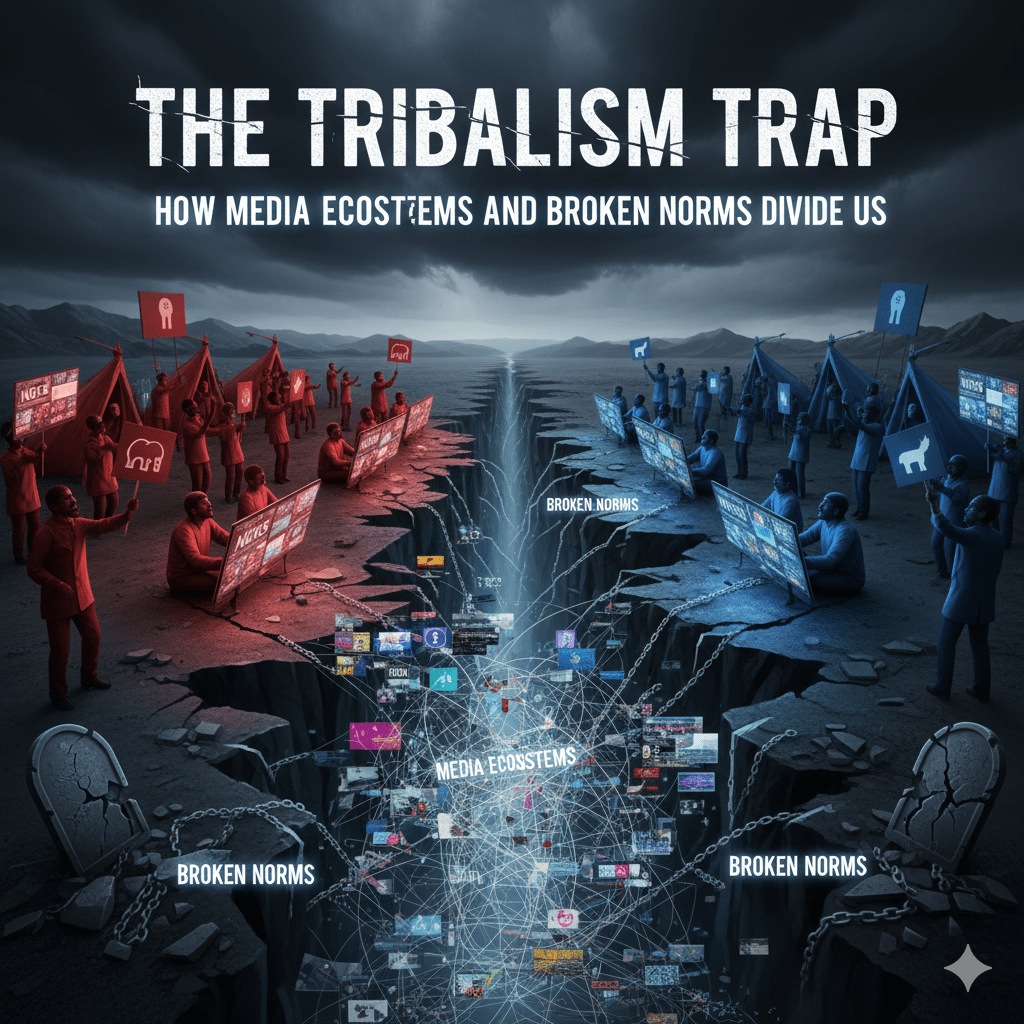
How Media Ecosystems and Broken Norms Divide Us
A number of years ago, watching news coverage of conflicts in Afghanistan, Pakistan, the Middle East, and various African nations, I remember having a thought that now fills me with embarrassment: No wonder there are always conflicts in those parts of the world—they’re still organized around tribal loyalties, territorial disputes, and sectarian identities. If that continues, they’ll never have lasting peace.
And then I remember feeling grateful: At least in America, we’ve moved past that. Sure, we have disagreements, but we’d never return to tribalism. We’re too advanced, too educated, too rational for that.
I could not have been more wrong.
Here’s what I missed: tribalism isn’t something that only happens “over there” among “those people.” It’s a fundamental human tendency that emerges whenever social conditions create strong in-group/out-group dynamics. Geography doesn’t matter. Education level doesn’t matter. Economic development doesn’t matter. What matters is whether the systems organizing society encourage tribal thinking or discourage it.
And in America today? Our systems aren’t just encouraging tribalism—they’re actively manufacturing it. For profit.
Here’s a thought experiment that proves it: Imagine two people watching the exact same news event unfold. One turns on CNN. The other turns on Fox News. By the end of the evening, they’ll have completely different understandings of what happened, who’s to blame, and what it means for the country. They’ll both be absolutely certain they have the facts, and they’ll both be convinced the other person is living in a delusional bubble.
Welcome to American political tribalism in 2026. It’s not just that we disagree anymore. We can’t even agree on what happened, let alone what it means. We’re living in separate informational universes, and those universes are specifically designed to keep us apart.
But here’s what nobody’s saying out loud: this division isn’t an unfortunate side effect of modern media. It’s the entire business model. And while we’re screaming at each other about who’s more biased, the people extracting wealth from the bottom 90% of us are laughing all the way to the bank.
Consider what happened in March 2021. The media spent weeks covering whether Dr. Seuss books were being “cancelled” and whether Mr. Potato Head was becoming gender-neutral. Fox News mentioned “Dr. Seuss” 342 times in one week. Cable news devoted hours to debates about toy potatoes.
Meanwhile, that same month, Congress passed a COVID relief bill that gave $1,400 checks to most Americans—but also included $30 billion in tax breaks for private equity firms and real estate investors. That got virtually no coverage. The House also quietly killed a $15 minimum wage increase that would have affected 27 million workers. Also barely mentioned.
That’s the pattern: culture war theater in the spotlight, wealth extraction in the shadows. And it works because we’re too busy fighting each other to notice we’re all being robbed.
The Fragmentation Engine: How We Ended Up in Separate Realities
Let’s start with a basic fact: political polarization in America is worse than it’s been in over a century. In 1960, roughly 5% of Americans said they’d be “displeased” if their child married someone from the other political party. By 2020, that number had jumped to 42%.
But this isn’t just about politics. It’s about epistemology—how we know what we know. And the answer for most Americans is: we know what our preferred media sources tell us.
The Death of the Shared Information Space
In 1980, if you wanted news, you had three choices: ABC, CBS, or NBC. These networks competed for viewers, sure, but they all operated under the same set of journalistic norms. They had to—the FCC’s Fairness Doctrine required broadcasters to present controversial issues in a balanced manner.
Then came 1987. The FCC, under Reagan-appointed chairman Mark S. Fowler, eliminated the Fairness Doctrine. Fowler’s philosophy? Television was just “a toaster with pictures.” In other words, it should be treated like any other business—no special public interest obligations.
The result? In 1996, Roger Ailes launched Fox News with an explicit mission: create a conservative counterweight to what he saw as liberal media bias. MSNBC followed suit on the left, though later and less successfully. The shared information space was dead.
Today, Fox News reaches about 2.5 million primetime viewers. MSNBC gets around 1.5 million. CNN pulls in about 700,000. These numbers might seem small, but they’re incredibly influential—these viewers are more politically engaged, more likely to vote, and more likely to shape conversations within their communities.
The Algorithm Amplification Effect
But cable news was just the beginning. The real fragmentation engine is social media, where algorithms learned that outrage equals engagement.
Facebook’s own internal research, leaked by whistleblower Frances Haugen in 2021, showed that content provoking anger and outrage generates significantly more engagement than neutral or positive content. The algorithm learned to serve up exactly what keeps people scrolling: stories that make them furious.
YouTube’s recommendation algorithm is even more insidious. A 2019 study by researchers at the University of California, Berkeley found that YouTube’s algorithm consistently recommends progressively more extreme content. Watch a video about conservative politics, and soon you’re being recommended white nationalist content. Watch progressive content, and you’re pushed toward revolutionary leftist material.
The numbers are staggering: 70% of time spent on YouTube is driven by algorithmic recommendations. That’s billions of hours of viewing shaped by an algorithm optimized for engagement, not accuracy. Not truth. Not social cohesion. Just keeping eyeballs on screens.
The Perceived Bias Spiral
Here’s where it gets diabolical: once people start perceiving bias in mainstream sources—even when that bias is minimal or imagined—they migrate to explicitly partisan sources that tell them what they want to hear.
A 2020 Pew Research study found that 69% of Republicans say journalists don’t understand people like them, while 53% of Democrats say the same. Both groups are convinced mainstream media is biased against their side.
And you know what? Sometimes they’re right. Sometimes coverage genuinely is slanted. But the solution most people choose—retreating to explicitly partisan sources—makes the problem exponentially worse.
A conservative who feels CNN is biased might switch to Fox News. A liberal frustrated with corporate media might turn to exclusively progressive outlets. Both believe they’re making a rational choice to escape bias. Both are actually diving deeper into a more filtered information bubble.
The result is a self-reinforcing cycle: mainstream sources try to appear balanced, which satisfies no one. Partisan sources provide the comfort of confirmation, which attracts more viewers. The shared reality fractures further. The spiral continues.
The Asymmetry Problem: Why “Both Sides” Isn’t the Whole Story
Now here’s where we need to get uncomfortable: the fragmentation isn’t symmetrical. The right-wing media ecosystem operates fundamentally differently from its left-wing counterpart.
This isn’t a value judgment. It’s an empirical observation backed by data from Harvard’s Berkman Klein Center, Oxford’s Reuters Institute, and multiple peer-reviewed studies. The asymmetry is real, it’s measurable, and pretending otherwise just makes the problem worse.
The Coordination Factor
A 2017 study by Harvard’s Berkman Klein Center analyzed 1.25 million news stories during the 2016 election. Their finding: right-wing media operates as a highly coordinated network, while left-wing and mainstream media are more fragmented and diverse.
Fox News, Breitbart, the Daily Caller, and other right-wing outlets frequently share the same narratives, often using identical language. Stories that originate on fringe sites quickly make their way to Fox News primetime, creating a unified message that reaches tens of millions.
The left lacks this coordinated infrastructure. MSNBC, while clearly liberal-leaning, still operates more like traditional journalism than Fox’s explicit partisan advocacy. Progressive outlets like The Young Turks or Democracy Now have a fraction of Fox’s reach and don’t coordinate messaging the same way.
The result? Conservative narratives can spread with remarkable speed and consistency. Liberal narratives tend to be more scattered and contested, even within left-leaning spaces.
The Reality Distortion Field
A 2020 study published in Science Advances found that Republicans are significantly more likely than Democrats to believe and share misinformation. This isn’t because Republicans are less intelligent—it’s because the media ecosystem they inhabit is more likely to spread false information.
During the COVID-19 pandemic, counties with higher Fox News viewership had lower vaccination rates and higher death rates, even after controlling for political affiliation, age, and other factors. That’s not correlation—that’s causation. The information environment literally affected life-and-death decisions.
After the 2020 election, 70% of Republicans believed the election was stolen, despite zero credible evidence. This wasn’t organic skepticism—it was the result of a coordinated disinformation campaign amplified through right-wing media, from Trump’s Twitter feed to Fox News hosts to local conservative talk radio.
Fox News paid $787.5 million to settle Dominion Voting Systems’ defamation lawsuit in 2023—the largest known media defamation settlement in U.S. history. Internal communications revealed hosts knew they were promoting false claims but did it anyway to maintain ratings and prevent audience migration to even more extreme competitors like Newsmax and OAN.
The Norm-Breaking Cascade
Here’s the thing about democratic norms: they only work when everyone follows them. And over the past decade, one side has systematically abandoned them while the other struggles to figure out how to respond.
Consider these norm violations:
- In 2016, Senate Republicans refused to even hold hearings for Supreme Court nominee Merrick Garland, citing an ‘election year’ principle they immediately abandoned in 2020 when rushing through Amy Coney Barrett’s confirmation.
- Trump refused to commit to accepting election results before the 2016 and 2020 elections, then refused to concede after losing in 2020—the first president in American history to do so.
- Republican officials in multiple states attempted to send fake electoral college certificates to Congress—literal forgery in service of overturning an election.
- The January 6th attack on the Capitol—the first time in American history that a losing candidate’s supporters violently stormed the Capitol to prevent certification of election results—is now downplayed or justified by major Republican figures and media outlets.
Each norm violation makes the next one easier. Each broken promise makes trust harder. And crucially, each violation is amplified and justified by a media ecosystem that treats winning as the only value that matters.
The TDS Flip: From Derangement to Defense
Remember when conservatives used “Trump Derangement Syndrome” as a cudgel against liberals who they claimed were irrationally hostile to Donald Trump? Turns out they were projecting—but in the opposite direction.
“Trump Derangement Syndrome” doesn’t describe people who criticize Trump. It describes people who can’t. Who will defend anything he does. Who have lost the ability to evaluate his actions objectively because their entire political identity has become wrapped up in supporting him.
That’s the real derangement: Trump Defense Syndrome.
The Cult of Personality
Consider the transformation of the Republican Party from 2015 to now. Before Trump, many prominent Republicans—including Ted Cruz, Lindsey Graham, and Marco Rubio—were harsh critics. Cruz called Trump a “pathological liar.” Graham said Trump was a “race-baiting, xenophobic, religious bigot” who would destroy the party.
By 2020, these same politicians were among Trump’s staunchest defenders. What changed? Not Trump—his behavior remained consistent. What changed was that Republican voters embraced him, and any Republican who criticized Trump risked being primaried out of office.
Look at what happened to Republicans who broke with Trump:
- Liz Cheney, daughter of Dick Cheney and once the third-ranking House Republican, was removed from leadership and then lost her primary by 37 points for voting to impeach Trump and serving on the January 6th committee.
- Adam Kinzinger, a six-term congressman, chose not to run for reelection after Trump supporters targeted him for criticism of the January 6th attack.
- Jeff Flake, Bob Corker, and other Republicans who criticized Trump chose retirement over facing Trump-backed primary challengers.
The message was clear: in the Republican Party, loyalty to Trump matters more than conservative principles, more than character, more than truth itself.
The Defense Reflex
Here’s how you know it’s Trump Defense Syndrome: there is literally nothing Trump can do that his core supporters won’t defend or excuse.
Bragged about sexual assault on tape? “Locker room talk.” Paid hush money to a porn star? “Private matter.” Called neo-Nazis “very fine people”? “Taken out of context.” Stole classified documents and refused to return them? “Presidential prerogative.” Incited a mob that attacked the Capitol? “False flag” or “peaceful protest” depending on which narrative is more convenient.
The pattern is consistent: first deny the facts, then downplay their significance, then attack anyone who brings them up, then claim victimhood. The specific defense doesn’t matter—what matters is that there must be a defense, always, no matter what.
This isn’t conservatism. It’s not principle. It’s tribalism in its purest form: my team, right or wrong, and anyone who criticizes my team is the enemy.
The Media Enablers
And who enables this? The right-wing media ecosystem that’s made defending Trump a 24/7 mission.
Sean Hannity speaks with Trump regularly and coordinates messaging. Tucker Carlson (before his Fox News exit) had Trump’s ear and used his platform to amplify Trump’s grievances. Conservative talk radio hosts like Rush Limbaugh (before his death) and Mark Levin frame every criticism of Trump as an attack on their listeners personally.
The result is a closed information loop: Trump says something, right-wing media amplifies it, Republican politicians endorse it, and conservative voters believe it. Anyone who breaks the chain—journalists, officials, even fellow Republicans—gets immediately attacked as “fake news,” “deep state,” or “RINO” (Republican In Name Only).
This is what Trump Defense Syndrome looks like at scale: an entire political coalition organized around defending one man, rather than advancing any coherent set of policy principles.
Why Democrats Can’t (and Shouldn’t) Respond in Kind
So if the right-wing media ecosystem is so effective at mobilizing its base and shaping narratives, why don’t Democrats just build their own version? Why not fight fire with fire?
The answer is simple: they can’t. And even if they could, they shouldn’t.
The Asymmetry of Trust
Here’s the fundamental difference: Democratic voters still care about truth.
A 2021 Pew study found that Democratic-leaning voters are more likely to stop consuming a news source if it gets facts wrong, while Republican-leaning voters are more likely to stick with sources that align with their views regardless of accuracy. This isn’t a moral judgment—it’s a behavioral reality that shapes how political coalitions operate.
When MSNBC host Brian Williams was caught embellishing a story about his reporting in Iraq, he was suspended and eventually left the network. When Fox News hosts were caught promoting false election fraud claims—claims that cost Fox $787.5 million in the Dominion lawsuit—they kept their jobs and continued making the same baseless accusations.
The Democratic coalition is diverse and fractious. It includes everyone from moderate suburban voters to democratic socialists, from Black churches to secular progressives, from labor unions to tech entrepreneurs. These groups don’t agree on everything, and they hold their leaders accountable when they mess up.
The Republican coalition under Trump has become more homogeneous and hierarchical. If you’re not with Trump, you’re not really a Republican anymore. This makes messaging easier but also makes the party more authoritarian and less democratic (small-d).
The Structural Barriers
Even if Democrats wanted to build a Fox News equivalent, they face structural barriers:
- Geography: Conservative media benefits from concentration in rural and exurban areas where there’s less media competition. Progressive voters are more urban and have access to diverse media sources.
- Age: Fox News’ median viewer age is 68. Older Americans watch more cable news and are more susceptible to televised propaganda. Younger, more liberal Americans get news from diverse online sources.
- Education: Higher education correlates with both liberal politics and media skepticism. College-educated voters—who lean Democratic—are less likely to trust any single source blindly.
- Coalition structure: The Republican base is more ideologically homogeneous and open to top-down messaging. The Democratic coalition is messier, more diverse, and harder to coordinate.
These aren’t value judgments—they’re strategic realities. Democrats couldn’t build a Fox News equivalent even if they tried because their voter base wouldn’t consume it.
The Moral Case
But here’s the real reason Democrats shouldn’t respond in kind: because democracy requires some people to keep acting democratically even when the other side doesn’t.
If both parties abandon norms, there are no norms. If both parties spread misinformation, there’s no shared reality. If both parties prioritize winning over truth, democracy is dead—it just doesn’t know it yet.
This doesn’t mean Democrats should be pushovers. It doesn’t mean they should unilaterally disarm. It means they need to find ways to fight effectively while still maintaining democratic principles.
It means being aggressive about calling out lies without spreading lies themselves. It means organizing and mobilizing without building a cult of personality. It means competing fiercely while still respecting election results and democratic norms.
Is this harder than just building a left-wing Fox News? Absolutely. Is it necessary for preserving democracy? Also absolutely.
The Dark Money Infrastructure: Who Built This Machine
So how did we get here? The coordinated right-wing media ecosystem and the asymmetric polarization didn’t happen by accident. They were built deliberately over decades, funded by billions of dollars from wealthy individuals and corporations who understood that controlling information meant controlling politics.
And while we’re busy fighting culture wars, this infrastructure keeps churning out the narratives that maintain economic arrangements benefiting the top 10%.
The Think Tank Network
At the heart of the conservative messaging machine sits a network of think tanks that produce the “intellectual” foundation for right-wing policies. These aren’t neutral research institutions—they’re advocacy organizations funded by wealthy donors to produce predetermined conclusions.
The Heritage Foundation, founded in 1973, has an annual budget exceeding $100 million. Major donors include the Koch family foundations, the DeVos family, the Scaife family, and the Mercer family. Heritage doesn’t just produce policy papers—it coordinates messaging across conservative media and politicians. When you hear the same talking points on Fox News, from Republican congressmen, and in conservative op-eds, that coordination often starts at Heritage.
The American Enterprise Institute (AEI) operates on a similar model, with a budget around $60 million annually. AEI scholars appear regularly on cable news as “experts,” rarely disclosed as representatives of a heavily funded advocacy organization. The Cato Institute, funded significantly by the Koch brothers, pushes libertarian economics under the guise of academic research—budget: $35 million annually.
These organizations share staff, coordinate messaging, and create an echo chamber of mutually reinforcing “research.” One think tank publishes a report. Another cites it as evidence. A third produces a policy brief based on both. Conservative media treats all of it as independent validation. The result: manufactured consensus.
The Koch Network
No discussion of right-wing infrastructure is complete without Charles Koch and the network he built. After his brother David’s death in 2019, Charles controls a political operation that spent over $750 million in the 2020 election cycle alone.
The Koch network isn’t just about elections. It’s about building permanent infrastructure:
- Americans for Prosperity (AFP): Koch’s grassroots organizing arm with chapters in 38 states and an annual budget exceeding $150 million. AFP mobilizes conservative voters around economic issues that benefit the wealthy—tax cuts, deregulation, opposition to unions.
- State Policy Network: Funds conservative think tanks in all 50 states, creating the appearance of local grassroots research while actually coordinating messaging nationally. Annual budget: $83 million.
- Academic centers: Koch has donated over $500 million to universities, often with strings attached requiring approval over hiring and curriculum. This creates academic credentials for free-market fundamentalism.
- Legal network: Through the Federalist Society (discussed below), Koch has shaped the judiciary to rule in favor of corporate interests.
Charles Koch’s net worth: $64 billion. That fortune came from Koch Industries, which benefits directly from the deregulation, tax cuts, and anti-environmental policies his network promotes. The “dark” in dark money isn’t just about disclosure—it’s about the invisible return on investment.
The Federalist Society: Capturing the Judiciary
Founded in 1982, the Federalist Society has become perhaps the most influential conservative organization in America—not by winning elections, but by capturing the judiciary.
The Federalist Society maintains an annual budget of about $25 million, funded by major conservative donors including the Koch network, the Bradley Foundation, the Scaife Foundation, and others. But its influence far exceeds its budget.
Here’s the playbook: The Federalist Society identifies, cultivates, and credentials conservative lawyers from law school through their careers. It provides networking, speaking opportunities, and intellectual cover for pro-corporate legal theories. When Republican presidents need to fill judicial vacancies, they turn to Federalist Society lists.
The results:
- All six conservative Supreme Court justices are current or former Federalist Society members: John Roberts, Clarence Thomas, Samuel Alito, Neil Gorsuch, Brett Kavanaugh, and Amy Coney Barrett.
- Under Trump, 85% of his judicial appointments were Federalist Society members or approved by the organization.
- Over 230 federal judges are Federalist Society members—lifetime appointments that will shape American law for decades.
This matters because these judges consistently rule in favor of corporations over workers, polluters over communities, and wealthy donors over campaign finance restrictions. Citizens United—the 2010 decision that unleashed unlimited corporate political spending—came from Federalist Society justices. Shelby County—which gutted the Voting Rights Act—same. Janus—which weakened public sector unions—same pattern.
The Federalist Society didn’t just capture the courts—it built a parallel legal system that consistently delivers outcomes benefiting the wealthy, then claims those outcomes are just “neutral” constitutional interpretation.
The Coordination Hub: The Council for National Policy
You’ve probably never heard of the Council for National Policy (CNP), and that’s by design. Founded in 1981, CNP is where the coordination actually happens—where wealthy donors, media figures, politicians, and religious leaders meet to align strategy.
CNP’s membership is secret, but leaked lists have revealed members including:
- Donors: Charles Koch, Dick DeVos (Amway heir), Foster Friess (investor), Rebekah Mercer (hedge fund heiress)
- Media: Steve Bannon, Kellyanne Conway, Sebastian Gorka, Jerome Corsi
- Politicians: Ted Cruz, Tom Cotton, Jim DeMint, Rick Perry, Mike Pence
- Religious leaders: Ralph Reed, Jerry Falwell Jr., Tony Perkins
- Organizations: Heritage Foundation, Family Research Council, NRA, Federalist Society
CNP meets three times annually, always in secret. These meetings are where messaging gets coordinated before it appears across conservative media. Where political strategy gets aligned. Where donors decide which candidates and causes to fund.
In August 2020, leaked audio from a CNP meeting revealed members discussing strategies to challenge the election results if Trump lost. This wasn’t spontaneous—the “stolen election” narrative was planned in advance by the same people who would amplify it through media and politics.
The coordination isn’t a conspiracy theory—it’s documented organizational structure. What looks like organic grassroots movement is often astroturf, carefully cultivated and funded by billionaires who benefit from keeping us divided.
The Left’s Lack of Equivalent Infrastructure
Does the left have similar infrastructure? Not really, and the asymmetry matters.
Liberal organizations exist—the Center for American Progress (CAP) has a budget around $50 million, the American Constitution Society provides a counterweight to the Federalist Society with a budget of $6 million (compared to Federalist Society’s $25 million). But these organizations are:
- Smaller and less well-funded
- Less coordinated (progressive organizations often compete rather than cooperate)
- More diverse in priorities (civil rights, environment, labor, healthcare—harder to create unified messaging)
- More transparent (liberal donors are more likely to be publicly known, making them easier targets)
More importantly, wealthy liberal donors—even billionaires like George Soros (net worth $6.7 billion) or Tom Steyer (net worth $1.6 billion)—generally fund organizations pushing for higher taxes on the wealthy, stronger regulations, and policies that would reduce wealth concentration. They’re funding against their own economic interests.
Conservative billionaires fund organizations that promote lower taxes on the wealthy, weaker regulations, and policies that increase wealth concentration. They’re funding in favor of their economic interests. The incentive structures are completely different.
This is why the right-wing infrastructure is so much more extensive and coordinated: it’s profitable. Every dollar spent building this machine returns dividends through favorable tax policy, deregulation, and weakened labor protections. The infrastructure doesn’t just create political power—it generates wealth.
The ROI of Division
So what’s the return on investment for building this infrastructure? Let’s do the math.
The 2017 Tax Cuts and Jobs Act, passed with overwhelming Republican support and virtually no Democratic support, gave massive tax cuts to corporations and the wealthy:
- Corporate tax rate cut from 35% to 21%—saving corporations about $100 billion annually
- Estate tax exemption doubled to $11.2 million per person—saving wealthy families billions
- Top individual rate dropped from 39.6% to 37%—overwhelmingly benefiting high earners
- Pass-through income deduction—primarily benefiting business owners and real estate investors
The Koch network spent about $20 million lobbying for this tax bill. Charles Koch’s personal tax savings from this legislation: estimated at $1-1.4 billion annually. That’s a 5,000% to 7,000% return on investment. Every year.
For the broader network of wealthy donors who funded the infrastructure that made this bill possible, the collective savings run into the tens of billions annually. The decades spent building think tanks, funding media, capturing the courts, and coordinating messaging—it all paid off in one piece of legislation.
And how did they sell it to working-class Americans who got almost nothing from the bill? Culture war distractions. While Fox News talked about NFL players kneeling and whether Happy Holidays was a war on Christmas, the tax bill sailed through with minimal scrutiny.
The tribalism isn’t just profitable—it’s essential to maintaining an economic system that transfers wealth upward. The infrastructure that manufactures division is the same infrastructure that writes the laws, approves the judges, and shapes the policies that extract wealth from the bottom 90%.
That’s not a side effect. That’s the whole point.
Who Benefits from Our Division
So we’ve established that American political tribalism is worse than ever, that the right-wing media ecosystem is more coordinated and extreme, and that Democrats can’t effectively respond in kind. Now let’s ask the most important question: who actually benefits from all this division?
Spoiler alert: it’s the same people who benefit from every system we’ve discussed in this series. The people extracting wealth from the bottom 90%.
The Media Companies
Let’s start with the obvious winners: media companies themselves.
Fox Corporation (which owns Fox News) generated $14.5 billion in revenue in fiscal year 2024. Fox News specifically brings in an estimated $3 billion annually, with profit margins around 50%—extraordinarily high for any business.
Rupert Murdoch, who controls Fox through the Murdoch Family Trust, has a net worth of $17.4 billion. His son Lachlan, who succeeded him as chairman, is worth an additional $3 billion. The Murdoch family built this fortune largely on the back of Fox News—which means they built it on polarization.
CNN generates about $1.5 billion in annual revenue for Warner Bros. Discovery. MSNBC brings in roughly $2 billion for Comcast. These are smaller numbers than Fox, but still substantial. The entire cable news industry—across the political spectrum—profits from keeping us angry and divided.
And then there’s social media. Meta (Facebook and Instagram) generated $134.9 billion in revenue in 2023. Alphabet (Google and YouTube) brought in $307.4 billion. Twitter/X was worth $44 billion when Elon Musk bought it.
All of these companies make money by keeping people engaged. And nothing keeps people engaged like outrage. Facebook’s own internal research showed that divisive, polarizing content generates 6 times more engagement than neutral content. That’s not a bug—it’s the entire business model.
The Politicians
Politicians benefit from tribalism because it guarantees votes without requiring them to actually deliver results.
If voters make decisions based on policy outcomes, politicians have to govern effectively. If voters make decisions based on tribal affiliation, politicians just need to maintain the tribal identity.
Consider this: Republican voters consistently say healthcare costs are a major concern. Yet Republican politicians spent years trying to repeal the Affordable Care Act with no replacement plan, which would have increased healthcare costs for millions of their own voters. Why? Because “owning the libs” mattered more than policy outcomes.
Democratic politicians benefit too. They can point to Republican extremism to motivate their base without having to fight too hard for transformative change. Why risk political capital on Medicare for All when you can just run against Trump?
The result: both parties can maintain power without actually addressing the structural economic problems facing the bottom 90%. As long as voters are focused on culture war battles and tribal affiliations, they’re not organizing around shared economic interests.
The Wealth Extractors
And this brings us to the biggest winners: the people and corporations extracting wealth from the rest of us.
While we’re fighting about whether Dr. Seuss is cancelled or whether Mr. Potato Head is gender-neutral, here’s what’s actually happening:
- Healthcare corporations continue extracting $4.5 trillion annually from a system that delivers worse outcomes than countries spending half as much.
- Financial firms and real estate investors buy up housing stock, driving up prices and rents while ordinary families struggle to afford shelter.
- Student debt continues ballooning—now exceeding $1.7 trillion—while university administrators take home million-dollar salaries.
- Defense contractors get $968 billion in annual military spending with bipartisan support, while infrastructure crumbles and public services starve.
- Private equity firms buy essential services—from hospitals to nursing homes to veterinary clinics—load them with debt, extract fees, and leave communities with degraded services.
All of this happens with bipartisan consensus. Both parties take money from these industries. Both parties vote for their priorities. Both parties benefit from keeping voters focused on cultural grievances instead of economic exploitation.
The tribalism isn’t just a distraction—it’s the defense mechanism that prevents the bottom 90% from organizing around shared economic interests. As long as working-class Republicans and working-class Democrats see each other as enemies, they won’t unite against the people actually extracting wealth from both groups.
Culture War Theater, Wealth Extraction Reality
Want to see how the distraction works in practice? Let’s look at specific examples of culture war controversies and what economic policies passed while we were all fighting about them.
Summer 2022: Groomer Panic and Inflation Reduction Act
Conservative media spent summer 2022 in full panic mode about schools “grooming” children with LGBTQ-inclusive content. Florida passed the “Don’t Say Gay” bill. Fox News mentioned “grooming” 170 times in April alone. Libs of TikTok, a Twitter account exposing LGBTQ teachers, gained millions of followers with Republican politician amplification.
Meanwhile, that August, Congress passed the Inflation Reduction Act. Sounds good, right? Except the corporate giveaways got almost no attention:
- $369 billion in climate and energy provisions—but fossil fuel companies got guarantees for continued drilling on federal lands
- Pharmaceutical price negotiation for Medicare—but only for 10 drugs initially, and not until 2026
- $80 billion for IRS enforcement—immediately targeted by Republicans, eventually cut by $20 billion in 2023 debt ceiling negotiations
- Corporate minimum tax of 15%—sounds tough until you realize it only affects companies with over $1 billion in profits and has so many loopholes that actual collections will be minimal
While cable news debated whether teachers saying “gay” would turn kids transgender, corporations got a climate bill that locked in their ability to keep extracting fossil fuels while claiming to support green energy.
Fall 2018: Migrant Caravan and Corporate Tax Avoidance
Remember the “migrant caravan” that dominated news before the 2018 midterms? Fox News mentioned it over 1,000 times in two weeks. Trump deployed 5,000 troops to the border. Conservative media portrayed it as an invasion.
The caravan was real—about 7,000 Central American refugees fleeing violence. But the threat was manufactured. After the election, coverage dropped 85% within a week. The “crisis” disappeared once it served its political purpose.
What didn’t disappear? The tax avoidance schemes that major corporations were implementing following the 2017 tax cuts:
- Amazon paid $0 in federal income taxes on $11.2 billion in profits
- Netflix paid $0 on $845 million in profits
- Chevron paid $0 on $4.5 billion in profits
- In total, 60 Fortune 500 companies paid $0 in federal taxes in 2018 despite $79 billion in combined profits
These stories got minimal coverage. The caravan got 24/7 cable news attention. The wealth extraction continued in silence.
Summer 2020: Statues and Unemployment Assistance
During the protests following George Floyd’s murder, conservative media fixated on statue removal. Fox News ran over 60 segments about statues in two weeks. Trump threatened 10-year prison sentences for anyone damaging monuments. The “heritage” debate consumed cable news.
What got far less coverage?
- The $600/week federal unemployment supplement that expired in July, cutting support for 25 million Americans during a pandemic
- The failure to extend eviction moratoriums, leading to 2.5 million eviction filings in the second half of 2020
- The CARES Act’s Paycheck Protection Program, where $525 billion in forgivable loans went to businesses—with minimal oversight, leading to widespread fraud and hundreds of billions going to companies that didn’t need it
- Companies like Yum Brands (Taco Bell, KFC) got $11 million in PPP loans while reporting increased revenues. Kanye West’s clothing line got $3.9 million. The Catholic Church received $1.4 billion.
Hours of cable news debate about Confederate statues. Minutes of coverage on the largest upward wealth transfer in American history.
Fall 2021: Critical Race Theory and Infrastructure
The “Critical Race Theory in schools” panic dominated conservative media in late 2021. CRT—an academic framework taught in some law schools—became a catch-all for any discussion of racism in education. Republican-controlled states passed 36 laws restricting how teachers could discuss race. School board meetings devolved into screaming matches.
That November, Congress passed the Infrastructure Investment and Jobs Act—$1.2 trillion in spending. But the corporate giveaways and missed opportunities got buried:
- Only $550 billion in new spending over 10 years—the rest was already budgeted
- Most work went to existing contractors through the usual procurement process—meaning the same companies that have been overcharging for decades
- No provisions for universal broadband—just subsidies to telecom companies that have already pocketed hundreds of billions without delivering promised service
- Public transit got just $39 billion over five years—a tiny fraction of what’s needed to build European-style systems
- Electric vehicle charging infrastructure went largely to private companies to build networks they’ll control and profit from
The bill was portrayed as a major investment. In reality, it was another round of public money flowing to private contractors. But cable news was too busy debating whether teaching about slavery made white kids feel bad.
The Pattern Is Clear
These aren’t isolated incidents. This is the business model:
- Manufacture or amplify a culture war controversy
- Get everyone fighting about it on social media and cable news
- Pass economic policy that benefits corporations and the wealthy
- Give the policy a misleading name (“Inflation Reduction Act,” “Tax Cuts and Jobs Act”)
- Move on to the next culture war controversy before anyone notices what just happened
The tribalism keeps us fighting each other. The wealth extraction continues regardless of which tribe wins. That’s not a bug—that’s the system working exactly as designed.
The Numbers Don’t Lie
Want proof this is deliberate? Look at where the money flows.
In 2024, corporate PACs and wealthy donors gave roughly equal amounts to both parties. Finance, insurance, and real estate interests gave $1.8 billion split almost evenly. Healthcare companies gave $843 million, again split relatively evenly. Defense contractors gave $56 million to Republicans and $44 million to Democrats.
These donors aren’t stupid. They’re not throwing money around randomly. They’re investing in both sides to ensure that regardless of who wins elections, the fundamental economic arrangements that benefit them remain unchanged.
The culture war keeps us focused on tribal identities while the wealth extraction continues unabated. It’s the perfect con: we fight each other while they rob us all.
Breaking the Tribalism Trap: Solutions That Might Actually Work
Okay, we’ve diagnosed the problem. Now comes the hard part: what do we actually do about it?
The good news: we’re not powerless. The bad news: none of these solutions are easy, and all of them require sustained effort from millions of people. But democracy was never supposed to be easy.
Individual Solutions: What You Can Do Right Now
1. Diversify Your Media Diet
The single most important thing you can do is expose yourself to diverse information sources. Not because you need to give equal weight to all views—some are objectively wrong—but because you need to understand how different groups perceive reality.
This doesn’t mean reading Breitbart if you’re liberal or following Daily Kos if you’re conservative. It means consuming news from outlets that use professional journalistic standards even if they lean differently than you: AP, Reuters, NPR, The Wall Street Journal, The Economist, The Atlantic, BBC.
Check your news consumption: If 80% of your political information comes from sources that share your political leaning, you’re in a bubble. Period.
2. Recognize Your Filter Bubble
Social media algorithms are designed to show you content you’ll engage with. That means content that confirms your existing beliefs and makes you angry about the other side.
Break the bubble:
- Follow people you disagree with but who argue in good faith
- Actively seek out counterarguments to positions you hold
- Ask yourself: “What would it take to change my mind on this?”
- Be especially skeptical of stories that perfectly confirm your worldview
3. Develop Media Literacy
Learn to distinguish between news, opinion, and propaganda:
- News: Reports what happened with attribution and evidence
- Opinion/Analysis: Interprets events through a particular lens (clearly labeled)
- Propaganda: Designed to manipulate rather than inform (often unlabeled)
Red flags for propaganda:
- Appeals primarily to emotion rather than evidence
- Uses inflammatory language (“radical,” “extreme,” “dangerous”)
- Presents complex issues as simple battles between good and evil
- Rarely or never acknowledges counterarguments
- Anonymous or vaguely sourced claims (“people are saying,” “sources confirm”)
4. Resist Tribal Thinking
This is the hardest one because tribalism is deeply wired into human psychology. But you can resist it:
- When you feel the urge to defend “your side” automatically, pause and ask: “Am I evaluating the facts, or just defending my tribe?”
- Practice criticizing your own side. If you can’t think of any legitimate criticisms of your preferred party, you’re not thinking critically.
- Acknowledge when the other side has a point, even on issues where you disagree overall.
- Remember: people on the other side aren’t evil or stupid. They have different information, different experiences, and different values. Understanding this doesn’t mean agreeing with them.
Systemic Solutions: What We Need to Change
Individual solutions help, but they’re not enough. We need systemic changes to break the tribalism trap:
1. Revive the Fairness Doctrine (or Create a Modern Equivalent)
The FCC’s Fairness Doctrine, eliminated in 1987, required broadcasters to present controversial issues fairly and provide contrasting viewpoints. Its elimination directly enabled the rise of partisan cable news.
We can’t simply restore the old Fairness Doctrine—it was designed for an era of limited broadcast spectrum. But we can create modern equivalents:
- Require news organizations to clearly label opinion content as distinct from news reporting
- Establish standards for what can be called “news” versus “entertainment” or “opinion”
- Create accountability mechanisms for deliberately spreading verifiable misinformation
Yes, this raises First Amendment concerns. But we already limit free speech when it causes direct harm (shouting fire in a crowded theater, defamation, fraud). We can have an honest conversation about whether deliberately spreading election misinformation that undermines democracy should face similar limits.
2. Break Up Media Consolidation
In 1983, 50 companies controlled 90% of American media. By 2012, that had consolidated to just 6 companies. Today, it’s even more concentrated.
This consolidation means:
- Fewer independent voices and perspectives
- Greater ability for wealthy individuals and corporations to shape narratives
- Reduced local news coverage as media becomes more nationalized
We should use antitrust law to break up media monopolies and prevent further consolidation. A diverse media landscape with many competing voices is healthier for democracy than a consolidated one controlled by a handful of billionaires.
3. Regulate Social Media Algorithms
Social media companies claim they’re neutral platforms, but their algorithms actively shape what we see. And what they choose to show us is optimized for engagement, not truth or social cohesion.
Potential regulations:
- Require algorithm transparency so users understand how content is being selected
- Give users control over their algorithmic recommendations
- Ban engagement-optimization algorithms for political content during election periods
- Require platforms to identify and reduce spread of verifiable misinformation
The companies will scream about censorship. But they’re already choosing what we see—they’re just doing it through opaque algorithms optimized for profit rather than truth. Regulation would make those choices more transparent and accountable.
4. Teach Media Literacy in Schools
Every American student learns algebra. How many learn how to critically evaluate news sources? How many are taught to recognize propaganda techniques? How many understand how social media algorithms work?
Media literacy should be a core part of education, taught from middle school through high school:
- How to evaluate sources and verify claims
- How to recognize bias and propaganda
- How algorithms shape information consumption
- How to have productive disagreements with people you disagree with
This won’t solve tribalism overnight, but over a generation, it would create a population more resistant to manipulation and more capable of critical thinking.
5. Support and Fund Quality Journalism
Local newspapers are dying, and the consequences are catastrophic for democracy. Since 2004, the U.S. has lost over 2,900 local papers—more than a quarter of all newspapers that existed. Over 200 counties have no local newspaper at all. These “news deserts” leave 70 million Americans without access to local news.
The numbers tell the story:
- Newsroom employment has dropped from 114,000 in 2008 to just 31,000 in 2024—a 73% decline
- Half of all counties have only one local news source, usually a weekly paper with minimal staff
- Local TV news has also collapsed—down from 27,000 journalists in 2008 to 19,000 in 2024
- Hedge funds and private equity now own 200+ newspapers, typically cutting staff by 50-75% immediately after acquisition
When local news disappears, bad things happen:
- Municipal borrowing costs increase by 5-11 basis points (research from Notre Dame) because bond markets know there’s less scrutiny of local government
- Voter turnout in local elections drops by 2-4 percentage points (University of Illinois study)
- Political polarization increases as people fill the local news gap with national partisan media
- Local corruption flourishes—a Stanford study found that after newspapers close, federal corruption convictions of public officials increase by 25%
Other democracies do this better. Let’s steal their ideas:
BBC Model (United Kingdom):
The BBC receives £3.7 billion annually from a mandatory license fee (about $159 per household). This funds comprehensive national and local news coverage independent of government control. The U.S. equivalent would be $50 billion annually—compared to PBS/NPR’s combined $500 million budget (100 times less).
Canadian News Bargaining Code:
Canada passed a law requiring Facebook and Google to pay news organizations for content distributed on their platforms. Google agreed to pay Canadian news outlets $100 million CAD annually. Applied to the U.S. market, this could generate $1-2 billion annually for journalism.
Nordic Model:
Norway, Sweden, Denmark, and Finland all provide substantial public subsidies for newspapers and journalism. Norway spends about $200 million annually (on a population of 5.5 million). Scaled to U.S. population, that’s $12 billion annually. The result? Thriving local journalism, higher media literacy, and less polarization.
Concrete U.S. Policy Proposals:
- Local Journalism Initiative: $5 billion annually in federal grants for local newsrooms, distributed by an independent board (similar to the Corporation for Public Broadcasting). Funds go only to nonprofits or B-corps, preventing private equity acquisition.
- Platform Payment Requirement: Require Facebook, Google, and other platforms to pay 1% of U.S. revenue to a journalism fund—about $3 billion annually—distributed to news organizations based on audience size and journalistic standards.
- Tax Credits: Allow individuals to deduct up to $500 annually for news subscriptions or donations to nonprofit news. Allow businesses to deduct advertising in local news at 150% of cost to incentivize supporting local journalism.
- Antitrust for News: Block private equity and hedge funds from acquiring newspapers. Require any newspaper acquisition to maintain newsroom staffing levels for at least 5 years.
- Postal Rate Reform: Give newspapers the ultra-low postal rates they had before 2006 changes. This would save surviving papers about $200 million annually in distribution costs.
Total cost: about $8-10 billion annually. That sounds like a lot until you realize:
- We spend $968 billion on military annually
- The 2017 tax cuts cost $1.5 trillion over 10 years ($150 billion annually)
- The Notre Dame study showed news deserts cost communities billions in higher borrowing costs
- A functional democracy requires informed citizens—the cost of quality journalism is tiny compared to the cost of losing democracy
Quality journalism isn’t a luxury. It’s infrastructure. It’s as essential to democracy as roads are to commerce. And like roads, it requires public investment.
The Hardest Solution: Building Cross-Tribal Coalitions
All of these solutions—individual and systemic—are important. But none of them address the fundamental challenge: we need to build political coalitions across tribal lines around shared economic interests.
Here’s the reality: the bottom 90% of Americans, regardless of political affiliation, are getting screwed by the same systems. We’re all paying too much for healthcare. We’re all struggling with housing costs. We’re all dealing with wage stagnation while corporate profits soar.
A working-class Trump voter in rural Ohio has more in common economically with a working-class Biden voter in urban Philadelphia than either has with the billionaire donors funding both parties.
But building coalitions across the tribal divide is incredibly hard because:
- We’ve been conditioned to see each other as enemies
- We live in different information universes with different facts
- Cultural and social issues do matter to people, even if economic issues should take priority
- The wealthy and powerful actively work to prevent such coalitions from forming
But it’s not impossible. Labor organizing has historically brought together people across racial, ethnic, and political lines around shared economic interests. The civil rights movement built coalitions across different groups. The women’s suffrage movement eventually succeeded despite deep internal divisions.
The key is finding issues where our shared interests are obvious:
- Universal healthcare (polls show 70%+ support when framed correctly)
- Affordable housing
- Reducing military spending to fund domestic priorities
- Getting money out of politics
- Breaking up monopolies and increasing competition
- Reforming the criminal justice system
These aren’t partisan issues—they’re class issues. And the only way to make progress on them is to organize across partisan lines around shared material interests.
The Real Fight
Let’s be clear about what’s happening: American political tribalism isn’t an accident. It’s not an unfortunate side effect of modern technology. It’s a deliberate strategy by people who benefit from keeping us divided.
Media companies profit from outrage. Politicians win elections by stoking tribal identity. Wealthy interests extract wealth while we’re distracted by culture war battles. The system works exactly as designed—just not for us.
The tribalism trap is this: we’re so focused on fighting each other that we can’t organize against the people actually extracting wealth from all of us. We’re so convinced the other tribe is the enemy that we can’t see who’s really robbing us blind.
And here’s the most insidious part: pointing this out makes you suspect to both tribes. Tell conservatives that right-wing media is misleading them, and you’re a liberal elitist. Tell liberals that they need to build coalitions with working-class Republicans, and you’re a class reductionist who ignores social justice.
But the math is simple: the bottom 90% can’t win if we’re divided. The top 10%—especially the top 1%—win when we fight each other instead of organizing together.
Breaking the tribalism trap requires:
- Recognizing that we’re being manipulated
- Taking individual responsibility for our media consumption
- Demanding systemic reforms to the media ecosystem
- Building political coalitions across tribal lines around shared economic interests
None of this is easy. The forces maintaining our division are powerful and well-funded. They won’t give up without a fight.
But here’s what gives me hope: once you see the manipulation, you can’t unsee it. Once you understand how the tribalism trap works, you can start breaking free from it. Once you realize that the culture war is a distraction from class war, you can refocus your energy on the real fight.
And that real fight isn’t Republican versus Democrat, liberal versus conservative, or rural versus urban. It’s the bottom 90% versus a system designed to extract wealth from us while keeping us too divided to do anything about it.
The tribalism trap keeps us fighting each other. The wealth extraction continues regardless of who wins elections. Both parties take money from the same corporations. Both parties vote for military spending while our infrastructure crumbles. Both parties protect the healthcare system that bankrupts us.
The question isn’t whether you’re liberal or conservative. The question is: are you part of the bottom 90% getting screwed by this system, or are you part of the top 10% benefiting from it?
If you’re in the bottom 90%, your real allies aren’t everyone who shares your tribal identity. Your real allies are everyone else in the bottom 90%, regardless of how they vote.
And your real enemies aren’t the other tribe. Your real enemies are the people who built this system and profit from keeping it exactly as it is.
That’s the tribalism trap. That’s how they win. That’s why nothing changes.
Want to break free? Start by looking past the tribal divide and identifying your real allies. They might surprise you.
—
This is Part 14 of “How Systems Are Rigged Against the Bottom 90%.” Previous posts have covered healthcare, housing, education, the prison industry, military spending, and political system dysfunction. All show the same pattern: wealth extraction with bipartisan consensus while culture war distractions keep us divided.
 Even that's Odd
Leave a comment