
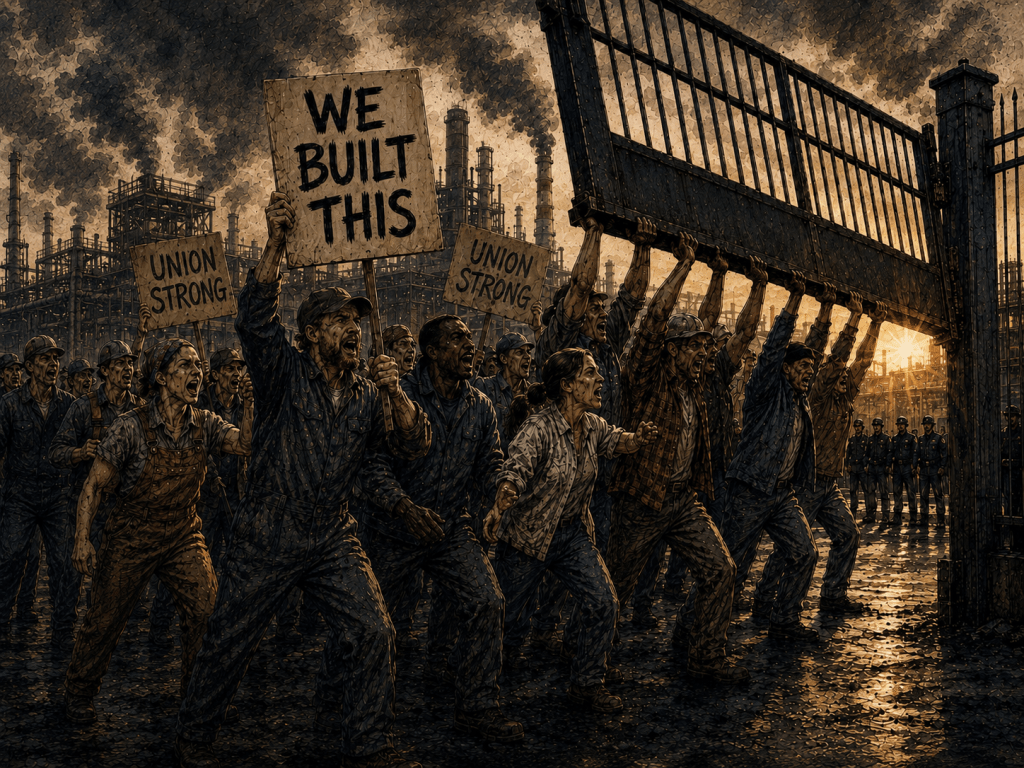
At seven in the morning on August 3, 1981, the air traffic controllers walked off the job. Almost thirteen thousand of them, out of a union of roughly seventeen thousand five hundred, went out over pay, hours, and the kind of working conditions you do not want the people watching the planes to have. Seven thousand flights were canceled that day.
About four hours later, President Reagan walked into the Rose Garden and read a sworn oath aloud — the affidavit every one of those workers had signed promising not to strike against the government. Then he gave them a number. Forty-eight hours. Come back inside two days or the job is gone. The union, PATCO, was one of the few that had endorsed him the year before.
On August 5, about thirteen hundred came back. The rest did not. The government fired eleven thousand three hundred forty-five air traffic controllers in a single stroke and banned every one of them from federal employment for life. Supervisors, military controllers, and the few who crossed kept the towers open while replacements were trained.
Here is the part that matters. It looked like a man reacting in the moment. It wasn’t. Years earlier, out of office, Reagan had sat down and written the whole thing out — the argument that public employees cannot strike, and that if they do, they are gone. The theory was on paper before the strike existed. The government can move hard and fast when it decides something matters. That August it decided, in the open, in front of everyone, that what mattered was the employer.
Twenty-four parts in, the picture doesn’t change. This is the part where the one tool that ever forced the people at the top to share the take got taken apart on purpose — not lost in an argument, but legislated, litigated, and starved down, the same playbook as Parts 21 and 23, just pointed at people this time instead of agencies.
The Union Boss Is The Part You’re Allowed To Be Angry About
The loud fight is the union boss. The dues. The Teamsters and the mob. The guy on your crew who can’t get fired no matter what he does. The transit strike that wrecked your week and had nothing to do with you. “Right to work,” sold to you as freedom, as if the alternative were being marched into a union at gunpoint. That fight is real, it runs every night, and it is almost never where the decision got made. What you are handed is the rot — some of it true, some of it ancient, all of it loud — and what you are kept from is the rule change. The argument about whether unions are corrupt and whether the strike was selfish runs forever, while the question of who quietly rewrote the rules so that organizing gets you fired and rarely gets you a contract does not get asked, because the people who would have to ask it have been pointed somewhere else for fifty years.
So the whole post is a contrast, and it holds the way the last several have. There is the fight you’re given — the crooked local, the lazy guy, the dues, the picket line that ruined your commute — and there is the thing underneath it: the one thing that ever kept your paycheck climbing along with what you actually produced got taken apart by rule changes you were never asked about, and the gap between what people make for the company and what the company pays them opens almost exactly when the teardown starts. From roughly 1948 to the late 1970s, pay and output went up together. Then they split, and they never came back. Since 1979 the economy has grown something like three and a half times faster than the typical paycheck. The work kept rising. The pay stopped following it. The first story is loud and on cable. The second is in a Senate that never voted, a Court that reversed itself, and a labor board left with no one to sign the rulings, if you go look for it.
And here is the door, held all the way open: you do not have to like unions, want to join one, or trust the guy running yours to follow any of this. A union electrician who has seen both the good and the rotten, a man in a right-to-work state who is dead certain the whole thing is a racket, a delivery driver who has been told a hundred times that he is his own boss, a small contractor who has been on both sides of the table — every one of them can read this straight through and stay exactly who they are. He is not wrong that some of them were crooked. He is not wrong that some of them protected dead weight. He has just been handed the rot and kept from the rule change. This isn’t a team you have to join. It’s a paycheck you’ve been kept from reading.
The last post ended on the obvious question. They keep telling you the cost of all of this is just the cost of doing business, that someone always has to carry it — so was there ever anything inside the system actually built to push back, one institution that, when it was strong, made the people doing the extracting carry their own bill? This is the answer. Yes. There was exactly one. It was a bunch of people at the same company agreeing to ask together instead of one at a time, and for about thirty years it worked well enough that ordinary pay rose in lockstep with what ordinary work produced. It wasn’t pretty and it wasn’t clean. It didn’t fail on its own either. Here is the fifty-year teardown.
Before the cases, the honest part, because the argument is worthless without it. The corruption was real. The Teamsters and the mob is history, not a smear, and the convictions happened; some locals ran no-show jobs and rigged hiring halls and the people who lived near that are not making it up. Some unions did protect bad work and dead rules, and the man who watched a useless coworker he couldn’t get rid of is not lying to you. Public-sector bargaining raises a genuinely hard question, because when the employer is the taxpayer, the person across the table partly helped elect the person on the other side, and a serious person can find that uncomfortable without being anyone’s stooge. Not every plant closed because of union-busting; automation and trade did real, brutal damage entirely on their own. A strike really can hurt regular people who had nothing to do with the fight. And “Big Labor” is also the favorite blanket of every person whose specific complaint folds the second anyone checks it. Concede all of it. The pattern is still the tell — because the thing that finished unions wasn’t losing an argument. It was changing the rules so the argument couldn’t be had.
And mostly the pattern is a consensus, and I’m not going to pretend it isn’t. The foundation is the Taft-Hartley Act of 1947, passed over President Truman’s veto — he called it a slave-labor bill — and it is the law that let states pass right-to-work in the first place. It has sat there, doing its work, under administrations of both parties ever since. The number of right-to-work states climbed for decades with help from both sides at the state level. The PATCO precedent from the top of this post was set by a Republican, and then a Democrat lifted the lifetime ban in 1993 and the new normal stood anyway, because the new normal was the point. The biggest pro-labor bill in two generations, the PRO Act, passed the House twice and never once got a vote on the Senate floor — not even in 2021 and 2022, when the party that wrote it held the House, the Senate, and the White House at the same time. Nobody filibustered it to death. It just never came up, because the votes were never quite there inside the party that campaigned on it. The structure is fifty years deep and bipartisan. There is no clean villain in it, and inventing one would be its own kind of lie.
One stretch is not symmetric, though, and pretending it is would be the opposite lie. In 2025 the long erosion stopped being a habit and became an operation. In January, the administration fired the National Labor Relations Board’s general counsel and removed a sitting board member, Gwynne Wilcox — the first board member fired in the agency’s ninety-year history — which dropped the board to two members and stripped it of the quorum it needs to decide anything at all. In May the Supreme Court, six to three, let the firing stand while the case ran. The board that is supposed to rule on whether you were illegally fired for organizing then sat unable to issue a single decision from January 2025 until January 2026, when the Senate finally confirmed two new members and a new general counsel — the general counsel a management-side lawyer, one of the new members straight from Boeing’s labor shop. In the same stretch the Labor Department stopped enforcing the 2024 rule that had made it harder to misclassify a worker as an independent contractor, and by February 2026 had formally proposed to erase it and go back to the version that makes misclassification easy. The structure is bipartisan and fifty years old. This last turn is one-sided and barely a year old. You have to say both, and let neither cover for the other.
One more thing belongs here, because it is why none of this needs a meeting. Nobody outlaws unions. There is no room where they vote to abolish the right to organize. The right is still right there in the 1935 statute, on the books, fully intact. What changed is everything around it: a state law that lets you take the contract without paying for it, a court ruling that does the same thing to every public worker at once, a penalty for firing an organizer that costs less than keeping the union out, a seat on the board left empty so the cases freeze. None of that requires a conspiracy you could expose. It is a stack of rule changes you could read, every one of them passed in daylight.
Nobody Outlawed The Union. They Changed The Rules Until It Couldn’t Win.
The cleanest way to see this is to walk it by how openly the government is choosing the employer, and how little the choice still bothers to dress itself up. The first one wears a full costume — the word “freedom” stamped right on it — and runs through ordinary state lawmaking. The second is a single afternoon in 1981 where the disguise barely existed and the lesson was the point. The third is a Supreme Court ruling that did to a whole sector in one stroke what the first one did state by state, wrapped in the First Amendment. The fourth wears nothing at all, because the move was simply to remove the referee and let the clock run. The thumb on the scale stops hiding as you go.
The first is right-to-work, and the cover story is the best brand name in American politics. Section 14(b) of the 1947 Taft-Hartley Act lets a state pass a law saying that even where a union has won an election and bargained a contract that covers everyone in the shop, no worker can be required to pay a cent toward it. Twenty-six states run one. Say it plainly and the trick falls out: the union is legally obligated to represent every worker in the unit, including the ones who pay nothing, so the rational move for any individual is to take the raise and the grievance protection for free and let someone else fund the lawyers and the organizers. Enough people do the rational thing and the dues dry up, and the thing that won the raise can no longer afford to win the next one. That is not a side effect anyone failed to foresee. The free rider is the design. Here is the tell. If right-to-work were really about a worker’s freedom and not about defunding the counterweight, repealing it would be easy and quiet. It is neither. Michigan repealed its law in 2023 — the first state to reverse one in roughly sixty years — and it took flipping the entire state government at the ballot box to do it. A dial that takes a once-in-six-decades political event to turn one notch back is not a freedom. It is a ratchet, and it only turns one way on its own.
The second is PATCO, the scene from the top of this post, and the disguise here is almost nothing, which is what makes it the cleanest demonstration in the set. The government fired eleven thousand three hundred forty-five workers in two days and banned them for life, fast, in public, with the President reading the oath into a microphone. The other case in this series where the government moved like that was the good kind — Part 23, where a starved agency could in fact be made to work the moment someone wanted it to. This is that same beat run in reverse: proof that the government can move hard and fast when it decides to, and a demonstration, broadcast on every network, of which side it would move that fast for. The lesson did not stay in the federal sector. Inside a few years private employers were breaking strikes by permanently replacing strikers the way the government just had, and the strike — the only real leverage a group of workers has ever had — quietly stopped being a thing most people dared to do. Nobody made permanent replacement mandatory. They just showed everyone it was allowed, at the highest possible volume, and let the fear do the rest. That is the tell: the firing was the message, and the message worked for forty years.
The third is Janus, and the costume is the Constitution, which is the thinnest one yet because it dresses a funding cut as a free-speech right. For forty years, under a 1977 precedent, public-sector unions could charge non-members a fair-share fee for the bargaining they were legally required to do on those non-members’ behalf. In 2018, in Janus v. AFSCME, the Supreme Court threw that out five to four, ruling that making a public worker pay anything toward the union that bargains his contract violates his First Amendment rights. Read what that actually did. In a single ruling it turned every teacher, firefighter, and city worker in the country into a potential free rider — the exact right-to-work mechanism from the first case, except imposed on the entire public sector at once, from the bench, no legislature required. The disguise is “speech.” The result is the dues math, run nationally, overnight. The tell is the timing of the certainty: a settlement that held without much controversy for forty years did not suddenly become unconstitutional. It became inconvenient, to people who had spent those decades getting the votes on the Court to say so.
The fourth wears no costume at all, which is why it is where this whole post has been heading. The labor board exists to enforce the right the 1935 law still guarantees — to run the elections, to rule on whether an employer broke the law by firing the organizers. In January 2025 the administration fired the board’s prosecutor and removed a member, and the board fell below the three it needs to decide anything. It then sat, frozen, for almost a full calendar year. Not abolished. Not stripped of its statute. Just unable to issue a ruling, because a seat was empty and stayed empty while the courts argued over whether the firing was legal, with the Supreme Court letting it stand in the meantime. An employer who fired an organizer in that year knew the case could not reach a decision. The misclassification fight is the same move on a different surface: whether a worker is an “employee” at all — which decides whether minimum wage, overtime, and the right to organize even apply to him — got switched, within months, from the 2024 rule that made misclassification harder back toward the rule that makes it easy, with a formal proposal to erase the harder rule entirely filed in February 2026. There is no cover story available for any of this. You do not strip the referee of the power to make calls because you think the calls are fair. You do it because you keep losing them. And the proof is not a ruling that went the employer’s way. It is the year with no rulings at all.
What’s Real
A few honest qualifications, because the strongest version of this is the one that doesn’t pretend the other side has nothing.
The thing worked when it was allowed to, and that cuts against the gloom as hard as it cuts against the skeptic. The reason ordinary pay tracked productivity for those three postwar decades was not luck and was not the natural generosity of employers. It was an economy that mostly kept employers hungry for workers, a minimum wage that actually went up, and about a third of the workforce able to bargain together. When that was deliberately wound down, pay and productivity split, and they have stayed split. Anyone telling you that organizing simply can’t move your paycheck anymore is selling you the same resignation the other side needs you to buy, and the thirty years before 1979 are the receipt that says otherwise.
The revival is real, and it also oversells if you push it too far. The 2023 strike wave was not a rumor: the autoworkers won raises of twenty-five percent and more over the contract, the deal dragged nonunion plants at Tesla and Volkswagen and Honda upward in its wake, election petitions to the labor board jumped sharply, and public approval of unions sits around seven in ten, the highest in roughly sixty years. That is real and worth saying plainly. But notice what carried those workers across: a historically tight labor market and a handful of high-profile fights that broke through, not a rule that made organizing reliably win. A good year is not a safeguard, and “it’s coming back” is not a design.
Some unions genuinely are sclerotic, or captured, or run for the people running them, and the honest version says so out loud. A local that defends a pointless work rule for thirty years because nothing ever forces the issue is a real failure, not a slander, and the member stuck paying for leadership that has stopped fighting for him is not imagining it. A serious person can hold all of that and still see the pattern, because the pattern was never “every union is good.” The pattern is who ends up holding the cost when the only counterweight is gone.
And almost all of the teardown was legal, which is the genuinely uncomfortable part. Taft-Hartley was an act of Congress. Right-to-work laws are state statutes, passed by elected legislatures. Janus was a Supreme Court decision. Removing a board member was a power the Court has now blessed. A company that fights an organizing drive to the very edge of the law, and an administration that lets a seat sit empty, are following the rules, not breaking them. That is exactly the problem, not the exception to it. When the legal, rational, by-the-book move is to make the counterweight unaffordable, “they should have played fair” is a wish, not an argument — and the thing to fix is the rule that made playing unfair the rational move.
One last honest note, on a number you have heard thrown around. People quote the union wage premium like a closing statement — union workers earn so many percent more than everyone else, full stop, as if the figure ends the conversation. It does not, and the strongest version of this says so. The raw federal numbers do show a large gap — in 2025 the typical nonunion worker’s weekly pay ran about eighty-four percent of the typical union member’s — but the government that publishes that figure says in the same breath that it controls for almost nothing: not industry, not occupation, not region, not skill. Serious economists fight about how much of the gap survives once you account for who ends up in union jobs in the first place, and the precise percentage genuinely oversells. Strip the slogan. The plain thing underneath it does not move: where workers can actually bargain together, they keep more of what they make, and the entire fifty-year fight has been over whether they are allowed to bargain together at all. You don’t need the exact number to notice that the people who profit from the gap are the ones who spent fifty years dismantling the only thing that ever closed it.
What They’re Paying For
So set what this actually produces against the fight you’re handed about union bosses. It is four things stacked together, and each one has a beneficiary you can name, which is the difference between this and yelling about “Big Labor.”
It is a paycheck quietly unhooked from the work that earns it. The beneficiary isn’t abstract. It is every employer and shareholder who kept the widening gap between what a worker produces and what a worker is paid — output per hour up roughly three and a half times typical pay since 1979 — because the one tool that ever forced that gap closed was taken off the table, rule by rule, and the silence cost them nothing and was worth almost everything.
And it is a free-rider engine handed to you with the word “freedom” stamped on the side. The beneficiary is every employer in the twenty-six right-to-work states, and every public employer after Janus, that gets the labor peace of a negotiated contract while the thing that negotiates it is starved of the dues it needs to function — the worker who hates the union still pockets the raise the union won, which is not the flaw in the design, it is the design.
And it is a referee pulled off the field with the clock running. The beneficiary is every employer who fires the organizer and waits it out, because the body that is supposed to make that illegal sat without a quorum for nearly a year, and even at full strength the worst it usually does is order a notice posted on the breakroom wall — a penalty smaller than the cost of the union, which makes breaking the law a line item instead of a risk.
And it is the question of whether you are even a worker, reopened on a timer. The beneficiary is the platforms that spent two hundred million dollars writing a single state ballot measure so the word “employee” would not reach them, and the political actors who suspended the rule that made misclassification harder and then went on the surviving networks to be asked, gently, about the price of a delivered sandwich. That is the bill the fight about union bosses has been keeping you from reading.
The Fixes Are Boring
The fixes are structural, not slogans, and the popular ones are mostly traps. “Just pass the PRO Act and it’s solved” is the loudest of them, and whatever you think of the bill, it is the single piece of labor legislation that has never once cleared a Senate — not even when the party that wrote it held everything — so betting the whole movement on the one law that has never passed is a way to lose for another decade while the seat on the board sits empty right now; it polls in some rooms, changes nothing about the existing machinery, and hands the other side a maximalist target to point at so the boring fixes never get a hearing. “Unions are obsolete, let the market handle it” is the other one, the populist version, and it is simply the sabotage finishing its own job out loud and calling the wreckage proof. Several of these are things the country actually had and then loosened. Roughly cheapest and most immediate to genuinely hard:
- Make the penalty for firing an organizer actually hurt, fast, and land on the person who ordered it. Liquidated damages, real civil penalties, and personal liability for the executives who sign off, not back pay minus other earnings two years later. The toothless version is on the record: for years the worst the board could do to a company that illegally fired union supporters was order it to post a notice promising not to do it again.
- Put board-member removal protection back in the statute with teeth, so the referee can’t be taken off the field to freeze the game. A labor board that can be dropped below a quorum by removing one member is a board the next administration can switch off at will. The diluted version is current events: the board sat unable to issue a single decision from January 2025 to January 2026 because one member was removed and the seat left empty while the courts argued.
- Put hard statutory deadlines on representation cases, with recognition if the employer runs out the clock. Delay is the cheapest union-buster there is; make stalling lose instead of win. The rigged version is the documented norm: an employer can appeal an administrative law judge’s ruling and stall the process more or less indefinitely, which is precisely why they do it.
- Repeal Section 14(b) and end the federal permission slip for the free-rider design. If a contract covers you, you pay for the contract; “freedom” that means free-ride only starves the thing that got you the raise. The rigged version is on the books in twenty-six states, and the one state that reversed it, Michigan in 2023, had to flip its entire government at the ballot box to manage it once in sixty years.
- Restore by statute the fair-share arrangement Janus blew up for the public sector. One five-to-four ruling turned every public worker in the country into a potential free rider and reversed a settlement that had held for forty years; legislate the floor back where a court erased it. The watered-down version already ran: the 2018 decision stands, and the entire public-sector fee question now turns on how one Court reads the First Amendment.
- Make worker classification a hard line in the statute, not an agency rule that flips every four years. Whether you are an “employee” decides whether the minimum wage, overtime, and the right to organize apply to you at all; that cannot be a coin that lands differently with each administration. The rigged version is recent history: the 2024 rule that made misclassification harder was suspended within months and formally proposed for erasure in February 2026, with a two-hundred-million-dollar ballot-measure template sitting there as the model.
- Rebalance the organizing fight itself — the captive-audience meeting, the avoidance-consultant industry, the whole legal asymmetry — and yes, this is the hard one. If the law lets an employer hold mandatory anti-union meetings on the clock, hire a hundred-million-dollar avoidance industry, and face penalties smaller than the cost of a contract, the only fix that reaches the root is structurally evening the contest, and the line-drawing there is genuinely contestable and the firms it touches will fight it hardest. It is last because it is the genuinely hard one. Saying that plainly is better than pretending the list is all easy.
Six of those seven are a statute, an appropriation, or an enforcement choice — things a Congress or an administration could do without inventing anything new, several of them just by undoing a loosening from the last few years. The seventh is the genuinely hard one, and it is more honest to say so than to pretend otherwise. None of them is the radical position. The radical position, measured against the simple idea that a group of people at the same company should be allowed to ask together instead of one at a time, is the one we’re already living in: break the strike in the open, starve the dues by statute, leave the board with no one to sign the ruling, and reopen the question of who even counts as a worker every four years until the law no longer reaches him.
Who Is This For
Twenty-four parts in, you’ve now watched the public thing get broken on purpose, the room where you’d have heard about it get emptied, the pipe that was left get paid to look away, the proof that any of it could work get deleted in the dark, and the bill for all of it mailed downstream to people who can’t vote on it because they aren’t here yet — and now the one institution that, when it was strong, actually made the people doing the extracting carry their own bill, taken apart on purpose, the same playbook as the agencies, just pointed at people. That is where this series stops describing the machine. Which leaves the question it has been walking toward the whole time: if the squeeze runs through every system and the one thing that ever pushed back is gone, what is actually left to do — and what do most people, across the whole tired argument, already agree on? That’s the next post. Part 25 is The Bottom 90% Agenda — not a manifesto, a short list of what most people already agree on across party lines, and what changes if we stop being pointed at each other and start asking together. Different layer. Same question.
 Even that's Odd
Leave a comment