
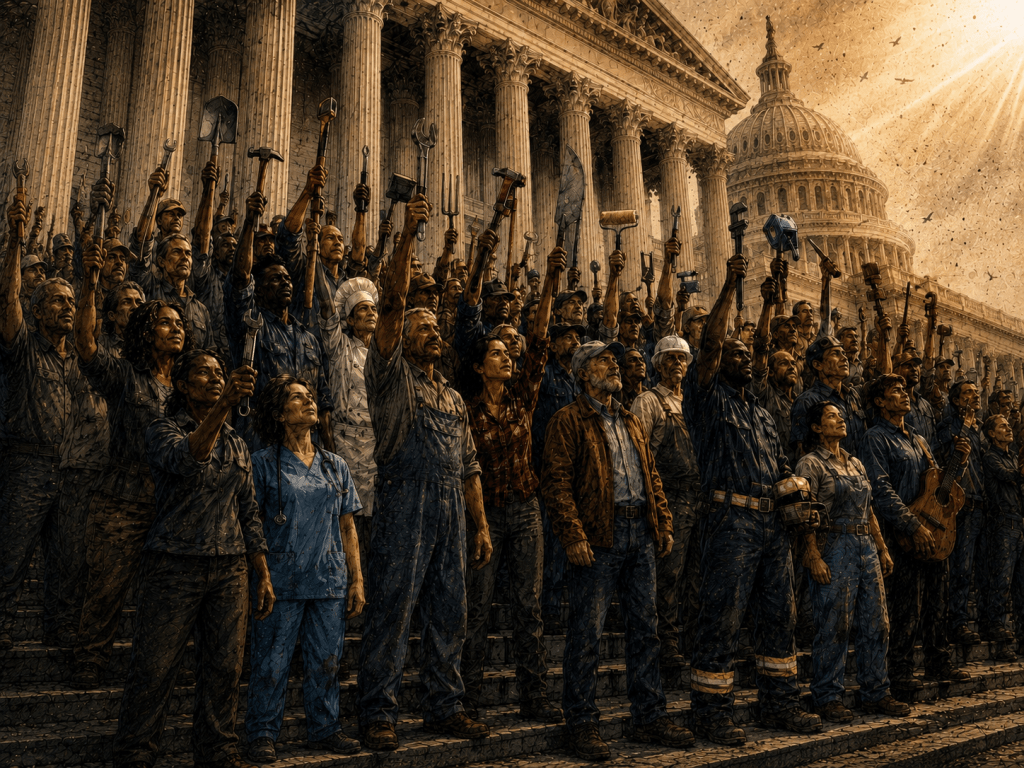
On September 3, 2025, a bunch of people who do not agree with each other about anything stood on a stage in the Capitol and unveiled a bill. The lineup was the tell. A Texas Republican from the hard right. A Rhode Island Democrat. Alexandria Ocasio-Cortez fist-bumped a Tennessee Republican from the Freedom Caucus on her way to the microphone. A swing-district Republican from Pennsylvania looked out at the press and said the smirking in the room was a good thing — it meant nobody could believe these particular people were standing together.
The bill was a flat ban on members of Congress owning or trading individual stocks. By then it had more than eighty cosponsors from both parties. A Senate committee had already approved its own bipartisan version that July. The thing polls at a level almost nothing in American life reaches: in a deep survey by the University of Maryland’s Program for Public Consultation, eighty-six percent of Americans wanted it — eighty-seven percent of Republicans, eighty-eight percent of Democrats. There is no real argument out in the country. There is barely a fight to have.
It did not get a vote. The Senate majority leader noted that some members had concerns and did not schedule it. By winter there were two competing petitions to force the thing onto the House floor, and they were built so neither could succeed: one drew Republicans and Democrats but stalled short of the signatures it needed, while the other, filed by Democratic leadership, was loaded with a piece extending the ban to the president and vice president — the exact addition that guaranteed not one Republican would sign it. A committee, meanwhile, advanced a separate version on a party-line vote that let members keep the stocks they already owned. Years of attention, multiple bills, repeated public promises from leaders of both parties that the practice should stop, and the structural outcome every time was motion without a vote.
Here is the part that matters. The bill did not die because the public is split — the public is about as unsplit as the public ever gets. It did not die because nobody wrote it — it has been written, in bipartisan ink, over and over. It died because the only people who lose if it passes are the same people who decide whether it gets a vote. Nobody had to vote it down. They just never had to let it come up.
Twenty-five parts in. This is the part where the picture finally changes — and not because the machine got weaker. It’s the part where the thing they spent twenty-four parts keeping out of your hands turns out to be this: you and the person across the aisle you’ve been taught you can’t stand already want most of the same things, and the only people who lose if you figure that out are the ones who have been paying for you not to.
The Team Jersey Is The Part You’re Allowed To Keep
The loud fight is the jersey. Left versus right, red versus blue, the forever food fight that runs every night on every channel: the bathroom, the border, the flag, the pronoun, the thing your cousin posted, the thing the other side’s anchor said. That fight is real, plenty of it matters to the people in it, and it is almost never where the decision got made. What you are handed is the team. What you are kept from is the list. The argument about which side is the whole problem runs forever, loud, while the question of what you and the people on the other team already both want — and who spends real money making sure you never find out you agree — does not get asked, because the people who would have to ask it are the ones selling the jerseys.
So the whole post is a contrast, and it holds the way the last several have. There is the fight you’re given — your team against their team, the thing on cable, the thing that makes you feel like the other half of the country is the enemy — and there is the thing underneath it: a short list of concrete stuff that big majorities on both sides of that line already want, that never gets done, and not because the country is divided about it. It never gets done because the people it would cost fund both jerseys at once. That is Part 12, the consensus you’re not supposed to notice, said one more time and for the last time: the parties stage the fight you’re allowed to have so the agreement you’re not supposed to notice never gets organized around. The first thing is loud and on television. The second is in poll crosstabs and bill numbers and a committee vote that never reached the floor, if you go look for it.
And here is the door, held all the way open, and for the last time in this series I want to hold it wider than I ever have. You do not have to give up one single thing you believe to want what is on this list. Keep your guns. Keep your church. Keep your guy, your party, your vote, your read on every culture-war fight in the country. The list is not asking you to switch teams or admit yours is wrong about anything. It is pointing at the handful of things your team and the other one already agree on, out loud, by enormous margins, and never get. The guy who is dead certain the other side is the entire problem is not being asked to stop thinking that. He is being asked to notice that he and the person he can’t stand both want their drug prices down and both think the place is bought, and to ask who benefits from him never noticing.
The last post ended on the question this whole series has been walking toward. The one counterweight that ever forced the people at the top to share the take got taken apart on purpose, so what is actually left to do — and what do most people, across the whole tired argument, already agree on? This is the answer. Yes, there is a list. Here it is. And here is what changes if people organize around the list instead of around the jersey, because organizing around something is the one tool the last post said still works — not a slogan, not a savior, the slow boring thing the 2023 strike wave proved still has a pulse.
Before the list, the honest part, because the argument is worthless without it — and this is the most important concession in the whole series, so I am going to make it as hard as I can. “Most people already agree, if we’d just unite we’d win” is the laziest sentence in American politics. It is what every cheap populist reaches for. This series spent twenty-four parts specifically refusing to make that move, because it is usually a lie told with one push poll and a feeling. So it only counts here if it comes with receipts: real, current, dated, cross-party numbers, and the paper trail of the thing dying or getting clawed back anyway. And even then, concede the rest of it plainly. Agreement is not power. A poll is not a movement. A landslide in a survey is not a landslide at the ballot box, because the survey is not what is on the ballot — the wording is, and the people who pick the wording are not on your side. The list is arguable at the edges. A couple of these carry real tradeoffs, and the people on the other side of those tradeoffs are not all stooges. Hold all of that in your head at once. The list still stands, and here is why.
Nobody Rigged The Poll. They Just Rigged What Gets A Vote.
This is the agenda. It is short on purpose. Every item is a thing big majorities of both parties say they want, with a date and a source, followed by the receipt: it didn’t happen, or it passed and got pulled back out. The thing standing in the way is never one party. It is the donor consensus from Part 12, the alignment that funds both jerseys at once. A Trump voter and a Bernie voter should each find three things here they want and one they’d fight over. That is not a bug in the list. That is the list working.
- Bring drug prices down — let Medicare negotiate, and cap what people pay at the counter. About eight and a half in ten Americans support letting the government negotiate Medicare drug prices — ninety percent of Democrats, eighty-seven percent of independents, seventy-nine percent of Republicans, in KFF’s tracking poll, and the number barely moves after people hear both sides argue it. Roughly three-quarters want the thirty-five-dollar insulin cap and the out-of-pocket ceiling extended past Medicare to everyone. The receipt: in 2022 a thirty-five-dollar insulin cap for people on private insurance was written into law, then pulled back out. A majority of the Senate — fifty-seven votes — voted to keep it. It came out anyway, because a procedural ruling meant a thing most of the country wanted needed sixty votes instead of fifty-one, and the consensus that funds both parties was happy to leave that rule exactly where it was. The cap almost nobody disagreed with is the cap almost nobody knows got deleted.
- Stop members of Congress from trading individual stocks. Eighty-six percent want it — eighty-seven percent of Republicans, eighty-eight percent of Democrats. The receipt is the one from the top of this post: bipartisan bills, eighty-plus cosponsors, a committee approval, and no floor vote, because the version with the votes to pass kept getting buried under poison pills and the Speaker would not schedule it while the committee quietly advanced a softer one that let members keep what they already owned. Eighty-seven percent of Republicans want the ban and the Republican-run committee gutted it; the Democratic leadership that swears it supports a ban filed the petition engineered so no Republican could ever sign. There is no public argument here at all. There is only the fact that the people who would have to give up the trades are the same people who decide what reaches the floor, and both teams’ leadership proved it in the same winter.
- Get the big money out — the system is bought, and almost everyone can see it. About seven in ten Americans say there is too much money in politics; in a 2026 Politico poll only five percent disagreed, and it split barely at all — eighty percent of one election’s voters, seventy-seven percent of the other’s. Roughly eight in ten say large donor and corporate spending in elections is corruption or looks like it, Republicans and Democrats alike. The receipt: the 2010 ruling that opened the spigot still stands, the bill written to claw back disclosure passed the House and died in the Senate, and twenty-three states have formally asked for a constitutional amendment that Congress has simply never moved. This is not a close call in the country. It is a closed door in the building.
- Make the very wealthy pay some floor. Across more than fifty-five national and state polls, a billionaire income tax averaged two-thirds support — eighty-four percent of Democrats, sixty-four percent of independents, and a bare majority of Republicans. The Republican number on this one is real but it is thinner than the others, and that is worth saying out loud rather than rounding up. The receipt is cleaner than the polling anyway. The carried-interest provision — the thing that lets some fund managers pay a lower rate than the people who work for them — has been called out by candidates of both parties for about twenty years, including a presidential promise to kill it. It has survived every major tax bill written by either party, untouched again in 2025. Two decades, both parties in power at various points, one loophole, still there.
- Term and age limits, and an end to lifetime court seats. About eight in ten Americans back age caps and term limits for Congress — near nine in ten Republicans, more than three-quarters of Democrats, in a 2026 NPR/PBS/Marist poll. Three-quarters want term limits for Supreme Court justices: eighty-five percent of Democrats, sixty-seven percent of Republicans. This is the Part 13 callback. The receipt is structural and bipartisan in the worst way: a term-limits resolution sat with a hundred-plus House cosponsors and never got a floor vote, the court-term-limit bills die in committee under both parties, and the one ruling that says congressional limits need a constitutional amendment is treated as a reason to never start rather than a thing to start.
- Guarantee paid family leave. The United States is the only industrialized country on earth without a national paid-leave policy; about fifteen percent of workers get a real one through a job. Roughly three-quarters of the country wants a national program — ninety percent of Democrats and a clear majority of Republicans, in poll after poll going back years. The receipt: the 1993 family-leave law guarantees only the unpaid kind, the comprehensive bill has been reintroduced for years and never moves, and the bipartisan working groups produce bills that get referred to committee and stop. Thirty years of agreement, still unpaid.
- Loosen the two-party lock on the ballot. The disease polls enormous: large bipartisan majorities call partisan gerrymandering a major problem and feel the duopoly is rigged against anything outside it. The cure is where this one gets honest. The specific fixes — ranked or approval voting, open primaries, independent maps — do not poll like the insulin stuff; several ballot measures for them lost in 2024, nineteen states have banned ranked-choice voting outright, and even the reformers split over which fix is the right one. It earns a spot because the agreement that the game is rigged toward two teams is real and huge. It gets the asterisk because the agreement is on the problem, not yet on the answer. That gap is the difference between a receipt and a wish, and the other six lines are receipts.
Every line says the same thing. This is not close. People want it. It does not happen. Now ask why, and notice that the answer is never “the country couldn’t agree.”
What’s Real
A few honest qualifications, because the strongest version of this is the one that doesn’t pretend the other side has nothing.
Agreement on the goal is not agreement on the method, and the post must not pretend a poll number is a policy. Eight in ten people wanting drug prices down is not eight in ten people agreeing on how, and the how is where the real fight lives and where it should live. The list is a floor, not the whole building. It is the stuff that is so obviously wanted that its absence is the clean proof of the rig — it is not a governing program, and anyone who tells you a list of seven popular things runs a country is selling the same easy thing this series exists to refuse.
A couple of these are genuinely harder than the poll makes them look, and the honest version names them instead of hiding them in the footnotes. Drug-price negotiation has a real argument on the other side about what it does to the money that funds new medicine, and the serious people who raise it are not all pharma shills. Term limits really do throw away institutional knowledge along with the entrenchment, and a thoughtful person can want the second without loving the first. Paid leave lands hardest on the smallest employers, and “how do you pay for it without crushing the corner business” is a real question, not a dodge. The billionaire-tax item, as I flagged in the list itself, has the softest cross-party number on it. None of that unmakes the pattern. It just means the pattern is the tell, not the whole map.
And the hardest concession of all: organizing around a list is slow, unglamorous, and mostly fails. “If the bottom ninety percent just united, we’d be unstoppable” is itself a thing people sell you, usually right before they sell you the savior who is going to do the uniting. There is no savior in this and there is no fast version. Most of the times people have tried this it fizzled. The 2023 strike wave that the last post leaned on was real and it was also riding a once-in-a-generation labor market, not a switch anyone gets to flip. A poll is not a movement. Knowing the agreement exists is the first inch of a long, dull, unfinished thing, and the dullness is not a flaw in the argument. It is the argument. The exciting version is the jersey. The boring version is the list.
One last honest note, on a number. People wave around “Medicare for All polls at sixty-something percent” the way other people wave the social cost of carbon — like the figure ends the conversation. It does not, and the strongest version says so out loud. That number swings twenty points the second you change three words of the question; ask it with the word “socialized” and watch it fall, ask it about a “choice” and watch it climb. The slogan is soft on purpose, on both sides. Strip the slogan. The plain thing underneath it does not move at all: across every party, year after year, after every argument, people want their drug prices down and think the system is bought. You do not need the bumper sticker. The thing it is glued to is the part that never wobbles, and it is the part they most need you to never test.
What They’re Paying For
So set what the misdirection actually produces against the fight you’re handed about the other team. The culture war is not a side effect of all this. It is the product. It is four things stacked together, and each one has a beneficiary you can name, which is the difference between this and yelling about “the media” or “the politicians.”
It is a country kept too busy fighting itself to organize around anything on that list. The beneficiary isn’t abstract. It is every interest that would have to pay if the seven items happened — the drugmaker, the fund manager, the donor whose access is the whole point — getting, for free, a public that spends its political energy on the one set of fights that threatens none of them, exactly as Part 14 laid out. The fight is not a distraction from the extraction. It is the fence around it.
And it is a permission slip for the people who decide what gets a vote. The beneficiary is every incumbent of either party who gets to run on the popular thing forever and never has to deliver it, because the jersey fight supplies an endless excuse — the other team — for why the thing eighty-six percent of the country wants somehow never reaches the floor. The misdirection is what lets “we couldn’t get it done” survive next to “almost everyone wants it.”
And it is a market. The beneficiary is everyone who sells the fight itself — the channels, the feeds, the consultants, the people whose revenue is your certainty that the other half of the country is the enemy — the same machinery Part 22 already showed you, pointed now at the only product that never runs out, which is grievance against your neighbor.
And it is the cheapest insurance policy ever written. The beneficiary is the donor consensus from Part 12, which never has to win the argument about drug prices or stock trades or who pays what, because the argument never gets had — it gets replaced, every single night, with the jersey. That is the bill the fight about the jersey has been keeping you from reading.
Who Is This For
Twenty-five parts in, you have now watched the public thing get broken on purpose, the room where you’d have heard about it get emptied, the pipe that was left get paid to look away, the proof that any of it could work get deleted in the dark, the bill for all of it mailed downstream to people who can’t vote because they aren’t here yet, and the one counterweight that ever made the extractors carry their own bill taken apart rule by rule. That was the diagnosis, and it was the same diagnosis every time, just pointed at a different system.
This is where it stops. Not with a candidate, because no candidate is the answer and the search for one is part of the trap. Not with a party, because the alignment that matters runs through both of them. Not with this post, which is just words, and which changes nothing by being read. The way out is the boring thing the last post already named, and it is the only thing on offer: people noticing that the agreement is real, that it is enormous, that it crosses the line they were taught not to cross — and then doing the slow, unsexy, mostly-thankless work of organizing around the list instead of around the jersey. It has worked before. It works when people don’t quit. It is not fast and it is not guaranteed and it is the only tool that has ever once moved any of this.
You were handed the fight on purpose, so you would never get around to the list. The list has been here the whole time. You already agree with the person you were told you couldn’t stand about more of it than either of you has been allowed to notice. That is not the end of the argument. It is the first thing that was ever true enough to start one. So that is the series. Read Part 3 if you only have time for the money, read Part 12 if you only have time for the trick, and then put the thing down and go find one person on the other team and one item off that list, and start there. There is no Part 26. There was never going to be. There is just the list, and the people who have it, and what they decide to do now that they know they are not nearly as alone as they were paid to believe.


Leave a Reply