
Spring-Summer 2008
With our house design settled, we needed the actual, you know, land to put it on.
The Land Hunt
Finding land was actually easier than finding an existing house, probably because land doesn’t have a leaky roof that sellers are trying to hide with strategic bucket placement.
We found a property that checked most of our boxes:
- Over 5 acres (our requirement – actually 14+ acres total)
- As large a piece of property as we could afford
- Commutable to NYC
- Rural but not remote
- Within budget
- Open field for the house site
- Room for a future barn
The property was actually 14+ acres total, but divided into three separate pieces of land: a long skinny piece, then a county road (not ours), then our main field where the house would go (about 5 acres), then the aqueduct (not ours), then the back lot. So we owned three disconnected parcels totaling 14+ acres. Not ideal to have your property chopped up by a road and aqueduct running through it, but it was the largest affordable property we could find that met our requirements.
We knew about this going in. We planned for it. Jennifer wanted the land, and I thought we could make it work, so we bought it.
What We Got Right: Planning
Unlike many of our later decisions, we actually planned the land use pretty well:
The house site: We built in an open field. No trees to clear, no major grading issues for the building site itself. Clean slate.
The barn location: We planned where the barn would go (we’d build it 2 years later). Not perfectly, but we accounted for it.
The back lot: There was an old farm path over the aqueduct to our back 2 acres. We cleared and improved it ourselves. I used my friend/builder’s bulldozer to make it easier. DIY land management—one thing we got right.
Sun exposure: The house site had no trees blocking sun from the south. Perfect for passive solar, right? (Spoiler: this became a problem later—no shade, porch too small, but that’s a story for another post.)
The Survey Situation
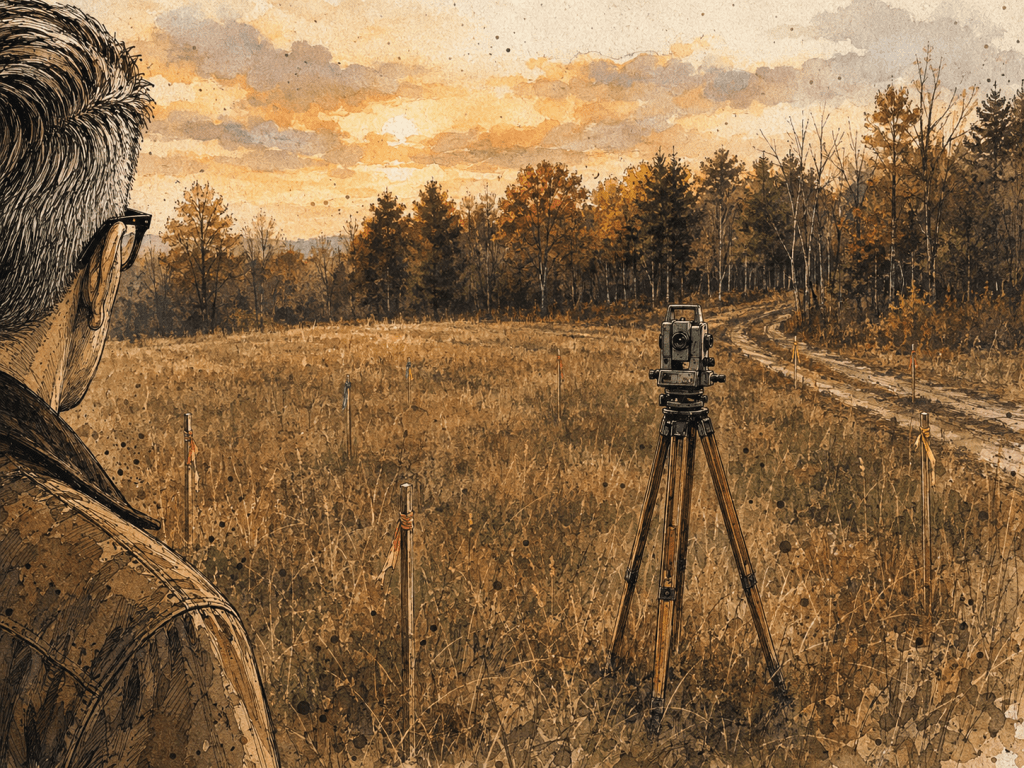
Before you close on land, you need a survey. This seems obvious in retrospect, but at the time I was like “Do we really need to pay someone to tell us where the property lines are?”
Yes. You absolutely do.
Ours revealed:
- The exact property boundaries (not always where you think they are)
- Easements we needed to know about
- The aqueduct situation and restrictions
- Where the county’s jurisdiction ended and ours began
- That we’d need approval to cut a driveway from the county road
We got title insurance. We filed all the paperwork. We tried to look like people who knew what they were doing.
For once, we actually did know what we were doing.
The Driveway Dilemma
Here’s something they don’t tell you when you buy vacant land: you need permission to cut a driveway onto a public road. It’s not your road, even if it fronts your property.
We needed approval from the county to create our driveway entrance. Fine, makes sense.
There was already an entrance cut for an easement on the property, but we needed the utility company to move a pole before we could use that entrance properly.
Utility companies move poles on their schedule, not yours. Their schedule was “eventually, maybe, we’ll get to it.”
We couldn’t wait for “eventually” because Connor Homes was ready to deliver our house kit, and we needed a way to get materials to the house site.
So we did what seemed reasonable at the time: we cut a temporary driveway in a different spot.
The Temporary Driveway Problem (Our One Big Land Mistake)
Nothing is more permanent than a temporary solution.
We cut a temporary driveway to get materials in while waiting for the utility company. The plan was to:
- Use temp driveway during construction
- Wait for pole to move
- Use real entrance
- Fill in temp driveway
- Restore that area
What actually happened:
- Used temp driveway
- Pole moved… eventually
- Temp driveway was already established and functional
- Money needed elsewhere
- Temp driveway is now permanent driveway
That temporary driveway cost us money twice: once to build it, and again because materials and base were in the ground where we eventually wanted lawn.
Don’t build anything “temporary” during construction. Either do it right or don’t do it at all. You’ll never have the time, energy, or budget to undo it later.
This was our one major land planning mistake, and we’re still living with it 15+ years later.
Topsoil and Grading: The Expensive Reality
When they cleared the site and cut the driveways, topsoil management became critical.
What we did right: We saved the topsoil. We had them pile it, tried to protect it, planned to use it for final grading.
What we underestimated: How much topsoil we’d actually need, and what proper grading would really cost.
Topsoil is the good dirt—the dark, rich, organic layer that actually grows things. It costs real money.
Subsoil is the junk underneath—clay, stones, sadness. You can’t grow grass in pure subsoil.
We saved topsoil, but it wasn’t enough. To actually fix the grading properly—to eliminate wet spots in the lawn, to get proper drainage everywhere, to make everything perfect—we would have needed to bring in thousands of dollars worth of additional materials.
We didn’t have thousands of dollars. We had a budget that was already hemorrhaging money on things Jennifer cared about more than perfect grading.
What we should have done: Budgeted an additional $5,000-7,000 for topsoil and final grading materials.
What we actually did: Used what we saved, made do, and now have some areas where drainage isn’t perfect and grass struggles. It works. It’s not perfect. But perfect would have cost money we needed for other things.
The Crash Timing: Lucky on Land
We bought in 2008, right at the peak before the economic crash. Terrible timing for real estate.
But we got lucky: we bought land, not a house. Land values dropped much less than house values in the crash. If we’d bought an existing house at peak prices, we’d have been underwater immediately.
The land held its value relatively well. One of the few things that worked out in our favor timing-wise.
The Driveway Surface
For the driveway base and surface, we used local materials:
- Ground cloth underneath (critical for clay soil—keeps base from sinking into the ground)
- Local shale for the base
- Crushed shale on top
- Eventually added item #4 and stone dust for the surface
The ground cloth was essential. Without it, the driveway base would have just slowly disappeared into our clay soil over time.
We should have invested more in the surface materials initially, but again: budget. We added better surface materials over time as money allowed.
Grade: B+. Good planning overall—survey, site selection, barn location, back-lot access, ground cloth under the driveway. One persistent regret: the “temporary” driveway that became permanent and still bugs me 15+ years later. Topsoil budget came up short, so some wet spots in the lawn are the price of perfect-was-not-in-the-budget. Big things right; small things imperfect.
Next up: Part 4 — Septic Systems and Well Disasters. In which we learn that clay soil is God’s way of saying “this will be expensive,” and that fracking a well has consequences.
 Even that's Odd
Leave a comment