
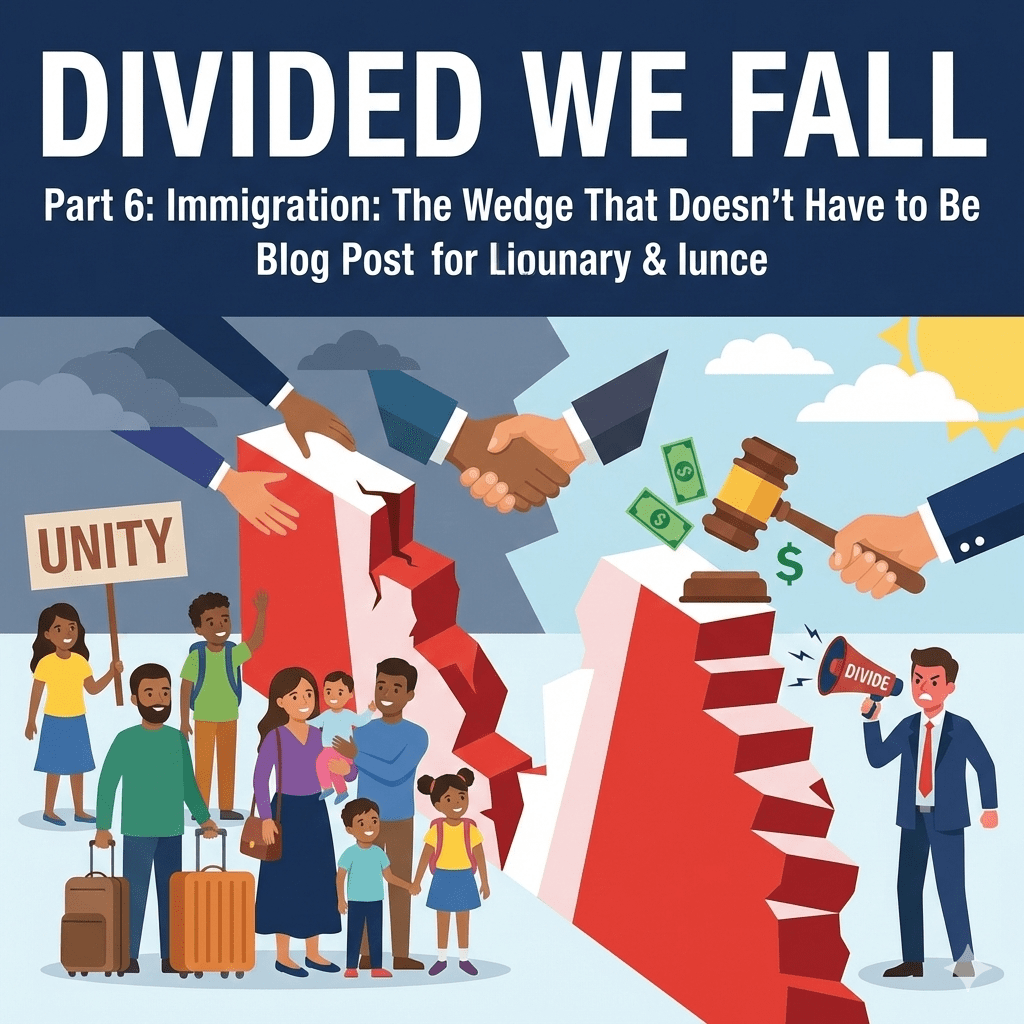
Facts, Myths, and Solutions Beyond the Culture War
For eventhatsodd.com – What Is Wrong With Us?
No issue in American politics generates more heat and less light than immigration. Every election cycle, we’re told it’s a crisis. Caravans are invading. Criminals are pouring across the border. Or alternatively, we’re told that opposing illegal immigration is racist, that borders are immoral, that everyone deserves to come here. The truth, as usual, is far more complicated and far less dramatic than either narrative suggests.
Here’s what’s actually true: Immigration is neither the existential threat conservatives claim nor the pure economic benefit progressives sometimes suggest. The people crossing the border illegally aren’t mostly criminals or welfare seekers, but they’re also not all desperate refugees fleeing for their lives. There are real costs and real benefits. There are legitimate concerns and bad-faith fear-mongering. And there are actual solutions that both parties refuse to implement because the issue is more valuable as a weapon than as a problem to solve.
Let’s cut through the noise and look at what we actually know.
Who’s Actually Coming and Why
The question “Would someone living comfortably go through that difficult journey?” answers itself. Of course not. The journey to cross illegally into the United States is brutal, dangerous, and expensive. People pay thousands of dollars to smugglers. They risk assault, robbery, rape, and death. They leave everything they know behind with no guarantee of success.
Nobody does this on a whim. Nobody does this because they heard America has generous welfare benefits. The data is clear on who’s coming and why:
Economic desperation is the primary driver. The vast majority of people crossing the southern border illegally come from Central America, particularly Guatemala, Honduras, and El Salvador—countries with crushing poverty, few job opportunities, and wages that can’t support a family. A farm worker in rural Guatemala might earn $3-5 per day. The same person doing agricultural work in the U.S., even paid under the table, can earn $60-80 per day. That’s not a marginal difference—it’s the difference between your children eating or going hungry.
Violence and instability compound the push. Many Central American communities are controlled by gangs that extort businesses, recruit children, and murder those who resist. Police and government are often corrupt or powerless. Parents watch their teenage sons get pressured to join gangs and their daughters face sexual violence. When staying means watching your children die or be recruited into criminal organizations, the calculation changes.
Family reunification drives continued migration. Once someone successfully migrates and establishes themselves, they often work to bring family members. This creates migration networks. A man who crossed in 2010 and found stable work might help his brother cross in 2015, who helps a cousin in 2020. This isn’t nefarious—it’s how humans have migrated throughout history.
Climate change is becoming a factor. Prolonged droughts in Central America have destroyed subsistence farming in regions that depended on it. When crops fail for multiple years and there’s no social safety net, people move or starve. This will only intensify.
The conservative narrative that migrants are criminals or welfare seekers doesn’t match the data. Study after study shows that immigrants, including those here illegally, commit crimes at lower rates than native-born citizens. They’re also ineligible for most federal benefits and pay billions in taxes they’ll never see returned through Social Security or Medicare. The typical unauthorized immigrant is someone who works hard, keeps their head down, and tries not to attract attention—because deportation means losing everything they’ve built.
How “Illegal” Status Benefits Corporations
Here’s what often gets left out of the immigration debate: the current system works exactly as designed for certain powerful interests. By making legal immigration nearly impossible while rarely prosecuting employers who hire undocumented workers, we’ve created a permanent underclass of exploitable labor.
This isn’t an accident. It’s a feature.
Agriculture: Between 50-70% of farmworkers in the United States are undocumented. They work long hours in difficult conditions, often for below minimum wage. They can’t complain about wage theft, unsafe working conditions, or lack of overtime pay—because complaining means risking deportation. They can’t unionize. They can’t report violations. The result: food prices stay low, corporate farms profit, and workers have no recourse.
Construction: About 15% of construction workers are undocumented. Wage theft is common in the industry. Dangerous conditions go unreported. Workers who get injured have no workers’ compensation. Contractors profit from paying below-market wages to workers who can’t complain without risking everything.
Food service: Restaurants and food service depend heavily on undocumented labor. Below-minimum-wage pay is common. No benefits. No overtime. No sick days. Workers who complain get fired or reported. The industry profits from a workforce that has no legal protections.
The pattern is clear: maintain “illegal” status, benefit from cheap and exploitable labor, blame immigrants for “taking jobs,” never prosecute the employers who create the demand.
Between 2008 and 2018, ICE conducted roughly 6,000 workplace raids and investigations. Thousands of workers were arrested and deported. How many employers were criminally prosecuted? Eleven. Not eleven thousand. Eleven total. The system punishes desperate workers while protecting the businesses that profit from exploiting them.
The Wage Suppression Myth
You’ve heard the claim: “Immigrants lower wages and take American jobs.” There’s a kernel of truth here, but it’s being deliberately misdirected.
Immigrants don’t lower wages. Employer exploitation lowers wages.
Here’s how it actually works: Businesses choose to hire undocumented workers at below-market wages because those workers can’t report violations without risking deportation. The business could hire American workers at fair wages with legal protections. They choose not to because exploitation is more profitable.
The problem isn’t that immigrants exist. The problem is that we’ve created a system where “illegal” status makes people exploitable, which creates downward pressure on wages for everyone. American workers and immigrant workers are both being screwed by the same employers.
There’s a solution that would help both American workers and immigrants:
• Make it easy for people to work legally with full labor protections
• Actually prosecute employers who exploit undocumented workers
• Enforce labor laws for everyone regardless of status
• Allow all workers to unionize without fear
• Create a clear pathway to citizenship for people already here
This would eliminate the exploitable underclass, force employers to pay fair wages, and protect all workers. Which is exactly why it doesn’t happen. Businesses profit from the current system. Both parties take money from those businesses. And it’s easier to blame immigrants than to hold employers accountable.
The Economic Reality: Costs and Benefits
The question “Do illegal immigrants cost taxpayers money?” has a frustratingly accurate answer: it depends on how you count, what timeframe you use, and which level of government you’re talking about.
The costs are real and localized. Unauthorized immigrants use public services. Their children attend public schools. They use emergency rooms for healthcare since they can’t access regular insurance. Some receive benefits through their U.S.-born children who are citizens. These costs fall heavily on state and local governments, particularly in border states and major destination cities.
A 2017 study by the Federation for American Immigration Reform, a restrictionist organization, estimated that illegal immigration costs federal, state, and local governments about $116 billion annually, with state and local governments bearing most of the burden. But this analysis has been criticized for inflating costs and ignoring economic contributions.
The economic contributions are also real but diffuse. Unauthorized immigrants pay taxes. They pay sales taxes on everything they buy. Many pay income and payroll taxes using fraudulent Social Security numbers or Individual Taxpayer Identification Numbers. The Social Security Administration estimates unauthorized workers contribute about $12 billion annually to Social Security with no ability to claim benefits. They pay property taxes through rent. The Institute on Taxation and Economic Policy estimates unauthorized immigrants paid $11.6 billion in state and local taxes in 2013.
They also provide labor that keeps industries functioning. Agriculture, construction, food service, hospitality, and meatpacking all depend heavily on immigrant labor, including unauthorized workers. If these workers disappeared tomorrow, these industries would face severe labor shortages, driving up costs for everyone.
The net fiscal impact is disputed and complex. Some studies find a net fiscal cost, particularly when looking at first-generation immigrants with limited education. Other studies, particularly those looking at longer timeframes and including second-generation effects, find a net positive contribution. The National Academies of Sciences 2017 comprehensive report found that while first-generation immigrants may impose net costs, their children are among the strongest fiscal contributors in the U.S. population, contributing more in taxes than they use in benefits.
The most honest answer is this: unauthorized immigration imposes some fiscal costs, primarily on state and local governments in certain regions. These costs are real and should be acknowledged. But the economic impact is far more nuanced than “they’re draining taxpayers.” They’re participating in the economy in complex ways that create both costs and benefits.
What’s True, What’s False
Let’s separate fact from fiction on common claims:
“Illegal immigrants are criminals.” FALSE as commonly used. Yes, illegal entry is a crime, but immigrants (including those here illegally) commit violent crimes and property crimes at lower rates than native-born Americans. Multiple studies across different methodologies confirm this. The image of immigrant criminals is politically useful but empirically wrong.
“They’re taking American jobs.” PARTIALLY TRUE but oversimplified. In some sectors and regions, immigration does create competition for lower-skilled jobs, which can depress wages for native-born workers without high school diplomas. This effect is real but modest. However, immigrants also create economic activity that generates jobs. They start businesses at higher rates than native-born Americans. They consume goods and services, creating demand. The overall effect on native employment is small and context-dependent.
“They’re here for welfare.” MOSTLY FALSE. Unauthorized immigrants are ineligible for most federal benefits including food stamps, Medicaid (except emergency), SSI, TANF, and public housing. Their U.S.-born children, who are citizens, do qualify for benefits. Some limited state and local benefits may be available. The idea that people risk death crossing the desert to access welfare programs they can’t actually get is nonsense.
“There’s a crisis at the border.” MOSTLY TRUE with important context. Yes, border crossings increased significantly in 2021-2022 compared to recent years. But calling it an “invasion” is deliberately inflammatory. The undocumented population peaked in 2007 at 12.2 million and has been declining since, sitting at about 11 million now. Context matters.
Why Immigration Doesn’t Get Fixed
If the solution is obvious—create legal pathways, prosecute exploitative employers, enforce labor laws for everyone—why doesn’t it happen?
Because immigration is more valuable to both parties as a weapon than as a solved problem. But they benefit in different ways:
Republicans benefit from manufactured crisis: Immigration works as a perfect wedge issue. It triggers economic anxiety, racial resentment, and cultural fear. Republicans use “invasion” rhetoric, promote replacement theory, and make careers out of being “tough on the border.” This motivates their base and raises money. Meanwhile, Republican-controlled states and districts benefit economically from undocumented labor in agriculture, construction, and service industries. So they campaign on deportation while their donors profit from exploitation.
The voting pattern is clear: Republicans vote against raising the minimum wage, against unions, against worker protections, and for trade deals that ship jobs overseas—but blame immigrants for wage stagnation. They block pathways to citizenship while their donor class profits from “illegal” status that creates exploitable workers.
Democrats benefit from opposition position: Democrats benefit by positioning themselves as the compassionate alternative. They don’t have to deliver solutions—just oppose Republican policies. They can attack harsh enforcement while avoiding the difficult tradeoffs that real reform would require. They can defend immigrants while avoiding concrete policy positions that might be unpopular with certain voters or with business donors who also benefit from cheap labor.
When Democrats control government, they also don’t push hard for comprehensive reform that includes serious employer prosecution. They reverse some enforcement policies, but they don’t fundamentally change the system that benefits their corporate donors too.
The media profits from conflict. “Immigration reform making steady progress through normal legislative process” isn’t a story. “Border crisis!” or “Family separations!” or “Caravans invading!” drives clicks and viewership. Nuanced coverage of policy tradeoffs doesn’t generate outrage. Dramatic footage does.
Primary voters punish compromise. Any Republican who supports legalization for unauthorized immigrants risks getting primaried for supporting “amnesty.” Any Democrat who supports stronger enforcement or employer prosecution risks getting primaried for being insufficiently progressive. The politicians who might find common ground face punishment from their bases for trying.
The Human Cost of Political Dysfunction
While politicians use immigration as a wedge issue, real human beings suffer the consequences of our broken system:
Migrants die in the desert. Over 8,000 migrant deaths have been recorded at the U.S.-Mexico border since 1998, and the real number is certainly higher. These are preventable deaths that happen because we force people to risk their lives to pursue opportunities that we could create legal pathways for.
Families remain separated for decades. A U.S. citizen trying to bring a sibling from the Philippines currently faces a 24-year wait. These aren’t criminals or freeloaders—they’re people trying to use the legal system who are told “wait a generation.”
Unauthorized immigrants live in constant fear. Many came as children themselves and know no other country. We could provide them legal status tomorrow if we chose to.
American workers face wage depression. If we required employers to verify authorization and actually penalized violations, both American workers and immigrants would benefit from fair labor standards. Instead, employers exploit unauthorized workers who can’t complain, which depresses wages for everyone.
Border communities deal with burdens without adequate support. They bear costs that result from federal policy failures while being used as political props by both parties.
Moving Beyond the Wedge
Immigration doesn’t have to be a wedge issue. Most Americans, when you get past the rhetoric, want something reasonable:
Secure borders with orderly legal processes for those seeking entry
Enough legal immigration to meet economic needs
Humane treatment of migrants and refugees
Swift deportation of those who don’t qualify to stay
A path to legal status for long-term unauthorized residents who’ve built lives here
Protection for American workers from unfair competition
Enforcement of laws, including against employers who exploit unauthorized workers
This isn’t radical. It’s not open borders or mass deportation. It’s sensible policy that acknowledges both the realities of human migration and the legitimate interests of a sovereign nation. We could do this. Other countries have. We choose not to because politicians on both sides, and the corporate interests that fund them, benefit more from fighting about immigration than from fixing it.
The Bottom Line
Immigration is complex, but it’s not unsolvable. The reason it remains broken isn’t because we don’t know what to do. It’s because the people with the power to fix it benefit from keeping it broken.
Every election cycle, you’ll be told immigration is a crisis that demands immediate attention. You’ll see dramatic footage and hear apocalyptic warnings. You’ll be asked to choose a side and hate the other. This is by design. The crisis generates money, votes, and power for those who manufacture it.
The truth is more mundane: we have a policy problem that could be solved through normal legislative compromise if politicians wanted to solve it more than they want to exploit it. We know what works. We have evidence from other countries and our own history. We choose dysfunction because it’s profitable—for politicians, for media, and for the businesses that profit from an exploitable workforce.
Nobody rational thinks breaking the law to enter the country is fine. But most reasonable people also recognize that when the legal system is broken, when people are desperate, and when businesses deliberately create demand for “illegal” labor while facing no consequences—maybe the solution is fixing the system rather than just demonizing those forced to navigate it.
Immigration doesn’t have to be a wedge. It’s made into one because wedges are profitable. Once you see how the wedge works—how it benefits corporations through exploitation, how it divides workers against each other, how it distracts from trade deals and tax policy that actually shipped your job overseas—you can stop letting it divide you from the solutions that actually exist.
The question isn’t whether you’re pro-immigrant or pro-American. The question is whether you’re pro-functioning-government or pro-keeping-everything-broken-for-political-gain.
Choose accordingly.
 Even that's Odd
Leave a comment