I scroll Instagram mostly because I have to. Crooked Number lives there and you can’t sell baseball mom shirts to an empty room, so I spend more time on it than I’d choose. Which means most of what I see is algorithm-served noise I didn’t ask for.
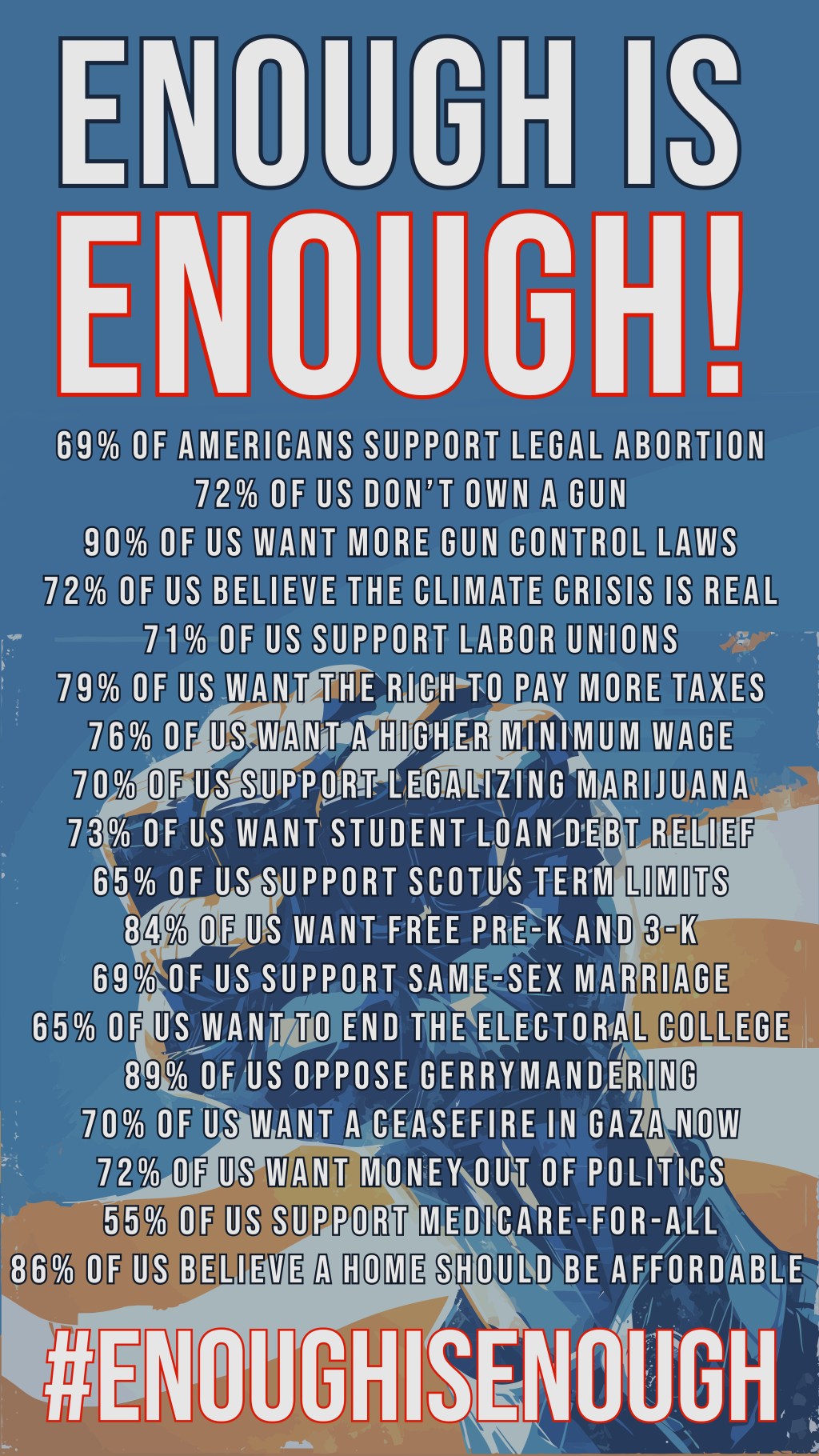
One of those infographics floated past the other day. The kind designed to be screenshot and shared. Big bold numbers, claims that Americans actually agree on most of the major stuff — guns, healthcare, abortion, climate, all of it. Bipartisan consensus. We just don’t realize it, the graphic said.
My honest first reaction was that someone had cooked the numbers. No way this is right. We’re supposed to be a country at each other’s throats. Red and blue, culture war, two Americas. That’s been the framing for twenty years. If we actually agreed on this much, somebody would have mentioned it by now.
So I went to check. Not to debunk it, exactly — more to figure out which numbers were a stretch and which had been juiced for the share button.
Turns out the infographic was conservative. The real numbers are worse, or better, depending on how you feel about being lied to for a generation.
What I actually found
Start with guns. Universal background checks poll at around 90% support nationally. Gallup, Pew, everybody who runs that question gets a similar number. The part that surprised me is that around 70% of NRA members support universal background checks. The “they’re coming for your guns” framing the lobby has been running for decades doesn’t even match what their own members say they want. Most gun owners want background checks. They just don’t hear that from anyone they listen to.
Abortion follows a similar shape. Around two-thirds of Americans say it should be legal in most or all cases. Somewhere between 8 and 13% want it banned outright. So the absolutist position — total ban, no exceptions for rape, incest, or the life of the mother — is held by a small minority of the country, and yet it’s currently winning in court after court because of how the math works in primaries.
Healthcare is where the framing matters most, and where the polling tells the most useful story. Asked plain — “do you support Medicare for All?” — it polls around 60%. Tell people it ends private insurance and it drops to 46%. Tell them they’d keep their doctors and hospitals, which is what most M4A proposals actually do, and it climbs back to 55%. Lay out the real tradeoff — higher taxes but no premiums, no deductibles, no copays, no medical bankruptcy — and it’s 63%. That range isn’t because Americans are confused. It’s because what people support depends almost entirely on which version of the pitch they’ve heard. The insurance industry has spent enough on the misleading version that the misleading version is the one most people know.
Climate action, raising the minimum wage, taxing the wealthy more, paid family leave, getting corporate money out of politics — same pattern across all of them. Strong majorities. In several cases supermajorities. Often genuinely bipartisan, which is the word I would have least expected to be writing down a few hours into this.
The University of Maryland ran a study where they tested around 150 specific policies on something like 80,000 people. Both Democratic and Republican majorities agreed on about 70% of them. The same study found that both sides overestimate how extreme the other side is by roughly 30%. So a real chunk of what feels like polarization is just both tribes assuming the other tribe is crazier than it actually is, because the loudest voices on the other side are the only ones we ever get to hear.
Why none of this is news
What’s strange about all of this is that none of it’s hidden. The polling is public. The Maryland study has been published for years. Anyone with a phone and a slow Sunday could do what I did and find the same numbers.
But almost nobody does, because the apparatus that pays for the news doesn’t have a financial reason to tell that story. “We mostly agree, here’s why we never get to act on it” doesn’t get clicks. It doesn’t fit the two-box graphic. It doesn’t produce a yelling pundit. The networks, the donors, the politicians, and the ad-supported platforms that monetize our attention are all making money off the version where we’re at each other’s throats. The version where we mostly agree is a worse business.
The piece I keep coming back to is that the specific policies most of us agree on — affordable healthcare, less corporate money in politics, a livable minimum wage, real action on climate — are the same policies the donor class stands to lose the most from. Of course those don’t happen. Not because we can’t agree on them. Because we can. And the people writing the checks know that.
We’re not a country split fifty-fifty on what to do. We’re a country that’s been told for twenty years that we are, by the people who profit when we believe it.
 Even that's Odd
Leave a comment