
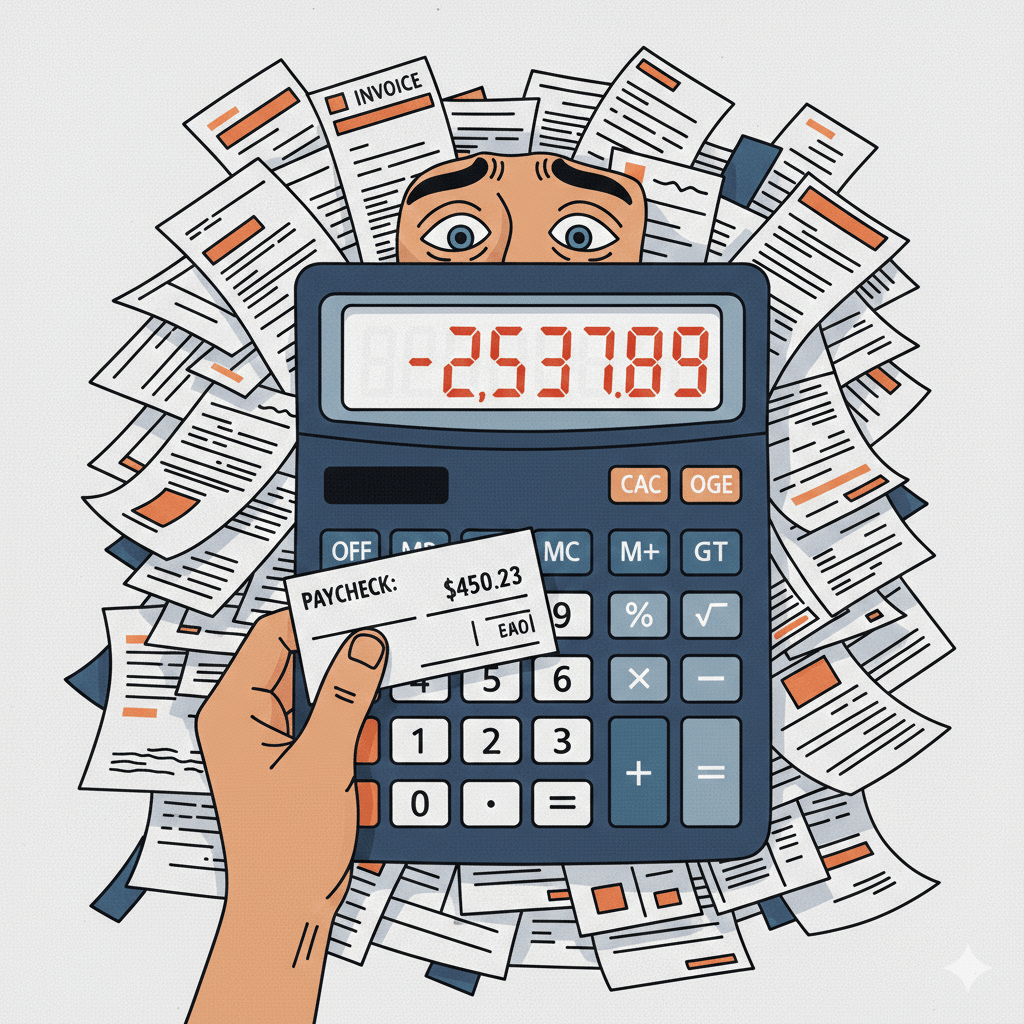
Part 1: The Impossible Math
When Median Income Meets Real Costs, America Fails
Meet Sarah.
She’s 34 years old, works as a registered nurse at a regional hospital, and makes $77,000 a year. That’s well above the median individual income in America ($59,228). She’s single, no kids, lives in a modest one-bedroom apartment in a mid-sized city in North Carolina. She doesn’t have expensive tastes. She drives a sensible used car. She meal preps. She’s doing everything right.
Sarah should be comfortable. She should be building savings, planning for the future, maybe even thinking about buying a house someday. She has a respected profession, above-average income, and no dependents.
Let’s do the math on what it actually costs to exist in America.
Sarah’s Income Reality
Annual Salary: $77,000
Sounds good, right? But Sarah doesn’t see $77,000. Nobody does. Here’s what actually hits her bank account:
Federal Income Tax: $10,267 (12% and 22% brackets after standard deduction) FICA (Social Security + Medicare): $5,890.50 (7.65%) State Income Tax (NC): $3,542 (4.6% effective) Health Insurance Premium (employee portion): $2,400 ($200/month for employer plan)
Total Deductions: $22,099.50 Net Annual Income: $54,900.50 Monthly Take-Home: $4,575
So Sarah’s actual monthly budget is $4,575. Not $6,416 (which would be the gross monthly). That’s a $1,841 difference between what people think she makes and what she actually has to spend.
Now let’s look at what it costs to simply exist.
The Mandatory Costs
Housing: $1,450/month
Sarah rents a one-bedroom apartment in a decent but not fancy neighborhood. It’s 680 square feet. No doorman, no gym, no amenities. Just a place to sleep. The national median rent for a one-bedroom is $1,487. Sarah found one slightly below that. This includes renters insurance ($15/month) which her landlord requires.
Healthcare: $458/month
- Insurance premium (her portion): $200
- HSA contribution to cover deductible: $125 (she has a $1,500 deductible)
- Average monthly co-pays and prescriptions: $83
- Dental and vision insurance: $50
Her employer plan isn’t generous. It’s a high-deductible plan with a $1,500 deductible and a $3,000 out-of-pocket max. She needs to actually budget for healthcare use, not just the premium.
Transportation: $782/month
- Car payment: $350 (she bought a 3-year-old Honda Civic, financed $18,000 over 5 years at 6.5%)
- Car insurance: $180 (full coverage, required by her loan, clean driving record)
- Gas: $160 (12,000 miles/year, 32 mpg, $3.20/gallon)
- Maintenance and repairs: $92 (averaged out – oil changes, tires, unexpected repairs)
Sarah lives in North Carolina. There’s no subway. There’s barely a bus system. A car isn’t a luxury—it’s mandatory for getting to work, groceries, and basic errands.
Student Loans: $340/month
Sarah has $38,000 in student loans from her BSN (Bachelor of Science in Nursing) degree. That’s actually below the national average of $40,681 for bachelor’s degree holders. At 5.5% interest on a 10-year repayment plan, that’s $340/month.
She can’t discharge these in bankruptcy. She can’t negotiate them. She just pays.
Food: $450/month
Sarah isn’t eating out much. This breaks down to:
- Groceries: $380 (she meal preps, buys store brands, uses coupons)
- Eating out: $70 (maybe twice a month, nothing fancy)
The USDA’s “low-cost food plan” for a single woman is $301/month. That’s rice, beans, and chicken every night. Sarah’s budget is between “low-cost” and “moderate-cost” ($377). She’s being responsible.
Utilities: $285/month
- Electric: $95 (average, varies by season)
- Water/Sewer/Trash: $65 (included in some rentals, not hers)
- Internet: $75 (Spectrum, the only real option in her building)
- Cell Phone: $50 (unlimited plan, she needs it for work)
Internet isn’t optional. Her employer requires portal access for schedule changes and training modules. Her cell phone needs to be reliable because the hospital calls when they need coverage.
Other Non-Negotiables: $185/month
- Household items and toiletries: $60
- Clothing and shoes (work scrubs, etc.): $50
- Laundry: $30 (apartment has coin-op only)
- Basic haircuts and personal care: $45
These aren’t luxuries. This is toilet paper, soap, toothpaste, replacing worn-out scrubs, and basic grooming for a professional job.
The Math
Monthly Income: $4,575 Monthly Mandatory Expenses: $3,950
Remaining: $625/month
Now, before you say “See, she has $625 left over!” let’s talk about what’s NOT in that budget yet:
- Emergency fund: $0
- Retirement savings: $0 (her employer offers a 401k but no match)
- Saving for a house down payment: $0
- Entertainment/hobbies: $0
- Gym membership: $0
- Streaming services: $0
- Gifts (birthdays, holidays): $0
- Pet: $0
- Vacation: $0
- Any unexpected expense: $0
That $625 has to cover:
- Car repairs (when the average goes over $92/month)
- Medical bills (when she actually hits that deductible)
- Any emergency whatsoever
- Any quality of life at all
And here’s the kicker: Sarah makes 30% more than the median individual income. If someone making $77,000 is barely scraping by, what about the 50% of working Americans making less than $59,228?
Let’s run those numbers.
The Median Income Reality
Median individual income: $59,228 Monthly take-home (after taxes and employer health insurance): ~$3,480
Using the same expenses (and these are conservative for most cities):
- Housing: $1,450
- Healthcare: $458
- Transportation: $782
- Student Loans: $340
- Food: $450
- Utilities: $285
Total: $3,765
The median American worker is $285 short every single month before considering savings, emergencies, or any quality of life expenses.
They’re not making it. The math literally doesn’t work.
The National Picture
This isn’t just Sarah. This isn’t just people who “made bad choices.” This is America:
- 78% of Americans live paycheck to paycheck (including 45% of those making six figures)
- 40% of Americans couldn’t cover a $400 emergency without borrowing or selling something
- Median savings account balance: $5,300 (while the average is $65,100—extreme inequality)
- Total consumer debt: $17.5 trillion
- Credit card debt: $1.13 trillion (average balance: $6,501)
- 60% of Americans are in debt for basic living expenses
This is the richest country in the world. We have more billionaires than any other nation. Our GDP is $27 trillion. Corporate profits are at record highs.
And the median worker can’t afford basic existence.
What Changed?
Sarah’s grandmother was also a nurse. In 1975, she made $11,000 a year. Adjusted for inflation, that’s $63,279 in today’s dollars.
Sarah makes $77,000—about 22% more in real terms than her grandmother.
But her grandmother:
- Bought a house on that single income (median home was 2.3x annual salary)
- Had a pension
- Had fully employer-paid healthcare
- Had no student loans (nursing school cost $800/year)
- Had 3 weeks vacation and unlimited sick days
Sarah:
- Can’t afford to buy a house (median home is 7.6x median annual salary)
- Has no pension (401k she can’t afford to contribute to)
- Pays $200/month for a high-deductible health plan
- Has $38,000 in student loans
- Has 2 weeks vacation and 6 sick days
Sarah is more productive. She uses electronic health records that improved efficiency. She handles more patients per shift. She has more education and certifications.
And she can barely afford rent.
This Isn’t an Accident
Every single one of these costs has increased faster than wages:
- Housing: Up 121% vs wage growth of 17% (inflation-adjusted since 1970)
- Healthcare: Up 3,429% vs wage growth of 17%
- Education: Up 6,650% vs wage growth of 17%
- Childcare: Up 214% vs wage growth of 17%
Meanwhile, productivity is up 77% since 1970, but wages are only up 17%.
Where did that productivity money go? It sure didn’t go to workers.
None of these increases happened because of natural market forces. Each one is the result of specific policy choices:
- Housing: Zoning restrictions, private equity buying homes, tax incentives for investors
- Healthcare: Employer-based system, lack of price transparency, pharmaceutical patents
- Education: State funding cuts, unlimited federal loans inflating costs
- Wages: Union busting, right-to-work laws, arbitration clauses, non-compete agreements
This isn’t a story about irresponsible people. This is a story about a system designed to extract more than it allows you to earn.
Sarah isn’t failing. Sarah is being failed.
And she’s one of the lucky ones. She makes above-median income. She has no kids. She has no major health problems. She has no credit card debt (yet).
Imagine trying to do this on $40,000 a year. With two kids. With a chronic health condition. In a more expensive city.
The math doesn’t just fail to work—it’s violently, impossibly broken.
What’s Next
This is Part 1 of our series “Passing the Buck: Why We Pay More But Make Less.” We’ve shown you that the math doesn’t work. That basic survival costs more than median income provides. That this isn’t individual failure—it’s systematic cost-shifting.
In Part 2, we’re going to show you how we got here. How what used to be considered baseline expectations—a single income supporting a family, employer-paid healthcare, pensions, affordable education—got redefined as “entitlements” and “luxuries.”
Because here’s what they don’t want you to understand: Your grandparents weren’t smarter or harder-working than you. The math was just different.
And the people who changed that math got very, very rich doing it.
In the parts that follow, we’re going to follow the money. We’re going to show you exactly who profits from each of these impossible costs. We’re going to name names and show profit margins.
Because Sarah’s $625/month shortfall? Someone’s collecting it.
Every. Single. Month.
Passing the Buck: Why We Pay More But Make Less is a 15-part series examining how corporations and government systematically shifted costs onto working Americans—while wages stagnated and benefits disappeared.
 Even that's Odd
Leave a comment