
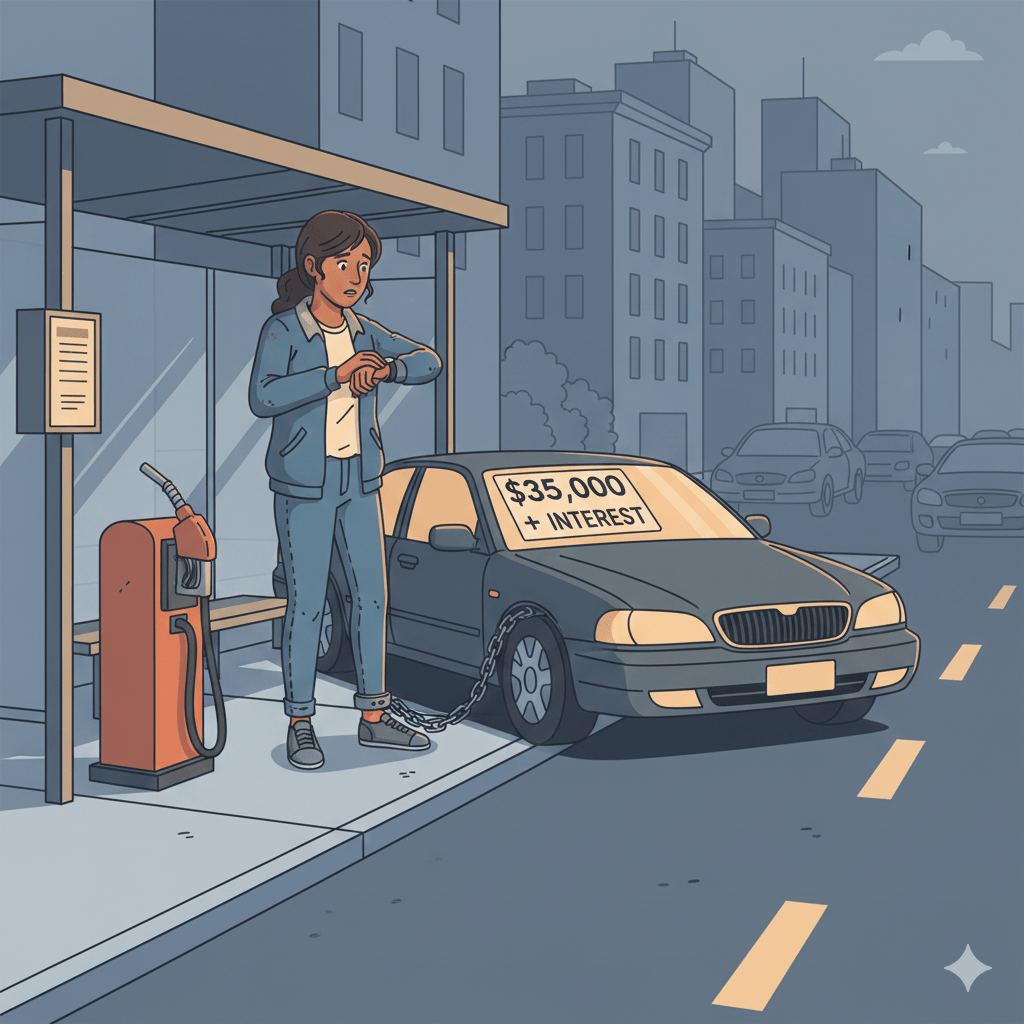
Forced to Buy What You Can’t Afford
Jennifer lives in Phoenix, Arizona. She’s a single mom with two kids, works as a pharmacy technician, makes $42,000 a year. Her shift starts at 7 AM at a CVS 8.5 miles from her apartment.
She doesn’t own a car by choice. She owns a car because there is literally no other way to get to work.
Let’s map her commute:
By car: 8.5 miles, 14 minutes
By public transit: Not possible. The nearest bus stop to her apartment is 1.2 miles away. The bus doesn’t run before 6 AM. It doesn’t go to her CVS. She’d need two transfers. Total time: 1 hour 45 minutes each way. Assuming the buses run on time. Which they don’t.
By bike: 8.5 miles in Phoenix summer heat (110°F by 10 AM). Arrive drenched in sweat. No shower at work. Handle medications and interact with customers. Not viable.
By walking: 8.5 miles = 2 hours 50 minutes each way. Impossible with kids’ school drop-off and pickup.
So Jennifer drives. Not because she wants a car. Because American infrastructure gives her no choice.
And that forced choice costs her $11,400 a year—27% of her gross income.
The Full Cost of Forced Car Ownership
Jennifer drives a 2018 Honda Civic with 78,000 miles. She bought it used three years ago for $19,500. She financed $17,000 at 7.9% APR for 72 months.
Here’s what that “basic necessity” actually costs her:
Car Payment: $293/month ($3,516/year)
She still has three years of payments left. She’ll pay $21,096 total for a car she bought for $19,500. The bank makes $3,596 in interest.
When she’s done, the car will be 9 years old with 150,000 miles. Trade-in value: maybe $6,000.
She’ll pay $21,096. Get back $6,000. Net cost: $15,096 for six years of transportation. Plus everything below.
Auto Insurance: $185/month ($2,220/year)
Arizona requires minimum coverage:
- $25,000 bodily injury per person
- $50,000 bodily injury per accident
- $15,000 property damage
That’s just liability. If she hits someone, they’re covered. If someone hits her? She’s on her own unless they have insurance (12% of Arizona drivers don’t).
But she has a car loan, so her lender requires full coverage:
- Comprehensive
- Collision
- Higher liability limits
Her $185/month is actually cheap for Phoenix. She has good credit, no accidents, and a safe car. If she had one accident, it would jump to $245/month.
Over six years of ownership: $13,320 in insurance for a car she paid $19,500 for.
Gasoline: $160/month ($1,920/year)
- 12,000 miles per year
- Honda Civic gets 32 mpg
- 375 gallons per year
- $3.50/gallon average (Phoenix prices)
She’s lucky—she has a fuel-efficient car. If she drove a truck or SUV (like many workers need for their jobs), she’d pay $250-300/month in gas.
Maintenance & Repairs: $125/month ($1,500/year)
This is averaged. Some months nothing. Then $600 for tires. Then $400 for brakes. Then $150 for oil changes and filters.
AAA estimates average annual maintenance for a sedan at $1,186, but that’s for newer cars. Jennifer’s car is 7 years old. Things break more.
This year alone:
- Oil changes (4x): $240
- Tires (needed 2): $340
- Brake pads: $380
- Battery died: $180
- AC refrigerant recharge: $150
- State emissions test: $20
- Registration renewal: $178
Total: $1,488
Next year she’ll need all four tires ($680) and likely new rotors with the brake pads.
Parking: $20/month ($240/year)
Her apartment complex charges for covered parking. Uncovered is free, but Phoenix sun destroys car interiors. She pays $20/month to not have her dashboard crack and her steering wheel become untouchable by 2 PM.
Total Annual Cost: $9,396
Monthly: $783
Jennifer makes $42,000/year. After taxes, she takes home about $32,500 ($2,708/month).
Her car—which she must have to work—costs $783/month. That’s 29% of her take-home pay.
For comparison:
- Housing (recommended max): 30% of income = $812/month (she pays $1,100)
- Transportation (recommended max): 15% of income = $406/month (she pays $783)
She’s spending double the recommended maximum on transportation because she has no choice.
The American Reality: Cars Are Mandatory
Jennifer’s situation isn’t unusual. It’s the American standard.
85% of American workers commute by car:
- 76% drive alone
- 9% carpool
- Only 5% use public transit
- 2.8% walk
- 0.5% bike
Why? Not preference. Necessity:
- 45% of American households have zero access to public transit
- Only 20% of jobs are accessible by public transit in less than 90 minutes
- Average American commute by public transit: 48 minutes vs. 26 minutes by car
- Public transit coverage decreased 21% since 1990 while population grew 30%
In most of America, not having a car means not having a job.
How We Got Here: The Deliberate Destruction
This wasn’t inevitable. It was designed.
1920s-1930s: America Had Public Transit
In the 1920s, American cities had extensive streetcar networks:
- Los Angeles: 1,100 miles of electric streetcar track (the most extensive system in the world)
- New York: 1,350 miles
- Chicago: 1,040 miles
- Philadelphia: 790 miles
- Even smaller cities had comprehensive systems
Over 44,000 miles of electric streetcar track nationwide.
You could live car-free in most American cities. People did. Most families didn’t own cars—they didn’t need them.
1936-1950: General Motors Buys and Destroys It
Here’s what happened, and it’s not a conspiracy theory—it’s documented in federal court:
National City Lines was a front company funded by:
- General Motors (buses and car manufacturer)
- Firestone Tire (tires for buses and cars)
- Standard Oil (fuel for buses and cars)
- Phillips Petroleum (more fuel)
- Mack Trucks (buses)
Between 1936 and 1950, National City Lines bought over 100 electric streetcar systems in 45 cities, including:
- Los Angeles
- Philadelphia
- Baltimore
- Oakland
- Phoenix
- Tulsa
- El Paso
- And dozens more
Here’s what they did:
- Bought the profitable electric streetcar systems
- Shut them down
- Replaced them with GM buses (inferior, slower, less capacity)
- Let the bus service decline (cut routes, reduce frequency)
- Made public transit so bad that people bought cars
In 1949, they were convicted in federal court of conspiracy to monopolize the sale of buses and supplies to transit companies.
The fine? GM was fined $5,000. The executives were fined $1 each.
That’s not a typo. One dollar each.
Meanwhile, they’d destroyed the transportation infrastructure of dozens of American cities. Made hundreds of millions in car, tire, and fuel sales.
Los Angeles went from the world’s best streetcar system to a car-dependent sprawl in 15 years. By design.
1956: The Interstate Highway System
President Eisenhower signed the Federal-Aid Highway Act, creating the Interstate Highway System.
Sounds good, right? National defense, economic growth, connecting the country.
But here’s what it actually did:
$114 billion spent on highways (1956-1990s, inflation-adjusted) $0 billion spent on inter-city rail or public transit (federal funding)
The highway system:
- Cut through the hearts of cities, destroying neighborhoods (usually minority neighborhoods)
- Made car ownership necessary to access the highways
- Encouraged suburban sprawl (cheap land far from city centers)
- Created car-dependent development patterns
Meanwhile, passenger rail died:
- 1945: 98 million inter-city train trips
- 1970: 16 million inter-city train trips
- Rail companies went bankrupt
- Amtrak was created as a last-ditch government rescue (underfunded from day one)
Europe and Japan invested in high-speed rail. We invested in highways.
Who lobbied for this?
- Auto manufacturers
- Oil companies
- Tire companies
- Construction companies
- Suburban developers
Who paid for it? Taxpayers.
Who profited? The companies that lobbied for it.
1970s-Present: Zoning Laws Lock It In
Once the infrastructure was car-centric, zoning laws made it permanent:
Euclidean zoning (named after the Supreme Court case, not the mathematician) separates:
- Residential from commercial
- Single-family from multi-family
- Living from shopping from working
Result:
- Can’t walk to a grocery store (residential and commercial separated)
- Can’t walk to work (jobs zoned away from housing)
- Can’t walk to restaurants, pharmacy, school (everything separated)
- Must drive everywhere
Compare to pre-car American cities (and current European/Asian cities):
- Mixed-use development (shops on ground floor, apartments above)
- Corner stores in neighborhoods
- Schools within walking distance
- Jobs accessible by walking or transit
We banned that development pattern with zoning laws.
In most American cities, it’s illegal to build a corner store in a residential neighborhood. Illegal to build an apartment above a shop. Illegal to build anything except single-family houses.
So you must drive. By law.
1980s-Present: Defund Public Transit
Once everyone needed cars, public transit funding dried up:
Federal funding for transit:
- 1960: Minimal, but cities had local funding
- 1970: Federal aid started after crisis
- 1980: Reagan cut federal transit funding 20%
- 1990-present: Chronic underfunding
Results:
- Routes cut
- Frequency reduced
- Service areas shrunk
- Infrastructure deteriorates
- Ridership declines (because service is bad)
- Politicians point to low ridership as reason to cut more funding
- Death spiral
Meanwhile, highway funding increased:
- Federal gas tax goes mostly to highways
- States spend 80% of transportation budget on roads
- Transit gets scraps
In Phoenix (Jennifer’s city):
- Bus service: Limited routes, 30-60 minute waits
- Light rail: One line (opened 2008, covers 28 miles in a metro area of 14,600 square miles)
- Valley Metro budget: $1.2 billion/year
- Arizona DOT highway budget: $3.1 billion/year
Phoenix metro area: 5 million people. One light rail line.
The Math: What Car Dependence Actually Costs
Let’s compare Jennifer’s reality to alternatives:
Jennifer’s Current Car Cost: $9,396/year
That’s if nothing major breaks. If her transmission fails ($3,500), engine problems ($2,500), or she gets in an accident with an uninsured driver (totals her car, she’s out the loan balance), her costs skyrocket.
If Phoenix Had Functional Public Transit: ~$1,200/year
- Phoenix light rail monthly pass: $64
- Annual cost: $768
- Add occasional rideshare when needed: $400/year
- Total: ~$1,200/year
Savings: $8,196/year
For someone making $42,000, that’s a 19.5% raise. Just from not being forced to own a car.
If America Had Transit Like Japan: ~$1,500/year
Japan’s extensive rail network:
- Tokyo to Osaka (340 miles): 2.5 hours, $120
- Monthly unlimited pass in Tokyo metro: $150
- Most people don’t own cars in cities (don’t need them)
Average Japanese household transportation cost: $3,200/year Average American household transportation cost: $12,295/year
We pay $9,095 more per year because our infrastructure forces car ownership.
If Jennifer Could Walk/Bike: $200/year
If Jennifer lived in a walkable neighborhood:
- Job within 2 miles
- Grocery store within 0.5 miles
- School within 1 mile
- Pharmacy, restaurants, services all walkable
Transportation costs:
- Used bike: $100 (one-time)
- Maintenance: $50/year
- Occasional rideshare/bus: $150/year
Total: $200/year
Savings vs. current: $9,196/year
But in most American cities, that neighborhood is illegal to build.
The Modern Numbers: Cars As Forced Expense
Average annual cost of car ownership (AAA, 2024):
Small sedan: $9,566/year
- Depreciation: $3,384
- Finance charges: $817
- Fuel: $1,766
- Insurance: $1,588
- Maintenance: $1,186
- Fees and taxes: $825
Medium SUV: $12,182/year Pickup truck: $12,259/year
For median household (income $80,610):
- One car: 11.9% of gross income
- Two cars (most households): 23.8% of gross income
Nearly a quarter of gross income just to be allowed to participate in the economy.
Who Profits?
The companies that designed this system profit from it:
Auto Manufacturers (2023)
General Motors:
- Revenue: $171.8 billion
- Profit: $10.1 billion
- CEO Mary Barra compensation: $27.8 million
Ford:
- Revenue: $176.2 billion
- Profit: $4.3 billion
- CEO Jim Farley compensation: $21.0 million
Stellantis (Chrysler, Jeep, Ram):
- Revenue: $189.5 billion
- Profit: $18.6 billion
Auto Finance (The Banks Again)
GM Financial:
- Outstanding loans: $108 billion
- Revenue: $14.1 billion
Ford Credit:
- Outstanding loans: $153 billion
- Revenue: $13.3 billion
And the regular banks:
- Chase auto loans: $73 billion outstanding
- Bank of America auto loans: $88 billion outstanding
- Capital One auto loans: $112 billion outstanding
Same banks from Parts 3 and 4. Overdraft fees, credit card interest, and now auto loan interest.
Average auto loan:
- Amount: $40,538 (new car), $27,250 (used car)
- Rate: 7.2% (new), 11.2% (used)
- Term: 68 months (new), 65 months (used)
On Jennifer’s $17,000 used car loan at 7.9% for 72 months:
- Monthly payment: $293
- Total paid: $21,096
- Interest paid: $4,096
The bank makes $4,096 in interest on a car she was forced to buy because they lobbied to destroy public transit.
Insurance Companies (2023)
State Farm:
- Auto insurance revenue: $51.6 billion
- Profit: $6.7 billion
GEICO (Berkshire Hathaway):
- Auto insurance revenue: $39.4 billion
- Profit: $4.2 billion
Progressive:
- Auto insurance revenue: $56.7 billion
- Profit: $5.5 billion
Total U.S. auto insurance industry:
- Premiums collected: $322 billion
- Profit: $42 billion (2023)
You’re required by law to buy their product. You have no choice but to buy a car (thanks to destroyed transit). And you have no choice but to insure it.
They set the prices. You pay.
Oil Companies (2023)
ExxonMobil:
- Revenue: $344.6 billion
- Profit: $36.0 billion
Chevron:
- Revenue: $200.9 billion
- Profit: $21.4 billion
ConocoPhillips:
- Revenue: $59.5 billion
- Profit: $10.8 billion
Americans consume 134 billion gallons of gasoline per year. At $3.50/gallon average, that’s $469 billion annually.
Every gallon you’re forced to buy because you have no transit alternative is profit for companies that lobbied to eliminate your alternatives.
The Compounding Extraction
Remember Jennifer? Let’s look at her full picture now:
Monthly expenses:
- Rent: $1,100
- Car payment: $293
- Car insurance: $185
- Gas: $160
- Car maintenance (averaged): $125
- Health insurance: $180
- Utilities: $250
- Phone: $50
- Food: $400
- Student loans: $185
Total: $2,928
Monthly income after taxes: $2,708
Shortfall: $220/month
She’s $220 short every month. Before:
- Savings
- Clothes for kids
- School supplies
- Any emergency
- Any quality of life
Where does the $220 come from? Credit cards (Part 4). Which charge 21% interest. Which she can’t pay off.
And here’s the thing: $783 of her $2,928 in monthly expenses is the car.
If Phoenix had functional public transit, she’d pay $100/month for an unlimited pass instead of $783 for a car.
Savings: $683/month
Instead of being $220 short, she’d have $463 surplus.
She could:
- Build an emergency fund
- Pay off her credit cards
- Save for her kids’ education
- Not live in constant financial stress
But she can’t. Because American infrastructure was deliberately designed to force her to own a car she can’t afford.
The International Comparison
This isn’t normal. It’s American.
Tokyo, Japan:
- Population: 14 million (metro: 37 million)
- Rail lines: 121 (Tokyo Metro + JR East + private lines)
- Households without cars: 45%
- Average commute by transit: 27 minutes
- Monthly unlimited rail pass: $150
London, UK:
- Population: 9 million (metro: 14 million)
- Tube lines: 11, plus extensive bus network
- Households without cars: 42%
- Average commute by transit: 32 minutes
- Monthly unlimited pass (Zones 1-3): $200
Paris, France:
- Population: 2.2 million (metro: 12 million)
- Metro lines: 16, plus extensive bus and tram
- Households without cars: 55%
- Average commute by transit: 29 minutes
- Monthly unlimited pass: $75
Phoenix, USA:
- Population: 1.7 million (metro: 5 million)
- Light rail lines: 1 (28 miles)
- Households without cars: 6%
- Average commute by car: 26 minutes (transit: not viable for most)
- Monthly unlimited pass: $64 (but doesn’t go where you need)
The pass is cheaper. The system doesn’t exist.
The Shift: From Optional to Mandatory
1920s America:
- Streetcars in every major city
- Most families didn’t own cars (didn’t need them)
- Car ownership: 60% of households
- Transportation cost: ~5% of household income
1970s America:
- Streetcars gone, highways built
- Car ownership: 80% of households
- Public transit declining
- Transportation cost: ~13% of household income
2024 America:
- 91% of households own at least one car
- 85% of commutes by car (forced, not choice)
- Public transit serves 5% of commutes
- Transportation cost: ~15% of household income (second-largest expense after housing)
The shift:
- Car went from luxury/option to mandatory
- Cost shifted from minimal to 15% of income
- Alternatives were destroyed
- You pay for the destruction
Jennifer’s Future
Jennifer will pay for that Honda Civic for three more years. By then it’ll have 150,000 miles and be worth $6,000.
She’ll need another car. Because Phoenix still won’t have functional public transit.
She’ll finance another $20,000-25,000 at 8-10% APR for 72 months. She’ll pay $350-400/month for another 6 years.
For her entire working life, she’ll pay:
- 40 years of work
- Average $10,000/year in car expenses
- Total: $400,000 spent on cars
For comparison:
- Median home price: $412,300
- Jennifer will spend almost as much on cars as a house costs
And unlike a house, the cars will be worth $0 when she’s done.
She’ll spend $400,000 on a mandatory expense that depreciates to nothing.
Because General Motors destroyed her city’s streetcars in 1948.
Because we built highways instead of rail.
Because we zoned her neighborhood so she can’t walk anywhere.
Because we defunded the bus system.
Because the system was designed to extract from her. Forever.
What’s Next
We’ve covered the impossible math (Part 1), cost-shifting (Part 2), banking fees (Part 3), credit card debt (Part 4), and now forced car ownership (Part 5).
In Part 6, we’re examining food—how four companies control 85% of meat processing, how grocery prices increased 25% in four years while profits soared, and how “inflation” is often just monopolistic price-setting.
Because Jennifer isn’t just forced to own a car. She’s also forced to pay whatever Kroger, Albertsons, Walmart, and Amazon decide groceries cost this week.
And the prices keep going up while her wages don’t.
Passing the Buck: Why We Pay More But Make Less is a 15-part series examining how corporations and government systematically shifted costs onto working Americans—while wages stagnated and benefits disappeared.
 Even that's Odd
Leave a comment