
Part 8 of Passing the Buck, a 15-part series on why we make less but pay more.
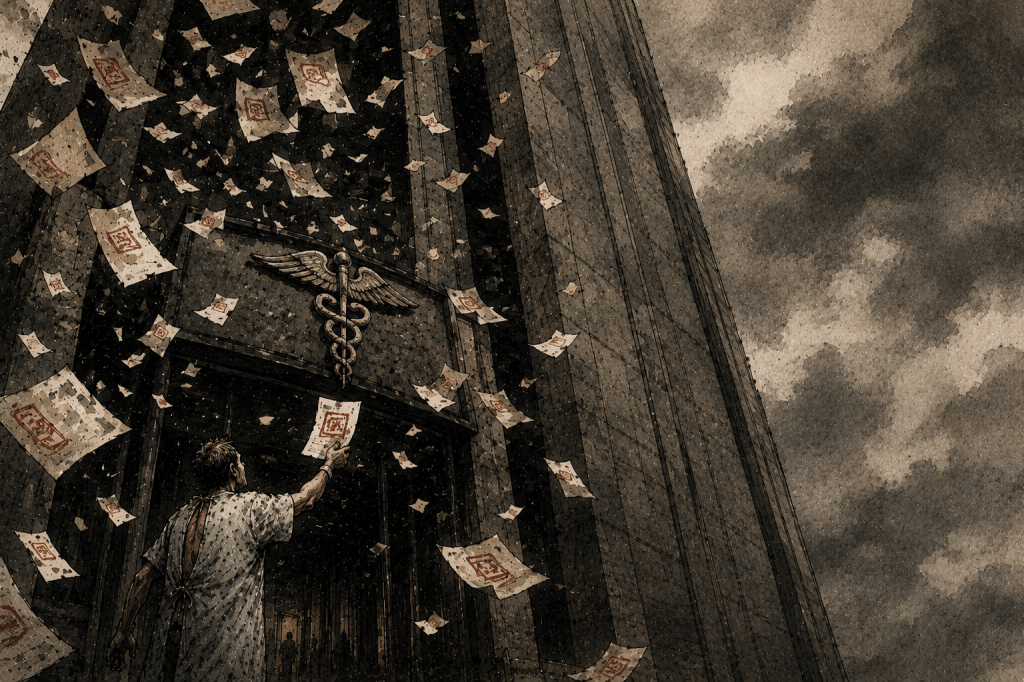
On the morning of December 4, 2024, the CEO of UnitedHealthcare, Brian Thompson, was shot and killed on a sidewalk in Midtown Manhattan on his way to his company’s annual investor day. The bullet casings recovered at the scene were inscribed with the words “delay,” “deny,” and “depose” — a reference, the suspect’s writings later confirmed, to the practices health insurers use to avoid paying claims. The man accused of the killing, Luigi Mangione, was arrested at a McDonald’s in Altoona, Pennsylvania, five days later.
I want to be careful with this opening, because a man was killed and his children are growing up without a father, and that is a tragedy regardless of what his company did for a living. But what happened on social media in the hours and days after the shooting was something I do not remember happening in modern American life. A NORC poll conducted later that month found that roughly seventy percent of Americans believed insurance company denials and insurer profits bore “a moderate amount” or “a great deal” of responsibility for Thompson’s death — nearly the same share that assigned responsibility to the man who pulled the trigger. UnitedHealthcare locked the comments on its own memorial Facebook post about Thompson after the laughing-face reactions ran into the tens of thousands. Multiple major insurers immediately disclosed sharp increases in executive security spending; UnitedHealth alone reported $1.7 million in such costs for 2024. The chief executive of a competing insurer published an open letter that began, in part, “We are sorry, and we can and will be better.”
I am not telling that story to make a point about the killing. I am telling it because it is the clearest expression in my lifetime of how American households actually feel about their health insurance, after thirty years of premium increases, denied claims, prior-authorization fights, and out-of-network bills. This installment is about insurance — health, auto, and property — which is the category of household spending where the gap between what is collected and what is delivered is widest, and where the public’s patience appears to have finally run out.
The numbers, health
The Kaiser Family Foundation’s annual Employer Health Benefits Survey is the standard data source on employer-sponsored insurance, which still covers about 154 million Americans under age 65. The 2025 survey, released last fall, put the average annual premium for family coverage at $26,993, up six percent from the $25,572 figure for 2024 and seven percent the year before that. The worker contributes, on average, $6,850 a year toward that premium. The employer pays the rest. Average single-coverage deductibles ran $1,886 in 2025; family deductibles ran higher, with significant variance by employer size — small-firm workers face meaningfully larger deductibles than large-firm workers.
The premium has grown roughly twenty-four percent over the past five years, compared with twenty-three percent inflation and twenty-eight percent wage growth over the same period. That is the headline KFF cites to argue that premiums have, on a relative basis, held more or less even with the broader economy. The piece of the story that the headline does not capture is the long-running shift inside the policy: the deductible the worker has to hit before insurance pays anything, the out-of-pocket maximum the worker can be exposed to in a bad year, the narrower networks, the prior-authorization requirements that delay routine care, and the growing share of workers in high-deductible plans where the deductible is the meaningful cost rather than the premium. Those structural shifts are why a family that pays its premiums in full can still face a $3,000 to $9,000 out-of-pocket bill before the insurance kicks in.
Aggregated up, the seven largest for-profit health insurance conglomerates — UnitedHealth, CVS Health (Aetna), Cigna, Elevance (Anthem), Humana, Centene, and Molina — collected nearly $1.7 trillion in revenue in 2025, and booked roughly $54 billion in operating earnings. Revenue has grown roughly threefold since 2015. Most of that growth, according to industry analysts, came from mergers and acquisitions and from the expansion of Medicare Advantage and Medicaid managed-care contracts (i.e., taxpayer-funded programs), rather than from organic growth in private commercial enrollment.
The 2010 Affordable Care Act capped insurance company “medical loss ratios” — the share of premium revenue that has to go to actual medical care — at no lower than eighty-five percent for large group plans and eighty percent for individual and small group. That cap is binding. It is also, in practice, why the major insurers have spent fifteen years vertically integrating into pharmacy benefit management, physician practice ownership, data analytics, and other adjacent businesses where the MLR cap does not apply. UnitedHealth Group is no longer primarily a health insurer; its Optum subsidiary, which manages pharmacy benefits, owns physician practices, and runs data analytics, accounts for a steadily growing share of profits. The same is true of CVS-Aetna and to a lesser extent of Cigna with its Express Scripts subsidiary. The companies have built an architecture in which they sit on both sides of the patient transaction — they own the insurer, they own the pharmacy benefit manager that negotiates drug prices, and increasingly they own the doctor’s practice you walk into. The MLR cap has not produced more spending on care so much as it has produced a different organizational structure inside which the same dollars get captured.
What actually changed (and what didn’t)
Two pieces of federal legislation in the last fifteen years have meaningfully constrained insurer behavior at the margin, and they are worth flagging in a series that argues, mostly accurately, that the regulatory environment runs heavily in industry’s favor.
The Affordable Care Act of 2010 ended preexisting-condition exclusions, capped annual and lifetime coverage limits, mandated coverage of preventive care without cost-sharing, allowed children to stay on parents’ plans until age twenty-six, and — most importantly for cost-of-care purposes — expanded Medicaid coverage to roughly twenty million additional people in the states that took the expansion. The uninsured rate, which was thirteen percent in 2013, runs around eight percent now. The Supreme Court allowed states to opt out of the Medicaid expansion in 2012, and ten states still have not taken it, which is why the uninsured rate is higher in the Deep South than the national average.
The No Surprises Act, which took effect January 1, 2022, banned the worst form of out-of-network billing. Before the law, a household could go to an in-network hospital, receive in-network care from an in-network surgeon, and then receive a separate bill for thousands of dollars from an out-of-network anesthesiologist, radiologist, or emergency room physician who happened to be on staff at the in-network facility. The Act prohibited that practice for emergency services and for ancillary services at in-network facilities. The patient now pays only the in-network cost-sharing amount, and the dispute over the rest is between the insurer and the provider, resolved through a federal arbitration process. The law has been imperfectly enforced and the arbitration process has been contested, but the basic protection works. It is the rare consumer-protection law of the last decade that operates roughly as advertised.
What the ACA and the No Surprises Act did not do is constrain the core extraction model. The premiums kept rising. The deductibles kept growing. Prior authorization expanded into more categories of care. The networks narrowed. Insurer-owned pharmacy benefit managers became the gatekeepers for prescription drug coverage. The vertical-integration play I described above accelerated after 2014, in significant part as a response to the MLR cap. The Brian Thompson reaction was not about a household whose grandmother’s anesthesiologist sent a surprise bill in 2019; it was about a present-tense system where prior authorizations get denied, claims for cancer scans get rejected, and the wheelchair for a child with cerebral palsy gets refused. Those denials are still happening, post-No Surprises Act and post-ACA, because the underlying business model rewards them.
Auto and home
Auto and homeowners insurance have spent the last four years getting more expensive faster than almost anything else in the household budget, and the reasons are partly structural and partly tied to the broader inflation and tariff story I have been telling through this series.
Auto insurance premiums are up roughly fifty percent nationally since 2020, according to BLS Consumer Price Index data. The proximate cause is the cost of repairing cars. Modern vehicles are heavily computerized; even minor collisions can require replacement of sensors, cameras, and sealed control modules that did not exist in vehicles built ten years ago. Roughly sixty percent of replacement parts used in U.S. auto repair are imported, which means the tariff regime imposed in 2025 has flowed through to repair costs and, on a one-to-two-quarter lag, to insurance premiums. The Insurance Information Institute’s projections, which I cited in Part 5, suggest the premium increases are not yet fully baked in.
The market is concentrated but not as severely as healthcare. State Farm, GEICO (Berkshire Hathaway), Progressive, Allstate, and USAA together write roughly sixty percent of U.S. auto insurance. There is more state-level competition than in, say, cable broadband, and the rates in any given state are set under regulatory review by a state insurance commissioner. The commissioner approval process is slow and is largely a matter of insurers showing combined-ratio data and the regulator either approving or modifying the requested rate. In practice, the regulator usually approves, because if it does not, the insurer can choose to stop writing new business in the state.
That last dynamic is the one playing out most dramatically in Florida and California homeowners insurance. State Farm stopped writing new homeowners policies in California in 2023 and in Florida in 2024. Allstate, Farmers, and AAA have made similar exits or restrictions in one or both states. Several smaller Florida insurers have gone bankrupt. The remaining insurers have raised rates by forty to sixty percent over four years. The Florida-specific narrative that the original version of this post leaned on — that insurers are inventing climate-risk justifications to extract higher margins — is partly true and partly not. Florida is genuinely exposed to hurricane risk that has gotten worse in real terms (Hurricane Ian in 2022 caused over $100 billion in damages, the costliest in state history), and the reinsurance market that backstops Florida insurers has repriced that risk substantially upward in the last five years. At the same time, the insurers that remain in Florida are reporting healthy profit margins, the rate increases have substantially exceeded the increase in actual claims, and the state-run Citizens Property Insurance Corporation has had to absorb an enormous and rapidly growing share of policies that the private market has dumped. The honest version of the story is that climate risk is real, the repricing is partly justified, and the way the industry has used the moment to harvest margin and dump unprofitable policies onto the public insurer is also real. The household pays either way.
What I see from here
I have spent most of the last twenty-five years on employer-sponsored health insurance. Now that I am running my own apparel business, I am on the marketplace. The difference is dramatic. The employer plan, even in its most degraded recent form, was substantially cheaper and substantially better than what I can buy on the New York State of Health exchange for the equivalent family coverage. The exchange plans I have looked at run roughly $1,800 a month in unsubsidized premium for a family plan with a $7,000 family deductible and a $17,000 out-of-pocket maximum. That is more than I spent on healthcare in any single year of my employed life, and it is before any actual healthcare gets used. The household tax credit subsidies under the ACA’s American Rescue Plan provisions help significantly at lower income levels, but those subsidies have been a perpetual political football and the enhanced version expired at the end of 2025.
The Hudson Valley house I live in is on its third homeowners insurer in four years. Each transition came not because I shopped around but because the previous insurer chose to stop writing in my zip code or to drop my specific policy. The premiums have approximately doubled since I bought the house, on a property whose underlying replacement cost has gone up perhaps twenty percent. The coverage has been progressively narrowed in each renewal cycle. The auto insurance on my Tesla and my wife’s Audi has roughly doubled over the same period, and the only claim either of us has made in fifteen years was a routine windshield replacement.
None of this makes me think the right answer is to shoot the CEO. It does make me understand why the reaction to that shooting was what it was. The American insurance system has spent thirty years making itself unloved in a way that very few corporate sectors have managed. The combination of mandatory purchase, high premiums, high deductibles, narrow networks, prior authorization, surprise billing (until recently), claim denials, and rate increases that outpace wage growth has produced a customer base that does not believe the product works as advertised, paying more for it every year. That is the actual problem. The Affordable Care Act mitigated the worst of the access problems. The No Surprises Act mitigated the worst of the billing problems. But the underlying structural issue — that insurance company profits depend on collecting premiums and denying or delaying claims — is intact, and a quorum of the American public now seems to recognize it.
That is the design. The cost did not go away. It moved — from the employer’s books to the household’s, from the premium to the deductible, from the visible price to the denied claim. The household pays in the premium, and pays again in the deductible, and pays again in the out-of-pocket, and pays a fourth time in the appeal of the denied claim, and pays a fifth time in the surprise bill that the No Surprises Act now mostly prevents but did not prevent for the twenty years before 2022. The household is the last line item in the budget, every time.
The next installment looks at the rest of the fees.


Leave a Reply