
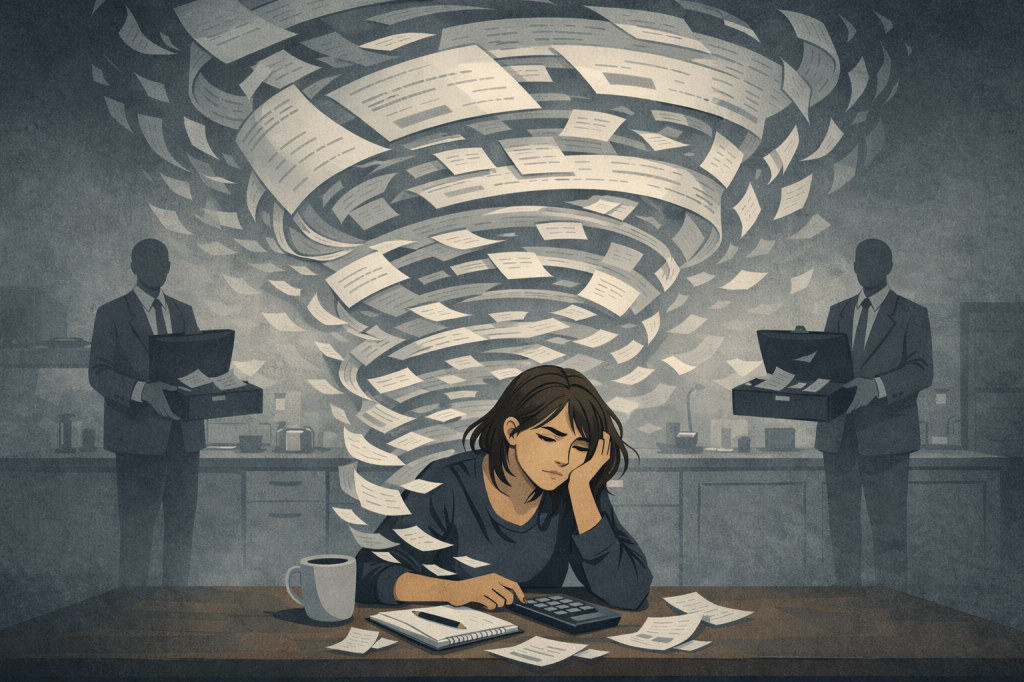
The Fee Economy
Lisa decided to track every fee she paid for one month. Not the big stuff—rent, car payment, insurance. Just the fees. The extra charges. The convenience fees. The service charges. The processing fees. All those little costs that companies tack on for doing business.
She’s 29, works as a marketing coordinator in Denver, makes $52,000 a year. She considers herself financially savvy. She budgets. She tracks her spending.
But she’d never actually counted the fees.
Here’s what one month looked like:
Week 1: The Rent and Utilities
Day 1 – Rent Payment: Lisa pays rent online through her apartment complex’s portal. Rent: $1,450.
- Convenience fee for paying online: $35
She could pay by check, but the office is only open 9-5 weekdays (she works 9-5). She could mail a check, but they charge $25 if it’s late, and mail is unreliable. The “convenience” of paying online costs $35.
Day 2 – Electric Bill:
- Bill: $98
- Online payment fee: $2.95
She could pay by check. But same problem—mail delays risk late fees ($15). The $2.95 “service fee” is cheaper than the risk of a late fee.
Day 3 – Internet Bill: Lisa got her Comcast bill. We covered this in Part 7, but let’s look at the fee breakdown:
- Service: $65 (advertised)
- Equipment rental: $15
- Broadcast TV fee: $8 (she doesn’t have TV service)
- Regional sports fee: $10 (she doesn’t watch sports)
- Taxes and “fees”: $12
That’s $45 in fees on top of a $65 service charge.
Day 5 – Concert Tickets: Lisa bought two tickets to see a band at Red Rocks. Tickets: $65 each.
- Service fee: $18 per ticket
- Order processing fee: $6
- Facility charge: $4 per ticket
- Total fees: $50
$130 in tickets became $180 after fees. That’s 38% in fees to click “buy” on a website.
Week 1 Total Fees: $144.95
Week 2: Transportation and Travel
Day 8 – Parking: Lisa had a doctor’s appointment downtown. Hospital parking:
- Parking: $18 for 90 minutes
The hospital doesn’t validate. There’s no street parking. She paid $12/hour to park to see a doctor.
Day 9 – ATM Fee: Lisa needed cash. Her bank’s ATM was 2 miles away. There was a non-bank ATM at the grocery store.
- Withdrawal: $40
- ATM operator fee: $3.50
- Her bank’s out-of-network fee: $3.00
$6.50 to access her own money. That’s 16% of the $40 she withdrew.
Day 10 – Flight Booking: Lisa booked a flight to visit her parents for Thanksgiving. Flight: $280.
- Booking fee: $12
- Checked bag fee: $35 each way (she needs to check a bag)
- Seat selection fee: $25 (to not get a middle seat)
$280 flight became $387.
Day 12 – Hotel Reservation: Hotel room: $149/night for 2 nights.
- Resort fee: $35/night (pool, gym, WiFi—all things that should be included)
- Tourism fee: $8/night
$298 in rooms became $384 after mandatory fees that weren’t shown in the initial price.
Day 14 – Lyft to Airport: Ride to airport: $42
- Service fee: $3.80
- Airport fee: $4.00
$42 ride became $49.80.
Week 2 Total Fees: $209.30
Week 3: Financial Services
Day 15 – Credit Card Interest: Lisa has $2,100 in credit card debt from last year’s medical bills. She pays $100/month.
- Payment: $100
- Interest charge: $35 (19.99% APR)
Only $65 of her $100 payment goes to reducing the debt.
Day 16 – Bank Account Fee: Lisa’s checking account requires a $1,500 minimum balance to avoid a monthly fee. She had $1,480 at the end of last month.
- Monthly maintenance fee: $12
She paid $12 for being $20 short of the minimum.
Day 18 – Money Transfer: Lisa paid her share of utilities to her roommate via Venmo.
- Transfer: $75
- Instant transfer fee: $2.25 (3% fee to get money immediately instead of waiting 1-3 business days)
Her roommate needed the money that day (utilities were due), so Lisa paid $2.25 to transfer her own money instantly.
Day 19 – Foreign Transaction Fee: Lisa bought something online from a Canadian company. Price: $35 USD.
- Foreign transaction fee: $1.05 (3% fee even though the price was already in USD)
Day 21 – Late Payment Fee: Lisa’s phone bill auto-pay failed (bank account didn’t have enough the day it tried to pull). She paid it three days later.
- Late fee: $10
- Reactivation fee: $25
She was three days late. The bill was $85. They charged her $35 in fees (41% of the bill amount).
Week 3 Total Fees: $85.30
Week 4: Everything Else
Day 22 – Prescription: Lisa picked up her prescription.
- Medication: $45 (after insurance)
- Pharmacy convenience fee: $4.99
The pharmacy charges a “convenience fee” for filling prescriptions. Which is literally their only business.
Day 24 – Event Parking: Lisa went to a Rockies game. Parking at the stadium:
- Parking: $30
The parking lot is owned by the stadium. It’s gravel. No attendant. You scan a QR code and pay. $30 for a gravel lot.
Day 25 – Food Delivery: Lisa ordered food delivery (working late, too tired to cook).
- Food: $18
- Delivery fee: $4.99
- Service fee: $3.50
- Small order fee: $2.00 (order under $25)
- Driver tip: $5 (20% of food total – not a fee, but a necessary cost)
$18 in food became $33.49. That’s 86% in fees and tip.
Day 27 – Baggage Fee (return flight):
- Checked bag: $35
She already paid for a bag on the way there. Airlines charge per segment, not round-trip.
Day 28 – Bill Payment: Lisa paid her gas bill.
- Bill: $52
- Pay-by-phone fee: $6.95
The gas company charges $6.95 to pay by phone and $2.95 to pay online. She tried to pay online but the website was down. $6.95 for a 3-minute automated phone call.
Week 4 Total Fees: $92.93
Lisa’s Monthly Fee Total: $532.48
Lisa paid $532.48 in fees in one month. Not for goods or services—for fees.
Annualized: $6,389.76
Lisa makes $52,000/year. After taxes, she takes home $39,520 ($3,293/month).
She spends 16.2% of her take-home income on fees.
Over $6,000 a year. For nothing. For “convenience.” For “processing.” For “service.”
And she’s not unusual.
The Scale of Fee Revenue
Banking Fees (Revisited from Part 3):
- Overdraft fees: $9 billion/year
- ATM fees: $5 billion/year
- Monthly maintenance fees: $6 billion/year
- Total banking fees: $33 billion/year
Credit Card Fees:
- Late payment fees: $12 billion/year
- Foreign transaction fees: $4 billion/year
- Cash advance fees: $2 billion/year
- Over-limit fees: $1 billion/year
- Total: $19 billion/year
(This is separate from the $120 billion in interest from Part 4)
Airline Fees (2023):
- Baggage fees: $7.1 billion
- Seat selection fees: $3.4 billion
- Change/cancellation fees: $2.8 billion
- Total: $13.3 billion
That’s revenue from charging you for things that used to be included in the ticket price.
Hotel Fees (2023):
- Resort fees: $3.5 billion
- Early departure fees: $400 million
- WiFi fees: $200 million (declining as WiFi becomes expected)
- Total: $4.1 billion
Ticketing Fees (Ticketmaster/Live Nation, 2023):
- Service fees, processing fees, facility charges: $2.3 billion
Rental Car Fees:
- Airport concession fees: $1.8 billion
- Additional driver fees: $600 million
- Underage driver fees: $400 million
- GPS rental fees: $300 million
- Total: $3.1 billion
Payment Processing Fees:
- Credit card merchant fees: $160 billion (2-3% of all credit card transactions)
- Debit card fees: $40 billion
- ACH processing fees: $8 billion
- Total: $208 billion
(Businesses pay these, then pass costs to consumers through higher prices)
Telecom Fees (Beyond the base price):
- Late payment fees: $5 billion
- Activation/reactivation fees: $2 billion
- Early termination fees: $1.5 billion
- Equipment fees: $8 billion
- Total: $16.5 billion
Utility Fees:
- Late payment fees: $3 billion
- Reconnection fees: $1 billion
- Convenience fees (online payment): $2 billion
- Total: $6 billion
Grand Total: Over $300 Billion Annually in Fees
Americans pay over $300 billion per year in fees. Not for products. Not for services. For fees.
That’s:
- $2,308 per household per year
- $192 per household per month
For comparison:
- Median household income: $80,610
- Fee burden: 2.9% of median income
The bottom 50% of earners pay a higher percentage (can’t maintain bank minimums, use out-of-network ATMs, pay late fees, pay convenience fees).
The Fee Playbook
How did we get here? Companies discovered they could make more money by:
1. Advertise a Low Price, Add Fees Later
Airlines perfected this:
- 1990: $300 ticket included checked bags, seat selection, meals, changes
- 2024: $280 ticket, but add $70 for bag, $25 for seat, $200 to change
- Final price: $575 (vs. 1990’s $300, which is $691 inflation-adjusted)
The advertised price went down. The actual price went up. But consumers comparison shop on advertised price.
Hotels copied it:
- Advertise $149/night
- Add $35 resort fee at checkout
- Actual price: $184/night
You’ve already driven to the hotel. You’ve already planned your trip. You pay the fee.
Rental cars too:
- Advertise $40/day
- Add airport concession fee ($15/day)
- Add facility fee ($8/day)
- Add licensing fee ($5/day)
- Add insurance ($25/day if you don’t opt out carefully)
- Actual price: $93/day
2. Make the Included Option Inconvenient
Paying rent by check:
- Office hours: 9-5 weekdays (when you work)
- Must drop off in person (no mail slot)
- Takes 3-5 days to process
- Or: Pay $35 to pay online instantly (when you want to)
Bank transfers:
- Free: Wait 1-3 business days
- $3-25: Instant transfer
They make the free option so inconvenient you pay the fee.
3. Charge for Things That Used to Be Included
Airlines (things that used to be free):
- Checked bag: $35
- Carry-on bag (on some airlines): $30
- Seat selection: $15-150
- Early boarding: $15-50
- In-flight entertainment: $8
- Snacks: $5-10
- Blanket/pillow: $7
- WiFi: $10-20
Hotels:
- WiFi: Used to be free, now often $15/day (or included only if you pay resort fee)
- Parking: Used to be free, now $25-50/day
- Pool/gym: Now called “resort amenities” and charged as resort fee
Banks:
- Checking account: Used to be free, now $12/month unless you maintain high balance
- Cashier’s check: Used to be free, now $10-15
- Paper statements: Used to be free, now $2-5/month
- Talking to a teller: Some banks now charge if you use tellers instead of ATMs
4. Make Fees Mandatory But Call Them Optional
Resort fees:
- Hotels claim they’re “optional”
- But try checking in and declining the resort fee
- You can’t
- They’re mandatory, but called fees so they don’t have to advertise them
Ticketmaster “convenience fee”:
- It’s not convenient
- There’s no other option
- It’s mandatory
- But it’s called a “convenience” fee
5. Create Fees That Cost Nothing to Provide
Baggage fees:
- Airlines claim bags cost money to transport
- But in 2007, before baggage fees, airlines transported bags free
- The planes weigh the same whether your bag is in cargo or you wear all your clothes
- Cost to airline: ~$0 marginal cost per bag
- Revenue from baggage fees: $7.1 billion
ATM fees:
- Electronic transfer costs the bank approximately $0.01
- They charge $3-6
- That’s a 30,000-60,000% markup
Online payment “convenience fees”:
- Electronic payment costs the company less than processing a check
- Processing a check: Staff time to open mail, deposit, record (~$2-3 cost)
- Processing online payment: Automated, near-zero cost
- They charge $2.95-35 for the cheaper option
6. Penalize Normal Behavior
Late fees:
- Credit card: $41 for being one day late
- Utility: $15 for being one day late
- Rent: $25-100 for being one day late
- Phone: $10-25 for being one day late
Studies show 70% of late fees are paid by people who are habitually on time but missed a due date by accident or because of a temporary cash flow issue.
Early termination fees:
- Cable/internet: $200-350 to cancel before contract end
- Cell phone: $200-350 per line
- Gym membership: Often 2-6 months remaining dues
You’re penalized for changing circumstances.
The Wealth Transfer
Remember Lisa paid $532 in fees in one month. She’s paying for:
Concert Tickets: Ticketmaster/Live Nation
Live Nation Entertainment (owns Ticketmaster):
- 2023 revenue: $22.7 billion
- 2023 profit: $1.4 billion
- CEO Michael Rapino compensation: $139 million (yes, $139 million)
Lisa’s $50 in ticket fees is profit. The band doesn’t get it. The venue doesn’t get it. Ticketmaster does.
Airline Baggage: The Airlines
U.S. Airlines combined (2023):
- Baggage fee revenue: $7.1 billion
- Profit margin on baggage fees: ~90% (minimal cost to transport)
Lisa’s $70 in bag fees is almost pure profit.
Hotel Resort Fees: The Hotels
Hilton (2023):
- Revenue: $9.9 billion
- Resort/facilities fee revenue: ~$800 million
- These fees bypass credit card processing fees and franchise fees
- Hotels keep more of resort fees than room rates
Lisa’s $70 in resort fees goes to hotel ownership.
ATM Fees: Banks (Again)
From Part 3:
- Top 4 banks combined profit: $110.9 billion (2023)
- ATM fee revenue: ~$5 billion industry-wide
Lisa’s $6.50 ATM fee is profit.
Payment Processing: Visa, Mastercard, Banks
Visa (2023):
- Revenue: $32.7 billion
- Net income: $17.3 billion
- Profit margin: 53%
Mastercard (2023):
- Revenue: $25.1 billion
- Net income: $11.2 billion
- Profit margin: 45%
Every time Lisa pays the $2.95 “convenience fee” to pay a bill online, the payment processor takes a cut. When businesses pay 2-3% credit card fees, they pass those costs to consumers through higher prices.
The Compounding Effect
Let’s add fees to our running total for our people from previous parts:
Sarah (nurse):
- Monthly fees (estimated): $180
- Already at $115/month remaining after all costs
- Fees push her into the red: -$65/month
Jason (teacher, $11,400 credit card debt):
- Monthly fees (estimated): $220
- Credit card late fees alone: $41/month (he’s been late twice)
- Concert/sports tickets for kids: $40/month in fees
- Already maxed out, fees making it worse
Jennifer (pharmacy tech, already $580/month short):
- Monthly fees (estimated): $140
- Now $720/month short
Maria (home health aide, overdraft fees):
- Monthly fees: $95
- Plus those $150 overdraft fees from Part 3
- Fees are 10% of her income
Rachel (customer service rep):
- Monthly fees (estimated): $165
- Works from home, fewer transport fees
- Still $2,000/year just in random fees
Lisa (marketing coordinator):
- Monthly fees: $532
- 16.2% of take-home income
- Over $6,000/year
The Fee Escape: Can You Avoid Them?
Lisa tried to avoid fees for a month. Here’s what she learned:
Can’t avoid:
- Rent payment fee (no other option)
- Baggage fees (needed to check bag)
- Credit card interest (can’t pay off $2,100 immediately)
Can avoid with significant effort:
- ATM fees (drive to her bank, plan ahead for cash)
- Concert fees (buy at box office in person—if they sell tickets there, which many don’t)
- Hotel resort fees (stay at hotels without them—limits options)
Can avoid with lifestyle changes:
- Delivery fees (cook at home, no delivery)
- Parking fees (take public transit when possible, leave earlier to find street parking)
- Late fees (set up more auto-pay, maintain higher balances)
Even trying hard, she could only eliminate about 30% of fees. The other 70% are unavoidable for someone living a normal life.
What Used to Be Free
In 1995, these things were typically free:
- Checking accounts
- ATM use (at your bank)
- Airline checked bags (2 bags free)
- Hotel WiFi
- Concert tickets (service fees were 10-15%, not 38%)
- Hotel parking
- Paying bills (no convenience fees)
- Rental car pickup (no facility fees)
- Paper statements
- Talking to a bank teller
In 2024, all of those cost money.
The services didn’t get better. The companies didn’t add value. They just started charging for things they used to include.
Why?
Because they could. Because once one company does it successfully, all competitors follow. Because consumers can’t avoid them.
And because it’s incredibly profitable.
The Psychology of Fees
Companies use behavioral economics to maximize fee revenue:
The Drip Pricing Method
Show low price → Customer commits mentally → Add fees → Customer pays anyway
Studies show once customers commit to a purchase, they’re 80% likely to complete it even if the final price is 40% higher than advertised.
The Mandatory Optional Fee
Resort fees, facility charges—they’re mandatory but called fees so customers think they could avoid them (but can’t).
The Penalty Frame
“Late fee,” “early termination fee”—frames it as your fault, makes you less likely to complain.
The Small Amount Deception
$2.95 seems small. But $2.95 on a $50 bill is 6%. On a $100 bill, it’s 3%. Framing it as a small dollar amount disguises the percentage.
The Comparison Trap
Hotel shows $149/night in search results. You search, compare hotels, pick one at $149. At checkout, it’s $184 with resort fee. But you already mentally committed. Other hotels probably have fees too. You just pay it.
The Regulatory Failure
Some fees are illegal. Most aren’t.
Credit Card Act of 2009:
- Limited late fees to $41
- Required clear disclosure
- Didn’t ban late fees
Companies just charge the maximum allowed.
Airline Fee Disclosure (2012):
- Required airlines to show full price including mandatory fees
- Didn’t apply to baggage or seat selection (called “optional”)
Airlines complied with the letter of the law, not the spirit.
Hotel Fee Transparency (Proposed):
- FTC has proposed rules requiring full price disclosure
- Hotels are fighting it
- As of 2024, still not implemented
Truth in Billing (Various States):
- Some states require clear fee disclosure
- Enforcement is minimal
- Companies pay small fines if caught, keep charging fees
The pattern:
- Regulate one type of fee
- Companies invent new fee with different name
- Repeat
The $300 Billion Question
$300 billion per year in fees.
That’s $2,308 per household.
Where does that money go?
Not to workers:
- Ticketmaster customer service reps: $15-18/hour
- Airline baggage handlers: $16-22/hour
- Bank tellers: $14-17/hour
- Hotel front desk: $14-18/hour
Not to infrastructure:
- Airlines spend less on amenities than ever
- Banks close branches and push customers to ATMs
- Hotels reduce services while adding resort fees
It goes to:
- Executive compensation (Ticketmaster CEO: $139 million)
- Share buybacks (airlines spent $45 billion on buybacks, 2018-2023)
- Dividends (banks paid $100 billion in dividends, 2023)
- Profit margins (Visa: 53%, Mastercard: 45%)
Lisa’s $532/month in fees doesn’t buy her anything. It buys executives private jets.
What’s Next
We’ve now covered nine categories showing how costs shifted to individuals:
- The impossible math
- The baseline shift
- Banking fees
- Credit card debt
- Forced car ownership
- Food monopolies
- Phone/Internet monopolies
- Insurance (mandatory purchase, shrinking coverage)
- Death by a thousand fees
In Part 10, we’re bringing it all together. We’re going to show the compound effect—how all these costs combine to make survival impossible on median income. We’re going to add up every dollar that’s been shifted onto working Americans.
And we’re going to show you exactly how much corporations have profited from each shift.
Because Sarah, Jason, Jennifer, Maria, Rachel, Lisa, David, and Tom aren’t struggling because they’re bad with money.
They’re struggling because the math literally doesn’t work anymore.
Passing the Buck: Why We Pay More But Make Less is a 15-part series examining how corporations and government systematically shifted costs onto working Americans—while wages stagnated and benefits disappeared.
 Even that's Odd
Leave a comment