
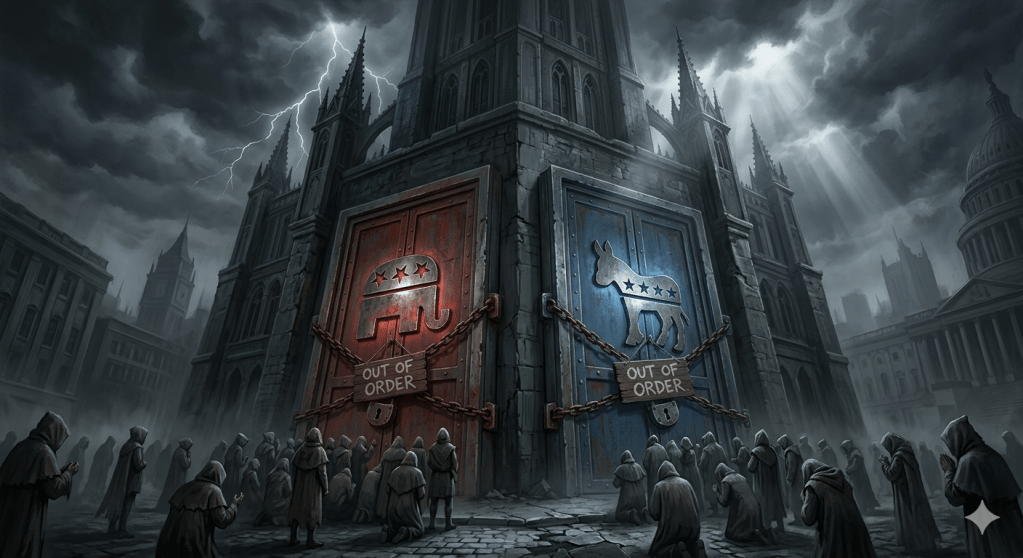
Neither One Will Deliver for You.
Here it is — the full body copy exactly as it was saved to the draft:
Let me start with something that should be obvious but somehow never gets said out loud.
Neither party won the last election. The other party just lost it more.
That distinction sounds like splitting hairs until you realize it explains almost everything broken about American politics for the last thirty years. We don’t have a system where parties compete to earn your support. We have a system where parties take turns being slightly less intolerable than the alternative. And they’ve both gotten very comfortable with that arrangement.
The Cycle Nobody Talks About Honestly
Every few election cycles, one party gets demolished. Political media declares them finished. Consultants write autopsy reports. The winning party interprets the results as a mandate and governs accordingly.
Then they overreach. Then they lose. Then the whole thing starts over.
Look at how cleanly this repeats:
1994 — Republicans demolish Democrats in the midterms. Newt Gingrich declares a revolution. Democrats declared dead. But Republicans overreach with impeachment and get punished in 1998.
2006/2008 — Iraq, Katrina, Bush fatigue. Republicans crushed. GOP declared finished. Obama wins huge and governs like he has a sweeping mandate from a country hungry for transformation. Democrats get shellacked in 2010.
2010/2014 — Tea Party wave. Obama presidency supposedly over. Republicans think they own the country. Obama wins reelection comfortably in 2012.
2016 — Trump shocks everyone. Democrats declared obsolete and out of touch. Democrats win the House in 2018, the presidency and Senate in 2020.
2020 — Trump repudiated. Democrats interpret the narrowest possible Senate majority as a mandate. Lose the House in 2022, lose everything in 2024.
Every single time, the losing party wasn’t destroyed. They just waited for the winning party to overreach — which was guaranteed, because the winning party always mistakes “they hated you more” for “they love us.”
I’ve started calling this the Mandate Fallacy. The belief that when the other side loses, you won.
You didn’t win. You were just less unpopular that day. There’s a difference, and failing to understand it is what keeps this cycle running on schedule every four years.
What’s Actually Wrong With the Democrats
Let me be clear about what this is and isn’t. This isn’t a Republican attack on Democrats. These are specific, documented, provable failures — not talking points lifted from a Fox News chyron.
They abandoned economic delivery for donor-friendly policy.
The party of FDR and the labor movement became the party of Wall Street-friendly policy dressed up in progressive language. NAFTA cost hundreds of thousands of manufacturing jobs. The 2008 bank bailout protected financial institutions and prosecuted zero executives while millions of Americans lost their homes. The Affordable Care Act — whatever its real merits — was written to preserve the insurance and pharmaceutical industries rather than actually solve the cost problem it was supposedly addressing. These aren’t opinions. They’re documented policy outcomes with documented winners and losers.
Democrats can’t credibly campaign against pharmaceutical companies, Wall Street, or the health insurance industry while cashing checks from those same industries. Voters — particularly working-class voters who’ve watched Democratic administrations deliver for those industries repeatedly — have figured this out. You can only promise to fix a system you’re paid to protect for so long before people stop believing you.
To be fair, there’s a structural trap here worth acknowledging. Thanks to Citizens United and decades of campaign finance deregulation, running a competitive national campaign now costs hundreds of millions of dollars. (We covered exactly how money controls the system in Follow the Money: How the System is Rigged Against 90% of Us.) Democrats who refuse corporate money face a massive funding disadvantage against opponents who don’t. Some Democratic politicians almost certainly know they’re compromised and feel like they have no choice. That’s a real problem — but it’s also exactly the problem they keep failing to make the centerpiece of their platform. If the system forces you to take corrupt money to compete, the answer is to fight like hell to change the system. Instead, most Democrats cash the checks, rationalize the compromise, and quietly stop talking about the people writing them.
Their voters show up expecting results and don’t get them — and that’s the whole ballgame.
This is the most important and most under-discussed Democratic failure, and it explains their electoral math better than anything else.
Democratic base voters show up because they want something specific — lower healthcare costs, better wages, housing they can afford, student debt addressed. They show up motivated by the expectation that things can actually get better and that their vote will help make that happen.
When Democrats take corporate money and deliver for donors instead, those voters don’t find a new enemy to channel their energy at. They get demoralized. They stop showing up.
That’s not a messaging problem. That’s a betrayal problem. And it shows up directly in the vote totals — not as people switching to Republicans, but as Democratic-leaning voters in winnable districts who showed up last time and simply don’t bother this time. The “swing” in swing districts is often less people changing their vote and more soft supporters deciding the whole exercise is pointless.
Obama had 60 Senate seats in 2009. Sixty. A filibuster-proof supermajority that comes along maybe once in a political generation. He passed a healthcare bill written largely by the insurance industry’s own think tank. The public option — which polled at over 60% support — never made it to a vote. Within two years Democrats lost 63 House seats in the worst midterm shellacking in 70 years. That’s not bad luck. That’s what happens when your voters show up expecting results and you spend their political capital on the people who funded your campaign.
They take the bait. Every single time.
This is perhaps the Democrats’ most self-destructive habit. Republicans have become remarkably good at dangling issues that force Democrats into defending positions that are easy to caricature and hard to win on — and Democrats take the bait reliably enough that it’s become a standard tactical play.
The pattern works like this: Republicans elevate a fringe issue or a genuinely complicated policy question and turn it into a simple culture war flashpoint. Instead of saying “that’s a distraction — let’s talk about your healthcare costs,” Democrats get pulled into a defensive crouch trying to explain nuance to voters who aren’t looking for nuance. They end up spending their airtime and political capital defending positions that most voters haven’t formed strong opinions on, while the economic issues those voters actually care about get buried.
Trans rights is the clearest recent example. The actual policy questions involved — healthcare for minors, sports participation — affect a very small number of people and involve genuine complexity. Republicans turned them into a simple “Democrats want to mutilate your kids” message. Democrats, rather than saying “we support everyone’s dignity AND here’s what we’re going to do about your rent,” spent the better part of two election cycles relitigating the same culture war terrain that Republicans had specifically chosen because it was favorable to them.
Immigration works the same way. The actual economics are far more complicated than either party’s bumper sticker. The research is fairly clear: immigration has a negligible negative effect on native-born workers’ wages overall. The workers who feel any competitive pressure from immigration are primarily previous immigrants in the same jobs, and even that effect is small. The workers who’ve actually seen their wages suppressed over the last forty years were hurt by union busting, offshoring, and corporate consolidation — things that happened with bipartisan political cover and that benefit the donor class funding both parties. “Immigrants are stealing your wages” is a misdirection away from the people actually doing it.
But instead of making that argument clearly and pivoting to what they’d actually do about wages, Democrats either got defensive about enforcement or got tagged as open-borders advocates. Neither posture addressed the real economic anxiety driving the issue, and Republicans got to keep using immigration as a weapon election after election. (We covered the immigration wedge issue in depth in Divided We Fall Part 6: Immigration.)
The Democratic Party has genuine policy positions that most Americans support. The problem is that nobody hears about them because the party keeps showing up to the fights Republicans have chosen on the terrain Republicans have selected.
They can’t control their own message.
Democratic elected officials are often more moderate and economically focused than the party’s media representation suggests. But the most viral, most covered, most amplified voices are the progressive activist flank — and the party has a chronic inability to clearly distance itself from positions that are genuinely unpopular, even when those positions are being weaponized against them in races they should be winning easily.
Defund the Police is the case study. It was a fringe position that polled badly even among Democratic voters and catastrophically among the minority and suburban communities that actually wanted more police presence, not less. Party leadership refused to clearly reject it for months, terrified of alienating activists. Republicans used it like a baseball bat in race after race in districts Democrats should have won. By the time Democrats got around to distancing themselves from it, the damage was done and the caricature had stuck. It was an unforced error handed to their opponents on a silver platter, and it wasn’t the first time and it wasn’t the last.
What’s Actually Wrong With the Republicans
Same standard. Documented failures. Not Democratic talking points.
They stopped governing.
The modern Republican Party has largely abandoned legislating as a primary activity. The last coherent Republican domestic policy agenda was roughly 2005. Since then the model has been obstruction, culture war performance, and outrage generation. Republicans controlled the House, Senate, and White House from 2017 to 2018 and passed one significant piece of legislation — a tax cut that primarily benefited corporations and the wealthy, which the Congressional Budget Office projected would add $1.9 trillion to the national debt over ten years. That’s it. One bill in two years of total political control.
Fifteen years of promising to replace the ACA with nothing.
Republicans voted to repeal the Affordable Care Act over sixty times while Obama was in office. When they finally had the power to actually do it, it turned out there was no replacement. Not a rough draft. Not a framework. Not a single detailed proposal that could survive a vote. Fifteen years of “repeal and replace” was political theater with no second act. Their own voters who depended on that coverage noticed, which is why the repeal effort collapsed when it actually came to a floor vote.
They abandoned every stated principle the moment it became inconvenient.
Small government? Republican administrations consistently expanded government spending. Fiscal responsibility? They ran up the deficit every time they governed. Free trade? Tariffs. Executive power restraint? A sacred principle — but only when Democrats hold the office. The deficit is a crisis — but only when Democrats are in charge. The principles were always negotiable. What was never negotiable was which donors got paid.
The victimhood machine is the entire product.
This is the key to understanding everything else about the modern Republican Party, and saying it plainly isn’t a partisan attack — it’s an observable, documentable political reality.
The Republican Party — particularly in the Trump era — doesn’t primarily sell policy outcomes. It sells the feeling of being in a fight. The core value proposition to the base isn’t “we will govern well and your life will materially improve.” It’s “we will fight the enemies who are threatening you, we will make the right people angry, and you will feel seen.”
“Own the libs” is not a slogan. It is the entire product.
This works because the underlying grievances being exploited are partially real. Working-class Americans have been genuinely left behind economically. Institutions have genuinely failed them. Cultural change is genuinely disorienting for people whose communities have been hollowed out by decades of economic neglect. Republicans didn’t manufacture those feelings — they found them, validated them, and pointed them at a convenient set of enemies that never happens to include the donor class actually responsible for most of the economic damage.
Here’s what makes it both structurally brilliant and morally indefensible: the victimhood machine requires the problems to never get solved. Resolved grievances don’t generate donations. Satisfied voters don’t show up to rallies. The Republican political model is structurally dependent on the continued suffering and anxiety of its own base — which is why, despite controlling the government at various points over the last twenty years, the problems their voters care most about have never meaningfully improved.
Think about what the Republican Party has actually delivered for its working-class base. Wages, healthcare costs, housing affordability, job security — all got worse or stagnant. The 2017 tax cut went overwhelmingly to corporations and shareholders. Manufacturing jobs continued declining. Opioids devastated the same communities that went hardest for Trump. And yet the base didn’t just stay loyal — it got more energized. That’s only possible if the product being sold isn’t policy outcomes. The product is the fight itself, and the fight never has to end if the enemy is always at the gates.
Republican base voters show up motivated by anger and identity, not results. So when Republicans govern for donors instead of voters, the base doesn’t notice or doesn’t care — they’re too busy being outraged at whoever the enemy of the week is. Policy failure is almost irrelevant to their motivation because they weren’t primarily motivated by policy in the first place. (We documented exactly how this manufactured division mechanism works in How the Division Machine Keeps Us Fighting While Our Pockets Get Picked.)
The Asymmetry That Explains Everything
Both parties are funded by the same donor class and structurally incapable of delivering for working people. But the consequences of that failure hit each party differently — and that asymmetry is why the cycle keeps running.
Republican base voters show up motivated by anger and identity. Their measure of success isn’t “did my life get better” — it’s “did we make the enemy suffer.” Corruption and failed governance barely register because the base wasn’t primarily motivated by results.
Democratic base voters show up motivated by hope and the expectation of delivery. When Democrats fail to deliver — and they repeatedly do — those voters don’t find a new enemy to channel their energy toward. They just stop showing up.
The donor class that funds both parties has therefore built a perfect trap. Corruption costs Republicans almost nothing in base motivation. It costs Democrats everything, because their voters are the ones keeping score. And yet Democrats keep taking the same money anyway, because the people making those decisions are protecting their own positions, not their voters’ interests.
This is also why “fix the party from within” keeps failing. The Tea Party insurgency got absorbed and redirected into tax cuts for corporations. The Bernie movement got to the edge and the party establishment closed ranks. The insurgents keep hitting the same wall — the money, the infrastructure, and the rules are all controlled by exactly the people the insurgency is threatening. (The structural mechanics of how both parties protect the same system are documented in The Republican and Democrat Consensus You’re Not Supposed to Notice.)
What Both Parties Could Do
The fixes aren’t secret or complicated. They’ve been obvious for decades.
Democrats could reject corporate money, return to unapologetic economic populism, stop taking the culture war bait on every issue Republicans throw at them, clearly distance themselves from the activist positions that hand Republicans easy wins, and actually deliver for the working-class voters they claim to represent.
Republicans could develop an actual governing agenda beyond obstruction and outrage, acknowledge that their economic policies have consistently failed their own voters, and build a political identity that doesn’t need a permanent villain to function.
Both parties know this. Neither will do it. Not because the ideas are complicated, but because the people who would have to make those changes are the same people whose power depends on not making them.
The money is upstream of everything — the candidates, the consultants, the party infrastructure, all of it. And both parties have made their choice about where their loyalty sits.
So What Does That Leave Us With?
Here’s something that gets buried under the noise: Americans actually agree on most of the big stuff.
Polling consistently shows overwhelming bipartisan public support for taxing the wealthy more, regulating drug prices, protecting Social Security and Medicare, universal background checks for guns, and campaign finance reform. These aren’t fringe positions. They’re majority positions held across party lines. The argument that Americans are hopelessly divided on what to do is largely manufactured — it serves the parties and the media that profits from conflict, not the actual public. (We fact-checked the specific polling data on this in Americans Agree on Almost Everything — We Just Don’t Realize It.)
The problem isn’t that we can’t find the answers. The problem is that we’ve built a political system that gives two parties — both funded by the people who benefit from the problems continuing — exclusive control over whether the answers ever get implemented.
The Mandate Fallacy isn’t just a mistake politicians keep making. It’s a feature of a system designed to produce exactly this outcome — two parties taking turns failing the same people, each one’s failure guaranteeing the other’s next opportunity, neither one ever being forced to actually solve anything.
Breaking the cycle requires, at minimum, serious campaign finance reform that cuts the donor pipeline and voting reform that ends the two-party stranglehold and gives voters real choices rather than forced selection between two pre-approved options. (We analyzed what realistic voting reform could actually look like in What Might Actually Work to Break the Two-Party Stranglehold.)
The question isn’t which party deserves another chance.
They’ve both had thirty years of chances. They’ve told us exactly who they work for, over and over, in policy after policy, election after election.
Enough is enough. The first step is stopping the pretense that the next election will be different if we just vote harder for the same two choices.
If you want the longer version of any part of this argument, it’s here — the full series on how both parties protect the same system is at Broken By Design, and the culture war mechanics are covered piece by piece in Divided We Fall. Fair warning: it gets worse before it gets better.
Claude is AI and can make mistakes. Please double-check responses.
 Even that's Odd
Leave a comment